
Harvest Taurus 80M-6M
4.0Editor score
Covers 80 through 6 meters
Rated for 400-watt operation
Includes 9:1 unun
Explore the best Multiband Dipole Antenna for Ham Radio, comparing band coverage, power handling, portability, construction, and setup for different operating
A multiband dipole antenna gives amateur radio operators one practical way to cover several HF bands without replacing a full-size wire antenna for every frequency. The strongest choices balance useful band coverage, manageable installation, dependable impedance matching, and enough power handling for the radio operator’s usual SSB, CW, or digital modes.
We compared all ten products by examining their stated frequency coverage, antenna architecture, maximum power, connectors, included components, portability, setup method, and suitability for base-station, POTA, SOTA, emergency, or travel operation. The list includes true long-wire dipoles, end-fed half-wave designs, rotatable dipoles, a portable vertical, a fiberglass base antenna, and a DIY balun.
Each review explains the product’s strongest benefit, practical limitations, and best-fit operator, whether that is someone building a permanent home station or assembling a compact field kit. Ratings reflect the supplied customer feedback, while specifications remain subject to manufacturer revisions and listing updates, so verify the current details and availability before buying.
4.0Editor score

4.5Editor score

4.2Editor score
The table below compares the ten antennas by design, stated frequency range, power capability, and deployment style, helping operators distinguish permanent wire systems, portable verticals, rotatable dipoles, end-fed antennas, and supporting balun hardware.




The JYR8010-150W is an eight-band end-fed half-wave antenna with a 4.5 customer rating. Its defining feature is the integrated impedance-transformation system, which is designed to provide low SWR from 80 through 10 meters without the repeated adjustment normally associated with compromise wire antennas. That combination makes it a practical choice for operators who want broad HF coverage without carrying a separate tuner for each band.
We may earn a commission when you buy through this link, at no additional cost to you.
The stated operating limits are 150 watts for SSB, 120 watts for CW, and 80 watts for FT8. A 40-meter radiating element and selectable transformer description support the listed 10, 12, 15, 17, 20, 30, 40, and 80-meter coverage. The single-wire format is easy to orient horizontally, vertically, or diagonally, while the low-profile housing can be positioned near a support or under a roof edge when appropriate clearance is available.
The construction is aimed at permanent outdoor or field use. It uses a durable ABS enclosure, heavy-gauge antenna wire, a reinforced end insulator, a waterproof M-J connector, UV-resistant housing, and a large ferrite core. Its convection-oriented enclosure is intended to dissipate heat during extended transmission, although actual results still depend on the transmitter’s duty cycle, ambient temperature, mounting, feed line, and ground environment.
This is the most balanced recommendation for an operator who wants one flexible antenna for multiple HF bands, particularly if avoiding a tuner is a priority. It can support a home station, portable activation, or emergency deployment, provided the operator can accommodate the full wire length and follow the stated clearance recommendations. Check the final transformer configuration and operating limits before connecting a transmitter.
The integrated transformer is central to the design, allowing the listed bands to operate with low SWR and less manual retuning. This is valuable when changing modes or bands during a contest, field day, or portable session.
The antenna can be strung between trees, secured to a roof or mast, or mounted diagonally. Its weather-resistant enclosure and flexible balun placement make it more adaptable than a conventional rigid vertical system.
We may earn a commission when you buy through this link, at no additional cost to you.
The JPC-12 has a 4.7 rating, the highest customer score among the listed products, and offers a different approach from wire dipoles. It is an eight-band HF vertical covering 40 through 6 meters, with a stated frequency range of 7–50 MHz. Although it does not fit the strict definition of a dipole, it is a relevant multiband HF option for operators who value quick setup over a large overhead wire installation.
We may earn a commission when you buy through this link, at no additional cost to you.
Its multi-band inductive coil and sliding regulator are the most important features. Operators can make tool-free adjustments with the radio’s SWR meter, while an antenna analyzer is recommended for faster and more precise initial setup. Once satisfactory positions are found, those positions can be marked for easier future band changes. The stated SWR target is 1.5:1 or lower across the supported bands.
Deployment is unusually convenient for a ground-mounted HF system. The package includes aluminum tubes, a stainless-steel top rod, ground anchor, ten-strand ground mesh, aluminum-alloy base, and the multiband inductive coil. One person can assemble it in approximately five minutes, and the listed weight of 1.35 kilograms makes it manageable for parks, campsites, beaches, and backyards.
Choose this antenna if your priority is rapid field deployment and a complete portable package rather than a traditional dipole. The ground mesh and radial arrangement must be installed properly, and the M10 thread specification on the aluminum rods is worth noting before assembly. It is the strongest portable-vertical alternative in this guide, but it should not be mistaken for a wire dipole.
The sliding regulator replaces screw-and-plug adjustment with a tool-free control. Marking known positions after tuning can make later band changes more consistent and reduce the need for repeated SWR checks.
Tubes, base components, anchor, and ground mesh fit into the stated carry bag. This gives operators a more organized portable option than assembling a wire antenna from separate components at the operating site.
We may earn a commission when you buy through this link, at no additional cost to you.
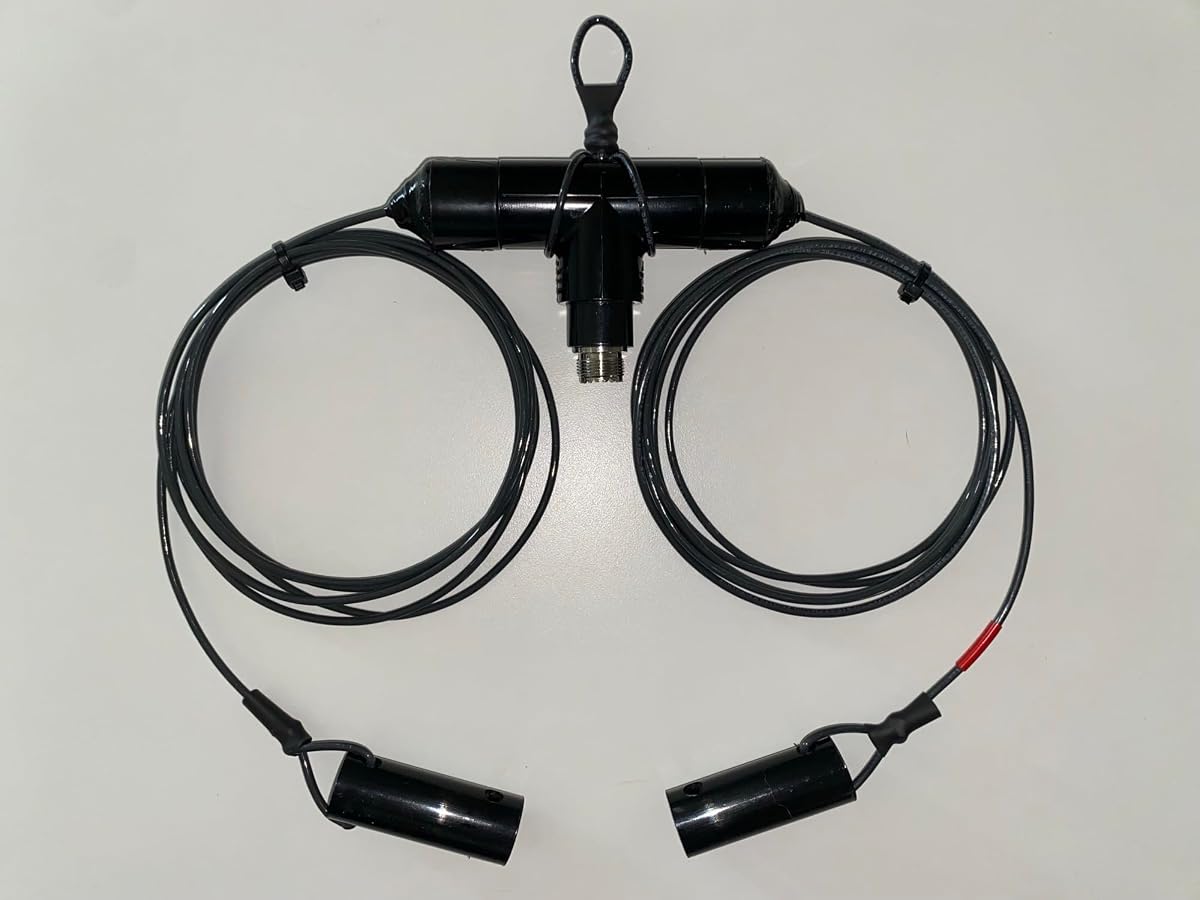
The Harvest Taurus 80M-6M is a 20-meter long-wire dipole covering 80 through 6 meters, including WARC bands. Its 4.0 rating makes it a practical entry into long-wire multiband antennas, while the stated 400-watt maximum power and integrated 9:1 unun provide useful specifications for a range of amateur stations.
We may earn a commission when you buy through this link, at no additional cost to you.
This antenna is especially attractive to operators who already understand how to route and support a long wire. The 9:1 unun provides the impedance transformation required for practical multiband operation on a long-wire element, while the SO-239 connection offers broad compatibility with common amateur radio feed lines. The listing’s compact specification set does not include a detailed mounting guide, so setup planning is especially important.
Its principal advantage is straightforward value. Rather than bundling a large collection of rigid parts, it delivers the core components needed for a wire-based multiband installation. The trade-off is that performance depends heavily on installation, including wire height, orientation, nearby objects, feed-line routing, and the quality of the unun connection.
This model fits operators building a permanent wire antenna, experimenting with long-wire layouts, or seeking a cost-conscious way to cover many HF bands. It is less convenient for someone who wants a self-contained portable kit or a rapid no-tuning setup. Carefully support the 20-meter element and follow the instructions supplied with the matching system.
The product centers on a 20-meter wire and 9:1 unun rather than a collection of separate traps. That makes it appealing for operators who prefer to understand and control the antenna system directly.
A stated 400-watt maximum provides a useful margin for many high-power HF stations. Actual safe output also depends on the transmitter, duty cycle, feed line, matching unit, and installation conditions.
We may earn a commission when you buy through this link, at no additional cost to you.
The Harvest Taurus 160M-6M expands the long-wire concept down to 160 meters, creating a stated 160-through-6-meter range that includes WARC bands. With a 4.2 rating, it is a more specialized choice than the 80-meter version, aimed at operators who want access to the 160, 80, and 60-meter bands from one long element.
We may earn a commission when you buy through this link, at no additional cost to you.
The antenna uses a 9:1 unun, a stated maximum power of 400 watts, and an SO-239 socket. Its 40-meter length is both its strength and its principal logistical challenge. A property with suitable supports, a hilltop location, or an expansive open area can make this arrangement practical, while a small city lot or rooftop with limited clearance may not.
A long-wire installation is sensitive to its surroundings. Nearby buildings, utility lines, metal structures, and the angle of the wire can affect resonance and radiation patterns. The feed line should be routed deliberately, and operators should follow the unun manufacturer’s grounding and connection instructions. The sparse published specifications leave fewer details about the physical installation than some competing products provide.
The Taurus 160M-6M makes the most sense for a dedicated HF station with room for a full 40-meter wire. It is less suitable for portable activations or quick rooftop installations. For those who can protect the installation and value access to 160 meters, it offers broad coverage and a high stated power rating.
The 160-meter lower limit distinguishes this model from shorter long-wire systems. It is intended for operators with adequate space and an interest in low-band HF propagation.
A 40-meter element requires careful support and a clear installation plan. A sturdy mast, multiple anchor points, and attention to nearby conductive objects are more important than for a compact rotatable antenna.
We may earn a commission when you buy through this link, at no additional cost to you.
The Falcon 10 Meter Dipole is a single-band, half-wave base-station antenna with a 4.5 customer rating. It is included because it provides a useful contrast with the true multiband designs: instead of attempting to cover numerous frequencies through traps or impedance transformation, it concentrates on the amateur 10-meter band.
We may earn a commission when you buy through this link, at no additional cost to you.
The weather-tight construction is designed for indoor or outdoor use, making it potentially useful for a home station, attic, balcony, or other installation where a dedicated 10-meter antenna is wanted. A conventional half-wave dipole generally benefits from the widest possible installation area and suitable clearance, so the mounting location remains more important than the product title suggests.
The principal limitation is obvious but important: it is not a multiband antenna. Operators who need 10 meters alongside 20, 40, 15, 17, 12, 30, 80, or 160 meters will need a separate matching solution or a different antenna. The supplied information also provides fewer measurable details than the long-wire listings, including no stated power limit or impedance information.
Buy the Falcon when 10-meter operation is your priority and you prefer a straightforward half-wave antenna over a complex multiband system. It may also serve as a dedicated band antenna in a multi-antenna station. For the stated keyword, however, it is best viewed as a specialist companion rather than a primary multiband solution.
A dedicated half-wave element can be straightforward and dependable on its chosen band. It is a sensible alternative for operators who do not need one antenna to cover every HF frequency.
The listed weather-tight design supports protected or exposed installations. Even so, the antenna still needs a sensible mounting position and appropriate feed-line routing for reliable operation.
We may earn a commission when you buy through this link, at no additional cost to you.
The Taurus JN-316 is a six-meter fiberglass vertical with a 4.0 rating. Its transmit range is stated as 3.5–57 MHz, while receive coverage extends from 2–90 MHz. An external antenna tuner is specified for transmission, and the base uses an unmatched network, distinguishing it from products designed to operate without a tuner.
We may earn a commission when you buy through this link, at no additional cost to you.
Its vertical architecture is useful when a horizontal dipole cannot receive adequate clearance. The 400-watt maximum rating and SO-239 connector suit many base-station applications, while the fiberglass body offers a practical alternative to a wire element that must be stretched between supports. The stated gain figures are 4 dB in VHF and 5 dB in UHF.
Tuning is the deciding factor. Because the system requires an external any tuner for the stated transmit range, operators must be comfortable adjusting the antenna across bands and verifying resonance. Ground-system design, coax routing, nearby objects, and the vertical’s placement will influence efficiency and tuning range. A tuner also adds another component to the station and operating routine.
Choose the JN-316 for a permanent base installation where vertical space is more available than broadside dipole space and where the operator already uses an external tuner. It is not a true dipole, and it is less convenient for fast portable use, but it provides a substantial platform for receiving and transmitting across a wide HF range.
A fiberglass vertical avoids the need for two long horizontal support points. This can be valuable where trees, buildings, or property dimensions limit full-size wire antennas.
The tuner requirement allows broad operating flexibility but adds setup and retuning. Operators should include a suitable tuner, accurate SWR measurement, and a dependable ground-plane arrangement in their installation plan.
We may earn a commission when you buy through this link, at no additional cost to you.
The Radioddity HF-010 is a ten-band portable vertical with a 4.2 rating and a 3.5–50 MHz operating range. It is not a dipole in the traditional sense, but its field-focused package makes it one of the most complete portable HF antenna options in this comparison. It supports 100 watts CW and 150 watts PEP SSB.
We may earn a commission when you buy through this link, at no additional cost to you.
The antenna uses fixed coils for 80 meters and a sliding tuning coil for 60 through 17 meters, with additional coverage extending through 10 and 6 meters. Typical SWR is listed at 1.5:1 or lower. The supplied tape measure helps operators record resonant points, and the sliding design allows rapid changes once those settings are known.
Deployment options are unusually broad. A ground spike works in soft soil, a tripod with a weighted water bag is intended for hard surfaces, and a compatible magnetic vehicle base can be purchased separately. The package includes a 32.8-foot 50-ohm coaxial cable, BNC-to-SO-239 adapter, cable-management spools, a tape measure, and an Oxford carrying bag with Velcro straps.
This is the strongest premium portable kit for POTA, SOTA, camping, travel, and emergency use. It is heavier and more complex than a simple wire antenna, and operators must select the right mounting arrangement for the terrain. Its organized accessory set reduces the chance of leaving essential cables or adapters behind during a field activation.
The included coax, adapter, spools, tape measure, and padded bag make the package easier to transport as one organized system. This is useful for operators moving between parks, campsites, and emergency locations.
The ground spike, hard-surface tripod, and optional magnetic vehicle base provide several mounting paths. Choosing the correct support can improve deployment speed and reduce dependence on permanent structures.
We may earn a commission when you buy through this link, at no additional cost to you.
The Comet CHV-5X is a compact, rotatable five-band dipole covering 40, 20, 15, 10, and 6 meters. It has a 3.6 customer rating, the lowest in this group, but its physical design addresses a clear need: fitting a useful multi-band antenna into patios, balconies, attics, or other limited spaces.
We may earn a commission when you buy through this link, at no additional cost to you.
Each band section tunes independently and is intended to maintain low SWR near its center frequency. The rotatable mount lets the operator change the antenna’s direction without relocating the entire installation. Rugged aluminum elements, stainless steel hardware, and an SO-239 connector support both permanent and temporary configurations.
The design has unavoidable compromises. It does not cover the 80- or 60-meter bands, which can be important for low-frequency DX and nighttime propagation. Its compact dimensions also mean it cannot reproduce the full-scale spatial relationship of a large wire dipole, even though the rotating mount improves directional flexibility.
The CHV-5X is most appropriate for operators who want five common bands, limited real estate, and easy directional adjustment. It can serve a patio or balcony station, a portable setup, or an emergency antenna. The 3.6 rating warrants checking recent customer feedback about construction and tuning, but the specifications clearly support its intended role.
The rotating mount allows the operator to alter direction without moving the antenna. This is valuable when working several stations or trying different headings for improved contact.
The 40, 20, 15, 10, and 6-meter selection covers several of the most common amateur allocations. Operators needing 160, 80, or 60 meters should select a different system or add another antenna.
We may earn a commission when you buy through this link, at no additional cost to you.
The HF Balun 1:1 is a DIY antenna-matching component rather than a complete radiating antenna. It supports a stated 1.8–50 MHz range, handles up to 500 watts, and uses a 1:1 transformation to connect balanced antenna structures with unbalanced radio equipment. Its 4.4 rating makes it a useful option for builders assembling their own dipole.
We may earn a commission when you buy through this link, at no additional cost to you.
The product description emphasizes a 50-ohm input impedance, balanced-to-unbalanced signal conversion, low loss, reduced heat generation, and an SWR target of 1.2. A waterproof housing is intended to protect the internal assembly during indoor or outdoor use, and the standard SO-239 connector supports connection to common amateur radio equipment.
The main caution is that a balun cannot create a good antenna from a poor installation. A 1:1 device generally presents a different impedance relationship to a balanced line than a 9:1 unun does for a long-wire element. Wire length, height, nearby structures, feed-line routing, and environmental conditions remain central to achieving a low SWR.
Choose this product if you are comfortable assembling a DIY antenna and need a robust, waterproof matching enclosure. It is not a turnkey substitute for a dipole, and the stated performance figures should be evaluated alongside the antenna system you intend to build. It can be especially useful for emergency communications or custom installations.
The unit is designed to integrate with various balanced antenna structures. It gives builders a standardized matching and connection point without requiring a complete factory-assembled dipole.
The waterproof materials support operation in exposed conditions. Sealing, mounting, and strain relief should still be handled carefully to preserve long-term reliability.
We may earn a commission when you buy through this link, at no additional cost to you.
The Portable HF Antenna for Ham Radio is a folding end-fed half-wave design covering 7–54 MHz. It supports the 20, 17, 15, 12, 10, and 6-meter bands, giving it a useful place among compact multiband options. The supplied information does not include a customer rating, so its real-world reception is less documented than that of the other products in this guide.
We may earn a commission when you buy through this link, at no additional cost to you.
The radiating structure is made from stainless steel and folds from 50 centimeters to 5.6 meters. Its spring pads and locking knobs are intended to hold the bracket securely and reduce accidental movement. The V-shaped arrangement provides flexible installation options, while the complete kit includes two antennas, a base, an instruction manual, a 32.8-foot RG58 cable with a PL-259 plug, and a stainless-steel tripod.
The included cable and tripod make this more turnkey than a bare wire system, but the published specifications do not state a maximum power rating or provide detailed SWR figures. Those omissions deserve attention from operators who transmit at substantial output. RG58 also has more loss than common lower-loss coax at higher frequencies, making cable length and placement important.
This antenna is best suited to portable HF work where folding storage and quick deployment matter. It may be useful for travel, camping, emergency communication, or a temporary station. Because there is no customer rating and little matching detail, cautious operators should verify the instructions, power limits, and expected SWR before relying on it for a demanding installation.
The stated 50-centimeter folded length and locking bracket make the antenna practical to carry between operating locations. The spring pads and knobs help keep the extended structure stable.
Two antenna sections, a base, tripod, instructions, and 32.8-foot RG58 cable are included. This is a more complete starting point than purchasing a single wire or bracket and assembling every supporting component separately.
We may earn a commission when you buy through this link, at no additional cost to you.
The right antenna depends on the bands you need, available installation space, operating environment, portable gear, and willingness to tune. Compare the complete system rather than focusing only on the headline frequency range.
Begin with the exact amateur allocations you plan to operate. A system covering 80–10 meters is materially different from one covering 40–6 meters, while the Taurus 160M-6M reaches down to 160 meters and the 1:1 balun supports a broad DIY range from 1.8–50 MHz. Make a band list before comparing hardware, and account for any WARC, receive-only, or tuner-based coverage separately.
Choose coverage that matches your operating needs, not merely the largest advertised span. Extra bands add complexity if you never use them.
A dipole uses two opposing radiating arms and normally presents different directional behavior from a vertical or end-fed half-wave antenna. Several products in this guide are vertical antennas, not conventional dipoles. If a true dipole is essential, focus on the Harvest long-wire models and Comet CHV-5X while recognizing that end-fed designs use only one principal radiating wire.
Pick the architecture that matches your site and operating style rather than relying on the broad term multiband alone.
Some products promise stable low SWR without constant adjustment, while others expressly require an external tuner. The JYR8010-150W is designed around an integrated impedance transformer, the JPC-12 and Radioddity HF-010 use sliding coils, and the Taurus JN-316 requires an external any tuner. The 9:1 unun models use a different transformation from a 1:1 balun, so they should not be treated as interchangeable.
Favor no-tuning operation if convenience is critical, but accept a tuner when broad flexibility and established station equipment matter more.
Compare the stated maximum power with the output of your radio. The listed limits range from 150 watts for SSB on the JYR8010-150W and 100 watts on the JPC-12 to 400 watts for the Harvest and JN-316 models and 500 watts for the 1:1 balun. SSB, CW, and digital modes can place different average demands on an antenna, and duty cycle matters as well.
Select a system with comfortable headroom for your planned output and operating style, while also observing mode-specific limits.
Long-wire antennas demand room. The Harvest Taurus 80M-6M uses 20 meters of wire, the 160M-6M uses 40 meters, and the JYR8010-150W uses a 40-meter radiating element. The Comet offers a much smaller rotatable footprint, while the JN-316 and portable vertical products concentrate radiation into a mast-supported element. Consider property boundaries, roof access, nearby buildings, trees, and possible guy-line conflicts.
Select a design that can be installed safely with the clearance it actually needs, rather than a larger system you cannot fit.
Portable operation requires more than an antenna. The JPC-12 includes a carry bag, ground anchor, and mesh, while the Radioddity HF-010 supplies coax, adapters, cable spools, a tape measure, a tripod, a weighted water bag, and a padded case. The folding end-fed product includes a tripod and RG58 cable but provides less published matching information. Check that the package includes every item needed for your intended deployment.
Prioritize a complete, organized kit when moving frequently, and simpler components when you already own all required support hardware.
Most products use an SO-239 coaxial connection, while the Radioddity kit also includes a BNC-to-SO-239 adapter. Match the antenna connector to the radio, transceiver, or transmission line in your station. The folding end-fed antenna specifies 32.8 feet of RG58 with a PL-259 plug, and cable loss becomes increasingly relevant at upper HF frequencies and long runs.
Verify connectors, cable impedance, and length before assembly to avoid avoidable signal loss or installation changes.
Outdoor antennas must tolerate rain, moisture, sunlight, and mechanical movement. The JYR8010-150W lists a waterproof M-J connection and UV-resistant housing, the 1:1 balun uses a waterproof enclosure, and the Radioddity HF-010 uses stainless steel components and an enclosed sliding coil. The JPC-12 includes corrosion-resistant aluminum components and is designed for grass or sand installation.
Inspect seals, fasteners, wire tension, ground hardware, and support points regularly, especially after severe weather or frequent field use.
Begin by reading the instructions supplied with the selected model and identifying which components form the complete signal path. For a wire system, install the radiating element, matching unit, and feed line as specified; for a portable vertical, assemble the tubes, coil, base, and ground system. Place the antenna as high and as far as practical from conductors, metal, concrete walls, dense wiring, and other antennas.
Connect the radio using a suitable 50-ohm coax, minimize sharp bends, and secure any excess cable so it does not become part of the radiating system. Check SWR on every intended band with the antenna in its final operating position. For sliding-coil models, move the adjustment slowly and mark confirmed settings. For tuner-based systems, start with low power and follow the tuner manufacturer’s tuning procedure.
For portable use, inspect the ground spike, tripod feet, locking knobs, cable, connectors, and radials before each activation. For permanent installations, check wire tension, support hardware, seals, corrosion, and nearby construction changes at least every six months. Clean removable dirt gently, keep moisture out of connectors, and replace damaged hardware rather than continuing with a compromised installation.
A multiband dipole can let one antenna support several amateur radio bands, reducing the need for separate antennas and complex switching. The actual benefit depends on the matching method: transformer-based, trap-based, long-wire, and tuner-assisted systems do not provide identical bandwidth or tuning behavior. Installation quality remains central to whether the theoretical coverage translates into useful performance.
Neither design is universally better. A dipole can provide useful broadside radiation and favorable noise characteristics for many HF applications, while a vertical is easier to deploy in a limited footprint and can be installed with fewer support points. The best choice depends on available space, operating location, directional needs, and whether your chosen product actually uses a dipole architecture.
It depends on the model and operating conditions. The JYR8010-150W is designed for no-tuning multiband use, the JPC-12 and Radioddity HF-010 provide manual sliding adjustments, and the Taurus JN-316 explicitly requires an external tuner. Even an antenna designed for low SWR can benefit from checking matching because nearby structures and installation changes affect performance.
The listed maximum ratings vary substantially, from 100-watt SSB on the JPC-12 to 400 watts for the Harvest long-wire models and JN-316, and 500 watts for the 1:1 balun. Do not treat a component rating as blanket permission to use any mode at any level. Also consider the feed line, matching unit, connector, duty cycle, and manufacturer instructions.
A compact model such as the Comet CHV-5X may be better suited to a balcony or patio than a 20- or 40-meter wire antenna. Clearances and nearby metal can still distort tuning, so check SWR after installation and avoid placing the antenna where it could create safety hazards or interfere with other equipment. A rotatable antenna can also help manage directional requirements.
The JPC-12 and Radioddity HF-010 provide the most organized portable packages, with carrying bags, support hardware, and fast assembly or tuning features. The folding end-fed antenna offers an even more compact transport concept, although its published specifications are less complete. The best choice depends on whether you value the largest accessory kit, rapid ground deployment, or the smallest folded package.
A 9:1 unun transforms the impedance presented by a long wire to a value more suitable for connection to a 50-ohm feed line. It is not the same as a 1:1 balun, which serves a different matching role for balanced antenna systems. A successful installation also depends on the actual wire length, height, nearby objects, and the grounding or counterpoise arrangement.
Dry the antenna and connectors before packing, coil the feed line without sharp twists, and protect the connector from dirt and impact. For the JPC-12 and Radioddity HF-010, use the included carry bags and keep the tuning mechanism from being compressed. For the folding end-fed model, clean and dry the stainless steel sections and confirm the locking knobs are secure before storage.
The JYR8010-150W stands out as the most balanced option for an operator seeking eight-band coverage, no routine tuning, and flexible mounting. The Harvest Taurus 80M-6M offers a simpler long-wire path with a 9:1 unun, while the Radioddity HF-010 delivers the most complete premium portable package for field and emergency use.
Prioritize your required bands, installation space, portable equipment, and tolerance for tuning. A genuine dipole should be chosen by radiation architecture, while a vertical or end-fed system should be selected for its compact deployment benefits. Confirm connectors, cable type, power limits, mounting accessories, and the exact transformation used by the matching component before ordering.
Specifications and customer feedback can change as listings are updated, so check the current product page, manufacturer instructions, and component list before making a final purchase. Confirm that the antenna suits your radio, operating environment, and skill level rather than relying only on its broad frequency label.

