
VCE 3.5mm to 1/4 Adapter
4.7Editor score
24K gold-plated connectors
Solid brass construction
Two adapters included
A 14 Inch to 3.5mm Adapter connects equipment with a quarter-inch stereo jack to headphones, phones, laptops, speakers, and other devices that use a 3.5mm connection. The right choice depends on connector direction, TRS support, materials, cable length, and whether you need a compact adapter or a short cable.
We compared ten popular adapters using the supplied specifications, ratings, connector layouts, shielding, grip design, and stated compatibility. The list covers direct adapters, short braided cables, and bidirectional sets for home audio, stage equipment, instruments, mixers, amplifiers, headphones, and mobile devices.
Each pick highlights the qualities that distinguish it, including durability, signal transmission, portability, and practical connection options. Product specifications and customer ratings can change, marketplace listings can shift, and prices fluctuate, so verify the current details and connector orientation before ordering.
4.7Editor score

4.6Editor score

4.6Editor score
As an Amazon Associate we earn from qualifying purchases.
The comparison below covers every adapter in the guide, emphasizing connector direction, physical format, materials, and practical compatibility. Because several products use similar 6.35mm and 3.5mm terminology, checking the male and female ends is essential before making a selection.




The VCE 3.5mm to 1/4 Adapter is a compact 6.35mm male to 3.5mm female solution with a 4.7 customer rating. Its combination of 24K gold-plated contacts, solid brass construction, and a precision-engineered TRS interface makes it a convincing all-around choice for connecting standard audio equipment to compatible 3.5mm devices.
We may earn a commission when you buy through this link, at no additional cost to you.
The adapters are designed to minimize signal loss and unwanted noise while preserving clear stereo output. Solid brass gives the body a durable feel, while the circular knurling provides traction when you are plugging into a mixer, amplifier, keyboard, or another device mounted in a less accessible position. Receiving two adapters also makes it easier to keep one at home and another in a bag or studio case.
The main limitation is that both pieces have the same 6.35mm male to 3.5mm female orientation. That is ideal for plugging 3.5mm headphones into a quarter-inch output, but it will not solve a connection that requires a quarter-inch female socket to accept a 3.5mm male plug. Its direct, cable-free format also gives you less positioning flexibility than a short adapter cable.
This is a strong recommendation for musicians, home listeners, and anyone who wants a simple, durable adapter without carrying unnecessary cable length. Check both device ends and confirm that your equipment uses a standard stereo TRS jack. For most people searching under the broader 14 Inch to 3.5mm Adapter keyword, this focused two-pack provides the strongest blend of construction, rating, and practicality.
The gold-plated connector and precision TRS interface support stable, low-noise stereo transmission. That makes the adapter suitable for instruments, amplifiers, mixers, studio monitors, and ordinary headphone connections.
Solid brass and 360-degree knurled grips improve durability and handling. These details are particularly useful when connecting behind an amplifier or navigating a crowded equipment rack.
We may earn a commission when you buy through this link, at no additional cost to you.
This 1/4 to 3.5mm Adapter Cable is a one-foot cable with a 3.5mm male plug and a 6.35mm female socket, rated 4.6 by customers. It provides more physical separation than a direct adapter while retaining the convenience of a compact audio connection.
We may earn a commission when you buy through this link, at no additional cost to you.
Its construction is the central attraction. The flexible rubber and nylon braided jacket protects the internal wiring, while polyethylene insulation is intended to improve high-frequency response. Tinned copper, aluminum foil, and durable PVC layers create multiple shielding barriers that help isolate the audio signal and preserve the character of the source.
The tradeoff is that it is less flexible in spatial terms than a pocket-sized adapter and still offers only one connection direction. Users who need to connect a 3.5mm male plug into a 6.35mm female jack will find the orientation correct, while those with the reverse requirement will need a different product. Gentle rotation and full insertion are important when seating the plugs.
Choose this cable when shielding, durability, and a little extra distance between devices matter. It is well suited to amplifiers, mixers, guitars, pianos, karaoke equipment, home stereo systems, speakers, and stage setups. For a user who frequently moves between home and rehearsal spaces, the short flexible lead is more versatile than a rigid adapter.
Tinned copper wiring, aluminum foil, and a durable outer casing work together to reduce interference. This layered design is useful around electric instruments, amplifiers, and other environments with nearby electronic equipment.
The 4.0mm cable diameter and rubber-and-nylon jacket make the lead more pliable than a rigid connector. It can also provide enough separation to reduce strain on a device's built-in 3.5mm socket.
We may earn a commission when you buy through this link, at no additional cost to you.
The 3.5mm to 1/4 TRS Adapter Set includes both 3.5mm female to 1/4-inch male and 3.5mm male to 1/4-inch female adapters. Its 4.6 rating reflects a versatile design that removes much of the guesswork involved in choosing the correct connector direction.
We may earn a commission when you buy through this link, at no additional cost to you.
Gold-plated connectors support durable signal transmission, while the TRS design is intended to preserve stereo audio with minimal loss. The set is particularly useful for musicians because one orientation can connect a 3.5mm headphone cable to a quarter-inch amplifier output, while the other can accept a quarter-inch source into a 3.5mm input.
Unlike a short cable, these direct adapters do not add meaningful reach between two devices. They are best when both pieces can sit close together. The inclusion of a transparent storage box also introduces a small amount of bulk, although it keeps the two easily identifiable and useful for travel or stage work.
This is the most versatile option for anyone who owns several types of 6.35mm and 3.5mm equipment. It is especially appealing to guitarists, keyboard players, home-studio users, and mobile listeners who want one set to cover both connection directions. Confirm that your devices require stereo TRS rather than a mono microphone connection.
The male-to-female and female-to-male pieces cover the two most common conversion arrangements. This is convenient when moving between headphones, instruments, mixers, laptops, tablets, and phones.
The TRS layout is designed to carry left and right audio channels through a standard stereo connection. It suits headphone monitoring and instrument output without requiring software or external power.
We may earn a commission when you buy through this link, at no additional cost to you.
The MOBOREST Stereo Adapter Set combines a 3.5mm male to quarter-inch female adapter with a quarter-inch male to 3.5mm female adapter. With a 4.6 rating, solid brass construction, and high-purity copper contacts, it is a practical two-way solution for a broad collection of audio devices.
We may earn a commission when you buy through this link, at no additional cost to you.
The one-piece brass shells are designed to withstand repeated insertion, removal, vibration, and travel. Gold-plated contacts resist corrosion and interference, while 360-degree textured treads make the connectors easier to grip. The adapters require no drivers, software, or external power, so setup is limited to physically connecting the correct orientation.
These are stereo TRS adapters rather than dedicated mono microphone adapters. The product information also does not promise microphone functionality, which is an important distinction for users searching by a broad keyword that can include headsets and instrument connections. The direct format can also place pressure on a phone or laptop socket if the devices are positioned awkwardly.
The set is ideal for users who want protection against choosing the wrong direction, whether at home, in a studio, in class, or on the road. It combines robust construction with easy handling and broad compatibility. A musician with both a 3.5mm headphone lead and quarter-inch equipment will probably find this more useful than a single-direction adapter.
Including both conversion directions makes the set resilient to changing equipment. It can be placed in a studio bag and remain useful across instruments, headphones, amplifiers, and mobile devices.
The solid brass bodies and non-slip circular texture improve control in live or studio environments. These practical details matter when changing connections quickly or working in a crowded rack.
We may earn a commission when you buy through this link, at no additional cost to you.
The ANDTOBO Stereo Adapter is a straightforward 3.5mm male to 6.35mm female adapter sold as a two-pack. It carries a 4.6 customer rating and is built around pure copper connectors intended to offer reliable service life, corrosion resistance, and minimal signal loss.
We may earn a commission when you buy through this link, at no additional cost to you.
Its simplicity makes it suitable for connecting headphones, earphones, or karaoke systems to compatible devices. The pack gives you a spare for a home setup and another for a bag, while the small format avoids the extra bulk of a cable. The copper-focused construction also differentiates it from adapters that rely primarily on plated plastic bodies.
One limitation is that both adapters have the same connector direction. It cannot provide the reverse 6.35mm male to 3.5mm female arrangement, and the product details do not emphasize multi-layer shielding in the way several cable-based competitors do. Users should ensure the 3.5mm plug is fully inserted before judging connection quality.
This is a compelling choice for listeners who mainly need to plug standard 3.5mm headphones into a quarter-inch headphone output. The two-pack adds convenience without complicating the setup, and the product is backed by the stated lifetime warranty and customer-service commitment. It is a good simple option when shielding layers are not central to your decision.
Pure copper connectors are intended to maintain dependable electrical contact while resisting corrosion. This can support stable transmission and a long service life in regular use.
Two identical adapters make it easy to maintain a connection at more than one location. The compact format is particularly convenient for portable headphones and karaoke use.
We may earn a commission when you buy through this link, at no additional cost to you.
The Chadou Audio Adapter provides two compact 6.35mm male to 3.5mm female connectors and holds a 4.6 rating. It is designed as a simple bridge between quarter-inch equipment and compatible headphones, phones, tablets, and other 3.5mm devices.
We may earn a commission when you buy through this link, at no additional cost to you.
Pure copper construction and gold plating are the principal technical features. The 360-degree grip treads help with insertion and removal, while the direct body avoids the tangling associated with short cables. The stated compatibility covers amplifiers, mixing consoles, home theater equipment, AV receivers, smartphones, tablets, and iPods.
Because the set does not include the reverse orientation, it is not the most flexible option for a complex collection of audio gear. Nor do the listed specifications describe advanced shielding, so buyers seeking a heavily insulated cable may prefer one of the braided models. Direct adapters also place less strain relief between devices than a lead with a defined cable body.
Choose the Chadou pair when compactness, a metal construction, and a two-piece quantity matter most. It is particularly useful for someone who connects 3.5mm headphones to an amplifier or other quarter-inch home audio device and wants a spare available. Verify that the source has a 6.35mm stereo headphone output and that the destination accepts a 3.5mm plug.
The textured exterior improves control when plugging or unplugging the adapter. This is useful around equipment cabinets where a smooth connector can be difficult to grip.
The 6.35mm male and 3.5mm female arrangement creates a direct path between standard stereo ports. It is well suited to headphones and common consumer or home audio sources.
We may earn a commission when you buy through this link, at no additional cost to you.
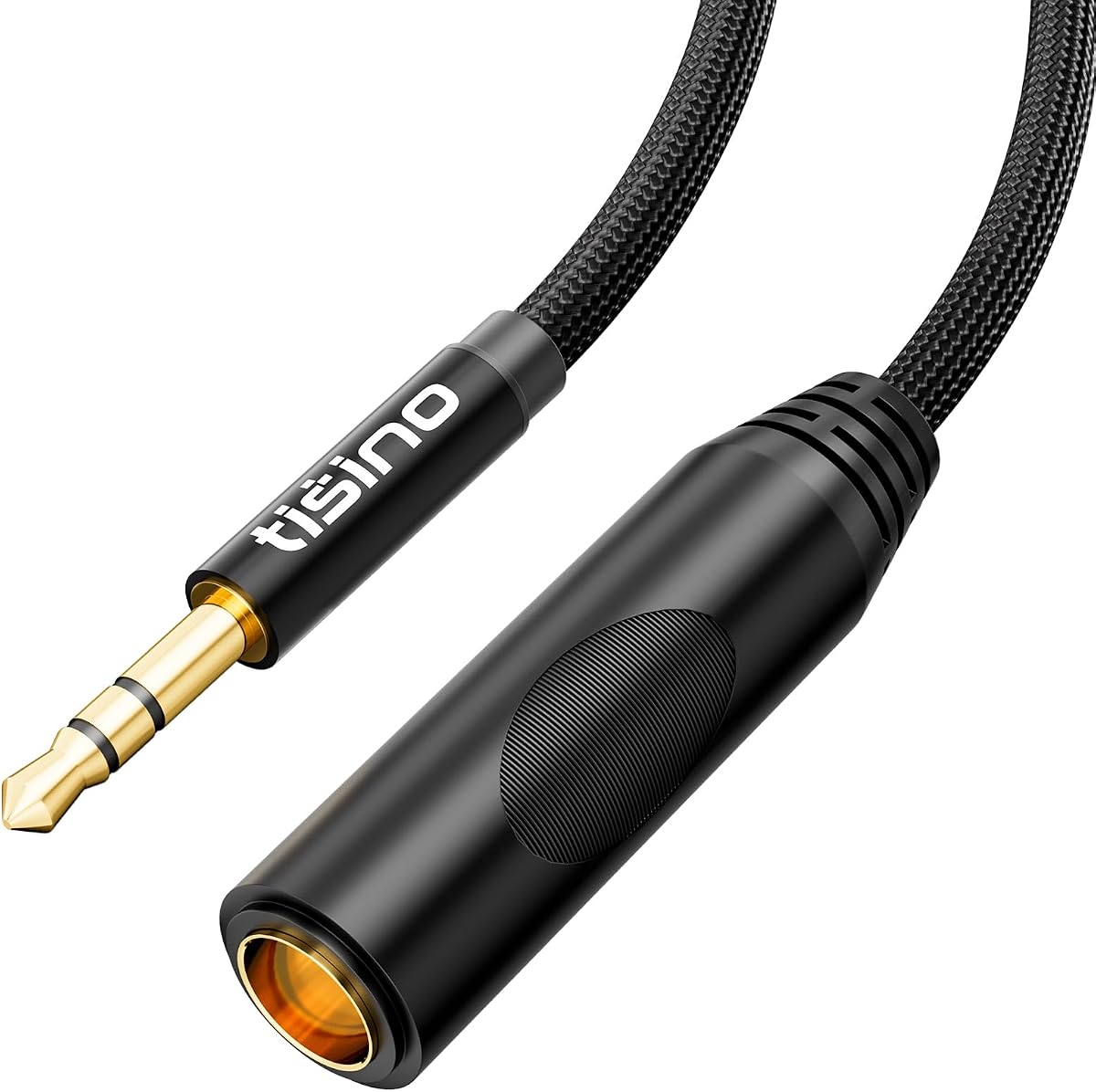
The Tisino 1/4 to 3.5mm Cable is a 30cm adapter lead with a 6.35mm male plug and a 3.5mm female socket. Its 4.6 rating and combination of shielding, a braided jacket, and a reusable organizing strap make it especially appealing for stage and performance gear.
We may earn a commission when you buy through this link, at no additional cost to you.
The cable uses heavy-duty 24K gold-plated contacts, a copper shell, polyethylene insulation, and multiple shielding layers. Its 4.0mm outer diameter and flexible rubber-and-nylon braid help it resist tangling while remaining easy to coil after a rehearsal or performance. The supplied reusable velcro strap keeps the lead compact in a gig bag.
The cable supports only one direction, so it cannot accommodate every possible equipment pairing. It is also longer and less pocketable than a direct adapter, although that is a meaningful advantage when strain on a built-in phone or laptop jack is a concern. Plug and socket dimensions can be confusing, so identify the male and female ends before purchasing.
This is an excellent pick for guitarists, keyboard players, stage performers, and home users who value a short, protected cable. It works with amplifiers, guitars, mixing consoles, pianos, stereo systems, karaoke machines, and other standard stereo equipment. The included strap adds organization that many basic adapter leads do not provide.
The reusable velcro strap keeps the 30cm lead compact after use. It is a small but useful feature for musicians who repeatedly transport cables to rehearsals, lessons, and gigs.
Shielding and insulation help isolate the audio path, while the copper shell and gold-plated contacts support dependable signal transmission. The flexible braid also helps the cable survive repeated handling.
We may earn a commission when you buy through this link, at no additional cost to you.
The MillSO Headphone Adapter Cable is a 12-inch lead with a 6.35mm female socket and 3.5mm male plug. It has a 4.6 rating and is positioned for reliable stereo transfer among headphones, phones, laptops, guitars, amplifiers, pianos, mixers, and home theater equipment.
We may earn a commission when you buy through this link, at no additional cost to you.
Gold-plated connectors support stable transmission, while tin-plated oxygen-free copper wiring, aluminum foil, and a soft PVC exterior create a four-layer shielding structure. The sapphire-blue metal housing adds wear resistance and corrosion protection, and the stated construction is designed to maintain a clear, balanced stereo signal.
The most important limitation is explicitly noted: this product transfers audio only and does not support microphone functionality. That matters for users expecting a headset adapter with an integrated microphone channel. The 12-inch lead also provides less freedom than a longer cable, although it remains easy to arrange between nearby devices.
Choose MillSO when you need a clearly labeled 6.35mm female to 3.5mm male cable and value multi-layer shielding. It is particularly useful for connecting a pair of standard 3.5mm headphones to a quarter-inch amplifier output, or for moving audio from a piano or home theater system to a phone or laptop. Its modest length suits desktop and stage-side setups.
The combination of copper wiring, foil, and durable outer covering is intended to reduce interference. This helps preserve a clean stereo signal when the cable is used near powered audio equipment.
The quarter-inch female end accepts a standard 3.5mm male plug, which is the orientation required for many headphone-to-amplifier connections. Clear labeling helps reduce setup errors.
We may earn a commission when you buy through this link, at no additional cost to you.
The SOLMIMI 1/4 to 3.5mm Adapter is a 30cm braided extension with a 6.35mm male plug and a 3.5mm female socket. Its 4.7 rating places it among the strongest customer-rated options in this guide, while the extended format gives connected devices more room from one another.
We may earn a commission when you buy through this link, at no additional cost to you.
The cable uses pure oxygen-free copper wiring, a 24K gold-plated connector, four spiral contacts, and an aluminum shell. Its crystal-style nylon braid is advertised with a bend lifespan above 15,000 bends, while the anti-slip connector housing provides a secure grip. A short extension can also reduce unwanted leverage on a device's built-in socket.
The product supports four-pole and three-pole 3.5mm plugs, but the microphone function does not work. That makes it suitable for stereo headphone and auxiliary audio but not for a headset whose microphone signal must pass through the adapter. It also offers only the 6.35mm male to 3.5mm female direction.
This is a strong choice for users who need a little more separation than a rigid adapter provides. It suits amplifiers, mixers, home theater devices, AV receivers, guitars, pianos, and other equipment with a standard 6.35mm stereo auxiliary port. The combination of a 4.7 rating, flexible braided construction, and practical strain relief makes it an appealing middle ground.
The 30cm extension creates physical space between two connected devices. That can reduce bending stress on a phone or laptop socket and makes controls easier to reach.
The nylon braid and advertised bend-life figure target repeated use. The anti-slip housing also helps the quarter-inch plug remain easy to remove.
We may earn a commission when you buy through this link, at no additional cost to you.
The UGREEN 6.35mm male to 3.5mm female adapter is a compact two-pack with a 4.7 customer rating. It offers a familiar direct-adapter format for connecting standard 3.5mm headphones and mobile devices to quarter-inch audio ports.
We may earn a commission when you buy through this link, at no additional cost to you.
Solid brass copper construction gives the adapters a more durable feel than plastic alternatives. Their 24K gold-plated connectors are designed to resist corrosion and minimize signal loss, while the gear-grinding finish creates 360-degree grip treads for easier handling. Both ends are designed to form a secure connection without requiring extra equipment.
The set works with keyboards, digital pianos, guitars, bass amplifiers, mixers, speakers, home theaters, recorders, and other compatible gear. It accepts four-pole and three-pole 3.5mm plugs for audio, but the microphone function does not work. Both adapters point in the same direction, which is important when planning a purchase.
UGREEN's pair is a balanced selection for listeners who want recognized construction, a strong rating, and two compact units. It is a particularly practical option for keyboard owners and home listeners who regularly use quarter-inch headphones. Confirm the device jack types and ensure that microphone support is not part of your intended setup.
Brass copper gives the connector body a sturdier construction than lightweight plastic alternatives. This is valuable for travel, repeated plugging, and use in active home or studio environments.
The gear-grinding texture improves leverage when connecting or removing the adapter. It helps maintain control when the jack is recessed in a mixer, amplifier, or keyboard.
We may earn a commission when you buy through this link, at no additional cost to you.
The most important buying decision is not simply the connector size, but whether the male and female ends match the devices you want to join. After confirming direction, consider signal format, construction, cable length, grip, shielding, portability, and intended use.
A 3.5mm male to 6.35mm female adapter accepts a 3.5mm plug from your headphones and presents a quarter-inch male plug to an amplifier or keyboard. A 6.35mm male to 3.5mm female adapter works in the opposite arrangement, accepting a quarter-inch source plug and providing a socket for 3.5mm headphones or an auxiliary cable. Some products include both directions, while others provide two identical pieces.
In short, trace the actual cable and plug before ordering, and match every male end with the corresponding female socket. Do not assume that two products described as 1/4-to-3.5mm adapters are interchangeable.
Most consumer headphones, smartphones, laptops, amplifiers, mixers, and instruments use a stereo TRS connection. An adapter that explicitly supports TRS is more likely to carry both left and right channels correctly. Mono adapters and microphone adapters have different contact arrangements, so they should not be treated as substitutes for a standard stereo adapter.
Prioritize standard stereo TRS support unless your equipment requires a mono connection. If you need headset microphone support, look for explicit four-pole or microphone compatibility rather than assuming every 3.5mm-compatible adapter will work.
Gold-plated contacts, oxygen-free or high-purity copper, and multiple shielding layers can support stable signal transfer and resist corrosion. These details are especially relevant near amplifiers, electric instruments, computers, and other electronics that may introduce interference. A well-constructed connector also makes a more consistent physical connection than a lightweight, loose-fitting alternative.
For clean stereo playback, look for gold-plated contacts and copper wiring, and favor shielded cable designs in demanding environments. Material claims alone do not guarantee a particular listening experience, but they provide a useful basis for comparing otherwise similar products.
A direct adapter is smaller, leaves no cable to coil, and keeps the connection tidy. It is convenient for portable headphones and permanently installed equipment. A short adapter cable offers more reach, relieves strain on built-in device sockets, and may be easier to arrange when controls are close together.
Choose a direct adapter for compactness and a short cable for flexibility or device separation. For most desk and stage-side setups, 12 inches or 30cm is enough to avoid excess slack while keeping the connection manageable.
Brass bodies, flexible braided jackets, and reinforced insulation are useful in equipment bags, rehearsal rooms, and studios. A textured exterior also makes the connector easier to grasp, especially if the socket is recessed or surrounded by other cables. The difference becomes noticeable when you need to connect or disconnect equipment quickly.
Prefer solid metal contacts, a durable housing, and a grip texture that feels secure. If portability is your main concern, also consider the adapter's dimensions and whether it includes a case or strap for organization.
Shielded cables can reduce hum, static, and unwanted noise, especially around powered amplifiers, electric guitars, mixers, and home theater systems. Products using tinned copper, aluminum foil, dense shielding, and a protective outer jacket provide several layers between the audio conductors and the surrounding environment.
Use a well-shielded short cable when noise reduction is important or devices sit close to interference sources. For basic headphone listening in a quiet location, a compact direct adapter with good contact construction may be sufficient.
Direct adapters are easiest to carry because they have no trailing cable. Short cable models should be coilable and flexible, and a reusable hook-and-loop strap can prevent tangles in a studio bag. A transparent case is also useful for a bidirectional set because it keeps the two orientations together and easy to identify.
Choose the least bulky format that meets your connection needs. If you travel frequently, prioritize a compact body, a secure case, or a strap and a short, flexible cable that can be coiled without tangling.
Stereo audio support and microphone support are not the same. Several adapters in this guide accept three-pole or four-pole 3.5mm plugs for audio while explicitly stating that the microphone function does not work. This distinction is essential for gaming headsets, headset microphones, and any setup where voice input must pass through the adapter.
Check the exact requirements of your headset and source device before purchasing. Choose an explicitly microphone-compatible product when needed, and otherwise confirm that standard stereo audio is the only function you require.
Identify the male and female ends of the adapter, then compare them with the ports on your two devices. A male connector enters a female socket, so the adapter must create a continuous path from the source output to the destination input. Make sure the devices are powered off when practical, especially if you are changing a connection while audio is playing.
Align the plug with the jack and insert it straight rather than forcing it at an angle. The 6.35mm plug is larger and can feel as though it is not fully seated, so gently rotate it while pushing until it is properly installed. For a cable model, check that both connectors are secure and that the cable is not sharply bent immediately next to the housing.
Store direct adapters in a small case or a dedicated pocket so they do not disappear among other accessories. Coil short cables loosely, secure them with the included strap when available, and avoid sharp creases. Disconnect the adapter by gripping its connector body rather than pulling on the attached headphone cable, and keep the contacts dry and free from debris.
It connects a 6.35mm, or quarter-inch, stereo audio port with a 3.5mm headphone or auxiliary connection. Common uses include connecting 3.5mm headphones to an amplifier, keyboard, guitar, mixer, or home theater device. The required male and female orientation depends on which direction you want the signal to travel.
It will work when the headphone plug and adapter orientation match the available equipment port. A 3.5mm male to 6.35mm female adapter is often used to connect 3.5mm headphones to a quarter-inch headphone output. You should also confirm that the source provides stereo audio rather than a mono microphone signal.
Several options in this guide support stereo audio from three-pole or four-pole 3.5mm plugs but explicitly do not support the microphone function. If you need headset voice input, look for a product that specifically states four-pole headset or microphone support. Otherwise, use a separate microphone adapter or a natively compatible headset connection.
Not necessarily. The 6.35mm and 3.5mm dimensions describe connector size, while TRS describes a standard stereo contact arrangement. True balanced audio is a different signal method with specific wiring and equipment requirements, so check the device documentation rather than assuming a size adapter is balanced.
A direct adapter is smaller, tidier, and easiest to carry. A short cable provides more reach, can reduce strain on a device's built-in socket, and may be easier to position when connected equipment sits close together. Choose the direct form for portability and the short cable for flexibility or a little extra separation.
A 6.35mm plug requires a gentle rotation during insertion to engage its spring contacts properly. Push it in while turning it slightly, then check that it is seated fully and does not move when the attached cable is supported gently. Do not force the plug if it does not fit, because the adapter and device jack may use different formats.
It can help connect compatible stereo equipment, but you must match the connector direction and the signal type. A quarter-inch instrument output is often mono, while a standard stereo TRS adapter may not be the correct interface for every guitar, amp, pedal, or recording setup. Check the manufacturer's connection guidance before routing an instrument signal.
Fully seat both connectors, confirm the adapter orientation, and test the source cable and headphones if possible. A shielded adapter cable can help when the connection is near amplifiers, electric instruments, or computers. Also check source-level settings and remove other cables from the signal path, since poor grounding or incompatible equipment may be the underlying cause.
The VCE two-pack stands out for its 4.7 rating, solid brass construction, gold-plated contacts, and straightforward 6.35mm male to 3.5mm female design. The MOBOREST set is the most adaptable choice when both connector directions may be needed, while the gold-plated TRS set adds a compact storage case and broad instrument and mobile-device compatibility.
Prioritize connector direction first, then decide whether you need a direct adapter, a short shielded cable, or a bidirectional set. Pay attention to TRS stereo support, microphone limitations, contact materials, grip design, and the amount of space available between your devices. For the most uncertain setups, a two-direction set offers the broadest practical coverage.
Ratings, specifications, listings, and prices can change over time, so review the current product page before making a final decision. Confirm the exact jack types on both pieces of equipment, check whether your headphones need microphone support, and compare the current features and price with the priorities outlined in this guide.