
OBD1 to OBD2 Adapter for Ford 7 Pin to 16 Pin OBD2 Diagnostic Cable
4.0Editor score
Designed for 7-pin Ford vehicles
Works with ELM327 scanners
Plug-and-play connection
Compact portable construction
Supports live data access
Our OBD1 to OBD2 Adapter guide compares 10 cables for GM, Ford, and BMW, covering pin fit, scanner compatibility, construction, ease of use, and basic setup.
An OBD1 to OBD2 adapter provides the physical connection needed to use many modern 16-pin diagnostic scanners with older vehicles that use a different OBD1 connector. A useful adapter must match the vehicle connector, preserve reliable data communication, and work with a scanner that supports the relevant legacy protocols.
The ten products in this guide cover 12-pin GM connections, 7-pin Ford connections, and a 20-pin BMW option. We compared their stated connector layouts, intended vehicle applications, construction, installation method, power requirements, and compatibility limitations. The list also distinguishes simple cable conversions from products that include diagnostic capabilities.
The picks show that connector shape alone does not guarantee a successful scan. Vehicle year and model, the scanner's supported protocols, the available diagnostic functions, and whether the adapter supplies power all need to be considered. Product availability and pricing can change, so readers should verify current listings and vehicle compatibility before ordering.
4.0Editor score

3.8Editor score

4.5Editor score
This side-by-side comparison focuses on the details that determine whether an adapter fits a particular older vehicle and diagnostic scanner. The key distinctions are the number and type of vehicle pins, the scanner-side connection, stated vehicle applications, power requirements, construction, and any protocol limitations emphasized by the manufacturer.



The Autel Original OBD1 to OBD2 GM Adapter Cable is a 12-pin male-to-female conversion cable intended for compatible GM vehicles with an OBD1 socket. Its 3.8 rating reflects a practical product with clear specifications, although the adapter cannot guarantee communication with every scanner or vehicle. Its strongest feature is the straightforward connection between the vehicle's 12-pin port and an existing 16-pin diagnostic tool.
We may earn a commission when you buy through this link, at no additional cost to you.
The listing emphasizes compatibility with scanning software, stable transmission, and reduced wear on the vehicle's diagnostic connector when the cable is used as an extension. Made from metal and plastic, the adapter uses precision injection molding and has undergone more than 10,000 plugging and unplugging tests. It does not include a scanner, and the vehicle-side port does not provide a power supply, so the diagnostic device must handle that requirement.
There are important limits to consider. The cable only changes the physical connection; it does not add OBD2 protocol support to a scanner that lacks the required legacy GM protocols. The broad diagnostic functions described by the manufacturer—reading or clearing codes, ECU coding, full-system diagnosis, and bidirectional control—remain dependent on the scanner, software, vehicle, and available service information.
This is a sensible pick for a GM owner who already owns a compatible 16-pin scanner and wants a straightforward 12-to-16-pin connection. It is less suitable for someone expecting a complete diagnostic kit, a self-powered cable, or guaranteed compatibility with every Autel scanner. Verify the connector photograph, vehicle year and model, and scanner protocol list before purchasing.
The adapter's main value is physical connectivity: it joins a 12-pin GM OBD1 socket to a 16-pin OBD2 scanner. Its no-tool installation makes it convenient for owners who already understand the basic diagnostic connection process.
Because the cable can remain attached between diagnostic sessions, it may reduce repeated handling of the vehicle's original diagnostic connector. That is helpful in a repair setting where the same port might otherwise be plugged and unplugged frequently.
We may earn a commission when you buy through this link, at no additional cost to you.
This OBD1 Scanner GM Adapter is a 12-pin-to-16-pin extension cable for compatible GM vehicles. It has a 3.7 rating and focuses on the fundamentals: a straightforward converter, durable metal and premium PVC materials, and a plug-and-play design. It is an accessory rather than a scanner, so the user must already own a suitable OBD2 diagnostic tool.
We may earn a commission when you buy through this link, at no additional cost to you.
One notable characteristic is the claim that multiple cables can be daisy chained for longer distances. That flexibility may be useful where the vehicle's diagnostic socket is difficult to reach or where extra cable length improves positioning. The molded construction is designed to resist breakage, while the product description highlights stable transmission when used with compatible scanning software.
The trade-off is that physical connectivity does not overcome protocol limitations. A scanner must support the protocols used by the older GM vehicle, and the available functions depend on the scanner and software. The product is also entirely cable-based, so users who do not already own a scanner will still need to source one separately.
This adapter is a good choice for a budget-conscious GM owner with a compatible 12-pin socket and an existing 16-pin scanner. It is particularly appealing if daisy-chaining or extra reach is important. Confirm the connector layout, vehicle compatibility, and scanner protocol support before ordering.
The stated daisy-chain capability can help extend the working distance between a scanner and the vehicle. This may make a difficult socket position more manageable without requiring a permanently installed diagnostic fixture.
No driver or complex installation is required for the cable itself. The adapter uses a familiar male-to-female arrangement, while the scanner and vehicle software handle the actual diagnostic communication.
We may earn a commission when you buy through this link, at no additional cost to you.
The Autel 7 Pin OBD1 to 16 Pin OBD2 Diagnostic Adapter Cable is designed for older Ford vehicles using a 7-pin OBD1 interface, particularly Ford EFI models from 1985 through 1991. Its 3.9 rating and focused application make it a more specialized choice than the broad 12-pin products in this guide.
We may earn a commission when you buy through this link, at no additional cost to you.
The adapter converts the vehicle's irregular 7-pin port into a conventional 16-pin OBD2 connection. The stated use process is straightforward: insert the 7-pin side into the vehicle, connect the 16-pin end to the scanner, and begin scanning. Once communication is established, a compatible scanner may provide code reading, code clearing, real-time data, and full-system diagnosis.
The most important qualification appears in the product information itself: this is only a physical interface converter. It is not compatible with all Autel scanners, and it does not guarantee communication merely because the connectors fit. Diagnostic success depends on support for the relevant earlier protocols, including the Ford EEC-IV protocol referenced in the listing.
Choose this cable if the vehicle has the specified 7-pin arrangement and the scanner already supports the necessary legacy Ford protocol. It is not a substitute for a scanner, and a physical fit should not be taken as proof that every service function will operate. Check the port, protocol list, model year, and cable dimensions before buying.
The seven-pin connector is the product's defining feature. Matching this connector to the vehicle is more important than choosing a cable based only on a broad OBD1 description, especially among older vehicles that used several diagnostic layouts.
A scanner that accepts a 16-pin plug may still lack the legacy communication protocol used by the vehicle. Reviewing the scanner's supported protocol list helps prevent the disappointment of a clean physical connection that produces no usable data.
We may earn a commission when you buy through this link, at no additional cost to you.
This 12-Pin Most Models Adapter is a compact male-to-female cable intended to connect a 12-pin vehicle socket to a 16-pin diagnostic tool. It carries a 3.4 rating, making its selection more dependent on the vehicle fit and the user's existing equipment than on the product's broader feature claims.
We may earn a commission when you buy through this link, at no additional cost to you.
The cable is made from wear-resistant PVC and is described as rugged, resistant to deformation, and environmentally friendly. Its listed dimensions are 16.14 by 1.83 inches, allowing it to fit readily in a vehicle's storage area. Installation is plug-and-play: connect the OBD1 end to the vehicle and the OBD2 end to the scanner.
Its main weakness is the limited specificity of the phrase compatible with most models. A 12-pin socket is necessary, but the presence of a 12-pin socket does not establish that every vehicle with that shape uses the same protocol or pin arrangement. The listing also does not provide the detailed protocol guidance offered by the more specialized Ford and BMW products.
This cable may suit a generic 12-pin OBD1 application where the owner has already confirmed the connector and scanner compatibility. It is a practical, portable accessory rather than a complete diagnostic solution. Anyone considering it for a specific vehicle should compare the plug shape and pin layout carefully before ordering.
The short, lightweight form is convenient for keeping in a vehicle or in a technician's tool bag. It can remain available for diagnostics without taking up much room when not in use.
The straightforward plug-and-play layout avoids permanent wiring or complicated setup. It is a cable accessory, so the diagnostic application and protocol support come from the attached scanner.
We may earn a commission when you buy through this link, at no additional cost to you.
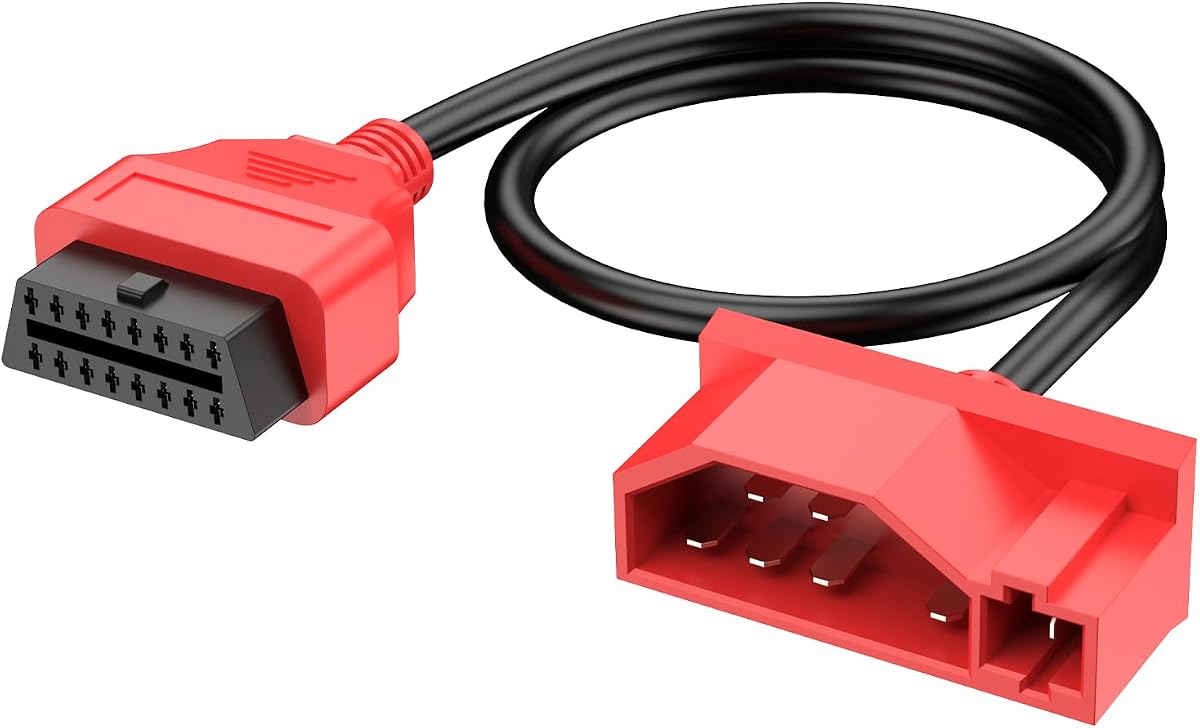
The OBD1 to OBD2 Adapter for Ford 7 Pin to 16 Pin OBD2 Diagnostic Cable combines a focused 7-pin Ford connector with support for ELM327 scanners and code readers. Its 4.0 rating is the highest among the 7-pin Ford options in this guide, making it a notable value for owners of older Ford vehicles.
We may earn a commission when you buy through this link, at no additional cost to you.
The cable's installation process is uncomplicated. One end connects to the Ford's 7-pin OBD1 port, and the other connects to a 16-pin OBD2 diagnostic device. The listing identifies compatibility with ELM327 scanners and describes access to real-time data, fault codes, and advanced diagnostic functions, subject to the attached scanner and vehicle.
Durable materials and a compact design make the cable practical for repeated use and transport. The main limitation is its specialization: it is intended for Ford vehicles with the 7-pin connector rather than for general OBD1 vehicles. It also does not explain every legacy protocol in the listing, so the product's claim of working with ELM327 devices should not be treated as a guarantee across all vehicles or scanners.
This is a strong choice for someone who knows the vehicle has a 7-pin Ford port and already owns an ELM327-based scanner or compatible reader. It is less suitable for a GM, BMW, or 12-pin vehicle owner. Confirm the connector, model year, scanner protocol support, and required diagnostic functions before purchasing.
The explicit reference to ELM327 scanners gives buyers a useful starting point for building a compatible setup. It narrows the search compared with a generic cable and helps identify the additional equipment needed.
Real-time data, fault-code retrieval, and more comprehensive analysis can be valuable for owners doing maintenance on older vehicles. The adapter provides the link, while the attached scanner determines which features are actually available.
We may earn a commission when you buy through this link, at no additional cost to you.
The 40CM OBD1 Scanner Connector is a 12-pin-to-16-pin cable designed to connect older OBD1 vehicles with OBD2 scanners. Its 3.0 rating is the lowest among the ten products, so buyers should place more emphasis on verifying the exact connector and protocol arrangement before purchasing.
We may earn a commission when you buy through this link, at no additional cost to you.
A stated 40-centimeter, or 15.7-inch, length provides more reach than many compact cables. The flexible construction and stable interface are intended to support reliable data transmission while positioning the scanner conveniently. The product is presented as useful for automotive technicians, repair shops, and owners who perform regular maintenance.
The product does not identify a specific vehicle make or explain protocol support in detail. Although it is described as compatible with most vehicles that use OBD1 interfaces, OBD1 encompasses several connector arrangements and legacy communication systems. This makes the phrase broad compatibility less useful than a precise vehicle-year and connector guide.
Its strongest use case is a confirmed 12-pin vehicle paired with a compatible 16-pin scanner where modest extra cable length improves access. It is not a standalone scanner and should not be expected to add unsupported diagnostic functions. Check both the physical plug and the scanner's legacy protocol support before ordering.
The 40-centimeter cable can make it easier to place a scanner on a seat, cart, or work surface while it remains connected. That extra distance can improve access to diagnostic ports installed in less convenient locations.
The product is best understood as a connection accessory for an existing scanner. Its value lies in linking compatible equipment rather than providing a complete diagnostic package.
We may earn a commission when you buy through this link, at no additional cost to you.
The CERRXIAN OBD1 to OBD2 GM Adapter is a cable for connecting a 12-pin GM OBD1 socket to a 16-pin diagnostic tool. Its 3.5 rating is supported by unusually transparent product information, including a specific explanation of which pins are connected and a clear warning that the cable does not supply power.
We may earn a commission when you buy through this link, at no additional cost to you.
The connected-pin description lists 4 and 5 for A, 7 for M and K, and 16 for G, while the remaining pins are not connected. This level of detail is valuable for diagnosing compatibility questions, although it also makes clear that the cable is not a complete pass-through for every potential OBD2 contact. The package contains one adapter.
The requirement for scanner power is another important limitation. A compatible diagnostic device must include its own power supply, and it must support the GM vehicle's communication protocol. The adapter can support reading or clearing codes and complete-system diagnostics when the scanner, software, and vehicle cooperate, but it does not independently provide those capabilities.
This is a useful option for a GM owner who wants a compact plug-and-play converter and already has a self-powered, protocol-compatible scanner. It is a less flexible choice for anyone expecting every OBD2 pin to be carried by the cable. Confirm the scanner power arrangement, vehicle connector, and required functions before ordering.
Listing the connected pins helps buyers understand the cable's exact role. That specificity can be more useful than a broad compatibility claim when comparing it with a generic 12-pin-to-16-pin cable.
Because the adapter has no power supply, the connected diagnostic tool must provide what is needed for communication. Buyers should check that requirement before assuming the cable alone is sufficient.
We may earn a commission when you buy through this link, at no additional cost to you.
The Ford 7-Pin Replacement Cable is a 7-pin-to-16-pin adapter aimed at Ford EFI vehicles from 1985 through 1993. It has a 3.5 rating and distinguishes itself with a specific model-year range and an explicit incompatibility notice for the 1992 Ford F350.
We may earn a commission when you buy through this link, at no additional cost to you.
The product uses metal and PVC materials with precision injection molding, offering a flexible and durable connection between the vehicle and a 16-pin scanner. It is designed for use with diagnostic software and code-reading or scan tools, provided those devices support the vehicle's communication protocol.
The explicit F350 exclusion is helpful because it prevents an overly confident purchase based on a general Ford label. At the same time, the range is still broad, and the listing does not provide a full protocol matrix. Users should confirm the physical connector, exact model, scanner compatibility, and the presence of any campaign-specific revisions.
This cable suits a Ford EFI owner whose vehicle uses the listed 7-pin arrangement and who needs a replacement-style diagnostic connector. It is not appropriate for the excluded 1992 F350 or for vehicles with another connector layout. It also requires separate diagnostic equipment, so it is best chosen as a targeted accessory.
The named 1992 F350 exception demonstrates why model-specific details matter. Checking an exclusion can prevent buying a cable that appears to fit the general application but does not match the vehicle's connector.
The metal-and-PVC construction and molded connectors are designed for repeated diagnostic use. The cable links the vehicle to existing code readers and scan tools without requiring permanent installation.
We may earn a commission when you buy through this link, at no additional cost to you.
The Autel Original 20 Pin to 16 Pin OBD2 Cable for BMW is the most specialized product in the guide. It converts a 20-pin BMW diagnostic port to a 16-pin scanner connection and carries a 4.5 rating. It is also the only product here designed explicitly for a listed family of BMW models rather than GM or Ford platforms.
We may earn a commission when you buy through this link, at no additional cost to you.
The stated compatibility list covers BMW OBD models E28, E30, E32, E34, E36, E38, E39, E46, E52, E53, R50, R52, and R53. The cable is 15.75 inches, or 40 centimeters, long and can function as an extension to reduce wear on the vehicle's original connector.
The construction details reinforce its premium positioning. The product is described as using industrial-grade heavy-duty materials, precision injection molding, and connectors that underwent more than 10,000 plugging and unplugging tests. It includes a one-year warranty and replacement or return coverage, according to the listing. Like most cables in the category, it does not include a scanner or provide power.
This is the strongest choice for a BMW owner with one of the listed 20-pin configurations and a compatible 16-pin diagnostic tool. It is unsuitable for 12-pin GM or 7-pin Ford applications, and scanner support still depends on the vehicle's protocol. Verify the listed model, connector photograph, scanner functions, and power arrangement before purchase.
The explicit list of supported BMW codes is a major advantage over generic 20-pin cables. It gives owners a concrete way to compare their vehicle with the adapter before ordering.
The industrial-grade connectors and extensive plug-cycle testing claim address durability in repeated diagnostic work. The extension design can also reduce direct handling of the original vehicle port.
We may earn a commission when you buy through this link, at no additional cost to you.
The 12-Pin Universal-Style Cable is a 12-pin-to-16-pin diagnostic extension with a 5.0 rating, the highest numerical rating among the listed products. It distinguishes itself with unusually precise construction and dimensional information, including copper cores, flame-retardant PVC housing, and measurements for both connectors.
We may earn a commission when you buy through this link, at no additional cost to you.
The cable measures 16 inches overall. Its OBD1 male end is listed at 1.8 by 2.2 by 0.7 inches, while the OBD2 female end measures 1.8 by 1.9 by 0.8 inches. The product is designed to support fault-code reading, data-stream monitoring, and sensor-status checks when paired with a suitable OBD2 diagnostic tool.
The stated vehicle range covers cars, trucks, and SUVs equipped with OBD1, but the listing does not identify particular makes or model years. Copper cores and anti-interference construction are positive technical details, yet they cannot resolve a mismatch in pin arrangement or legacy protocol. The scanner still determines the available functions.
This is a compelling general 12-pin option for buyers who have confirmed the physical connector and scanner compatibility. It is especially attractive for home self-checks or repair-shop inspections where a compact, tool-free cable is needed. It should not be selected for a 7-pin Ford, 20-pin BMW, or an unconfirmed 12-pin layout without checking the vehicle.
The stated connector and cable dimensions help buyers judge fit before ordering. They also make it easier to compare this option with other 12-pin cables that use less precise descriptions.
Copper cores are intended to support stable signal transmission, while the flame-retardant PVC housing is designed for durability. These material claims make the cable appealing for regular diagnostic use.
We may earn a commission when you buy through this link, at no additional cost to you.
The correct adapter depends on more than the OBD1 label. Start with the vehicle's exact connector, then confirm the scanner's protocol support, power arrangement, and required functions before comparing cable construction and convenience features.
Choose the exact connector configuration, not merely the broadest advertised fit. A matching outline still does not prove full protocol compatibility.
The right cable and the right scanner must work together. Never assume a 16-pin connection guarantees usable data.
Treat the adapter as a connection accessory. Select a scanner separately based on the functions the vehicle and owner actually need.
Verify where diagnostic power comes from. A compatible scanner with suitable built-in power may be required.
Choose a length that improves positioning without becoming cumbersome. Extra reach is useful around awkward diagnostic ports.
Look for molded connectors, suitable cable materials, and evidence of repeated-plug testing. Avoid forcing a connector into a port that does not match.
Check exclusions and model-year notes before ordering. A single vehicle revision can be more important than a brand-wide compatibility claim.
Documented warranty and support add confidence, but compatibility must come first. Check the terms before purchase and keep the listing information available.
Before connecting anything, identify the vehicle's OBD1 port and confirm that the adapter's vehicle-side plug matches its shape and pin layout. Review the scanner's supported protocols and make sure it has the required power source or built-in power. With the ignition in the appropriate accessory or running position for the scanner's instructions, seat the adapter in the vehicle port without forcing it.
Connect the 16-pin end to the diagnostic scanner, then open the scanner's software and select the vehicle, model, year, and appropriate legacy protocol if the application requires manual selection. Begin with a basic communication or fault-code check. If the scanner does not communicate, disconnect it and revisit the connector fit, protocol choice, power arrangement, and any model-specific exception before trying again.
After the session, disconnect the scanner first, then remove the adapter by its molded connector rather than pulling on the cable. Keep the cable straight when stored, avoid sharp bends, and keep the connectors clean and dry. Inspect the housing and pins periodically, and replace the cable if it is damaged, loose, or no longer provides a stable connection.
No. The adapter changes the physical connector so an appropriate 16-pin tool can connect, but the scanner must also support the vehicle's legacy communication protocol. A scanner may fit perfectly yet return no usable data if it only supports modern OBD2 protocols. Check the scanner's protocol list and the vehicle requirements before buying.
Yes. Every product in this guide is described as a cable or converter, not a complete diagnostic scanner. You will need a compatible 16-pin OBD2 scanner, code reader, or scan tool to perform diagnostics. The adapter supplies the physical link between that device and the older vehicle's connector.
The pin count and connector arrangement correspond to different vehicle diagnostic-port designs. The 12-pin options in this guide are primarily presented for GM vehicles, the 7-pin options for older Ford EFI vehicles, and the 20-pin Autel cable for specified BMW models. Match the exact connector rather than relying on the vehicle's make alone.
Several listings explicitly state that their vehicle-side ports do not provide a power supply, and the CERRXIAN GM cable specifically requires a scanner with built-in power. Confirm how the diagnostic tool is powered before use. A physically correct adapter can still fail to communicate if the required power arrangement is missing.
Those functions depend on the scanner, its software, the vehicle, and the communication protocol. The adapter itself does not add those capabilities to every scanner. If advanced service functions matter, verify that the attached tool explicitly supports them for the exact vehicle before purchasing.
Start by disconnecting everything and checking that the connector shape and pin layout match the vehicle. Confirm that the scanner supports the required legacy protocol, check its power requirements, and select the correct vehicle settings in the software. Also review model-year exceptions, including the listed 1992 Ford F350 exclusion on one of the Ford cables.
The product descriptions present extension use as a way to reduce wear on the vehicle's original diagnostic port. Whether it is left connected should follow the scanner and vehicle instructions, and the adapter should be removed when not needed for extended storage. Handle the molded connector rather than pulling on the cable.
No. The relevant vehicles may use different OBD1 connector shapes, so the listed GM adapters have 12-pin vehicle ends, the Ford adapters have 7-pin vehicle ends, and the BMW option has a 20-pin vehicle end. Each is designed to connect that vehicle-side arrangement to a 16-pin scanner.
The Autel Original OBD1 to OBD2 GM Adapter Cable is the leading pick for a 12-pin GM owner seeking a well-described, no-tool connection with solid construction and warranty support. The Ford 7-Pin Diagnostic Cable stands out as the best budget-oriented choice for compatible older Fords, particularly when paired with an ELM327 scanner, while the Autel Original 20 Pin to 16 Pin OBD2 Cable for BMW is the premium specialist option with detailed model guidance.
Prioritize the vehicle connector first, then the scanner's protocol support, diagnostic functions, and power arrangement. Cable length, material, warranty, and model-year exceptions are secondary refinements. A product that looks universal on paper is not a better choice than one whose connector, vehicle range, and protocol requirements can be verified against the exact car.
Product listings, availability, and pricing can change, so check the current details before buying. Review the latest vehicle compatibility notes, connector images, included items, warranty terms, and scanner requirements. Buying the adapter first and confirming compatibility afterward can lead to a cable that fits imperfectly or communicates with an unsupported protocol.