
Antrader F/F IDC 20-Pin Ribbon Cable
4.7Editor score
Six dual-row cable assemblies
2.54mm connector pitch
28 AWG stranded conductors
Explore the best 20 Pin Flat Ribbon Cable options, comparing pin pitch, connectors, length, voltage, applications, and installation needs for every project.
A 20 pin flat ribbon cable is a compact interconnect solution for circuit boards, computer equipment, cameras, monitors, programmers, and other electronics. The right cable depends on connector arrangement, conductor pitch, length, voltage rating, and whether you need an IDC termination or a finer-pitch FFC connection.
This guide compares ten 20-pin options by examining their documented dimensions, connector styles, electrical specifications, included quantities, and stated applications. It covers conventional IDC assemblies, color-coded wire ribbon, long unterminated runs, and A-type flexible flat cables for compact electronics.
Each review highlights the characteristics that distinguish one cable from another and identifies the projects for which it appears most suitable. Customer ratings provide additional context, although they do not replace checking connector compatibility, pin spacing, and cable length before ordering; prices and availability may change over time.
4.7Editor score

4.8Editor score
5.0Editor score
The following side-by-side comparison covers all ten cables, emphasizing the practical differences that matter most: pitch, connector configuration, cable length, construction, and documented use cases.


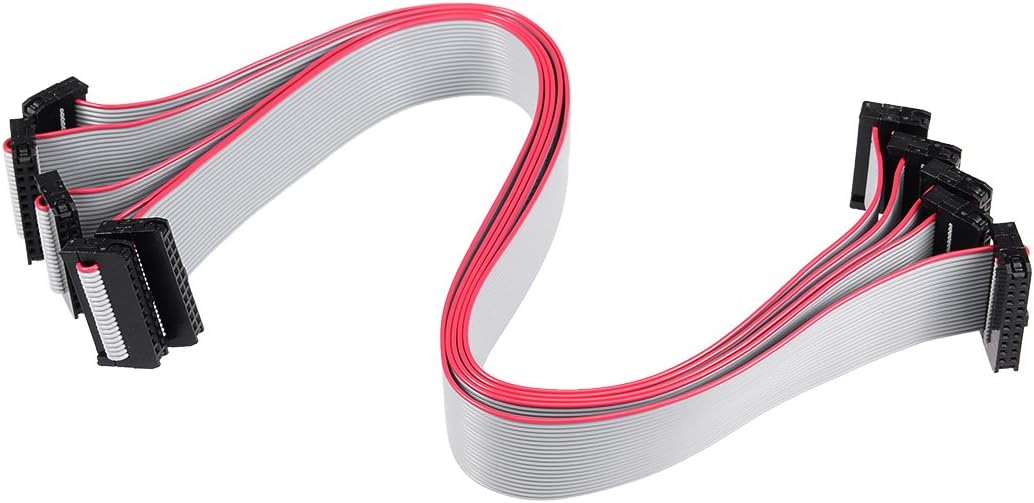
The Antrader F/F IDC Connector 20 Pins Flat Ribbon Cable is a versatile pack of six 30cm assemblies built around the widely encountered 2.54mm pitch. Its 4.7 rating reflects a generally favorable customer response, while the included quantity makes it especially appealing for repeated bench wiring, prototyping, repairs, or keeping spare assemblies available.
We may earn a commission when you buy through this link, at no additional cost to you.
Each cable uses 28 AWG stranded wire rated for 300V and provides a 20-position, two-row female-to-female arrangement. The conductors can be separated for individual terminations when a standard connector, jack, or pin is more suitable. That flexibility is valuable when a project requires only a few signals rather than all 20 conductors.
The main compromise is the 30cm length. It works well for nearby circuit boards, internal computer equipment, cameras, and compact electronic assemblies, but it offers limited reach across larger enclosures. Buyers must also ensure that the target equipment accepts the specified female connectors and 2.54mm spacing rather than a finer or different header arrangement.
This is a strong recommendation for builders who want several ready-made cables at once and value standard 2.54mm compatibility. It is less suitable for long-distance equipment runs or projects requiring a 1.27mm or 0.5mm pitch. For compact, repeatable electronics work, the six-piece format is especially useful.
Having six assemblies allows one cable to be dedicated to each subsystem or retained as a spare. The individually separable conductors also make it easier to tailor a termination without committing every signal to a single preassembled connector.
The 2.54mm arrangement is broadly recognized and easier to match than less common spacing. It remains essential to inspect the receiving header rather than relying only on its stated pin count.
We may earn a commission when you buy through this link, at no additional cost to you.
This uxcell cable is a compact 20cm assembly with 20 female IDC positions at 1.27mm pitch. Its 4.8 rating is among the strongest in the group, and the narrow contact spacing gives it a clear role in fine-pitch internal wiring where a standard 2.54mm connector would be too large.
We may earn a commission when you buy through this link, at no additional cost to you.
The listed overall width is 12.6mm, and the package contains two flat ribbon cables made primarily from plastic. The connectors are designed for direct insertion into compatible PCBs, making the assembly useful in office equipment and video machines where internal board connections need a compact profile.
Because the pitch is 1.27mm, compatibility is the decisive issue. A connector with the same nominal pin count can still be physically incompatible if its row spacing, contact arrangement, or mounting style differs. The short 20cm length also means the cable is best confined to a single enclosure or nearby subsystem.
This option is a good fit for technicians who already know their board uses a 20-position, 1.27mm female IDC connection. It is less convenient for general-purpose use because the fine pitch demands careful alignment and provides less tolerance for improvised connections.
The 1.27mm pitch allows all 20 contacts to fit into a smaller connector footprint than a 2.54mm assembly. This makes the cable appropriate where board space around the header is limited.
Pin count and pitch should be checked together. The target header must also match the female connector's row layout and mating orientation, not merely provide 20 total contacts.
We may earn a commission when you buy through this link, at no additional cost to you.
The uxcell FC-to-FC A-Type cable combines a one-meter length with 20 color-coded conductors on a standard 2.54mm pitch. Its 4.8 rating and generous reach make it a practical choice when two compatible FC-equipped boards or modules need to be connected across a larger workspace.
We may earn a commission when you buy through this link, at no additional cost to you.
Color coding simplifies conductor identification during installation, and the conductors can be separated for clean terminations with standard wire connectors and pins. The product is also described for cameras, camcorders, laptops, LCD televisions, monitors, 3D-printer expansion, circuit boards, LEDs, lights, and computers.
Its defining limitation is the FC-to-FC A-type termination. It is not interchangeable with a female-to-female IDC extension even if both have 20 positions, so the mating equipment must support the correct connector family and orientation. The one-meter length is helpful for routing, though it can be excessive inside a tightly packaged enclosure.
Choose this cable when color identification, ample length, and a documented 2.54mm FC-to-FC arrangement are the priorities. It is especially suitable for prototyping and repair setups that use matching FC connectors. Verify the mating headers and keep the cable gently routed to preserve conductor integrity.
Distinct conductor colors make it easier to identify and document individual connections. This is particularly helpful when troubleshooting a multi-signal assembly or reproducing wiring across several prototypes.
The one-meter run provides ample slack for routing around panels, boards, and fixtures. Excess length can be managed with gentle folds or an appropriate retainer, provided the conductors are not sharply bent.
We may earn a commission when you buy through this link, at no additional cost to you.
This five-meter rainbow-color ribbon wire provides 20 individually colored conductors in a flat, 24mm-wide construction. With a 1.27mm pitch, it offers a practical starting point for custom terminations, prototype wiring, and internal projects where the final connector arrangement has not yet been decided.
We may earn a commission when you buy through this link, at no additional cost to you.
The cable is made from plastic and copper, and its stated capacitance is 40PF/M. Rainbow coloring makes each conductor easier to distinguish, while the long length allows the installer to cut only the amount required for a particular assembly.
The major tradeoff is that it does not arrive with preinstalled IDC connectors. Creating a clean termination requires suitable tooling and careful alignment, and the 1.27mm conductor pitch calls for precision. The five-meter length also provides more material than many compact projects need.
This ribbon wire is best for experienced electronics builders who want the freedom to create custom cable ends or route individual conductors. It is less convenient for quick plug-and-play work. Buyers should obtain compatible connectors and verify the conductor orientation before terminating the cable.
An unterminated ribbon allows the cable length and connector arrangement to be selected for the actual device. It can also be cut into shorter assemblies when a permanent 20-position link is unnecessary.
The rainbow conductor sequence provides a visible reference during installation. Recording pin-one orientation and checking the receiving device still remain necessary.
We may earn a commission when you buy through this link, at no additional cost to you.
The Antrader 1.27mm Gray Flat Ribbon Cable is a five-meter, 20-pin bulk cable designed to mate with 2.54mm IDC connectors. Its 4.6 rating reflects a favorable overall reception, and the gray jacket gives it a neutral appearance suited to internal equipment wiring.
We may earn a commission when you buy through this link, at no additional cost to you.
The construction uses seven-core tinned copper conductors with a PVC insulation cover. It is listed for computer internals, industrial instruments, and automation machinery, making it a flexible choice for projects that need more cable than a short prewired assembly can provide.
Its main drawback is the absence of a ready-made connector on the supplied cable. A compatible 2.54mm IDC termination must be installed and crimped correctly, and the 1.27mm conductor spacing demands careful alignment. Buyers without suitable crimping tools or experience should favor a preassembled option.
This cable is most appropriate for technicians creating longer custom interconnects, carrying multiple signals through an enclosure, or matching an established 2.54mm IDC wiring standard. Its combination of length, conductor count, and material makes it more versatile than a short fixed cable but less convenient for immediate installation.
Five meters can run through a large cabinet, machine, or multi-bay assembly. It can also be trimmed to fit custom equipment without restricting the design to a standard cable length.
Seven-core tinned copper provides a defined conductor construction for multi-signal internal wiring. The cable is intended to be terminated into compatible 2.54mm IDC connectors.
We may earn a commission when you buy through this link, at no additional cost to you.
This uxcell FFC uses a 0.5mm pitch to provide 20 contacts in an extremely thin and flexible form. The 150mm length and A-type same-side contact configuration suit compact assemblies such as cameras, laptop components, LCD televisions, monitors, DVD players, stereo equipment, and computer modules.
We may earn a commission when you buy through this link, at no additional cost to you.
Its structure uses a flexible plastic film base with metallic conductors bonded to one surface. Stiffeners reinforce both ends to support insertion, and the package includes five cables. The listed dielectric strength is 60V, while heat resistance is specified at 80°C.
This is a different product family from the IDC ribbon cables. A 0.5mm FFC will not fit a conventional 2.54mm or 1.27mm header, and the receiving socket must also accept A-type contact orientation. The lowest rating in the group, 4.3, should be considered alongside these strict compatibility requirements.
Buyers repairing or assembling compact electronics should choose this cable when the original device specification calls for a 20-position, 0.5mm A-type FFC. It is not a convenient substitute for general IDC wiring, and its five-piece quantity is useful for having matched spares available.
A 0.5mm pitch places 20 contacts in a very narrow footprint. The thin film construction suits equipment where connector bulk and cable thickness are restricted.
The stiffened ends help the cable enter a compatible socket in a controlled way. They do not change the requirement for exact contact count, pitch, and orientation.
We may earn a commission when you buy through this link, at no additional cost to you.
The uxcell 250mm A-Type FFC is the longer counterpart to the 150mm model in this roundup. It has 20 contacts at 0.5mm pitch, a thin flexible construction, and a listed 60V dielectric strength. Its 4.5 rating gives a moderate indication of customer satisfaction.
We may earn a commission when you buy through this link, at no additional cost to you.
The additional 100mm of length provides more routing freedom inside cameras, laptops, LCD displays, DVD players, stereo systems, audio equipment, and other compact electronic modules. Reinforced ends support insertion into a matching connector, and five assemblies are included.
Compatibility remains the decisive concern. This is an A-type FFC with contacts on the same side, not an IDC ribbon cable, and the receiving equipment must support all 20 positions at 0.5mm spacing. Its extra length may be unnecessary in tightly constrained products, though it can help when the connector positions are farther apart than the 150mm version allows.
This cable is a practical option for replacement or custom work involving fine-pitch FFC connections. It is best for builders who have confirmed the device's pitch, contact orientation, and socket dimensions, rather than for users selecting a cable only by the number of pins.
The 250mm length offers greater positioning freedom while retaining a low-profile cable. It can route between modules that cannot be placed directly next to one another.
Five assemblies make it easier to complete multiple repairs or retain matching spares. Each still requires the same precise compatibility check at the receiving socket.
We may earn a commission when you buy through this link, at no additional cost to you.
The BLS 2.54mm Pitch IDC 20-Pin F/F Connector Extension is a ready-made 150cm cable for connecting two compatible female-to-female IDC headers. Its 4.8 rating and combination of length and documented electrical specifications make it one of the most versatile choices in the roundup.
We may earn a commission when you buy through this link, at no additional cost to you.
The cable uses 20 positions on a standard 2.54mm pitch, 28 AWG wire, and a reported withstand voltage of 300V. It is rated to 105°C and has a width of approximately 2.5cm. Those figures are useful when comparing it with shorter assemblies or cables intended only for low-voltage consumer electronics.
A long extension reduces the need to relocate equipment merely to close the connection gap. The trade-off is that excess cable may need to be routed carefully inside an enclosure, and the 20-position female connectors must match the headers on both devices. The listing describes a single cable rather than a multipack.
Choose the BLS extension for internal systems, prototyping, or bench work that requires a long 2.54mm connection without custom termination. It is a particularly good fit when a standard 300V withstand specification and 105°C temperature rating are important to the design.
The installed female connectors allow the cable to function as a complete extension. This removes the need to crimp new ends and is convenient when working with standard IDC headers.
A 300V withstand rating and 105°C temperature specification provide clearer guidance than many competing listings. Actual suitability still depends on the connected equipment, current, environment, and installation quality.
We may earn a commission when you buy through this link, at no additional cost to you.
This uxcell 20-pin cable uses an intermediate 2mm pitch, providing a distinct option between the more common 1.27mm and 2.54mm arrangements. The package includes five 30cm female-connector assemblies, and its 4.6 rating indicates generally positive customer feedback.
We may earn a commission when you buy through this link, at no additional cost to you.
The listed dimensions are 20cm? No: the product data specifies 30cm, or 11.8 inches, and an overall width of 20mm, or 0.78 inch. The plastic cables have a stated withstand voltage of 300V and temperature rating of 105°C, and they are designed for direct insertion into compatible PCBs.
The main limitation is the less ubiquitous 2mm spacing. Even though it falls between common standards, a buyer must not assume it fits a 2.54mm header. Contact spacing, row geometry, and socket orientation all need to match. The fixed 30cm length is practical for internal assemblies but restrictive for widely separated modules.
This is a useful multipack for technicians who service equipment with confirmed 2mm headers. It offers an easy, preassembled alternative to custom ribbon termination and includes enough units for several projects or a small repair inventory.
Five ready-made assemblies support several repairs or prototype branches at once. The pack format is convenient for maintenance teams that repeatedly encounter the same connector format.
The 2mm pitch is neither interchangeable with 1.27mm nor 2.54mm headers. Compare the actual receptacle dimensions and contact layout before purchasing for a specific device.
We may earn a commission when you buy through this link, at no additional cost to you.
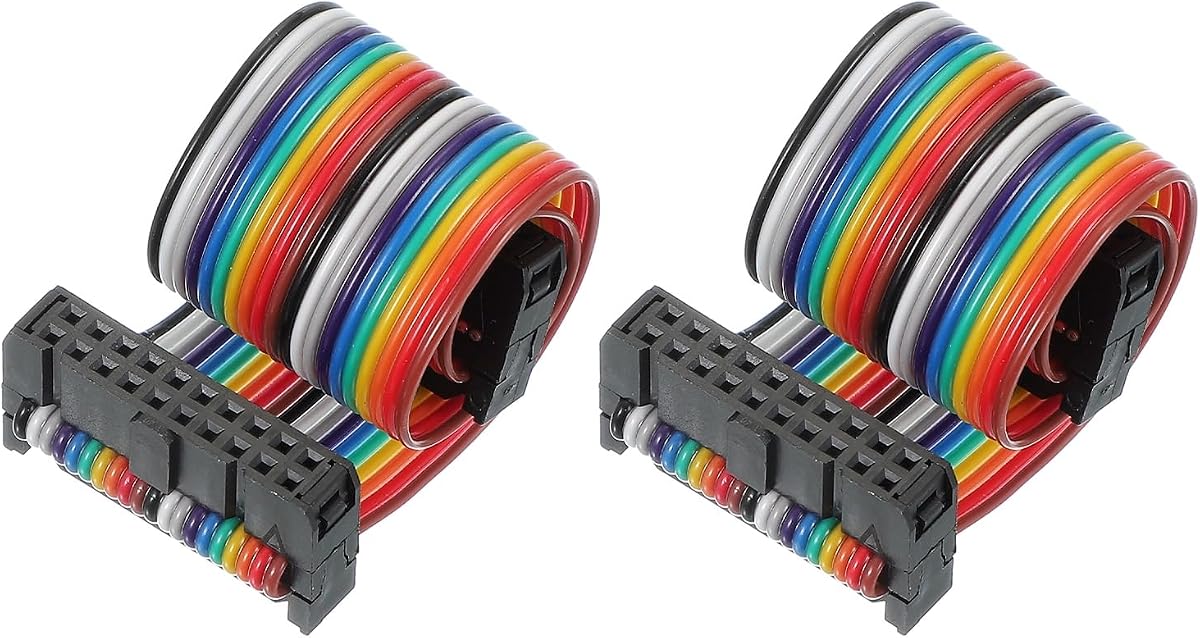
The PATIKIL 20-Pin IDC Cable is a compact pair of 150mm dual-row female-to-female assemblies with 2.54mm spacing. Its 5.0 rating is the highest listed in the group, although ratings should still be considered alongside fit, length, and the particular equipment being connected.
We may earn a commission when you buy through this link, at no additional cost to you.
A red stripe identifies pin one and provides a clear orientation reference. Installation does not require soldering: the cable is aligned with the correct headers and pressed into place. The product data lists a 300V rating, an 80°C operating figure, and a separate 105°C temperature reference.
The compact 150mm length is the principal limitation. It suits direct connections between nearby boards but offers almost no slack for equipment spaced farther apart. Incorrect insertion can also be damaging, so the connector geometry and pin-one position should be confirmed before pressing the cable into a header.
This is a strong choice for short internal data links, IDE-style board connections, printer or drive wiring, and hobby projects using standard 2.54mm female headers. Its clear orientation marking and simple press-fit installation are especially helpful for users who want a tidy, purpose-made cable rather than a custom termination.
The red conductor stripe provides a visible reference for the correct side of the header. On a 20-pin dual-row connection, reversing the cable can incorrectly align every conductor, so this marker deserves careful attention.
A compatible IDC header accepts the cable by firm, even pressure. This simplifies installation and avoids creating a permanent soldered joint, although the connector must still be pressed fully and correctly.
We may earn a commission when you buy through this link, at no additional cost to you.
The best cable is the one whose pitch, connector configuration, length, and electrical construction precisely match the equipment. The following factors help narrow the selection before installation.
A 20-pin label describes the number of conductors, but it does not reveal the physical spacing between them. The roundup includes 0.5mm, 1.27mm, 2mm, and 2.54mm pitch options. These dimensions are not interchangeable, and a 20-position cable can still be physically unable to enter a header intended for a different pitch.
Choose the exact pitch specified by the manufacturer or measured from the existing socket. If replacing a cable, compare the contact spacing, number of rows, and connector width rather than relying on the nominal pin count alone.
Connector terminology varies across listings. Options in this guide include female-to-female IDC, female-only assemblies, FC-to-FC A-type, and A-type FFC configurations. A cable that looks similar in a product image may have a different mating family, contact side, or mounting arrangement.
For an IDC connection, determine whether the equipment presents female or male headers and whether both ends need the same orientation. For an FFC, confirm the 0.5mm pitch and whether contacts are on the same side. The cable name and application list should be treated as clues, while the physical interface is decisive.
Cable length must accommodate the distance between connection points while leaving enough slack to avoid tension. The shortest options are 150mm and 200mm, while others reach 300mm, one meter, 150cm, or five meters. A nominally longer cable can still be inconvenient if excess length cannot be safely coiled or routed.
Measure the actual path rather than estimating only the straight-line distance between boards. Include clearance for plugs, connectors, service loops, cabinet walls, and nearby moving components. For custom bulk ribbon, select a length that can be trimmed to the final design without wasting material.
IDC cable uses flat stranded conductors and a press-on insulation-displacement connector, making it convenient for general board interconnects. FFC uses a thin plastic film with bonded metallic contacts and a much finer 0.5mm pitch. The FFC route is appropriate for compact consumer electronics, while IDC is more common in internal wiring and prototyping.
Do not substitute one family for the other merely because both contain 20 contacts. An FFC has a different physical construction, insertion method, and connector format. Confirm the replacement part number, connector drawings, and required orientation whenever possible.
Several products list a 300V withstand rating, and some also state a 105°C temperature figure. The FFC options list a 60V dielectric strength and 80°C heat resistance. These values provide useful boundaries, but they should not be treated as blanket permission for every operating environment.
Consider the actual circuit, current, ambient temperature, connector quality, and nearby heat sources. For power or safety-critical equipment, use the manufacturer's wiring requirements and professional engineering guidance rather than relying solely on a marketplace listing.
Preassembled cables are faster to install and reduce the risk of poor terminations. This is especially useful for short internal links, repairs, and users without IDC crimping equipment. Bulk rainbow ribbon is more adaptable when only selected conductors are needed or when the final connector must be customized.
Preassembled products also limit the available length, while bulk cable can be trimmed to fit and may allow individual conductors to be separated. The trade-off is labor: custom termination requires the correct connector, tools, and knowledge of pin-one orientation.
Multipacks can be valuable for maintenance benches, repeated prototyping, or teams that want standardized spare cables. The Antrader 2.54mm option includes six assemblies, several uxcell products include five, and some choices contain only one or two. The number of cables does not change their electrical design, but it affects convenience and inventory planning.
Choose a smaller pack for one dedicated connection and a larger pack when several identical assemblies are likely. Avoid buying extra solely by quantity if the connector format has not been confirmed; spare cables only help if they fit the intended equipment.
Correct orientation can prevent conductor-to-conductor misalignment that might damage a device. A color-coded pin-one stripe, as offered by the PATIKIL cable, makes this easier to see. Other cables use rainbow conductors for signal identification, while some FFC assemblies have reinforced ends that guide insertion into a fine-pitch socket.
These features improve usability but do not replace inspection. Before installation, compare the cable's contact side, row layout, and pin-one position with the receiving connector. Make sure the header is rated for repeated press-fit connections and that the cable is inserted evenly.
Before installation, power down and disconnect the equipment. Compare the cable with the intended header, identify pin one on both the cable and board, and verify the pitch, row spacing, connector type, and available cable length. For a dual-row IDC cable, align both rows evenly rather than forcing one side into place first.
For press-fit IDC assemblies, hold the connector square and apply firm, even pressure until the cable seats evenly. A color stripe or other pin-one marker can help prevent reversal. For FFC cables, open the compatible locking socket, insert the reinforced end in the required contact orientation, and close the lock without twisting the conductors.
Route the cable away from sharp edges, fans, hot components, and moving parts. Avoid sharp bends, excessive tension, and repeated folding at the same point. When stored, keep it flat in a clean protective area rather than wrapping it tightly. If a conductor is damaged, the connector does not seat correctly, or the pin-one orientation is uncertain, replace the cable rather than forcing continued use.
It indicates that the cable carries 20 separate signal or power conductors. A 20-pin cable may still use a dual-row connector, so buyers should also check whether the mating header contains one row of 20 contacts or two rows of 10. The conductor pitch and connector dimensions determine physical compatibility.
No, not reliably. Cables with 0.5mm, 1.27mm, 2mm, and 2.54mm pitch have different contact spacing and connector geometry. Even two cables that both contain 20 conductors can be physically incompatible, so the pitch, row layout, contact side, and mating connector must all match.
A female-to-female cable is designed to mate with male IDC headers at both ends. It will not fit directly onto another female header unless the intended arrangement includes a correct opposing connector. Verify the equipment's header type before ordering to avoid a mismatch.
An IDC ribbon uses separate flat stranded conductors and usually ends in a press-on insulation-displacement connector. An FFC has metallic contacts bonded to a thin plastic film and commonly uses a finer 0.5mm pitch. The two families require different sockets and installation methods.
Look for a pin-one marker, such as a red stripe, on the cable and compare it with the orientation of the board header. Trace the marking before pressing either end into place. On a dual-row connector, an incorrect orientation may align every conductor incorrectly, so extra visual checking is worthwhile.
It depends on the product. Bulk unterminated ribbon can generally be cut to length and terminated with a suitable IDC connector, although precision is important. A preassembled IDC cable can be shortened, but cutting it usually removes the factory connector and requires new termination. FFC cables are best replaced with the intended length rather than cut casually.
Route it in a smooth path without sharp bends, pulling force, or contact with hot or moving components. Secure the cable where necessary, but avoid crushing the conductors or placing stress on the connector. Gentle slack is preferable to a taut cable, especially around vibration-prone assemblies.
No. Ratings can be helpful for assessing general satisfaction, but they do not confirm compatibility with a particular device. Check the manufacturer or board documentation for pitch, row configuration, contact orientation, length, and connector type before making a selection.
The strongest all-purpose choice in this group is the BLS 150cm F/F IDC extension because it combines a standard 2.54mm pitch, a useful long reach, ready-made female connectors, and clearly stated electrical specifications. The Antrader six-pack is compelling for multiple nearby assemblies, while the PATIKIL pair is particularly user-friendly for short links because of its pin-one stripe and straightforward press-fit installation.
Your priority should be compatibility before length or appearance. Identify the required pitch and connector family first, then select a length that fits the installation without creating unnecessary slack. Fine-pitch 0.5mm A-type FFC cables serve compact electronics, whereas conventional IDC assemblies suit many internal board connections. Unterminated ribbon is the most adaptable but requires termination work.
Finally, review the current listing, customer feedback, and availability before purchasing because prices, stock, and product details can change. Match the connector to the equipment, confirm the orientation, and provide a safe routing path. With those checks completed, the right 20 pin flat ribbon cable can deliver a neat, dependable connection for electronics repair, prototyping, and internal system wiring.