
FOXWELL BT705Plus
4.5Editor score
Runs three diagnostic tests
Uses 2.8-inch color display
Stores readings for comparison
Our Lithium Ion Battery Tester guide compares models for battery compatibility, diagnostics, charging checks, display quality, portability, and overall value.
A lithium ion battery tester can reveal the condition of a battery without requiring access to a vehicle’s diagnostic port. The right model should match the battery chemistry, voltage, cell format, and diagnostic depth you need, while also providing clear readings that are easy to interpret at a glance.
The products in this guide range from compact 18650 and household-battery capacity checkers to sophisticated automotive testers with cranking and charging-system analysis. We compared them based on supported battery types, measurement functions, screen readability, protection features, portability, and their usefulness for DIY maintenance or professional diagnostics.
Each review explains the tester’s strongest capabilities, practical limitations, and ideal user. Ratings reflect the supplied customer feedback, while features and compatibility come from the listed product information. As with all commercial products, availability, specifications, and prices can change, so verify the current listing before buying.
4.5Editor score

4.5Editor score

4.7Editor score
This side-by-side comparison shows the battery formats, diagnostic capabilities, display type, and best use case for each tester, helping you distinguish purpose-built lithium-ion cell testers from general-purpose vehicle and household-battery checkers.


The ANCEL BT410 is an automotive battery and charging-system tester with a supplied customer rating of 4.5. It stands out because it combines 12V and 24V support with compatibility for regular flooded, AGM, GEL, EFB, and lithium-ion batteries, allowing one instrument to cover cars, trucks, RVs, motorcycles, and boats.
We may earn a commission when you buy through this link, at no additional cost to you.
Its reporting goes beyond a simple voltage display. The tester evaluates state of charge, state of health, voltage, internal resistance, cranking performance, charging-system performance, and ripple voltage, then presents a clear outcome such as good battery, good-recharge, or replace battery. A shareable QR report can preserve the results for maintenance records or further diagnosis.
The 2.4-inch color TFT display, adjustable contrast, and day-and-night mode make the information easier to inspect in bright sunlight or a dim garage. Eight languages, short-circuit protection, reverse-polarity protection, reinforced clamps, and 800mm cables improve convenience and safety. The tester draws power from the battery being tested, eliminating the need for internal batteries.
This is the strongest all-around recommendation for someone who wants genuine automotive diagnostics and also needs lithium-ion compatibility. It is less suitable for testing loose 18650 cells or checking household batteries, but for a vehicle-oriented tool it combines broad coverage, readable results, and useful documentation features in a compact package.
Battery health is only one part of a starting problem. By including cranking and charging-system tests, the BT410 helps distinguish a weak battery from an underperforming starter or alternator, reducing the chance of replacing a component that was not responsible for the symptom.
The QR report feature is especially helpful for fleet managers, mobile mechanics, and careful DIY owners. You can review the underlying readings and preserve a result instead of relying only on a pass-or-fail message that disappears when the tester is switched off.
We may earn a commission when you buy through this link, at no additional cost to you.
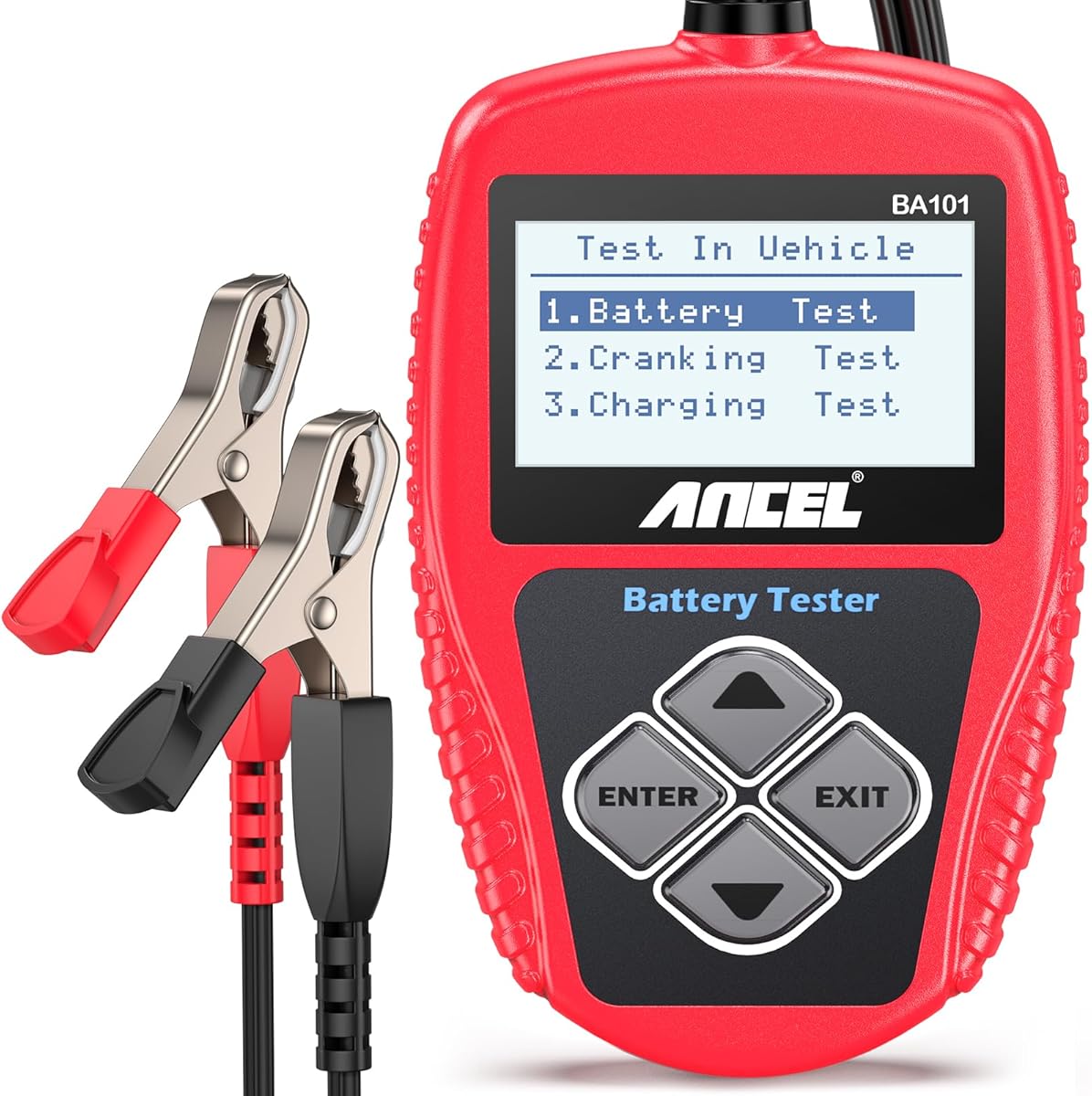
The ANCEL BA101 is a straightforward 12V automotive tester that carries a supplied rating of 4.5. It targets owners of conventional lead-acid batteries who want a practical way to check state of health, state of charge, voltage, current, CCA, cranking performance, and charging-system operation.
We may earn a commission when you buy through this link, at no additional cost to you.
The device supports many common battery rating standards, including JIS, EN, DIN, SAE, BCI, GB, CA, MCA, and IEC. Flooded, AGM, GEL, and EFB batteries above 30Ah are supported, making it relevant to cars, trucks, boats, RVs, ATVs, lawnmowers, golf carts, and motorcycles that meet those conditions.
Its adjustable-contrast black-and-white screen and white backlight prioritize affordability and readability over the color interface found in more advanced models. Reverse-polarity, short-circuit, overcurrent, and overvoltage protection help reduce the consequences of connection errors, while the reinforced housing and copper clips support regular use.
The BA101 is a sensible choice for a garage focused on conventional 12V vehicles, particularly when a full-color display and QR reporting are unnecessary. It should not be chosen for lithium-ion, 6V, 8V, or 24V batteries, and the listed exclusions include motorcycle batteries below 30Ah. For lithium compatibility, the BT410 or BT310 is a better fit.
The tester is designed to make the initial battery check less intimidating. Its readable screen, straightforward one-handed operation, and direct vehicle power supply keep the workflow simple for owners checking a battery before a trip or after extended storage.
Its strong lead-acid coverage does not make it a universal lithium-ion tester. Check the battery label and vehicle voltage before use, because the listed specifications explicitly exclude lithium batteries and systems other than 12V.
We may earn a commission when you buy through this link, at no additional cost to you.
The DWEII 18650 Capacity Tester is a specialized module for evaluating removable 18650 lithium-ion cells, and its supplied customer rating is 4.3. It is far more focused than the automotive testers in this list, offering capacity, internal resistance, voltage, current, power, and battery-level readings for up to four channels.
We may earn a commission when you buy through this link, at no additional cost to you.
Its integrated charge-and-discharge process simplifies testing by avoiding repeated disassembly and reassembly of equipment. The 1.77-inch screen presents internal resistance, capacity, voltage, current, and battery level at the same time, giving users a broader view than a simple voltage-only checker.
The specified working voltage is DC 5V, with a detection voltage no higher than DC 5V. Capacity measurement extends from zero to 99,999mAh, the discharge load is 10W, and the stated measurement error is about 10%. The product operates with a Type-C port, making it a bench-oriented solution rather than a handheld automotive diagnostic.
Choose this tester if you work with 18650 cells and need multi-channel capacity analysis. Its reported error and specialized format mean it is not the right choice for checking a vehicle battery, testing household cells, or performing cranking and alternator diagnostics. The value lies in bringing several cell measurements into one compact testing workflow.
This module is aimed at users who regularly rebuild packs, compare cells, or investigate battery performance. Four-channel operation can streamline comparisons and help identify cells that behave differently from the rest of a group.
The stated error of about 10% is important when making decisions. Use the readings for comparative analysis and verification, but allow for tolerance when deciding whether a cell is truly exhausted or merely performing near the expected range.
We may earn a commission when you buy through this link, at no additional cost to you.
The ANCEL BT310 combines broad automotive battery coverage with stored test history, and its supplied rating is 4.5. It supports 12V and 24V systems from 100–2000 CCA across batteries rated from 30Ah to 220Ah, including vehicles such as cars, trucks, motorcycles, RVs, ATVs, and boats.
We may earn a commission when you buy through this link, at no additional cost to you.
Six battery types are supported: flooded, flat-plate AGM, spiral AGM, GEL, EFB, and lithium-ion. The tester measures state of health, state of charge, voltage, current, CCA, and internal resistance, then converts those readings into five clear outcomes that tell the user whether the battery is good, needs recharging, requires charging and retesting, should be replaced, or has a bad cell.
A major advantage over simpler testers is the Review Data function, which retrieves previous battery, cranking, and charging reports. That makes the BT310 useful for tracking deterioration, comparing multiple vehicles, and noticing a change before a hard-starting problem appears. The 128-by-64 backlit LCD includes adjustable contrast for legibility.
The BT310 is an excellent choice for DIY users and small shops that want lithium-ion support and longitudinal records without a color screen. It also offers reverse-polarity, short-circuit, overvoltage, and over-temperature protection, along with an 800mm cable and reinforced case. Accurate comparison still depends on entering the correct battery type and rating.
Stored results turn the tester into a basic monitoring tool. Regular records can reveal a falling state of health, inconsistent cranking voltage, or weakening charging performance, giving owners useful evidence when deciding whether further service is required.
The five-result system is designed to make the conclusion easier than interpreting raw figures alone. It remains important to understand the rating and battery-type settings, because incorrect configuration can distort the meaning of the result.
We may earn a commission when you buy through this link, at no additional cost to you.
The TOPDON BT100 is a compact 12V lead-acid battery load tester with a supplied rating of 4.6, the highest among the lead-acid-focused automotive models in this guide. It provides state of health, state of charge, voltage, current, rating, and other analytical data in a package designed for cars and many other vehicle categories.
We may earn a commission when you buy through this link, at no additional cost to you.
Its three testing functions cover battery condition, cranking-system sufficiency, and charging-system operation. The charging check evaluates charging current, rectifier diode condition, and generator performance, helping users investigate more than a weak battery when a vehicle starts poorly or repeatedly loses charge.
A menu system guides operation, while three colors of LEDs provide quick status cues. Premium copper clamps offer polarity-reverse prevention and spark-resistant construction, which helps establish secure connections during testing. The passive approach means the tester powers on only after it is correctly attached.
The BT100 is attractive for owners who want a simple, compact tool for conventional 12V lead-acid batteries. It fits easily in a glove box or center console and is useful for cars, motorcycles, trucks, RVs, ATVs, SUVs, boats, yachts, lawnmowers, and golf carts. However, it does not support lithium-ion batteries, so it is not the most useful choice for the keyword’s specific chemistry.
The combination of battery, cranking, and charging tests helps narrow down common electrical complaints. Instead of automatically blaming the battery, a user can check whether the starter receives adequate power and whether the charging system is restoring voltage correctly.
Its small footprint makes periodic checks easier for owners of cars, motorcycles, boats, or recreational vehicles that sit unused. Keeping the tester nearby can encourage routine testing before a long period of inactivity or a seasonal trip.
We may earn a commission when you buy through this link, at no additional cost to you.
The RC Cellmeter 7 is a compact digital battery checker for LiPo, LiFe, lithium-ion, NiMH, and NiCd packs, with a supplied rating of 4.7. It supports two-to-seven-cell lithium configurations and four-to-seven-cell NiMH or NiCd configurations, making it a versatile budget meter for hobby and household battery checks.
We may earn a commission when you buy through this link, at no additional cost to you.
Its display includes individual cell voltages, total pack voltage, the lowest and highest cell voltage, the gap between them, and a remaining-capacity percentage. That combination makes it especially useful for spotting a weak or mismatched cell within a multi-cell pack, which may not be obvious from total voltage alone.
Operation is straightforward because the meter is designed to be simple and convenient to read. Its stated dimensions are 8.4 by 5 by 1.6 centimeters, and its listed weight is 45 grams, so it is easy to carry between a workbench, hobby area, and travel kit.
This is the best budget entry for a quick lithium-ion pack check when full capacity analysis is not required. It does not perform the charge-and-discharge capacity testing found in dedicated laboratory-style modules, and the battery is not included. Its strongest value lies in rapid chemistry recognition, cell-balance visibility, and portability.
The difference between the highest and lowest cell readings is particularly valuable. A pack may retain acceptable total voltage while one cell sits meaningfully below the others, which can make the imbalance easier to identify before a tool or device is affected.
Because the meter supports several chemistries and cell counts, it can be useful for comparing batteries from different devices. It is best treated as a fast screening tool rather than a complete laboratory analysis system.
We may earn a commission when you buy through this link, at no additional cost to you.
The FOXWELL BT705 is a professional-style automotive tester with a supplied rating of 4.5. It checks CCA, voltage, internal resistance, state of health, cranking performance, and charging output across 12V and 24V systems, serving cars, pickups, trucks, RVs, boats, commercial vehicles, and start-stop applications.
We may earn a commission when you buy through this link, at no additional cost to you.
The 2.8-inch screen presents step-by-step prompts and summarizes battery results as good, recharge, or replace. This guided structure makes the tool approachable for first-time users while providing the range of measurements expected by more experienced automotive technicians.
A 5.9-foot test cable is a particularly useful design feature. It can reach from a battery compartment to the driver’s seat, allowing one person to observe cranking voltage and cranking time while starting the vehicle. A protective housing, durable clamps, and an included hard carrying case support repeated workshop or garage use.
The BT705 is a strong premium choice for 12V and 24V lead-acid diagnostics, particularly for technicians who test multiple vehicles. It does not support lithium-ion batteries despite its broad automotive voltage coverage. Buyers focused strictly on lithium-ion chemistry should instead consider the ANCEL BT410, BT310, RC Cellmeter 7, or a dedicated 18650 capacity tester.
The long cable changes the testing workflow because the operator can remain in the driver’s seat. That allows cranking voltage and time to be viewed during startup rather than requiring another person to watch the instrument in the engine compartment.
The hard case, reinforced housing, and durable battery clamps are useful for mechanics, fleet maintenance teams, and advanced DIY users. They help keep the tester and accessories organized and protected between jobs.
We may earn a commission when you buy through this link, at no additional cost to you.
The FOXWELL BT705Plus is the upgraded version of the BT705, with a supplied rating of 4.5. Its stated improvements include results up to 30% faster, a more powerful processor, refined algorithms, and the ability to provide higher accuracy on low-voltage or nearly dead batteries.
We may earn a commission when you buy through this link, at no additional cost to you.
Battery, cranking, and charging tests can be performed in any sequence. The measurements include state of health, state of charge, CCA, cranking voltage and time, charging voltage, and ripple, giving technicians a detailed picture of battery condition, starter performance, and alternator operation.
A high-contrast 2.8-inch color LCD improves visibility, and the 5.9-foot cables again allow solo cranking and charging tests from the driver’s seat. High-conductivity clamps support consistent contact. The package includes a storage box for transport to shops, fleet locations, or mobile work.
This is the most advanced premium pick in the guide for conventional automotive battery diagnostics. It does not support lithium-ion batteries, and it should not be confused with an OBD2 code scanner. It also does not charge batteries. For a premium vehicle lead-acid workflow, however, it offers the strongest combination of fast processing, clear color results, and detailed reporting.
The upgraded processor and refined algorithms are especially relevant when testing many vehicles in succession. Faster results can improve workflow without removing the battery, cranking, and charging stages that make the tool diagnostically useful.
The BT705Plus diagnoses the battery and related vehicle systems but does not recharge a battery or read engine trouble codes through the OBD2 port. Understanding those boundaries prevents expecting a charger or scanner in a single package.
We may earn a commission when you buy through this link, at no additional cost to you.
The Dlyfull-DB1 is a reusable household-battery tester with a supplied rating of 4.5. It supports 1.2V NiMH or NiCd, 1.5V alkaline, 3.0V lithium, and 3.7V lithium-ion batteries across AAA, AA, C, SC, D, N, button-cell, CR123A, CR2032, LR44, 18650, and other listed formats.
We may earn a commission when you buy through this link, at no additional cost to you.
The digital display reports battery voltage and health, indicating whether the reading is good, weak, or poor. A magnetic slider holds the selected battery firmly in place, which reduces the chance of it slipping and makes one-handed checks more convenient.
Unlike a disposable standalone tester, the device is rechargeable through USB-C. The listed full-charge duration is up to 15 hours, and a full charge is intended to last for that period. Its compact form and broad format support make it useful for maintaining a mixed collection of remote controls, toys, household devices, and hobby batteries.
The DB1 is best for people who regularly test many common battery sizes and want one reusable meter. It is not designed for multi-cell pack analysis, cranking tests, or charging-system diagnostics. Because it checks a battery at a time, it offers a convenient screening approach rather than the deeper capacity measurements available from the DWEII module.
Its broad format compatibility reduces the need to keep separate testers for different household batteries. The ability to switch among several voltage and chemistry ranges is especially helpful in drawers containing an unpredictable mix of old and new cells.
The USB-C rechargeable construction and magnetic holder prioritize convenience over disposable operation. It is a practical choice for a home, office, or hobby bench where batteries are checked frequently and varied formats are common.
We may earn a commission when you buy through this link, at no additional cost to you.
The La Crosse 911-65557-INT is a portable household-battery tester with a supplied rating of 4.6. It supports rechargeable and alkaline batteries, including AAA, AA, C, D, N, 9V formats, as well as lithium-ion button cells for quick checks around the home.
We may earn a commission when you buy through this link, at no additional cost to you.
Its three-step process is particularly approachable. Select the appropriate 1.5V, 1.2V, or 3.0V range, pull out the orange tray, insert the battery with the correct polarity, and slide the tray closed. A dedicated touch-contact area on the left handles 9V batteries.
Once connected, the LED display indicates voltage and the relative strength level of the battery. The tray-based design helps establish the proper contact for cylindrical cells, while the dedicated 9V contacts expand coverage beyond the common AA and AAA formats.
This tester is a good fit for consumers who want a simple answer about common household batteries without navigating menus or learning advanced measurements. It does not offer cell-balance data, internal-resistance testing, or multi-channel capacity analysis. It is a screen-and-strength indicator rather than a workshop diagnostic instrument.
The three-step process and limited controls make this one of the easiest products in the guide to use. A user can select the correct range, insert the battery, and read the result without learning a complex diagnostic menu.
The tester works well for finding weak household cells before they cause a device to behave inconsistently. Its supported formats cover many common batteries, although the selectable voltage ranges remain narrower than those of the multi-chemistry RC Cellmeter 7.
We may earn a commission when you buy through this link, at no additional cost to you.
The best lithium ion battery tester depends on what you need to inspect. Start with the battery’s chemistry, voltage, physical format, and intended use, then compare display quality, diagnostic depth, protection, and record-keeping features.
A tester cannot provide a valid result if it does not support the battery being checked. Automotive models may cover lithium-ion while excluding some lead-acid chemistries, while compact cell meters may accept loose 18650, 18650-sized, and household cells. A vehicle battery tester is generally designed around terminal clamps and vehicle electrical systems; it is not automatically suitable for a removable cylindrical cell.
A single-cell pack tester may support only a limited range of series configurations, while automotive tools often handle complete 12V or 24V systems. Check the stated operating and detection voltages as well as the number of cells. A meter that works with one 3.7V lithium-ion cell may not support a seven-cell pack, and a 12V lead-acid analyzer may not correctly evaluate a smaller battery arrangement.
Voltage-only checkers provide a quick indication of electrical state, but they do not necessarily measure the full usable capacity of a lithium-ion cell. Dedicated capacity testers perform charge-and-discharge cycles to estimate internal resistance and capacity. That deeper process is valuable for reclaimed cells, matched battery packs, and diagnosing a cell that quickly loses charge, but it requires more time and careful setup.
An automotive tester becomes substantially more useful when it can evaluate battery health, cranking performance, and charging output. Cranking measurements can indicate whether the starter receives adequate voltage, while charging checks can reveal alternator or generator problems. These functions help distinguish a failed battery from a broader electrical issue that would otherwise be misdiagnosed.
A readable result is more valuable than a long list of measurements no one can interpret. Color TFT and LCD screens improve navigation and help distinguish status messages quickly, while backlights and adjustable contrast help in garages and outdoor conditions. The best action-oriented tester translates raw readings into a clear conclusion such as good, recharge, retest, or replace.
Battery testing involves high-current connections, so reverse-polarity, short-circuit, overvoltage, overcurrent, and over-temperature protection can be valuable. Look for sturdy clamps that maintain contact without slipping and a tester that clearly identifies incorrect connections. These safeguards are especially important around tightly packed engine bays, batteries with recessed terminals, and repeated fleet use.
Consider where the tester will live and how it receives power. Automotive tools that draw from the vehicle battery eliminate the need for internal batteries, which is convenient in a garage. Rechargeable household meters are useful around the home but require periodic charging. Larger diagnostic sets benefit from carrying cases, while a compact module may be better suited to a workbench or hobby kit.
Historical readings can reveal gradual deterioration that a single test misses. QR reports, stored test records, and consistent battery-type settings are useful for fleet managers and owners of aging vehicles. For accurate comparisons, repeat the test using the same connection point, battery type, rating value, and general battery condition whenever possible.
Begin by identifying the battery chemistry, nominal voltage, cell count, and rated capacity or CCA from its label. Configure the tester to match those details, clean the terminals if necessary, and confirm the correct polarity. For a loose 18650 cell, use a holder or fixture that prevents the cell from moving during charging and discharging.
Connect the tester as directed and keep the vehicle in the recommended state for the selected test. Turn off accessories and follow the tool’s prompts before cranking or charging analysis. For capacity testing, allow the cell to follow the complete specified cycle rather than interrupting when the display reaches an interesting intermediate value.
After testing, disconnect the unit safely, return any sliding or magnetic holder to its storage position, and wipe away residue from the contacts. Keep the tester dry, protect its screen and cables from impact, and recharge household models as directed. Store automotive testers in their cases and replace damaged clamps rather than continuing with a questionable connection.
Most testers in this guide diagnose battery condition but do not recharge the battery. The DWEII 18650 module includes a charge-and-discharge measurement process, but that activity is intended to estimate capacity and resistance rather than serve as a general-purpose charger. Always follow the instructions supplied with the battery and the specific tester.
A voltage tester usually checks the present electrical voltage and may report a basic health category. A capacity tester performs a more involved charge-and-discharge process to estimate usable capacity and internal resistance. The second approach is more useful for rebuilding packs and comparing cells, while the first is faster for routine household screening.
Only if the tester explicitly supports that voltage and chemistry. The ANCEL BT410 and BT310 list lithium-ion compatibility alongside 12V and 24V automotive operation. The BA101, BT100, BT705, and BT705Plus are described as lead-acid tools, so they should not be used on lithium-ion batteries.
The DWEII 18650 Capacity Tester is the closest fit because it is designed specifically for 18650 cells and combines capacity, resistance, voltage, current, power, and level readings. The Dlyfull-DB1 and RC Cellmeter 7 can also check many common cells, but they are more appropriate for quick voltage-based screening than full capacity analysis.
The rating provides a reference against which the measured condition is evaluated. Entering an incorrect value can make a weak battery appear healthier than it is or produce an unnecessary replacement recommendation. Check the battery label and use the tester’s supported rating standard and entered value exactly as specified.
They are helpful when a vehicle starts slowly, loses power quickly, or repeatedly needs a jump. A cranking test can help identify inadequate starting-system voltage, while a charging test can reveal whether the alternator is restoring power correctly. The BT310, BT705, BT705Plus, BA101, and BT100 all include these broader diagnostic functions.
No. Automotive testers are designed for high-capacity battery systems and use clamps sized for large terminals. A household tester such as the La Crosse 911-65557-INT or Dlyfull-DB1 is more appropriate for AA, AAA, C, D, 9V, button cells, and other small formats, subject to the tester’s stated limits.
Use the same battery type, rating setting, connection point, and general test conditions for each session. The BT310 includes a Review Data function for retrieving earlier battery, cranking, and charging reports, while the BT410 can generate shareable QR reports. Consistent settings make changes in performance much easier to interpret.
The ANCEL BT410 is the most balanced overall choice because it supports 12V and 24V automotive systems, lead-acid and lithium-ion batteries, cranking and charging analysis, and shareable reports. It is the most versatile option for a vehicle owner who wants more than a basic battery-voltage indication.
For loose-cell work, choose the DWEII module when capacity and resistance analysis are important, or the RC Cellmeter 7 when fast multi-cell voltage checks and imbalance detection are enough. For household batteries, the Dlyfull-DB1 offers broad format coverage and a rechargeable design, while the La Crosse tester remains a simple three-step option.
Before purchasing, verify the exact battery chemistry, voltage, cell count, and rating standard, then compare the tester’s protection and record-keeping features. Prices, ratings, and product details can change, so check the current listing and manufacturer instructions before making a final purchase.