
Taramps MD 4000.1
4.2Editor score
4000W RMS at one ohm
Adjustable high-pass and low-pass
Comprehensive smart protection
Our 4000 Watt Car Amp guide compares ten powerful amplifiers, covering output, channel flexibility, crossover controls, protection, and installation fit.
A 4000 watt car amp can transform a vehicle’s audio system, but headline output tells only part of the story. The best choices also match available power, speaker impedance, crossover flexibility, thermal protection, and installation space to the driver’s particular build.
This guide compares ten monoblock, multichannel, and five-channel amplifiers listed with 4000-watt peak or maximum power. The analysis considers channel configuration, measured or stated output, impedance support, filtering controls, bass-management features, wiring details, dimensions, and protection systems.
Each selection highlights a different use case, from compact subwoofer amplification to multi-speaker and full-range systems. Ratings and specifications reflect the supplied product information, while availability and pricing can change, so readers should verify current details before purchasing.
4.2Editor score

4.4Editor score

4.1Editor score
The comparison below organizes all ten amplifiers by architecture, power claims, load compatibility, crossover features, and practical installation considerations, making it easier to identify the model that fits a particular car audio build.


The Planet Audio AC4000.1D is a 4.4-rated monoblock for installers who want flexible subwoofer control in a conventional car-audio installation. Its headline capability is 4000 watts maximum at one ohm, with 2000 watts maximum at two ohms and 1000 watts maximum at four ohms. Two units can also be strapped for an 8000-watt maximum configuration.
We may earn a commission when you buy through this link, at no additional cost to you.
The amplifier’s controls are particularly useful for a subwoofer-centered build. Variable bass boost adjusts low-frequency emphasis, while the variable subsonic filter limits very low frequencies that could push a driver beyond its intended excursion. A variable low-pass crossover lets the installer choose where the amplifier stops passing signal to the subwoofer, helping it blend with front speakers.
Its Class D architecture is another meaningful strength. The supplied information emphasizes reduced power loss, efficient energy storage, a smaller heat sink, and compact circuitry. The amplifier is rated as one-ohm stable, allowing it to continuously power a one-ohm load without the instability or overheating problems that can burden less capable designs.
This is the strongest general recommendation in the list for a subwoofer amplifier because it combines high maximum output with useful filtering and strapping capability. The trade-off is its 15-by-10-by-2.4-inch body and 11.2-pound weight, which may be inconvenient in a cramped trunk or beneath a seat. Buyers who need a subwoofer-focused monoblock and can accommodate its size will find a well-rounded package.
Bass boost, subsonic filtering, and an adjustable low-pass crossover provide the core controls needed to shape a subwoofer’s response. These adjustments also help integrate the subwoofer with the rest of the vehicle’s sound system.
Strapping capability gives installers a path toward greater maximum output when one amplifier is insufficient. The second unit must be installed and configured correctly to operate as a matched pair.
We may earn a commission when you buy through this link, at no additional cost to you.
The Taramps MD 4000.1 is a 4.2-rated digital monoblock that emphasizes configurability and stated RMS output. It delivers 4000 watts RMS at one ohm and is described as suitable for demanding car audio systems, including subwoofers, woofers, midbass, and midrange drivers. That makes it more flexible than a basic subwoofer-only amplifier.
We may earn a commission when you buy through this link, at no additional cost to you.
Its filtering controls distinguish it from many conventional monoblocks. A variable high-pass filter covers 10 Hz to 90 Hz, while the low-pass filter ranges from 90 Hz to 10 kHz. This unusually wide selection allows the amplifier to support a dedicated subwoofer, a woofer, or even a full-range driver within a carefully designed system.
Low-end tuning includes adjustable bass boost from 35 Hz to 55 Hz with up to ten decibels of additional impact. The Smart Cooler is joined by thermal, voltage, short-circuit, and low-impedance protection, giving the amplifier several layers of safeguards for a demanding installation.
The MD 4000.1 is a persuasive premium pick for builders who care about precise signal routing and protection. Its monoblock format still concentrates on one load or a bridged arrangement, and the listed price tier places it above conventional entry models. For a serious system needing extensive crossover range, that tradeoff is likely worthwhile.
The independent high-pass and low-pass controls can serve several driver types, not only a subwoofer. That flexibility makes the amplifier suitable for custom multi-zone installations where conventional monoblock filtering would be restrictive.
Thermal, voltage, short-circuit, and low-impedance protection support more reliable operation. Smart Cooler adds a thermal-management feature designed for sustained high-output use.
We may earn a commission when you buy through this link, at no additional cost to you.
The Planet Audio PL4000.1D offers a 4000-watt maximum monoblock configuration with a 4.1 rating. It can deliver 2000 watts maximum at two ohms and 1000 watts maximum at four ohms, while two amplifiers can be strapped for an 8000-watt maximum setup. It is designed primarily for subwoofers that need meaningful load support.
We may earn a commission when you buy through this link, at no additional cost to you.
The Class D design uses a MOSFET power supply intended to control output voltage and current precisely. Its one-ohm stability and relatively compact 13.90-by-7-by-2.39-inch dimensions make it easier to consider than the much larger AC4000.1D. The stated weight is 8.2 pounds, which helps during installation.
Audio controls include a variable subsonic filter and variable low-pass crossover. The subsonic setting helps prevent excessive cone excursion, while the low-pass control assists system blending. Stated specifications also list 0.01 percent THD at RMS output, a 100 dB signal-to-noise ratio, a 15 Hz to 250 Hz frequency response, and a one-to-eight-ohm speaker impedance range.
The key caveat is that its headline 4000-watt figure is a maximum rating rather than a stated RMS value. Buyers comparing specifications should distinguish peak or maximum claims from continuous output. Even so, the combination of one-ohm stability, strapping, three 40-amp ATO blade fuses, and a six-year parts-and-labor warranty makes this a strong value-oriented monoblock.
The PL4000.1D offers a more compact footprint than the Planet Audio AC4000.1D. Its relatively low listed weight also makes positioning in a trunk or other installation area more manageable.
The published THD, signal-to-noise, frequency-response, and impedance details give installers a clearer technical picture. Those figures are especially helpful when comparing maximum-output marketing claims with expected system performance.
We may earn a commission when you buy through this link, at no additional cost to you.
The Taramps DS 4000×4 is a four-channel Class D amplifier with 4000 watts RMS across its channels. It produces 1000 watts per channel at two ohms and can operate in bridged mode at 2000 watts RMS per pair into four ohms. That makes it relevant to multi-speeter builds rather than a single-subwoofer installation.
We may earn a commission when you buy through this link, at no additional cost to you.
Its fixed crossover offers 90 Hz high-pass, low-pass, and full settings. Although the controls are not continuously variable, the three-position format simplifies system setup. The amplifier supports RCA and high-level inputs, allowing it to work with aftermarket head units as well as factory or integrated source signals that are already amplified.
The 8 Hz to 20 kHz frequency response is described as full-spectrum, covering deep bass through crisp high frequencies. The product information positions the amplifier for cars, trucks, custom trunks, SPL systems, and demanding multichannel builds. Its four-channel architecture also offers a way to power several speakers without a separate amplifier for every zone.
The main limitation is the fixed crossover. Installers who require a precisely chosen cutoff or steep slope may need more adjustment than this model provides. Still, the combination of four-channel output, bridgeability, high-level input support, and full-range capability makes the DS 4000×4 a practical choice for a large multi-speaker installation.
Four independently useful channels can serve door speakers, rear speakers, and other system sections. High-level input support broadens compatibility with factory-style vehicle electronics.
Bridging two channels as a pair raises the stated output to 2000 watts RMS at four ohms. This option helps when a pair of higher-power speakers needs more energy than conventional channel operation provides.
We may earn a commission when you buy through this link, at no additional cost to you.
The Rockville dB55 is a five-channel amplifier rated at 4.3, combining 4000 watts of peak power with a stated 980 watts RMS. At two ohms, it delivers 120 watts across four channels and 500 watts through the fifth channel. At four ohms, output is 80 watts across four channels and 300 watts for the mono channel.
We may earn a commission when you buy through this link, at no additional cost to you.
Its architecture is particularly attractive for a conventional complete-car system: four channels can handle the front and rear speakers while the dedicated channel powers a subwoofer. Adjustable 12 dB-per-octave crossover, subsonic filter, and 12 dB bass equalizer provide meaningful tuning control without requiring separate signal processors for every basic task.
A remote dashboard subwoofer control lets the driver adjust bass level from the front of the vehicle. The amplifier also includes an illuminated logo and RCA line input and output, which can simplify connection to an additional amplifier. MOSFET power technology and IC-controlled protection against overheating, voltage fluctuations, and short circuits support dependable operation.
The main point of comparison is its peak-power headline. Although 4000 watts peak is useful for understanding the product class, continuous RMS output is the more meaningful figure for system design. Buyers should match the four-channel and subwoofer outputs to their speakers rather than relying on the peak number alone. For an all-in-one system, the dB55 remains a flexible and approachable choice.
A dedicated subwoofer channel and four full-range channels can replace separate amplifiers in many complete builds. This consolidation may also reduce mounting and wiring complexity.
The included remote control makes level changes convenient while traveling. It also allows the installer to set a safe maximum in the vehicle and retain lower listening levels afterward.
We may earn a commission when you buy through this link, at no additional cost to you.
The BOSS Audio Systems AR4000D is a 4.1-rated Class D monoblock aimed at subwoofer installations. Its stated maximum output is 4000 watts at one ohm and 2000 watts at two ohms. Like several other models in this roundup, it relies on a maximum rather than RMS power claim, which deserves attention when matching it to a subwoofer.
We may earn a commission when you buy through this link, at no additional cost to you.
One-ohm stability makes it suitable for high-current subwoofer loads. It also supports strapping two amplifiers together, giving installers another way to increase available maximum power. The amplifier includes variable bass boost, a variable subsonic filter, and a variable low-pass crossover, covering the main adjustments expected in a car subwoofer system.
The Class D design is intended to minimize power loss and heat while keeping the chassis smaller and lighter. Dimensions are listed as 14.3 by 6.5 by 2.8 inches, and the weight is 7.96 pounds. Low-level inputs suit conventional aftermarket head units and pre-amplifier outputs.
Its straightforward feature set makes the AR4000D appealing to a builder who wants a recognizable subwoofer amplifier without a large collection of controls. The absence of stated high-level input support may make it less convenient for some factory-integrated systems, but for a standard low-level installation it is a well-balanced and capable choice.
Bass boost, subsonic filtering, and low-pass crossover adjustment cover the essential tuning functions for a subwoofer. The subsonic control is particularly valuable when the selected driver cannot safely reproduce the system’s lowest frequencies.
Class D efficiency supports a comparatively compact and light design for a high-output monoblock. The listed dimensions should still be checked against available trunk or seat clearance before installation.
We may earn a commission when you buy through this link, at no additional cost to you.
The Pyle PLA2678 is a two-channel car stereo amplifier with a 4.0 rating and a 4000-watt headline output. Its dual-channel format serves a narrower role than the four- and five-channel products in this guide, but that concentration can be useful when a build needs only front speakers, a pair of rear speakers, or a bridged mono output.
We may earn a commission when you buy through this link, at no additional cost to you.
The supplied product information highlights a compact design, bridgeability, MOSFET technology, crossover controls, bass boost, and silver-plated RCA input and output connections. An amplifier power cable is also included. These features cover the common needs of a basic aftermarket audio installation without requiring a complex external processor.
The main limitation is the limited technical detail available in the supplied information. The listing does not provide channel-by-channel RMS power, supported impedance, frequency-response limits, thermal-protection details, or exact dimensions. Those omissions make it harder to compare the PLA2678 precisely with the better-documented monoblock and multichannel alternatives.
For a compact installation, the Pyle remains worth considering. Its two-channel architecture can reduce wiring complexity, and the included power lead helps with installation planning. Buyers should still confirm continuous output, speaker impedance compatibility, protection features, and enclosure dimensions in the current product documentation before committing to a high-power build.
A dual-channel amplifier is easier to wire than a larger multichannel unit for a basic front- or rear-speaker installation. Bridgeability adds a mono option when the speaker arrangement requires it.
Silver-plated RCA input and output connections can support a straightforward aftermarket signal path. The included amplifier power cable helps prepare the installation, although adequate fusing and proper wire sizing remain essential.
We may earn a commission when you buy through this link, at no additional cost to you.
The Taramps DS 4000X4 is a 4.3-rated four-channel amplifier that delivers 4000 watts RMS across the unit. It produces 1000 watts per channel at one ohm, a specification that distinguishes it from the 4000×4 model in this list. Its channels can also be bridged in pairs for 2000 watts RMS at two ohms per pair.
We may earn a commission when you buy through this link, at no additional cost to you.
The amplifier covers 8 Hz to 20 kHz and is described as full-range, making it suitable for woofers, midrange speakers, drivers, and tweeters. A fixed crossover, input and output settings, and precise level control provide the essential system-management tools, although the fixed filter offers less adjustment than continuously variable controls.
Wiring information is unusually specific. The positive and negative power cable is 1/0 AWG, output cables are 11 AWG, the remote cable is 18 AWG, and the circuit breaker or fuse is rated at 160 amps. Those details help installers plan the electrical path, though the vehicle’s charging system and wiring still need to support the load.
This is a compelling pick for a demanding four-channel build where each driver may present a one-ohm load. It is less suitable for ordinary systems that do not need the amplifier’s current demands. The combination of RMS-rated output, one-ohm operation, and bridgeability makes it a strong specialist option for high-performance car audio.
Every channel is rated for one-ohm operation, giving the amplifier broader compatibility with demanding drivers. The tradeoff is substantial electrical demand, so proper power distribution and protection are critical.
Published cable gauges and the 160-amp protection specification reduce ambiguity during installation planning. These details are more useful than a general power claim because they show what hardware is expected to support the amplifier.
We may earn a commission when you buy through this link, at no additional cost to you.
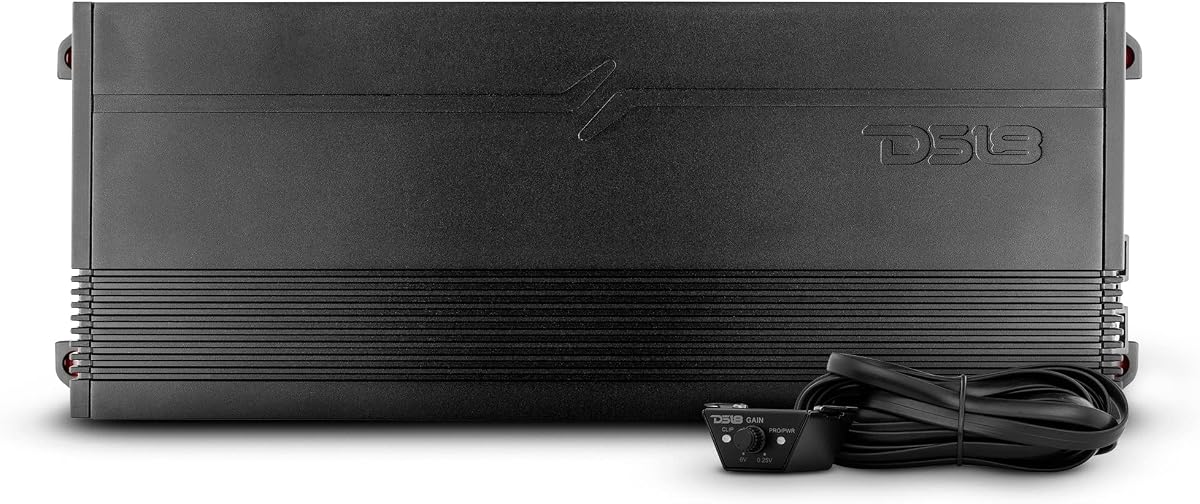
The DS18 SXE-4000.4D/RD is a 4.3-rated, four-channel Class D amplifier with a 4000-watt maximum power figure. Its continuous ratings are more revealing: 275 watts per channel at four ohms, 430 watts per channel at two ohms, and 750 watts for two channels bridged at four ohms. Those figures let buyers compare real channel output against the maximum headline.
We may earn a commission when you buy through this link, at no additional cost to you.
A fully variable crossover, adjustable input sensitivity, and multi-channel design provide useful tuning and system flexibility. The amplifier is marketed for full-range vehicle audio, so it can serve as a front-and-rear amplifier where separate amplification is unnecessary. Its Class D power-transformer design is intended to reduce size compared with conventional amplifier technologies.
The compact emphasis makes the SXE-4000.4D/RD appealing for custom builds where every inch of mounting space matters. It is especially relevant to projects that need four channels of amplified output but do not require the one-ohm capability offered by some competing four-channel amplifiers.
Its limitation is that the supplied information does not state a one-ohm per-channel rating, so drivers with very low impedance should be checked against current manufacturer documentation. Its 4000-watt maximum claim also should not be confused with 4000 watts of continuous four-channel RMS power. Within those limits, it is a polished choice for a compact, fully amplified cabin.
The two-ohm, four-ohm, and bridged ratings provide a clear basis for speaker matching. This is more useful for planning than treating the 4000-watt maximum as the output of every channel.
Variable crossover and sensitivity controls support cleaner system division and gain matching. Those controls are useful when combining amplified door, rear, and other full-range speakers in one vehicle installation.
We may earn a commission when you buy through this link, at no additional cost to you.
The DS18 G4000.5D GEN-X is the highest-rated product in this guide at 4.6. It is a compact, five-channel Class D amplifier with 4000 watts of maximum system power. Stated output is 220 watts across four channels at two ohms, 130 watts across four channels at four ohms, and 420 watts for two channels bridged at four ohms.
We may earn a commission when you buy through this link, at no additional cost to you.
Its five-channel format can cover four full-range speakers plus a subwoofer or other mono driver. The amplifier is stable from two to four ohms, bridgeable, and equipped with high-pass and low-pass filtering. These features make it a broad option for complete-car audio where a five-channel layout is more convenient than separate amplifiers.
The included remote bass knob provides convenient level adjustment for different genres or listening situations. More importantly for installation, the enclosure measures only 12.8 by 4.72 by 1.96 inches. That slim profile can fit into spaces that cannot accommodate a large conventional monoblock, helping preserve trunk and seat functionality.
Although it earns the highest rating, its headline power is a maximum figure rather than continuous five-channel output. The stated four-ohm ratings are considerably more modest than the headline suggests. Even so, the combination of compactness, five channels, bridgeability, filters, and remote bass control makes the G4000.5D an attractive all-in-one solution for space-conscious builders.
The 12.8-inch-long chassis and shallow 1.96-inch depth make the amplifier easier to conceal. It can serve multiple speaker groups and a subwoofer while taking up less mounting space than a large monoblock.
The included remote bass knob makes level changes simple for the driver. An installer can choose a conservative maximum at the amplifier and then vary the listening level from the front of the vehicle.
We may earn a commission when you buy through this link, at no additional cost to you.
The right amplifier depends on more than a large wattage label. Channel count, continuous output, speaker impedance, crossover requirements, protection, wiring demands, and available installation space should guide the decision.
A maximum or peak wattage figure describes a headline output condition, while RMS describes continuous power in a relevant testing context. Some products in this roundup state 4000 watts maximum, others use 4000 watts peak, and the Taramps MD 4000.1 and DS 4000X4 present 4000 watts RMS. Comparing unlike claims can be misleading, so buyers should examine output per channel at the impedance of the intended speaker load. For example, the DS18 SXE-4000.4D/RD has a 4000-watt maximum figure but publishes 275 watts per channel at four ohms, which is the more useful number for system design.
A monoblock is primarily suited to powering a subwoofer, while a four-channel amplifier can support front and rear speakers. A five-channel model combines multiple full-range outputs with a mono section, reducing the need for separate amplification. The Pyle PLA2678 offers a more compact two-channel route, while the Rockville dB55 and DS18 G4000.5D provide integrated five-channel arrangements. Choose the topology that matches the number of driven speakers and the role each one plays. A complex build may still need a dedicated subwoofer amplifier even when the front and rear channels are handled together.
Impedance is part of the electrical load presented by the speakers, and every driver must be compatible with the amplifier’s minimum load. The Planet Audio AC4000.1D, PL4000.1D, and BOSS AR4000D are explicitly one-ohm stable, while the Taramps DS 4000X4 supports one-ohm channels. Other models have different constraints, such as the DS18 G4000.5D’s stated two-to-four-ohm stability. Parallel wiring can reduce the total impedance seen by an amplifier, so two nominal four-ohm speakers may become a two-ohm load. That combined load can be safe with some amplifiers and dangerous with others.
Crossover controls determine which frequencies reach each speaker. A variable low-pass filter is useful when a subwoofer should roll off above a chosen frequency, while a high-pass filter can remove deep bass from door or rear speakers so they handle their intended range more efficiently. The Planet Audio monoblocks and BOSS AR4000D include variable low-pass filters and subsonic controls. The Taramps MD 4000.1 offers exceptionally broad high-pass and low-pass ranges, while the Taramps DS 4000×4 uses fixed 90 Hz choices. More adjustment offers refinement, but simpler controls can make a clean installation easier.
Bass boost, bass equalization, subsonic filters, and remote level controls all shape low-frequency output, but they serve different purposes. A subsonic filter protects the driver from excessive excursion, while a low-pass crossover establishes the upper limit of the subwoofer’s range. Bass boost adds low-frequency energy and therefore increases amplifier demand. A remote bass knob provides convenient level control, as included with the Rockville dB55 and DS18 G4000.5D. The best starting point is low boost, properly set filters, and sufficient clean headroom rather than relying on excess boost to create an oversized bass effect.
Reliable high-output operation depends on thermal, voltage, short-circuit, and low-impedance protection. The Taramps MD 4000.1 lists all four categories and adds a Smart Cooler system, while the Rockville dB55 includes protection against overheating, voltage fluctuations, and short circuits. Class D efficiency can reduce heat generation, but adequate airflow and correct mounting remain important. Protection circuits are not a substitute for proper speaker impedance, conservative gain settings, correctly sized power cables, and correctly installed fuses. A high-current amplifier can overwhelm an inadequate vehicle electrical system even when its internal safeguards are functioning correctly.
High output is only usable when the vehicle can supply it. The Taramps DS 4000X4 specifies 1/0 AWG power cable, 11 AWG output wiring, 18 AWG remote cable, and a 160-amp circuit breaker or fuse. The Planet Audio PL4000.1D lists three 40-amp ATO blade fuses. These examples show why installation planning matters as much as amplifier selection. Longer battery runs increase voltage drop, and multiple high-output amplifiers may require a dedicated power distribution system. Verify the alternator, battery, chassis grounding point, cable length, and protection rating before finalizing the build.
The power claim says little about whether an amplifier will physically fit. The Planet Audio AC4000.1D measures 15 by 10 by 2.4 inches and weighs 11.2 pounds, while the Taramps MD 4000.1 is described as a digital monoblock without dimensions in the supplied information. The DS18 G4000.5D is notably compact at 12.8 by 4.72 by 1.96 inches. Measure the mounting area, account for connectors and airflow, and check whether access to the vehicle’s electrical system remains practical. A slightly smaller amplifier can also be easier to secure and service.
Before installation, identify the amplifier’s minimum supported impedance, read the manual, and confirm that every speaker wiring plan remains within that limit. Mount the unit in a dry, ventilated location away from water and moving parts, and use the specified power, remote, signal, and speaker cables. Secure every connection, install the proper fuse close to the battery or distribution point, and check the vehicle’s grounding point for clean metal contact.
Set crossover controls before adding significant boost. Begin with a conservative low-pass frequency for a subwoofer, use the high-pass filter to protect full-range speakers from frequencies they cannot reproduce, and set input gain through the source unit’s clean output range. The remote bass control, if included, should be set to its minimum while gain and filters are established. Turn the system on at low volume and listen for clipping, distortion, instability, or unusual heat before increasing output.
For ongoing care, inspect connections periodically for corrosion, looseness, heat discoloration, or damaged insulation. Keep the amplifier’s heat-sink and fan paths clear of luggage, carpet, tools, and storage cases. Listen for rattles, loose speaker connectors, or a sudden change in output, and avoid repeatedly clipping the amplifier at maximum volume. If a protection system activates, correct the underlying cause instead of immediately increasing gain or reducing the speaker load.
No. Speaker power ratings and amplifier output are related, but they do not need to match exactly. A capable subwoofer with a lower RMS rating can work with a higher-output amplifier, although the amplifier’s high-current capability remains useful. Match the subwoofer’s impedance, power handling, and preferred crossover range to the amplifier rather than relying only on wattage.
An RMS claim generally gives a clearer indication of continuous output than a peak or maximum claim. However, the figures still need to be compared at the same impedance and channel configuration. For example, 4000 watts maximum across an amplifier may represent a different operating condition from 4000 watts RMS, and multi-channel models may never deliver the full headline figure to every channel simultaneously.
Only when their model and wiring configuration support the intended arrangement. The Planet Audio AC4000.1D and PL4000.1D, along with the BOSS AR4000D, are described as strapping capable. Some multichannel amplifiers can be bridged in pairs instead. The manual must be followed exactly, and both units should normally be the same model with compatible revisions.
One-ohm stability means the amplifier can support a one-ohm load, but it does not mean every speaker combination is safe. The final load must remain at or above the amplifier’s specified minimum. Remember that parallel wiring can lower impedance, and multiple channels share the power supply, so a nominally two-ohm combination may create a one-ohm load.
It is highly useful, especially when the subwoofer cannot safely reproduce very low frequencies. A subsonic filter removes content below the driver’s recommended operating range, helping reduce excessive cone excursion. Its cutoff should be set according to the subwoofer manufacturer’s specifications rather than chosen solely by ear.
It depends on the architecture and model. Full-size monoblocks may be around 14 to 15 inches long, while compact multichannel units can be shorter or shallower. The DS18 G4000.5D, for example, is listed at 12.8 by 4.72 by 1.96 inches. Measure the available area and include clearance for cables, heat dissipation, and future service access.
It can power a subwoofer if the subwoofer’s impedance and power requirements are compatible, usually through a bridged channel pair or another amplifier. Bridging increases the available power for that pair but does not change the underlying speaker impedance. For a dedicated high-current subwoofer, a purpose-built monoblock may be easier to power and configure.
Use the cable gauge specified by the amplifier manufacturer, along with proper fuse or breaker protection. The Taramps DS 4000X4, for example, lists 1/0 AWG power cable, 11 AWG output cable, and 160-amp protection. Cable length matters because long runs can create voltage drop, and the chassis connection should be clean, bare, and securely fastened.
The Planet Audio AC4000.1D stands out as the most versatile subwoofer-focused choice, combining one-ohm stability, strapping capability, variable bass boost, a subsonic filter, and an adjustable low-pass crossover. The Taramps MD 4000.1 is the premium option for installers who prioritize RMS output, broad crossover range, smart cooling, and detailed protection, while the Planet Audio PL4000.1D delivers the strongest value-oriented monoblock feature set.
For broader vehicle systems, the architecture matters more than the headline wattage. The Rockville dB55 and DS18 G4000.5D serve as integrated five-channel solutions, while the Taramps DS 4000×4 and DS18 SXE-4000.4D/RD favor multichannel full-range builds. Prioritize continuous output at the correct impedance, crossover flexibility, protection, and the physical demands of the wiring before making a final choice.
Product details, ratings, availability, and pricing can change, so readers should check the current listing and manufacturer documentation before ordering. Confirm impedance compatibility, fuse ratings, mounting space, crossover settings, and all required cables. With those details aligned, a 4000 watt car amp can become the controlled, reliable foundation of a stronger vehicle audio system.