
Cable Matters Premium XLR Cable 2-Pack
4.8Editor score
Oxygen-free copper conductors
Copper braided shielding
Heavy-duty metal connectors
Discover the best durable XLR cables for studio and live use, with expert comparisons of shielding, connectors, length, flexibility, and build quality.
A durable XLR cable should preserve a clean microphone signal while surviving repeated handling, cable coils, crowded stages, and the accidental pulls that come with live audio work. Connector strength, shielding, jacket construction, conductor quality, and flexibility all influence how reliably a cable performs over time.
We compared ten balanced microphone cables spanning six-foot studio leads, twenty-five-foot stage cables, extended runs, and multipack options. The evaluation considers the supplied construction details, connector design, signal characteristics, environmental resistance, and the needs of home studios, rehearsal spaces, venues, and touring users.
Each pick reveals where it is strongest: the Cable Matters bundle offers practical versatility, Mogami models target demanding signal paths, and several heavy-duty designs prioritize secure connections and easy maintenance. Product ratings and availability can change, so readers should confirm current listing details and prices before purchasing.
4.8Editor score

4.8Editor score

4.7Editor score
This side-by-side comparison evaluates all ten cables by their stated construction, connector approach, cable length, shielding, and intended use, helping readers distinguish compact studio leads from rugged stage and extended-run options.


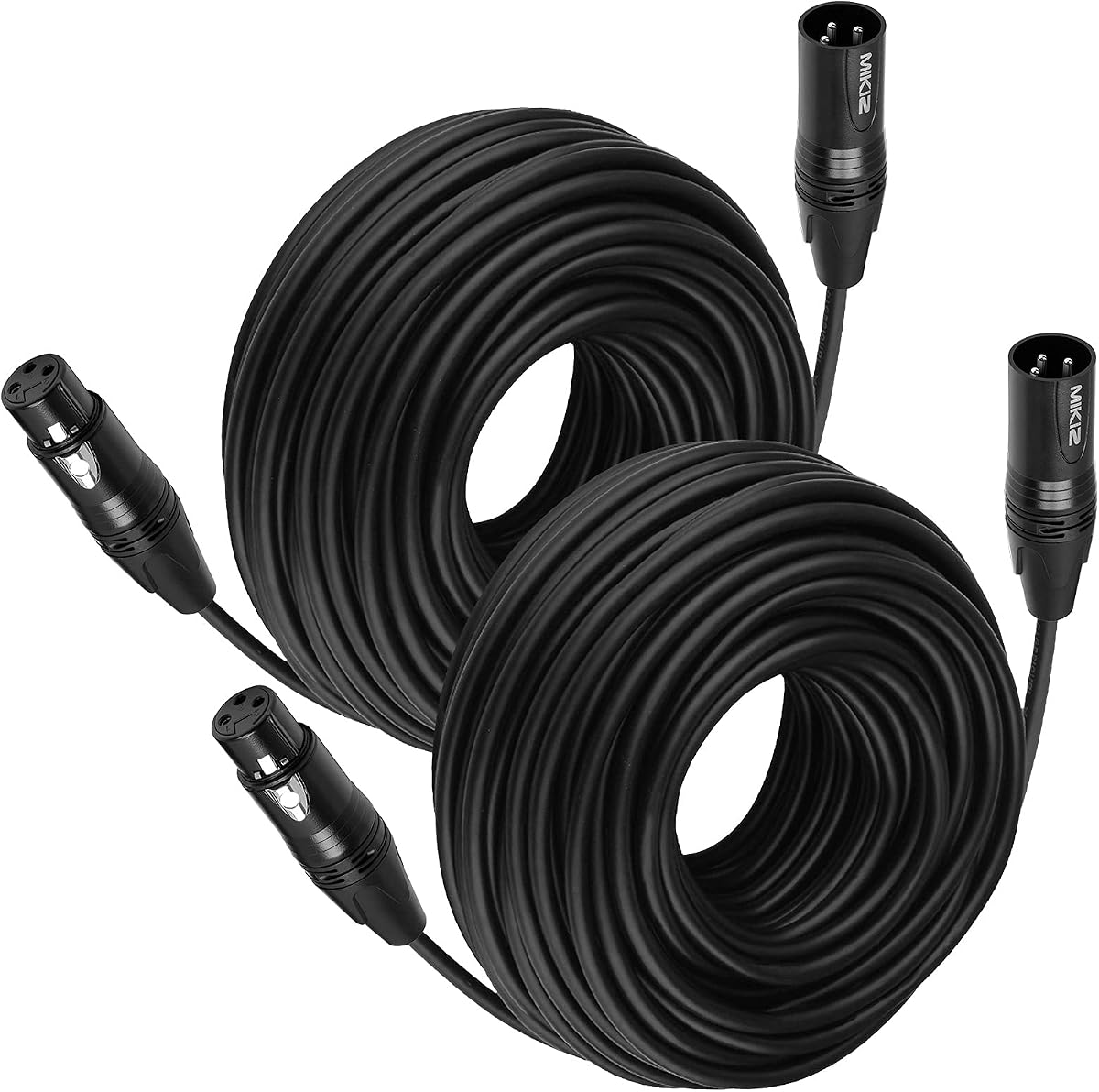


The Cable Matters Premium XLR 2-Pack carries a 4.8 rating and combines a six-foot male-to-female configuration with 21 AWG oxygen-free copper conductors. Its strongest qualities are practical shielding, heavy-duty metal connectors, molded strain relief, and a balanced design intended to limit interference while carrying microphone signals.
We may earn a commission when you buy through this link, at no additional cost to you.
The cable uses copper braided shielding to reduce noise pickup, while the soft PVC jacket is intended to balance protection with manageable handling. The two-pack format gives a user a primary cable and a spare or second connection without requiring two separate product listings. Compatibility with microphones, mixers, preamps, speakers, and lighting equipment makes it broadly useful.
The main limitation is its six-foot length. That makes the set less convenient for microphones positioned well away from a mixer or for larger stages where a twenty-five-foot or longer run is needed. It also provides only one spare for a two-cable setup, although that is a meaningful advantage over buying individual leads separately.
This is a strong recommendation for home studios, podcast desks, rehearsal rooms, and compact live setups. Users wanting an inexpensive two-pack that balances detailed construction with useful shielding and sturdy connectors will find it especially practical.
The balanced conductor arrangement and copper braided shielding are designed to reduce hum, electromagnetic pickup, and other interference. Together with the oxygen-free copper core, these features support clean microphone transmission in homes, studios, and moderately busy performance spaces.
Heavy-duty metal connectors and molded strain relief protect the points where cables typically experience the most stress. The soft PVC jacket also remains easier to handle and route than a rigid cable, making the set convenient for repeated setup and teardown.
We may earn a commission when you buy through this link, at no additional cost to you.
The Pig Hog XLR 25 Foot 2 Pack has a 4.8 rating and offers a straightforward pair of male-to-female microphone cables. Its defining advantage is the combination of a stage-friendly twenty-five-foot length and two cables in one package, which suits users who want flexibility without managing several individual purchases.
We may earn a commission when you buy through this link, at no additional cost to you.
Tour-grade positioning suggests the cables are intended for repeated live use rather than only permanent studio installations. The 4.8 rating indicates strong user satisfaction, although the supplied listing information is limited and does not break down the shielding, conductor gauge, connector alloy, or jacket material.
Because the product data provides fewer technical details than several competing options, buyers cannot compare this model line by line in terms of capacitance or shielding construction. Prospective owners should inspect the current listing closely for details such as connector retention, jacket composition, and warranty coverage.
It is best suited to musicians and small production teams who need two matching twenty-five-foot runs for rehearsal, small stages, or studio sessions. The multipack format and practical length may make it especially convenient for backup and quick-change setups.
Twenty-five feet offers enough reach for many microphones and stage positions without approaching the unwieldy length of a long extension. It is a versatile length for vocals, stage instruments, and room microphones placed at moderate distances from a mixer.
Keeping a matching second cable on hand makes it easier to replace a failed lead, route separate channels, or maintain a ready backup. That convenience is particularly valuable during live events where troubleshooting time is limited.
We may earn a commission when you buy through this link, at no additional cost to you.
The Mogami Gold Studio 03 receives a 4.8 rating and is built around Mogami Neglex Quad conductors, ultra-flexible XLPE insulation, and gold-plated contacts. Its three-foot length makes it best as a compact studio patch cable rather than a long microphone run.
We may earn a commission when you buy through this link, at no additional cost to you.
The quad conductor design is presented as providing up to 30 dB better noise rejection than twisted-pair cables. A spiral bare-copper shield further reduces RF and electromagnetic interference, while gold-plated contacts support dependable signal flow and resist corrosion.
Its most obvious trade-off is reach. A three-foot cable cannot serve a distant stage microphone or a widely spaced pair of studio monitors without additional routing. Buyers focused on durability should also recognize that flexibility and long-term physical resilience represent different qualities, even when both are desirable.
This cable is an excellent choice for patch bays, close-mic studio connections, preamp routing, and desktop recording systems in electrically busy environments. Its lifetime warranty and detailed low-noise construction make it particularly compelling for users who want a short but serious interconnect.
The Neglex Quad arrangement is designed to suppress interference while supporting detailed audio transmission. Its stated noise-rejection advantage makes it well suited to studios where hum, RF, and adjacent electronic equipment can affect otherwise clean microphone signals.
Ultra-flexible XLPE insulation makes a three-foot cable easier to route around desks and rack panels. Gold-plated contacts and a bare-copper spiral shield provide the type of construction commonly sought in critical recording paths.
We may earn a commission when you buy through this link, at no additional cost to you.
The Bietrun Heavy-Duty XLR 2-Pack has a 4.8 rating and distinguishes itself with one-hundred-foot cables, alloy connector housings, and a metal spring strain-relief design. It is a strong option for large rooms, outdoor stages, rehearsal spaces, and installations where standard leads do not reach.
We may earn a commission when you buy through this link, at no additional cost to you.
Its conductor and shielding system combines oxygen-free copper with cotton, copper, carbon-fiber, PE coating, and a six-millimeter TPE jacket. The listing claims effective shielding against a large majority of clutter and static signals, while the self-locking connector design helps resist accidental disconnection during movement.
The main challenge is handling two extremely long cables. Long runs need careful coiling and routing to avoid trip hazards and tangles, and they may be unnecessary for desk-based studios. The supplied information also presents the connector color as a means of identification, with included hook-and-loop ties intended to help organize each lead.
This is the recommendation for users who prioritize reach, secure connections, and physically robust accessories over compact convenience. It can cover microphones, mixers, speakers, preamps, patch bays, and lighting equipment with three-pin XLR interfaces, giving it unusually broad utility.
A one-hundred-foot run can connect a microphone in a large hall, rehearsal room, or outdoor performance area to a distant mixer. The two-pack provides matching options for multiple inputs or a ready spare when one long run is already in use.
The self-locking connector and metal spring relief address two common weak points: accidental unplugging and stress at the plug-to-cable transition. Alloy housings and copper pins add mechanical strength for regular plugging, unplugging, and mobile use.
We may earn a commission when you buy through this link, at no additional cost to you.
The Gearlux Balanced XLR 2-Pack carries a 4.8 rating and combines twenty-five-foot male-to-female cables with oxygen-free copper cores, copper braided shielding, and metal connectors. It is a versatile choice for users who want one cable design to cover both studio recording and live performance.
We may earn a commission when you buy through this link, at no additional cost to you.
The fully balanced construction is intended to support consistent signal quality and reduced interference. Its flexible PVC jacket is designed to withstand regular use without becoming difficult to route, while rugged metal connectors provide a dependable mechanical connection at each equipment end.
Compared with specialized models, this cable does not emphasize one unusual feature. It instead focuses on familiar professional qualities: balanced transmission, shielding, flexible handling, and substantial connector housings. As with any long cable, avoiding tight bends and repeated pulling at the connector is important for preserving its useful life.
This set is recommended for singers, podcasters, bands, and small production rooms that need two dependable twenty-five-foot cables. It is also a sensible choice for connecting microphones to mixers, preamps, and compatible speaker or stage-lighting equipment.
Oxygen-free copper cores and a braided copper shield support low-interference signal transfer. The balanced format is especially useful when nearby lighting, power systems, or other electronic equipment could introduce noise into an unbalanced connection.
A durable yet flexible PVC jacket makes the cable easier to move around a studio desk or stage box. That handling advantage allows users to route it more naturally without sacrificing the construction expected from a working microphone cable.
We may earn a commission when you buy through this link, at no additional cost to you.
The AuxLink XLR Microphone 2-Pack earns a 4.8 rating and provides twenty-five-foot balanced cables with 24 AWG all-copper conductors and 120-plus-ohm impedance. It is a detailed option for performers who want clear signal transmission, secure connections, and a jacket designed to resist everyday deterioration.
We may earn a commission when you buy through this link, at no additional cost to you.
The cable uses both foil shielding and an inner copper spiral shield to keep conductors away from electromagnetic and RF interference. Zinc-alloy housings, silver-plated copper pins, and self-locking male-to-female connectors are intended to stabilize the connection while equipment is moved.
The elastic PVC jacket is described as resistant to cracking, abrasion, oil, and dirt, while also avoiding knots during handling. One small point of ambiguity is that the listing says the package contains two twenty-five-foot cables but notes a true length of twenty-six feet, so buyers should check the final dimensions.
This set is well suited to stage speakers, club stages, karaoke rooms, home theaters, home studios, and patch-bay routing. It is particularly attractive for users who value a detailed materials description, two-year after-sale service, and secure connectors over a shorter patch-style cable.
Foil shielding provides broad coverage, while the copper spiral shield adds another conductive barrier around the conductors. Together, they are designed to reduce interference in environments containing powered equipment and substantial electromagnetic activity.
The high-elasticity PVC is described as resistant to abrasion, cracking, oil, and dirt. Those properties make the cable easier to maintain after repeated transport, storage, and handling in rehearsal rooms or live venues.
We may earn a commission when you buy through this link, at no additional cost to you.
The MIKIZ Long XLR 2-Pack has a 4.8 rating and uses fifty-foot cables built around 22 AWG balanced conductors. It is a sensible middle ground between conventional twenty-five-foot stage leads and very long cables intended for large installations.
We may earn a commission when you buy through this link, at no additional cost to you.
Dual shielding combines aluminum foil with braided copper strands to resist EMI and RFI. Tinned oxygen-free copper wire is used to optimize signal transmission and resist oxidation under humid conditions, while silver-plated contacts support consistent electrical contact.
The screw-type connector design offers a serviceable feature because users can unscrew the connector to inspect solder points if needed. On the other hand, fifty-foot cables can be cumbersome in compact rooms and should be routed safely to avoid trips, strain, or repeated sharp bends.
This pair is a good choice for larger rehearsal rooms, small stages, studio control rooms, and installations requiring extended reach. The two-pack provides either separate runs or a backup option for one of the longer cables.
Fifty feet accommodates microphones placed farther from a mixer while remaining more compact than a one-hundred-foot lead. It is a practical middle ground for medium-sized rooms and stages.
Silver-plated contacts are intended to provide reliable contact and resist tarnish. Screw-type housings can also be opened for inspection, which may be useful for technicians who maintain and repair cables.
We may earn a commission when you buy through this link, at no additional cost to you.
The Mogami Gold Stage XLR has a 4.7 rating and emphasizes touring durability, high-fidelity signal transfer, and dependable performance in demanding conditions. Its 105-strand core, full-coverage braided shielding, and low-capacitance design distinguish it as a premium cable for serious stage and studio work.
We may earn a commission when you buy through this link, at no additional cost to you.
Road-ready construction is central to the design. The cable is described as ultra-flexible and able to withstand daily stage, broadcast, or touring abuse without losing performance. It remains flexible in temperatures as low as minus twenty degrees Celsius, an important consideration for outdoor or cold-weather use.
The tradeoff is the premium positioning of the product and a twenty-foot length that may be insufficient for some stages. Flexible does not mean immune to damage, so users should still use proper strain relief, avoid sharp kinks, and avoid carrying a cable by its connector.
This cable is recommended for working performers, touring engineers, broadcasters, and studio professionals who need a road-ready lead with low capacitance and strong interference protection. The lifetime warranty adds reassurance for users seeking a long-term professional investment.
The flexible 105-strand core and rugged construction are designed for repeated transport and stage use. Low-temperature flexibility makes the cable easier to deploy in cold conditions without approaching the stiffness associated with less adaptable designs.
Low capacitance helps the cable maintain clear signal behavior over a useful run. Full-coverage braided shielding adds protection from electromagnetic interference in busy stages and broadcast environments.
We may earn a commission when you buy through this link, at no additional cost to you.
The Monoprice Stage Right XLR receives a 4.7 rating and emphasizes heavy-gauge wiring, balanced signal transfer, gold-plated contacts, and sturdy connector housings. Its twenty-five-foot length aligns well with standard live and studio microphone placement.
We may earn a commission when you buy through this link, at no additional cost to you.
The 16 AWG conductor specification gives this cable a notably substantial build. A separate braided shield is included to add resistance to interference without allowing that interference to modulate the audio signal, while balanced impedance helps reduce electromagnetic and RF noise and prevent ground-loop issues.
One ambiguity in the supplied information is a connector-type line that does not match the XLR product title. Buyers should therefore verify the connector format, cable length, and physical details in the current listing before ordering. The jacket material and detailed capacitance figures are also not provided.
This cable is a good candidate for permanent studio wiring, stage runs, and users who favor heavy-gauge construction. Its lifetime cable warranty provides added support for buyers seeking long-term reliability.
The 16 AWG specification distinguishes this model from cables built with lighter conductors. A heavier gauge can suit users who want a substantial cable that remains practical at a conventional stage length.
Balanced impedance and a separate braided shield help reduce electromagnetic and RF interference. Together, they are intended to protect microphone signals in environments where hum and ground-loop problems are common.
We may earn a commission when you buy through this link, at no additional cost to you.
The Roland Black Series Heavy-Duty XLR cable has a 4.6 rating and combines twenty-five-foot length, heavy-duty connectors, low capacitance, and an ultra-flexible jacket. It is a recognizable performance-oriented option for users who value easy routing and balanced microphone transmission.
We may earn a commission when you buy through this link, at no additional cost to you.
Its low-capacitance design is intended to preserve full frequency reproduction and maximum dynamic response. The balanced configuration supports dependable signal flow, while the ultra-flexible jacket is designed to reduce tangling during storage, transport, and repeated setup.
Compared with multipack alternatives, this listing represents one cable, so users who want redundancy will need to purchase more than one. Its rating is also slightly lower than the leading group, although that difference should be considered alongside the supplied design details rather than treated as a complete measure of performance.
This cable is well matched to musicians, mobile performers, and studio users who prefer a flexible twenty-five-foot lead. It is also a logical choice for anyone who values the broader availability of other lengths in the Black Series range.
The stated low-capacitance design supports accurate frequency reproduction and responsive dynamics. Balanced XLR wiring also suits professional microphone and interconnect applications where signal consistency matters.
An ultra-flexible jacket resists tangling and is easier to loop, coil, and connect than a rigid cable. This makes the model useful for performers who repeatedly pack and unpack their equipment.
We may earn a commission when you buy through this link, at no additional cost to you.
The right durable XLR cable depends on the signal path, physical environment, required length, and how often it will be moved. Comparing connector construction, shielding, conductor design, jacket flexibility, and warranty support helps narrow the field before purchase.
Choose a length that reaches the microphone or connected device without leaving excess cable exposed to feet, stage traffic, or snagging. Six-foot cables suit compact desks and close studio positions, twenty-five-foot leads cover most stage and rehearsal layouts, and fifty- or one-hundred-foot runs suit larger rooms and distant equipment. Long cables require secure routing and careful coils to avoid creating trip hazards.
In short, measure the actual connection path before choosing a length, including the distance needed to leave a relaxed service loop.
The connector is one of the most visible failure points on a microphone cable. Metal housings resist impact better than lightweight plastic, while molded or spring-style strain relief reduces stress where the cable enters the plug. Self-locking designs are useful in movement-heavy environments because they resist accidental disconnection. Some service-oriented connectors also use screws that allow inspection of the solder points.
Prioritize solid housings and flexible strain relief, and check whether a locking mechanism suits your setup.
Balanced XLR wiring already helps reject interference, but shielding provides another layer of protection. Braided copper, aluminum foil, spiral copper, and combinations of these materials are common approaches. More shielding layers are not automatically better in every situation, but they can be useful near lighting rigs, power systems, digital equipment, and long cable paths where hum or RF pickup is likely.
Look for balanced conductors and a continuous shield that reaches the connector, especially in electrically noisy live environments.
Conductor gauge affects the physical and electrical character of a cable. Heavier 16 AWG wiring can feel substantial and may suit users seeking a robust stage lead, while 21, 22, 24, and similar gauges can provide a lighter balance for mobile work. Low-capacitance and quad-conductor designs focus on preserving clean, high-definition audio signals. The best gauge depends partly on length, portability, and signal-path demands.
Match conductor design to the signal path rather than assuming a larger gauge is always more appropriate for every application.
A durable jacket should resist cracking, abrasion, oil, dirt, and repeated bending while remaining flexible enough to route easily. TPE, high-elasticity PVC, PE coatings, and braided fabrics offer different handling characteristics. Ultra-flexible cables are particularly useful for performers, while easier-to-clean PE finishes can benefit busy venues. Ultra-flexible models can remain usable in cold conditions where stiffer jackets may be difficult to handle.
Balance toughness with handling, because a cable that resists damage but resists bending can still be frustrating to deploy.
Studio cables are usually protected from weather, but live cables may encounter temperature changes, moisture, dust, and crowded stage conditions. Cold-rated flexibility is valuable for touring and outdoor use. Cleanable jackets are useful in venues where cables contact floors or cases. None of these features eliminates the need for sensible storage, but they can reduce the stress caused by everyday environmental exposure.
For touring or outdoor work, favor flexible cold-weather jackets, robust connectors, and easily cleaned outer surfaces.
A multipack can be more useful than a single cable because it provides a ready backup and allows multiple matching connections. Two six-foot cables suit a small desktop or podcast setup, while two twenty-five-foot cables cover a compact stage or two-channel recording session. Longer multipacks are useful for large rooms but demand more storage and routing discipline. Single-cable purchases make sense when a specific color, length, or system standard matters more than redundancy.
Decide whether convenience and spare capacity or a precise individual configuration matters most for your setup.
Long-term warranty coverage can add confidence, especially for cables intended to remain in service for years. Mogami and Monoprice products described in the supplied data include lifetime coverage, while AuxLink lists a two-year after-sale service period. Warranty terms should be checked on the current listing because policies and product availability can change. A good warranty does not replace careful handling, but it can complement quality construction.
Review the stated coverage and retain purchase documentation, particularly for professional equipment that remains in service for many years.
Before connecting a cable, inspect both XLR ends for bent pins, trapped dirt, damaged strain relief, or a jacket that has been sharply creased. Connect the cable to compatible three-pin XLR equipment while the connector is straight, and avoid forcing a male plug into a socket whose orientation or pin count does not match. Leaving a little slack near each connector reduces leverage if the cable is moved.
Route cables away from foot traffic, sharp edges, hot lighting fixtures, and equipment that can pinch them. For stage use, secure long runs with appropriate cable ramps or ties, but avoid wrapping ties so tightly that the jacket deforms. When coiling, use loose, consistent loops and secure the cable without crushing its connectors. A slow-release hook-and-loop tie can keep a cable organized without creating a permanent sharp bend.
After use, wipe dirty or damp jackets with a suitable damp cloth and dry the cable before storage. Do not pull a cable from a device by the cable itself; unplug it by the connector housing. Store long cables loosely rather than creating small, tight coils, and periodically inspect connectors that are used often. Proper care will not prevent every failure, but it reduces avoidable damage and preserves signal reliability.
Durability depends on the jacket, conductors, connector housings, and strain-relief design working together. A flexible outer jacket resists cracking, while strong metal connectors tolerate repeated plugging and impact. Effective strain relief protects the vulnerable point where the cable enters the plug. Shielding and conductor quality also contribute indirectly by supporting consistent performance in demanding electrical environments.
Length alone does not determine sound quality; cable construction matters just as much. A properly shielded, low-capacitance cable can carry a clean balanced signal over a long distance. Lower-quality cables may be more vulnerable to interference, poor connections, or signal loss. For long runs, select a reputable balanced cable, maintain secure connections, and avoid unnecessary sharp bends.
A twenty-five-foot cable is a common starting point because it reaches many stage positions without excessive excess. Larger stages may require fifty feet or longer, while compact rehearsal spaces may work with shorter leads. Measure from the microphone to the mixer and add enough service slack to prevent tension during movement.
Most microphone cables connect a male XLR plug on the microphone side to a female socket on a mixer, preamp, or interface. Some microphones and devices use female outputs, while others use male connectors, so check the equipment before buying. The ten products reviewed here are presented as male-to-female microphone leads.
Store long cables in loose, consistent loops rather than tight coils. Keep connectors straight and avoid placing heavy objects on the cable or its ends. Velcro ties can organize a loop without pinching the jacket, and a protective bag or case helps prevent tangles and contamination during transport.
Braided shielding provides flexible, continuous coverage and is often valued in stage cables, while foil shielding offers broad coverage with good high-frequency resistance. Some cables combine both. The best choice is a continuous shield with a flexible jacket and dependable connector grounding, particularly where lighting, power systems, or digital equipment may introduce interference.
Only when the equipment specifically uses a compatible three-pin XLR connection and the electrical requirements match the cable. XLR microphone cables are commonly used with microphones, mixers, preamps, patch bays, and some speaker or lighting systems, but they are not universal power cables or general-purpose speaker wiring. Check both device specifications before connecting them.
Inspect the pins for bends, looseness, discoloration, or debris, and look for cracks around the strain relief or jacket. Intermittent noise, hum, crackling, or a connection that only works when held at an angle can indicate a faulty cable. A healthy lead should connect firmly without requiring the plug to remain at an unusual angle.
The Cable Matters Premium XLR 2-Pack stands out as a practical all-around choice, especially for compact studios and users who want balanced construction, shielding, sturdy connectors, and a spare in one package. The Bietrun Heavy-Duty XLR 2-Pack takes the lead for extended reach, self-locking connections, and highly robust construction, while the Mogami Gold Stage XLR is the premium selection for touring durability and professional signal behavior.
Prioritize the features that match actual use rather than construction claims in isolation. Short patch applications benefit from compact flexibility, conventional stages often suit twenty-five-foot leads, and large spaces require secure, correctly routed long runs. Connector strength, continuous shielding, jacket resilience, and a sensible length will usually matter more to long-term satisfaction than having only one cable in the package.
Ratings, product details, and prices can change, so check the current listing before buying. Confirm the connector orientation, exact length, compatible equipment, warranty terms, and any included accessories, then choose the cable that best matches your signal path and handling conditions.