TroyStudio Portable Vocal Booth
4.3Editor score
Five dense foam panels
Portable foldable construction
Desk and stand compatibility
Quick one-minute assembly
This Isolation Box for Microphone guide compares ten models for sound control, portability, stability, microphone fit, and recording setup.
An isolation box for microphone creates a controlled recording area around your mic, helping reduce room reflections, echoes, and distracting ambient sound. The best models combine dense acoustic material, a stable enclosure, practical dimensions, and a mounting system that suits your voice, instruments, and workspace.
This guide compares ten microphone isolation shields and vocal booths using their published specifications, included features, dimensions, weight, compatibility, and customer ratings. It covers foldable panels, enclosed boxes, desktop designs, tripod-supported systems, and larger home-studio booths for podcasting, voice-over, vocals, and instruments.
Each review explains where a product is strongest, which recording tasks it suits, and what trade-offs to consider. The selections also show that the highest-rated model is not automatically the right choice for every setup. Product availability and pricing can change, so confirm current specifications and offers before purchasing.
4.3Editor score
4.6Editor score

4.5Editor score
The comparison below highlights the major differences among ten isolation boxes, including enclosure style, acoustic construction, portability, and microphone support. Foldable desktop shields offer flexibility, while rigid booths and tripod-mounted systems provide more structure for dedicated recording spaces.



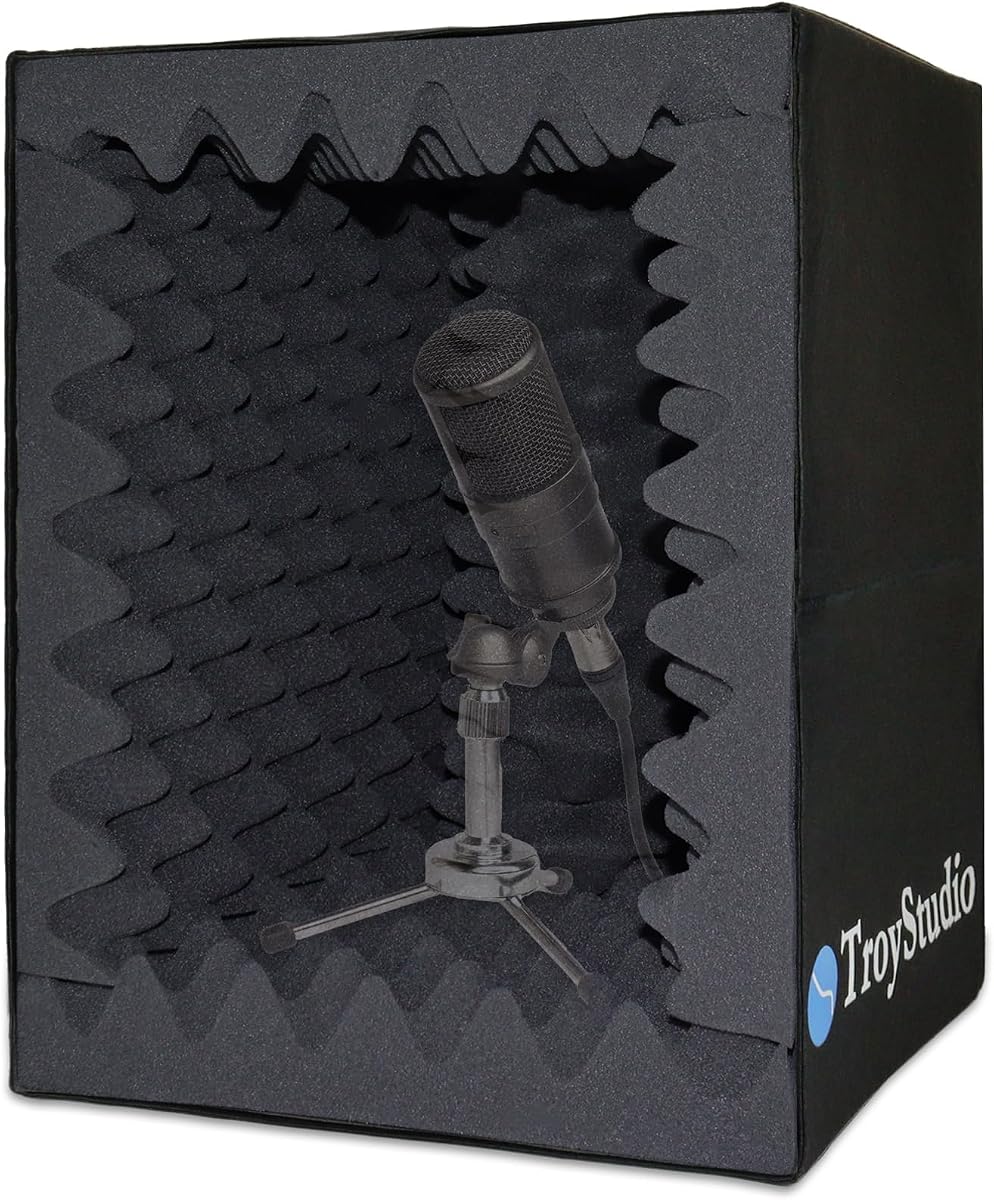
The TroyStudio Portable Vocal Booth is a lightweight, foldable enclosure designed to put a controlled acoustic surface around a microphone. It has a 4.3 customer rating and stands out for its generous use of dense foam, compact packed size, and ability to work on a desk or with a compatible microphone stand. Its inside dimensions provide space for several common recording devices without turning the booth into a large permanent fixture.
We may earn a commission when you buy through this link, at no additional cost to you.
Five pieces of two-inch-thick high-density egg-crate foam cover the interior surfaces. According to the product information, this treatment is intended to reduce echoes, reflections, and ambient noise, helping a direct vocal recording sound drier and more focused. Cable and microphone-stand holes make the enclosure practical for real sessions, while the supported applications extend from podcasting and voice-over to vocals, instruments, and percussion.
The main trade-off is that this is a folding panel system rather than a rigid full box. It must be assembled correctly to remain stable, and its specified stand compatibility is limited to poles with diameters below 0.86 inches. It also does not include a stand, pop filter, or a mount for a tablet. Those omissions matter, but they also help explain why the design remains compact and easy to move between a home studio, office, or temporary recording location.
This is the most sensible choice for budget-conscious vocalists, podcasters, and streamers who want more control over reflections than a basic desktop reflector offers. It is particularly useful when portability matters as much as isolation. If your recording space is permanent, a rigid enclosure may feel more substantial, but for travel, apartment recording, and quick setup, this TroyStudio booth offers a practical balance of size, weight, and acoustic coverage.
The five foam sections create an acoustically treated inner surface while the folding frame keeps the packed unit only six inches deep. That balance makes the booth easier to carry than a rigid cabinet without abandoning meaningful reflection control.
Cable openings, stand holes, and a choice of table or stand placement let the same enclosure support voice-over sessions at a desk, podcast recordings in an office, or larger vocal and instrument takes in a small studio.
We may earn a commission when you buy through this link, at no additional cost to you.
The TONOR Microphone Isolation Shield is a full vocal-booth structure that combines a box enclosure with a freestanding tripod. It carries a 4.5 customer rating, and its strongest appeal is the integrated stand. Unlike a basic reflection filter that must sit on a separate support, this product provides a complete recording package with height adjustment, a microphone holder, and a useful tray.
We may earn a commission when you buy through this link, at no additional cost to you.
The booth uses five high-density foam and sound-absorbing panel boards. The stated design is intended to reduce echoes, reflections, and ambient noise, with the manufacturer reporting that it prevents 96% of indoor reverb. Hardened plastic frames reinforce the front and back, while the wide steel tripod gives the tall assembly a more stable base. The telescopic pole adjusts from 51.2 to 74.8 inches, accommodating both seated and standing recording positions.
The interior measures 12 by 13.6 by 16.7 inches, creating useful room for larger condenser microphones and related equipment. The same pole can serve as a tray for a phone or tablet, which is particularly helpful for reading scripts or monitoring lyrics. A 3/8-to-5/8-inch adapter supports most common microphones, and the listed maximum microphone weight is 4.4 pounds. The trade-offs are size and setup complexity: it takes about five minutes to install and occupies more floor space than a foldable desktop shield.
Choose the TONOR booth if you want one integrated system for seated podcasting, standing vocals, voice-over work, or instrument recording. It is less suitable for a cramped desk where a flat folding shield would be easier to manage. Even so, the combination of a stable tripod, generous interior, adjustable height, and device tray makes it one of the most complete options in this guide.
The telescoping pole and heavy-duty tripod let the same system move between a seated desk-height session and a standing performance. A wide base and reinforced booth frame also reduce the likelihood of the small movement that can disturb a recording.
The integrated tray provides a convenient place for a phone, tablet, or reference material. That turns the enclosure into a practical recording workstation rather than simply an acoustic accessory.
We may earn a commission when you buy through this link, at no additional cost to you.
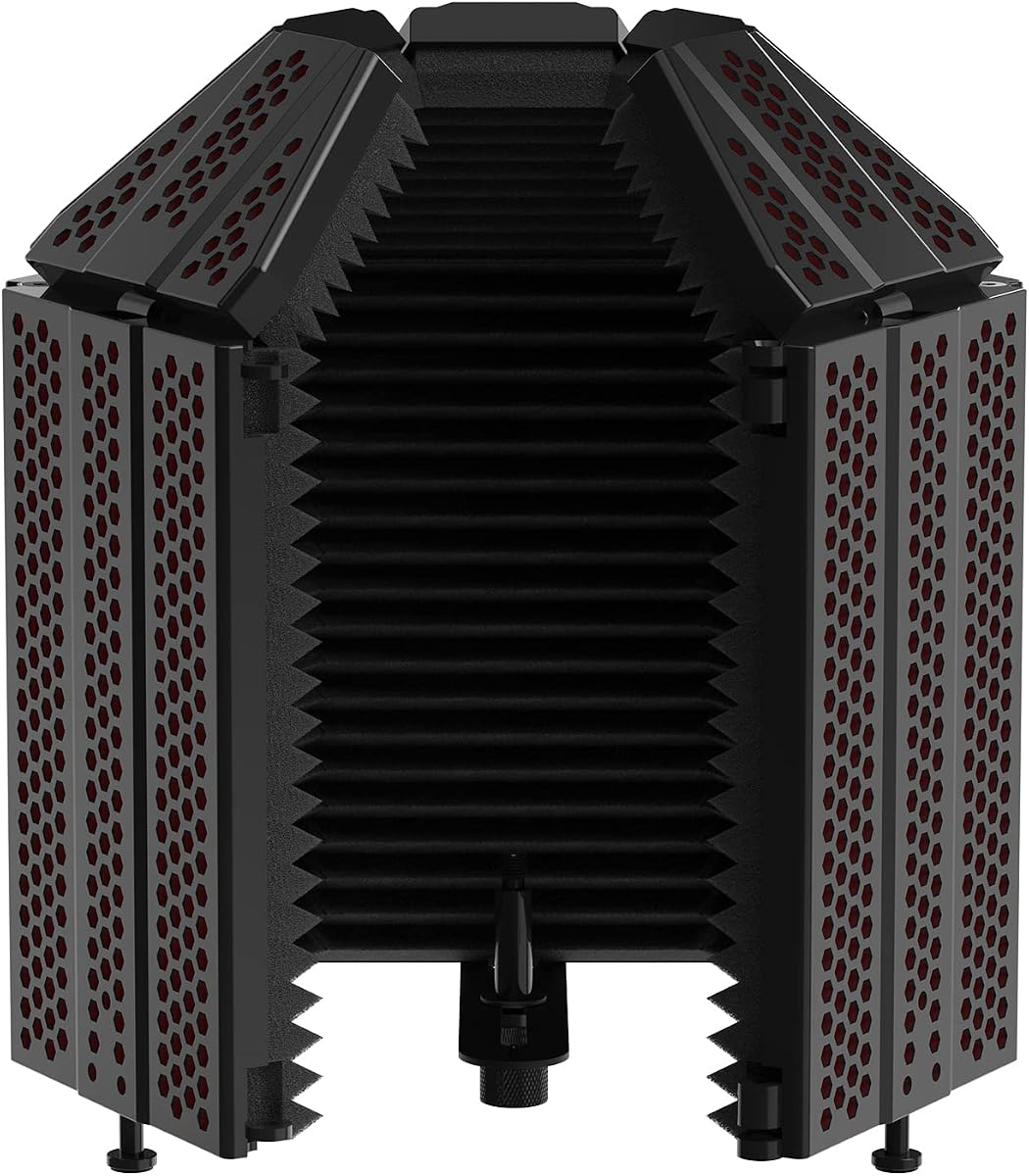
The AURAY ISO-Armor-2 takes a different approach from the larger vocal booths in this roundup. It is a compact, deep microphone chamber built around a perforated aluminum shell, high-density open-cell foam, and a built-in nylon pop filter. Its 4.5 customer rating reflects a focused design intended to give a microphone a more direct, controlled sound in an untreated room.
We may earn a commission when you buy through this link, at no additional cost to you.
At only 1.4 pounds, the chamber is easy to move between a desk, a stand, or a mobile recording kit. It accommodates microphone diameters up to 2.3 inches, which covers many small-diaphragm condensers and other common microphones, though it will not accommodate a large-diaphragm condenser with a broad body. The deep enclosure helps limit flutter echo and room reverb, while the foam is designed to reduce indirect sounds such as wall reflections and household equipment noise.
A two-layer sliding pop filter is built into the front and can move upward for microphone access or be removed for close-proximity vocals. An included suspension mount secures the microphone, helps isolate it from external vibration, and reduces sympathetic resonance. The main limitation is size. Because the chamber is built around a single microphone rather than a broad vocal workspace, it does not provide room for a laptop, phone, or hands inside the enclosure.
The ISO-Armor-2 is best for creators who want a sophisticated, compact isolation tool rather than a large booth. It is particularly appealing for close vocals, narration, untreated bedrooms, and mobile sessions where every extra case and support adds weight. Choose a larger side-address shield if you record with a large-diaphragm condenser or need a broad working area.
The deep chamber provides a defined path for direct sound while open-cell foam reduces unwanted off-axis reflections. Its low weight and focused size make it more discreet than a full vocal booth without reducing it to a single flat panel.
The removable sliding pop filter addresses plosive consonants, while the supplied suspension mount helps stabilize the microphone and reduce vibration transfer. Together, these additions make the chamber ready for serious close-mic recording work.
We may earn a commission when you buy through this link, at no additional cost to you.
The Soundbox Vocal Recording Isolation Booth is designed around the idea that a microphone should not sound cramped or overly boxy. It has a 4.4 customer rating and uses a large internal cavity lined with high-density open-cell acoustic foam. The goal is to reduce early reflections and harsh coloration while leaving enough space around the microphone for a natural, open vocal character.
We may earn a commission when you buy through this link, at no additional cost to you.
Its open-cell foam is intended to manage reflections without excessively dulling high-frequency detail. The internal spacing is a meaningful advantage over very tight shields, where the microphone can be too close to the absorbing surfaces. That design makes the Soundbox appealing to vocalists who want a controlled environment but remain concerned that an enclosed chamber might make their performance sound compressed or unnatural.
The enclosure is tailored to side-address condenser microphones with diameters from 38 to 63 millimeters, or 1.5 to 2.5 inches. That covers many common vocal and voice-over microphones, but it is not a universal fit for every large-diaphragm model. The product can be used by itself or paired with the separately referenced Flex Pro system to manage plosives and pop-filter distance. It is lightweight and intended to integrate into home studios, professional rooms, and mobile setups.
This is a strong option for singers and voice artists who value natural vocal tone over maximum physical enclosure. It is less suitable if you need a broad fit for many microphone bodies, a complete stand, or the full isolation of a rigid vocal booth. For the stated side-address use case, however, the generous cavity and open-cell treatment provide a thoughtful balance between reflection control and vocal openness.
The large internal cavity gives the microphone breathing room, reducing the risk of a tight, boxy impression. This is especially useful for expressive singers who want reflections controlled without making the recording feel overly confined.
The Soundbox can function as a standalone isolation shield or work with a compatible pop-filter system. Creators can choose mesh, metal, or foam filtering according to their delivery style and plosive-control needs.
We may earn a commission when you buy through this link, at no additional cost to you.
The TroyStudio Enclosed Vocal Booth is a foldable home-studio enclosure that combines four two-inch-thick acoustic foam panels with two high-density felt studio panels. It has a 4.1 customer rating, the lowest among the reviewed products, but its feature set is well suited to voice-over, streaming, audiobook, and scripted podcast work. The internal space measures 8 by 8 by 12 inches, with an exterior of 12 by 12 by 16 inches.
We may earn a commission when you buy through this link, at no additional cost to you.
The combination of foam and felt is intended to control reflections, echoes, and background sound from multiple directions. According to the product information, the booth protects recordings from room reverberation by 95.3%, producing a drier and more direct result. Front and rear support panels improve rigidity, reduce flexing, and help prevent the acoustic foam from sagging. The frame is also sturdy enough to support a laptop on top.
Script handling is a thoughtful addition. Notes can be attached to the front panel, and a phone can be mounted there, while the top surface provides space for a laptop when needed. The booth is compatible with desktop, wall-mounted boom-arm, and floor stands, but the specified stand pole diameter must be below 0.86 inches. Like other folding designs, it is not intended to function as a permanently rigid vocal booth.
Choose this model if you regularly read scripts or monitor lyrics and want a portable enclosure that can become part of a home-studio corner in under a minute. It is less compelling for users who want the strongest structure, a supplied stand, or broad acoustic coverage without positioning the panels carefully. Its script support and laptop capability give it a distinct advantage for controlled narration and podcast production.
The front panel creates a convenient place for notes, while its upper frame can support a phone or laptop. These practical touches help performers stay focused without placing reflective objects directly in front of the microphone.
Sturdy front and rear panels support the structure and reduce sagging in the foam. The design folds for storage but reassembles quickly enough for a mobile or mixed-use recording space.
We may earn a commission when you buy through this link, at no additional cost to you.
The Rockville ISOBOX is a rigid, fully enclosed microphone booth designed to create a more complete acoustic boundary than a folding shield. Its 4.2 customer rating reflects a practical approach centered on a secure door, an adjustable internal microphone mount, and dense foam. It is particularly appropriate for creators who want to record inside a defined enclosure rather than simply behind a reflective surface.
We may earn a commission when you buy through this link, at no additional cost to you.
One-and-a-half-inch high-density acoustic foam covers the interior and is intended to absorb noise, echoes, and reflections for a cleaner and drier recording. The interior microphone mount adjusts to four positions and can be removed, allowing dynamic, condenser, and USB microphones to be placed according to their size and recording requirements. This is more adaptable than a fixed microphone shelf and should make repeated setup more consistent.
A built-in single-layer pop filter helps control plosives and air bursts. The front door detaches and uses secure latches, so you can access the microphone without leaving the rest of the enclosure open during a take. For cable management, the product includes four XRL cable entry points, plus a 5/8-inch thread and 3/8-inch adapter for desktop or tripod stands. The principal compromise is portability: a rigid box is less convenient to move than a folding panel booth, and the included stand is not specified.
The Rockville ISOBOX suits dedicated bedrooms, offices, rehearsal rooms, and home studios where a permanent isolation station is beneficial. It is less appealing for on-location work or users who switch between very different microphones and mounting positions every session. If your priority is a sealed, orderly recording environment with accessible controls and dependable cable routing, it is a strong specialist choice.
The removable front door can be closed and latched for recording, helping prevent sound from entering through the open front. It also provides straightforward access when changing microphones or adjusting the mount.
Four rail positions make it easier to suit microphones of different shapes and sizes. Removing the mount offers an additional level of flexibility for unusual setups.
We may earn a commission when you buy through this link, at no additional cost to you.
The XTUGA MIS02 is a folding microphone shield that lets the user control the shape of the reflective surface. It has a 4.3 customer rating and distinguishes itself through a three-layer approach built around thick, high-density foam reflectors. The design is aimed at users who need to reduce side and rear interference while retaining the convenience of an open-front, portable panel.
We may earn a commission when you buy through this link, at no additional cost to you.
Five panels form the full configuration, while three panels can be used with two foldable end panels for a smaller arrangement. Each section can be angled to fit the recording environment, making it easier to block likely reflection paths without building a complete box around the performer. The foldable top further improves the shield's ability to limit interference arriving from above.
The shield can be disassembled for transport, placed flat on a desktop, or fitted to a microphone stand. It suits home studios, professional vocal spaces, and podcast setups where room shape and microphone position change. Because the panels remain open at the front, they are less likely to create the strongly enclosed sensation associated with a vocal booth, though that also means they provide less total physical isolation.
The XTUGA MIS02 is a good middle ground for performers who want a substantial multi-panel reflector without a rigid box. It is particularly useful when the microphone is in a fixed room and the panels can be positioned carefully. It is less appropriate when the surrounding environment is extremely noisy or when complete 360-degree separation is essential. Its adjustability is the central reason to choose it.
Adjustable angles allow the panels to cover the directions where reflections or interference reach the microphone. This makes the MIS02 more adaptable than a simple fixed semicircle.
The five-panel arrangement provides broader coverage, while the smaller three-panel setup saves desk space. Creators can switch between the two without changing the core components.
We may earn a commission when you buy through this link, at no additional cost to you.
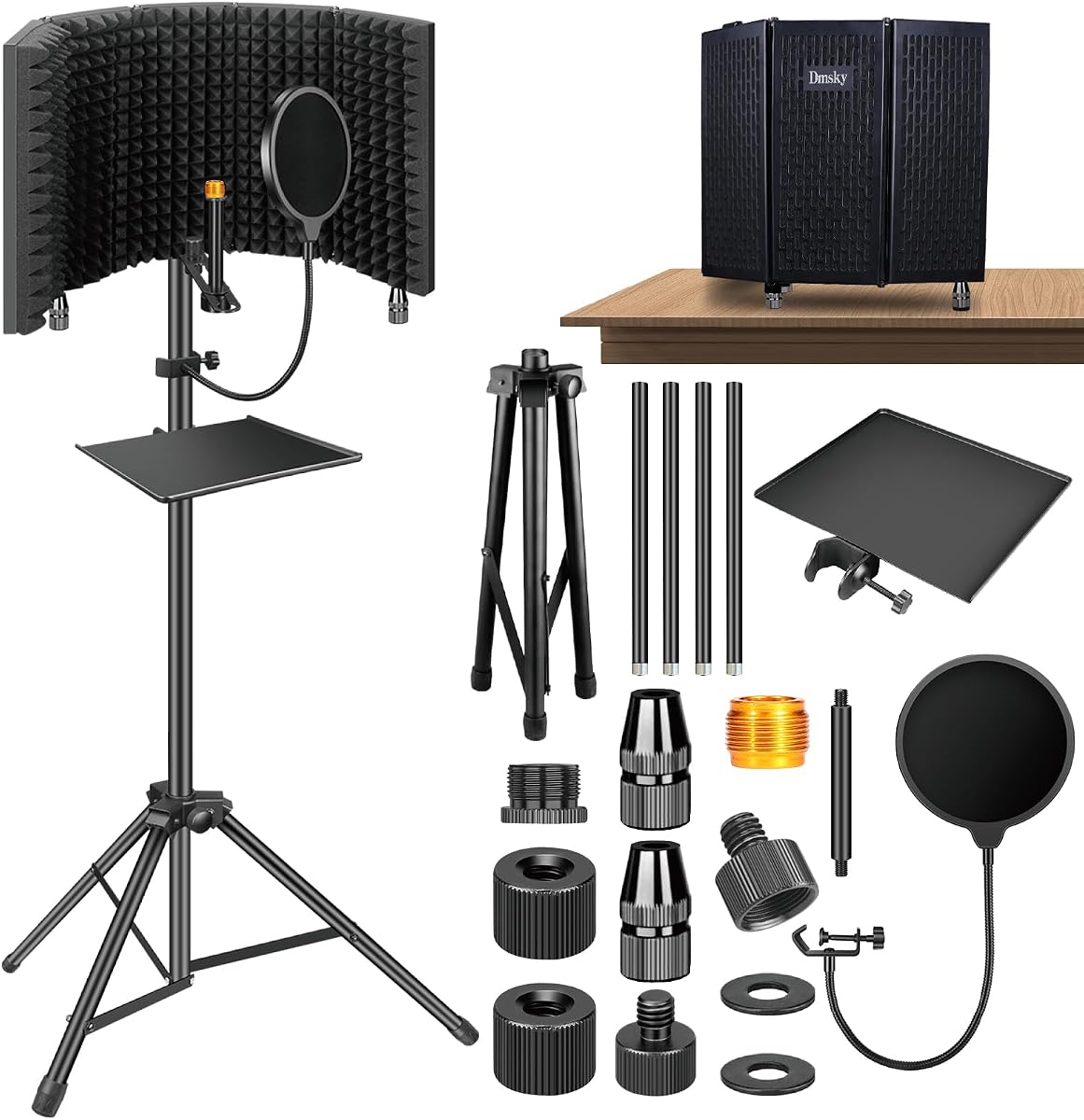
The Dmsky Microphone Isolation Shield combines five folding panels, a heavy-duty steel tripod, a pop filter, and microphone adapters in one coordinated package. Its 4.6 customer rating is the highest among the products reviewed. The design uses a reflective layer, a filter layer, and an absorbing layer, allowing it to address reflections, interference, and ambient sound through more than one treatment method.
We may earn a commission when you buy through this link, at no additional cost to you.
The steel tripod reaches a stated height of 78.7 inches, and the shield itself adjusts from 42 to 71.5 inches. Each of the five panels folds and changes angle, while anti-slip support points help maintain placement. The supplied screw adapter lets the assembly sit on a desk, tabletop, or microphone stand, making it suitable for both seated podcasting and standing performance. A wide tripod base is intended to reduce the chance of tipping.
The included pop filter improves vocal clarity by helping control plosive consonants, and adapters support common 3/8- and 5/8-inch microphone hardware. A storage tray provides room for a phone, sound card, or similar accessory. The primary drawback is the size of the full configuration. It is more substantial than a compact desktop shield, and the manufacturer notes that an upgraded stand tube may differ in appearance from older product imagery even though both use quality steel.
This is the most versatile all-in-one package for a creator who wants a full-height shield, included stand, pop filter, and extensive positioning control. It works especially well for seated voice-over, podcast, livestream, and standing vocal sessions. Choose it when you want to arrange the acoustic environment in real time rather than accept a fixed enclosure. Those willing to devote more desk or floor space receive the most complete package in the guide.
The reflective, filtering, and absorbing layers address different paths by which unwanted sound can reach the microphone. Combining the shield's surface treatment with foldable geometry gives it more placement options than a fixed reflector.
The telescoping stand and adjustable shield support sitting, standing, desktop, and boom-mounted configurations. This makes the system useful across voice-over, streaming, rehearsal, and performance tasks.
We may earn a commission when you buy through this link, at no additional cost to you.
The sE Electronics RF-X is a portable reflexion filter built around a four-layer acoustic design. It has a 4.5 customer rating and combines a vented composite panel, wool fabric, an air gap, and acoustic foam. This construction is intended to attenuate unwanted sound across a broad frequency range without producing the muddy coloration associated with some simpler foam shields.
We may earn a commission when you buy through this link, at no additional cost to you.
The layered baffle creates a controlled space in front of the microphone, reducing room reflections and ambient interference for voice-over, podcast, vocal, instrument, drum, and amplifier recording. A vented body supports consistent airflow and helps avoid tonal coloration while making the shield lighter and easier to reposition than a large rigid cabinet. The finish also gives a home studio a more professional appearance than an improvised foam arrangement.
A height- and distance-adjustable bracket is included with a microphone-stand thread adapter, allowing the shield to be placed precisely relative to the mic. It fits a wide range of large-diaphragm condensers, mic stands, and recording arrangements. The trade-off is that it is a filter rather than a self-contained vocal booth: it requires an appropriate stand, does not surround the performer, and will not control sound entering from every direction as effectively as an enclosed box.
The RF-X is an excellent choice for recording engineers and serious home-studio users who already have a reliable microphone and stand but need a polished reflection-control tool. It is particularly well suited to close vocal and acoustic instrument work. Choose a full box instead if the room has severe noise or if you need a physical boundary around the microphone.
The vented composite, fabric, air gap, and foam layers distribute attenuation across the spectrum. This layered approach controls reflections while preserving a balanced, articulate vocal character.
The adjustable bracket controls both height and distance from the microphone. These variables are important when establishing a repeatable vocal position in a room with reflective surfaces.
We may earn a commission when you buy through this link, at no additional cost to you.
The Microphone Stand With Isolation Shield is a coordinated package combining a folding acoustic shield with a full-height steel stand. It carries a 4.4 customer rating and is aimed at voice-over, podcast, live-stream, and broadcast-style setups. The shield uses a sandwich of sound-reflective, precision-filter, and absorption layers, with high-density foam on the front and lightweight ABS plastic behind it.
We may earn a commission when you buy through this link, at no additional cost to you.
The product information states that the dual noise-blocking zones reduce ambient noise by 87% and that the shield provides 26 dB of noise reduction. Its circular folding panel measures 17.1 inches in diameter and can be used as a desktop recording screen or mounted at the top of the included stand. The approach is especially useful for a voice positioned directly behind the shield, where it blocks a strong path for room reflections and direct environmental noise.
The 72.8-inch stand adjusts from 42 to 71.5 inches, and its weighted three-leg base is designed to resist tipping. An industrial-strength clamp with screw locking provides a secure connection, while quick-release adapters support 3/8- and 5/8-inch microphone hardware. It can also attach to a boom arm, and the microphone itself is not included. The round geometry and single front shield do not offer the all-around coverage of a box-style booth.
This package is a strong value for anyone starting a home broadcast or voice-over setup because the stand, shield, clamp, and adapters are supplied together. It is particularly suitable for a seated presenter or singer who can remain directly behind the shield. Choose a multi-panel or enclosed model for a mobile performer, side-address microphone with unusual dimensions, or a recording environment where reflections arrive from several directions.
The weighted tripod and locking clamp are intended to keep the shield and microphone stable during a session. The included adapters remove the need to separately identify the required microphone-thread connection.
The foldable 17.1-inch shield creates an acoustic barrier directly in front of the performer. Its layered construction targets reflections and environmental interference without requiring a full-size booth.
We may earn a commission when you buy through this link, at no additional cost to you.
The right microphone isolation box depends on your microphone, room, recording style, and tolerance for setup. Consider enclosure coverage, acoustic materials, dimensions, support hardware, portability, and accessory compatibility before choosing.
Enclosed vocal booths provide the strongest physical separation because walls, a roof, and a door surround the microphone. They are useful in noisy rooms but occupy more space and are usually less convenient to transport. Folding panel shields create a controlled reflective zone while leaving the performer and room more accessible. A single shield attached to a stand works well for a fixed voice position, while a five-panel system can be angled to cover more directions. Choose according to the severity of your room problems rather than assuming the smallest or largest format is automatically better.
Foam thickness, density, open-cell structure, and backing support all influence how effectively a shield controls reflections. Dense two-inch panels provide substantial surface treatment, while a multi-layer design can combine reflection, filtering, and absorption. Open-cell foam is designed to absorb energy without severely dulling high-frequency detail. Also consider the shell: a rigid exterior or reinforced backing panel helps the enclosure remain stable and prevents foam from sagging over time.
Isolation boxes are not universally compatible with every microphone. Some are designed for side-address condensers between 38 and 63 millimeters, while others accommodate diameters up to 2.3 inches. Large-diaphragm condensers may have broad bodies that prevent a deep narrow chamber from fitting around them. Check the microphone dimensions, mounting thread, capsule orientation, and required clearance before ordering. A model that closely supports your intended microphone will be more useful than a generic box that offers poor clearance.
Some products include a stand, suspension mount, microphone adapter, pop filter, or device tray, while others require these accessories separately. A full stand is convenient for dedicated studios, but a desktop option may be better for a small office. Check whether the stand is adjustable for seated and standing performers, whether its base is stable, and whether it can connect to a boom arm. Included adapters can simplify setup, but only when their thread sizes match your microphone and stand.
A very tight chamber can produce a boxy or constrained vocal impression, particularly when the microphone sits close to the foam. A larger internal cavity gives the mic more breathing room, and an open-front shield generally feels more natural. Conversely, an open design may not control loud environmental noise as effectively. For expressive singing, consider a design that combines broad internal spacing with layered treatment. For narration, where proximity and consistency are easier to control, a compact chamber may be sufficient.
Published interior dimensions are more meaningful than exterior size when determining whether a microphone will fit. Compare those figures with the footprint of the stand and the distance needed to speak or perform in front of the shield. A full-height tripod needs stable floor space, while a folding unit may sit on a desk but still require room to unfold. Also allow clearance for cables and access to the microphone. In a small room, a flat panel may be more effective than a booth that restricts movement.
Weight, folded thickness, and setup time matter if you record away from a permanent studio. Folding foam booths are easier to place in a suitcase, while rigid chambers and full tripods are more substantial. Check the stated weight, packed dimensions, and assembly time, as well as the durability of hinges, fasteners, and telescoping sections. A product that is quick to erect is often more useful in mixed-use spaces, provided the internal frame is assembled correctly each time.
A microphone shield does not remove every recording requirement. Plosive consonants may still need a pop filter, and scripts may require a phone, tablet, or music stand. Some models integrate a pop filter or tray, while others expect separate accessories. Consider cable routing, shock mitigation, and whether a suspension mount is needed. These details determine how smoothly the booth fits into a session and whether the performer can work comfortably without improvised objects reflecting sound near the microphone.
Begin by choosing an unobstructed position away from obvious noise sources and reflective furniture. Assemble the frame fully, confirm that every hinge and support is locked, and check that the enclosure is stable before placing the microphone. Position the shield according to the room rather than only according to the product photograph. Angle panels toward nearby reflective surfaces, keep the microphone in the intended central area, and leave enough distance from the foam to avoid a boxy close-mic impression.
Connect the microphone and cables before a formal take, then use headphones to monitor level, distance, and room response. Add a pop filter if plosives remain prominent, and position scripts on a separate stand or on an integrated tray rather than directly beside the capsule. Open the door or reposition a folding panel only during a pause. Once the sound is balanced, record a short test passage, listen for reflections, and make small adjustments rather than repeatedly moving the entire assembly.
For maintenance, remove the microphone and cables before folding or relocating the unit. Clean removable foam gently according to its care instructions, avoid compressing the material unnecessarily, and allow it to dry fully before storage. Check screws, knobs, hinges, clamps, and telescoping sections between sessions. If a stand has become unstable, tighten the relevant hardware before use. Store the unit in a dry area away from direct heat and heavy objects, and confirm that all fasteners are present before the next recording.
An isolation box for a microphone is an acoustic enclosure or shield that helps reduce unwanted room reflections, echoes, and some ambient noise around a recording setup. Designs range from compact chambers to folding panels and full vocal booths. They are especially useful in bedrooms, offices, untreated rooms, and other spaces that lack professional acoustic treatment.
An isolation box mainly improves the immediate environment around the microphone, while room treatment controls reflections throughout a larger space. It can make a major difference to vocal recordings, but it cannot prevent every sound from entering the room. For the cleanest results, combine a suitable box with good microphone placement, reduced noise sources, and broader room treatment when possible.
A foldable multi-panel shield offers flexibility for podcasters because it can cover the most reflective directions and adapt as the room changes. A full tripod booth is convenient when the same position is used for every episode. Compact chambers work best for narration and close-mic delivery, while open shields provide a more natural and comfortable experience for conversational speech.
Many models are compatible with USB microphones, including several TroyStudio designs that list vocal, condenser, USB, phone, and recorder compatibility. Confirm the internal dimensions and mounting method before purchasing. Also consider cable access and whether a small USB microphone can be positioned without contacting the foam or interfering with the pop filter.
It depends on the product and the performer. Some isolation boxes include an integrated or sliding pop filter, while others do not. A separate filter is still useful if you sing close to the microphone, speak at a low volume, or use a delivery that produces strong plosives. Choose the filter distance and material that suit your voice and recording style.
It can improve clarity, consistency, and directness by reducing reflections and unwanted sound that reach the microphone. It will not correct an unsuitable microphone, a poor gain setting, or a room containing constant disruptive noise. Compare recordings before and after adding the box, and keep microphone placement stable so you can hear the acoustic change clearly.
Leave enough room for the microphone body, movement, cable connection, and pop filter without placing the capsule against the foam. A wider internal cavity can produce a more open vocal character, while a compact chamber may offer stronger directional focus. Follow the product dimensions and test the distance with headphones before recording a full performance.
Not necessarily. Weight can contribute to stability, but acoustic performance depends more on enclosure geometry, foam treatment, construction rigidity, and placement. A lightweight folding design can work very well in a reflective room, while a heavier rigid box may still capture strong nearby noise. Choose stability and acoustic design together rather than using weight as the only measure of quality.
The Dmsky Microphone Isolation Shield is the strongest all-in-one recommendation, combining a highly rated adjustable panel system, a tall steel tripod, a pop filter, and useful adapters. The TroyStudio Portable Vocal Booth stands out as the budget option for users who value a compact foldable enclosure and quick setup, while the sE Electronics RF-X offers a refined layered design for users who already have a reliable microphone and stand.
Your priority should match the actual recording problem. Choose a rigid or larger booth for severe ambient noise, a folding multi-panel shield for flexible reflection control, and a compact chamber for focused close-mic work. Confirm microphone clearance, included hardware, internal dimensions, and mounting compatibility before ordering. The most effective product is the one that fits your voice, your equipment, and the acoustics of the room where you actually record.
Specifications and product availability can change over time, so review the current listing and included components before making a final purchase. Current offers may also differ from earlier promotions. Use this guide to narrow the field, then compare the final model against your microphone, room, and recording workflow to make a confident choice.