
ASUS ROG XG32UCWG
4.3Editor score
32-inch 4K OLED
Dual-mode high refresh
OLED Care Pro sensor
An OLED monitor for a dark room must do more than reproduce black well. It should deliver deep shadows, controlled reflections, comfortable brightness, accurate color, and smooth motion without overwhelming a dim environment. The best models also include practical OLED protection features that help manage image retention during extended use.
We compared ten gaming-focused OLED monitors by examining panel technology, resolution, refresh rate, response time, brightness, color coverage, adaptive synchronization, glare handling, connectivity, and OLED care functions. The list covers 26.5-inch, 27-inch, 32-inch, and 34-inch screens for different desk sizes and preferences.
Each pick reveals which product best fits a particular need, from fast competitive gaming to high-resolution immersion and broad productivity. Ratings and specifications come from the supplied product information, while availability and pricing change, so check the latest listing details before making a final purchase.
4.3Editor score

4.7Editor score

4.5Editor score
As an Amazon Associate we earn from qualifying purchases.
The comparison below places all ten monitors side by side, emphasizing the specifications that most affect dark-room performance: OLED panel type, native resolution, maximum refresh rate, response time, and dark-scene color and contrast capabilities.


The Samsung 27-inch Odyssey OLED G6 combines a QD-OLED panel, QHD resolution, a 240Hz refresh rate, and a 0.03ms response time, giving it an unusually balanced feature set for a dark-room gaming display. Its 4.7 rating is the highest in this group, while Glare Free technology adds a practical advantage when ambient light is limited but not completely absent.
We may earn a commission when you buy through this link, at no additional cost to you.
Dark rooms benefit especially from the monitor's combination of high brightness, wide color, and HDR10 support. Samsung says the screen reproduces more than 2,100 colors and over 110 skin-tone shades, while HDR10 adds brighter highlights and more nuanced shadows. The result should provide clear separation between shadowed areas, illuminated objects, and fast-moving gameplay without sacrificing color richness.
The main compromise is resolution. A 2560 x 1440 panel offers a sharp, practical gaming canvas, but it cannot provide the pixel density of a 4K display for text-heavy work or close-up creative use. The supplied specifications also do not list a numerical contrast ratio, so buyers should judge the screen's OLED-based black performance from its panel technology and visible use rather than from a quoted figure.
This is the strongest all-around recommendation because it combines a high rating, strong glare handling, accurate color, excellent motion, and a full set of ergonomic adjustments. It suits gamers who want a conventional 27-inch format, want rich dark visuals, and prefer not to manage a large 32-inch or curved display.
Glare Free technology is a meaningful feature for a dark-room display because even modest room light can become distracting on a glossy or reflective panel. This makes the G6 more versatile than a monitor that relies solely on its contrast ratio.
The 240Hz refresh rate, 0.03ms response time, and AMD FreeSync Premium support are ideal for fast gameplay. These specifications also reduce the chance that motion clarity will undermine the otherwise excellent dark-scene presentation.
We may earn a commission when you buy through this link, at no additional cost to you.
The ASUS ROG XG27AQDMGR is a 26.5-inch QHD glossy WOLED gaming monitor rated 4.6, with a 240Hz refresh rate and 0.03ms gray-to-gray response time. Its standout feature for a dark room is the combination of rich OLED contrast, a high 99% DCI-P3 gamut, true 10-bit color, and VESA DisplayHDR 400 True Black compliance.
We may earn a commission when you buy through this link, at no additional cost to you.
ASUS differentiates the display with OLED Care Pro and a Neo Proximity Sensor. When the user leaves, the monitor can switch to a black screen to help reduce the risk of burn-in. DisplayWidget Center provides direct access to protection functions and settings, making it easier to configure the display for regular use and intermittent sessions.
The glossy finish deserves careful consideration. It can create a vivid, high-clarity appearance, but it may also reflect room lighting, including small bright sources that are less distracting on a matte screen. The product information also lists a three-year warranty with advance replacement and burn-in coverage, which is reassuring for an OLED display.
This is a compelling premium choice for gamers and creative users who prioritize color precision and intelligent OLED protection. It works particularly well in a controlled room where reflections can be managed. Those wanting a matte-style surface or higher desktop resolution may prefer a different model.
True 10-bit color, 99% DCI-P3 coverage, and a stated Delta E below two make this a strong choice for realistic imagery. Those characteristics help maintain visible tonal separation and rich color as scenes become darker.
The Neo Proximity Sensor allows the display to go black when the user steps away. That behavior can help reduce the risk of image retention while also avoiding unnecessary OLED wear during unattended periods.
We may earn a commission when you buy through this link, at no additional cost to you.
The LG 27GX704A-B is a glossy 27-inch QHD OLED gaming monitor with a 4.5 rating, 240Hz refresh rate, 0.03ms response time, and a stated 1.5M:1 contrast ratio. Its unusual strength is brightness: LG specifies 275 nits as standard and up to 1,300 nits at peak, giving it room to reveal details in both shadows and highlights.
We may earn a commission when you buy through this link, at no additional cost to you.
For a dark room, the deep blacks of OLED technology work together with up to 98.5% DCI-P3 color coverage and VESA DisplayHDR True Black 400 certification. These specifications make the screen well suited to moody games, cinematic content, and mixed desktop use where visibility must remain balanced despite the surrounding darkness.
LG's OLED Care features include brightness adjustment, protection controls, and automatic pixel care cycles during standby or shutdown. The monitor also supports NVIDIA G-SYNC Compatible and AMD FreeSync Premium Pro. Connectivity is unusually thorough for this size, with dual HDMI 2.1, DisplayPort 1.4, and a three-port USB 3.2 hub.
Choose this model when brightness, contrast, and fast gaming matter more than 4K pixel density. Its anti-glare certification helps it remain practical in a dim room, although the glossy surface may still reveal carefully placed light sources. It is a strong alternative to the Samsung G6 for users who value higher stated contrast and broader connectivity.
A high peak-brightness figure can make highlights more convincing while OLED black levels keep unlit regions dark. The result is a display capable of presenting both deep shadows and energetic visual effects in the same scene.
Dual HDMI 2.1, DisplayPort 1.4, and USB connectivity simplify connections to a gaming PC, console, and peripherals. The included hub also makes the monitor more practical for a productive desk setup.
We may earn a commission when you buy through this link, at no additional cost to you.
The Samsung 27-inch Odyssey OLED G5 uses a QD-OLED panel at QHD resolution and carries a 4.4 rating. Its 180Hz refresh rate and 0.03ms response time place it among the quickest options in the list, even though several alternatives reach 240Hz or 360Hz.
We may earn a commission when you buy through this link, at no additional cost to you.
Its dark-room strengths include Glare Free technology, HDR10 with brighter highlights and nuanced shadows, and a Pantone Validated screen that reproduces more than 2,100 colors. OLED Safeguard's thermal modulation system actively helps prevent burn-in by keeping the screen cool, a useful feature for long gaming sessions and regularly displayed desktop applications.
G-SYNC compatibility and AMD FreeSync support help manage screen lag and image tearing, while Auto Source Switch+ makes transitions between connected devices more convenient. The trade-off is that its 180Hz ceiling may feel conservative beside 240Hz and 360Hz alternatives, particularly for competitive players who value the highest possible motion rate.
This monitor is best for gamers who want QD-OLED picture quality, accurate color, glare control, and fast response without moving to a larger screen. It is a particularly sensible option when the 27-inch format and QHD resolution align better with your desk than a 4K or ultrawide display.
Pantone validation and support for more than 2,100 colors support a natural-looking image. This can be particularly helpful in dark scenes where exaggerated color can obscure subtle environmental details.
OLED Safeguard uses a thermal modulation system to help prevent burn-in. While no display is entirely maintenance-free, this added protection supports the monitor's suitability for extended use.
We may earn a commission when you buy through this link, at no additional cost to you.
The ASUS ROG XG32UCWG is a 32-inch 4K glossy WOLED display with a 4.3 rating, 0.03ms response time, and an unusual dual-mode capability. It can run at 4K and 165Hz or switch to Full HD at 330Hz, allowing the user to prioritize competitive motion speed in suitable games.
We may earn a commission when you buy through this link, at no additional cost to you.
The 3840 x 2160 resolution provides substantially more detail than the QHD models in this roundup. That makes it valuable for text-heavy work, photo and video editing, and console gaming in a dark room, where the additional pixels can improve perceived sharpness. VESA DisplayHDR 400 True Black compliance, 99% DCI-P3 coverage, true 10-bit color, and Delta E below two reinforce its premium positioning.
OLED Care Pro and the Neo Proximity Sensor allow the display to switch to a black screen when the user is away, helping reduce burn-in risk. ASUS also includes a three-year warranty with advance replacement and burn-in coverage. The glossy panel may show reflections, which means thoughtful room lighting and monitor placement remain important.
This is the best choice for buyers who want one large screen to handle both detailed productivity and high-speed gaming. It also suits console players seeking 4K detail. The trade-off is physical size and the need to manage reflections on the glossy surface.
The native 4K panel makes this display more versatile than a QHD model. Text, menus, and fine graphical details can appear more defined, while OLED black levels preserve a cinematic look when the surrounding lights are dim.
The 4K at 165Hz mode favors visual detail, while Full HD at 330Hz serves fast competitive games. A hotkey-controlled mode makes the transition practical for users who switch between work and play.
We may earn a commission when you buy through this link, at no additional cost to you.
The ASUS ROG Strix XG27ACDNG is built around speed, offering a 360Hz refresh rate, 0.03ms response time, and G-SYNC Compatible technology on a 26.5-inch QD-OLED panel. Its 4.5 rating reflects a strong balance of competitive specifications, color performance, and OLED-focused protection.
We may earn a commission when you buy through this link, at no additional cost to you.
A custom heatsink and advanced airflow design support the high-refresh panel, while ASUS OLED Care+ functions help reduce the risk of burn-in. ROG-exclusive Anti-Flicker technology is also included to reduce flicker during refresh-rate fluctuations, potentially improving comfort in a dim room and during extended gaming sessions.
Picture quality remains a major strength. The monitor supports VESA DisplayHDR 400 True Black, 99% DCI-P3 coverage, true 10-bit color, and a stated Delta E below two. That makes it well suited to games with dark environments as well as photo and video work, provided the glossy or reflective qualities of the panel do not create distracting reflections.
This is the pick for competitive gamers who want the highest refresh rate in the group. The 2560 x 1440 resolution keeps GPU demands more reasonable than 4K at extreme refresh rates, and G-SYNC compatibility supports smooth synchronization. Buyers should also plan for a capable graphics card and consider energy use at the highest setting.
The 360Hz refresh rate and 0.03ms response time make this the fastest option listed. These characteristics are particularly valuable for fast competitive games where visual clarity and immediate motion response are central priorities.
A custom heatsink and advanced airflow design help manage heat around the panel. Cooling is an important part of maintaining consistent OLED performance, particularly when operating at very high refresh rates.
We may earn a commission when you buy through this link, at no additional cost to you.
The LG 32GX850A-B combines a 32-inch 4K glossy OLED panel with dual-mode operation at 4K 165Hz and Full HD 330Hz. Its 4.5 rating, 0.03ms response time, VESA DisplayHDR True Black 400 certification, and 1.5M:1 contrast ratio make it an accomplished option for a dim, focused workspace.
We may earn a commission when you buy through this link, at no additional cost to you.
LG's Micro Lens Array+ technology is designed to improve brightness and viewing angles, with typical brightness listed at 275 nits. Up to 98.5% DCI-P3 coverage supports saturated but controlled color, while the high contrast ratio is valuable for revealing subtle details in dark game scenes. The result is a screen that can feel cinematic without requiring a fully blacked-out room.
The monitor supports NVIDIA G-SYNC Compatible and AMD FreeSync Premium Pro. Its gaming tools include Dynamic Action Sync, Black Stabilizer, an FPS counter, and a crosshair. A hotkey switches between detailed 4K play and the faster Full HD mode, making the display adaptable to different genres and tasks.
This is a strong all-round 4K OLED for users who game, create, and work on the same screen. The native resolution is a major advantage over QHD models, while the Full HD performance mode is useful for competitive titles. Just ensure your desk has sufficient room and that room lighting does not create distracting reflections.
Micro Lens Array+ supports improved viewing angles and typical brightness. Pairing that capability with a 1.5M:1 contrast ratio helps the monitor remain readable and immersive in a dim environment.
Black Stabilizer can reveal hidden details, while Dynamic Action Sync targets input lag. The FPS counter and crosshair add practical convenience for competitive gaming sessions.
We may earn a commission when you buy through this link, at no additional cost to you.
The Acer Predator X27U W1 offers a 26.5-inch QHD QD-OLED gaming monitor with a 4.5 rating, a 240Hz refresh rate, and a 0.03ms gray-to-gray response time. That combination makes it a strong value-oriented option for gamers seeking OLED picture quality without moving to a larger or higher-resolution display.
We may earn a commission when you buy through this link, at no additional cost to you.
The monitor supports true 10-bit color, 99% DCI-P3 coverage, Delta E below two, and HDR10. These features support vivid imagery and accurate tonal reproduction, while the QHD panel offers a practical balance of detail and rendering demands. Its ZeroFrame design minimizes visible bezels, creating a more open view in a dark room.
AMD FreeSync Premium synchronizes the monitor's frames with compatible graphics-card output to help reduce tearing and stuttering. Image retention-refresh is also listed as a maintenance function. The supplied product information does not detail the full port selection or stand adjustment range, so those features should be verified on the listing if they are central to your setup.
This is our best budget designation because it preserves the essentials that matter most: QD-OLED technology, a 240Hz refresh rate, fast pixel response, wide color, and accurate color. It is best for budget-conscious gamers who want a compact OLED and do not need native 4K or an ultrawide format.
QHD at 240Hz provides a practical gaming combination that can reduce the rendering burden compared with 4K. The result is a monitor suited to fast games and high-refresh competitive play.
The combination of true 10-bit color, 99% DCI-P3 coverage, and Delta E below two supports accurate and vivid imagery. It is a strong specification set for games, video, and general visual use.
We may earn a commission when you buy through this link, at no additional cost to you.
The LG 34GX900A-B is a 34-inch WQHD curved OLED monitor with an 800R curve, 240Hz refresh rate, and 0.03ms response time. Its 4.3 rating reflects a strong feature set, while the 3440 x 1440 resolution provides substantially more horizontal workspace than a standard 16:9 display.
We may earn a commission when you buy through this link, at no additional cost to you.
Dark rooms benefit from a stated 1.5M:1 contrast ratio, up to 98.5% DCI-P3 coverage, and VESA DisplayHDR True Black 400 certification. Peak brightness reaches 1,300 nits under the stated APL condition, allowing highlights to stand out strongly against OLED blacks. The steep curvature also places more of the image around the viewer, increasing immersion.
LG includes AMD FreeSync Premium Pro and NVIDIA G-SYNC compatibility, along with Dynamic Action Sync, Black Stabilizer, an FPS counter, and a crosshair. USB Type-C provides 65 watts of power delivery, while the Switch app can divide the display into as many as six sections. OLED Care tools include pixel cleaning, and the panel is covered by a two-year limited warranty.
This is the best selection for a desk dedicated to one expansive display. It suits ultrawide gaming, cinematic entertainment, and multitasking without requiring a second screen. The trade-offs are the physical desk space required and the fact that 3440 x 1440 remains below 4K in vertical pixel density.
The 800R curvature wraps the image closely around the field of view. In a controlled dark room, that shape can create a stronger sense of enclosure for racing, simulation, and cinematic games.
The Switch app supports layouts with up to six sections. Combined with 65-watt USB-C power delivery, the monitor can also serve as a convenient central hub in a compact professional setup.
We may earn a commission when you buy through this link, at no additional cost to you.
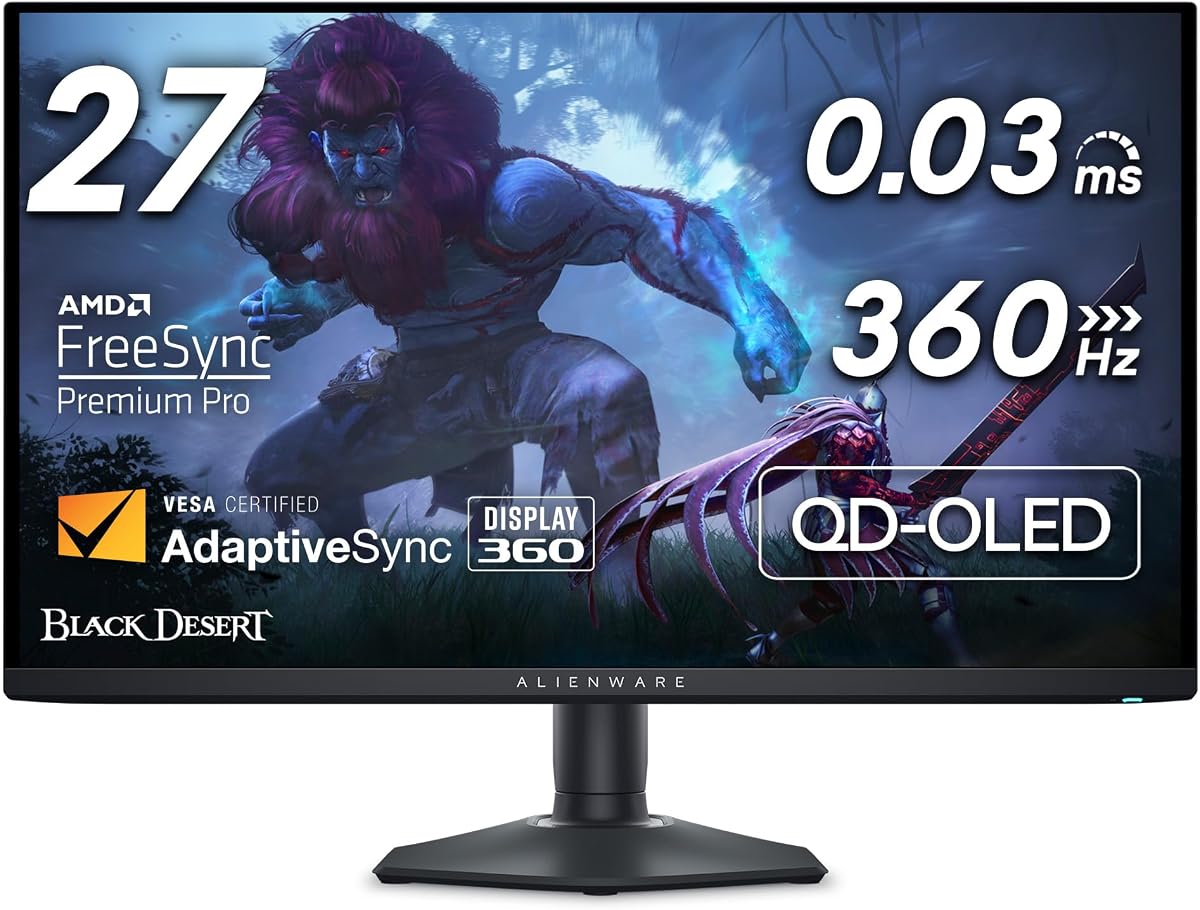
The Alienware AW2725DF combines a 26.7-inch QD-OLED panel with a 360Hz refresh rate and 0.03ms response time. Its 4.3 rating and competitive specifications make it one of the fastest conventional-size gaming monitors in the guide, particularly attractive for players in a dark room who want excellent motion clarity.
We may earn a commission when you buy through this link, at no additional cost to you.
Its picture-quality credentials include infinite contrast, VESA DisplayHDR True Black 400, 99.3% DCI-P3 color coverage, and Delta E below two. The extreme contrast is meaningful in dark game environments because it can separate dim subjects from near-black backgrounds while preserving bright highlights in the same image.
AMD FreeSync Premium Pro and VESA AdaptiveSync help provide tear-free, stutter-free visuals. Connectivity includes HDMI, DisplayPort, and USB 3.2 Gen 1, while the stand supports height, tilt, swivel, and pivot adjustment. These ergonomic options make it easier to position the screen correctly in a dark room, particularly if the primary light source comes from behind or beside the display.
Choose the AW2725DF if competitive speed is the priority and a roughly 27-inch footprint is preferable to 32 inches. The main limitation is QHD rather than 4K resolution, so it may be less suitable for dense professional work. For gaming, however, the speed and contrast combination is compelling.
A 360Hz refresh rate normally pairs with a 26.5-inch class screen, and the AW2725DF follows that familiar competitive-gaming format. It offers a high motion ceiling without moving to a large 32-inch panel.
Infinite contrast and deep OLED blacks can make low-luminance subjects more distinct. Black Stabilizer-style visibility considerations are less important than on conventional LCD gaming monitors, though brightness still affects how much detail is visible.
We may earn a commission when you buy through this link, at no additional cost to you.
The right OLED monitor for a dark room balances deep blacks with enough brightness to reveal detail, while managing reflections, image retention, and the demands of your preferred content. These are the main factors to consider before buying.
OLED panels are valued because individual pixels can switch off, producing black levels that traditional LCD monitors generally cannot match. This creates stronger perceived contrast, especially in a dark room where bright game elements, desktop windows, and media stand out against deep shadows. A high contrast ratio is especially useful for dark games, horror titles, cinematic content, and interfaces with large black areas.
Several products in this guide specify 1.5M:1 contrast or infinite contrast, while others achieve their native black level through QD-OLED or WOLED technology without a quoted figure. Do not rely on contrast alone, however. Actual visibility also depends on brightness, reflection handling, ambient light, and the content being displayed. A perfectly dark panel can still look washed out if the room contains bright reflections.
Prioritize a monitor that combines OLED black performance with controllable brightness and sensible glare management. This produces a more comfortable and consistent image than simply pursuing the highest contrast number.
Dark rooms do not always require the lowest possible brightness. A monitor that can reach sufficient luminance while retaining deep blacks makes it easier to see detail in dim game scenes, read menus, and work with dark creative applications. Some models in this list provide a standard brightness of 275 nits, while two specify peak brightness of up to 1,300 nits under specific conditions.
Peak brightness and sustained brightness are not interchangeable, so compare specifications carefully. HDR content also benefits from strong highlight performance, but excessive brightness can create a harsh image against a dim surrounding environment. Start with a moderate setting and adjust from there, especially if the display is close to your face or used for long sessions.
Choose a model with a useful brightness range and precise control rather than one that only delivers extreme peak output. The best dark-room experience balances visible shadow detail with a picture that remains comfortable to look at.
OLED monitors may use glossy, semi-gloss, or anti-glare treatments, and that distinction can outweigh other specifications in a dark room. Glossy panels can look vivid and provide excellent clarity, but they may reflect lamps, windows, and bright walls. Matte or anti-glare surfaces scatter reflections and are often easier to manage in rooms with unavoidable ambient light.
Several products specifically advertise glare reduction, including Samsung's Glare Free technology and LG's anti-glare certifications. Do not assume that a glossy panel is automatically unsuitable for a dark room; controlled lighting and careful positioning can minimize its impact. Conversely, a matte panel may be the safer choice if a lamp can be placed behind the display.
Position the monitor so bright sources do not sit directly opposite the screen, and use blinds or controlled lighting where necessary. For the least reflective experience, prioritize models explicitly designed to reduce glare. For a vivid, glass-like appearance, the glossy alternatives in this guide offer exceptional clarity.
A high refresh rate allows the display to show more frames per second, producing smoother motion and giving competitive players a clearer view of fast movement. The list spans 180Hz, 240Hz, and 360Hz models, with several premium screens capable of even faster Full HD performance through dual-mode operation.
Every product in the guide has a stated 0.03ms response time, so response time alone does not distinguish them. The more useful differentiator is refresh rate. A 360Hz screen offers the highest ceiling, while 240Hz remains excellent for most competitive gaming. A 180Hz model can still provide fast motion but sits below the highest-refresh alternatives.
Match the monitor to your GPU and preferred game type. Extremely high refresh rates may require substantial graphics performance, and some games are not designed to benefit from every available setting. Consider resolution, refresh rate, and synchronization as a single package rather than focusing on one number.
A 27-inch QHD monitor offers a familiar balance of sharpness, responsiveness, and manageable rendering demands. It is a popular size for competitive gaming because it keeps important visual information close and fits on a wide range of desks. Most products in this guide use 2560 x 1440, while two 32-inch models raise the resolution to 4K.
A 4K panel delivers more detail for text, video editing, and console gaming, but it can demand more from a graphics card. Ultrawide 3440 x 1440 increases horizontal workspace rather than vertical pixel density, making it useful for simulation, strategy, productivity, and panoramic immersion. A 34-inch curved screen requires more desk space and may not suit every seated position.
Choose based on your actual desk and workflow rather than screen size alone. Competitive gamers often favor 26.5 or 27 inches, creative professionals may appreciate 4K detail, and multitaskers may prefer the extra width of an ultrawide.
Wide gamut coverage is useful in a dark room because it gives bright elements more vivid color against the black background. Several monitors here support 99% DCI-P3 coverage, 98.5% DCI-P3 coverage, or 99.3% DCI-P3 coverage. High gamut potential does not automatically mean accurate output, so look for additional color-accuracy information and calibration tools.
True 10-bit color can produce smoother gradients and more nuanced shading than standard 8-bit output. VESA DisplayHDR True Black 400 certification addresses HDR presentation and black-level performance, while HDR10 support is common across the group. For gaming, accurate color helps enemies, interface elements, and environmental details remain distinct and recognizable.
Prioritize models that combine wide gamut, a low stated Delta E, 10-bit color, and credible HDR support if you also edit photos or video. For gaming only, these qualities still improve consistency, but refresh rate and resolution may matter more.
OLED image retention is the long-term display of a static image at a higher level than surrounding content. It does not mean every OLED will develop a problem, but preventive care is important for monitors used to show menus, dashboards, browser windows, or desktop icons for long periods. Protection should be treated as a combination of software, cooling, operating habits, and warranty coverage.
ASUS models offer OLED Care or OLED Care Pro functions, and the XG27AQDMGR and XG32UCWG include a Neo Proximity Sensor that can switch the display to black when the user leaves. LG includes automatic pixel care cycles during standby or shutdown, while Samsung uses OLED Safeguard and a thermal modulation system. Acer lists image retention-refresh support. The LG 34GX900A-B includes OLED Care tools and a two-year limited warranty.
Enable the available care features, use a screensaver when the PC is idle, and avoid leaving high-brightness static interfaces onscreen for prolonged periods. Protection features work best when paired with sensible habits, and warranty terms should be reviewed for the specific model.
A monitor with the correct ports can simplify a PC and console setup. DisplayPort 1.4 is common in this group, HDMI 2.1 appears on multiple LG and ASUS models, and USB hubs or USB Type-C power delivery can support peripherals and a cleaner desk. Check the exact port and power-delivery details before planning to connect a compact laptop setup.
Ergonomics matter because a dark-room monitor may be positioned closer than a conventional display to create an immersive view. Height, tilt, swivel, and pivot adjustment help you align the panel with eye level and reduce neck strain. A narrow bezel can further improve the sense of immersion, while a zero-frame design reduces distractions around the picture.
Look for a stand that supports your preferred position and verify that the included base fits your desk. A large 32-inch or 34-inch display also deserves more clearance than a compact 26.5-inch model, so check dimensions and wall or arm compatibility if space is tight.
Begin with a sensible room setup. Dim the lights without allowing a bright lamp, window, or reflective wall to sit directly behind the monitor. Give the screen a stable surface and set its height so the center of the panel is near eye level. A matte or anti-glare model is forgiving of stray light, while a glossy display benefits from careful positioning and controlled illumination.
After connecting the monitor, update the graphics driver and install the manufacturer's control utility when one is included. ASUS DisplayWidget Center, LG On-Screen Control, and Samsung's monitor controls can help configure picture modes, adaptive synchronization, brightness, and OLED care functions. Select the highest refresh rate supported by the graphics card and enable the appropriate variable refresh technology in both the monitor and game.
For daily care, enable the available pixel refresh, panel protection, or automatic maintenance functions. Use a screen saver when the computer is idle, and avoid leaving static, bright interfaces onscreen for long periods. Clean the panel with a soft microfiber cloth and follow the manufacturer's cleaning guidance, avoiding harsh liquids and unnecessary pressure on the screen surface.
OLED monitors are generally well suited to dark rooms because their pixels can switch off completely, producing very deep blacks and strong perceived contrast. The result is especially effective in cinematic games and dark interfaces. Glossy models can reflect nearby light sources, so room lighting and monitor placement are important.
A completely blacked-out room is not necessary, and a small amount of controlled ambient light can make viewing more comfortable. The goal is to avoid bright sources reflecting directly from the screen. Adjust the monitor brightness to match the surroundings rather than operating at maximum output all the time.
A glossy OLED can offer exceptional clarity and a vivid, glass-like appearance, but it is more likely to show reflections from lamps and windows. Anti-glare or matte models are generally easier to use when reflections cannot be controlled. The best choice depends on your room layout and sensitivity to reflections.
A 240Hz OLED is an excellent all-around option for high-speed gaming, while 360Hz models provide an even higher ceiling for competitive play. A 180Hz model can still deliver smooth motion but offers less headroom. Your graphics card and the games you play should determine how much refresh rate you can realistically use.
OLED image retention is possible with prolonged static content, but modern protection features and sensible operating habits can reduce the risk. Use the available OLED care functions, activate a screensaver, and avoid leaving bright menus or dashboards onscreen indefinitely. Screen darkness itself does not cause burn-in; static content and display wear management are the relevant issues.
QHD at a high refresh rate offers a strong balance for competitive gaming and places less demand on a graphics card. A 4K OLED provides much finer detail, which benefits text-heavy work, consoles, and creative applications, but demands more rendering power. Your usage mix and hardware should guide the decision.
A curved ultrawide OLED can create an immersive image because more of the screen wraps into the field of view. The 34-inch LG model in this guide also supports multitasking and USB-C charging. It requires more desk space, and reflections should be checked before choosing a glossy curved panel.
Match brightness to the room, use the manufacturer's flicker and low-blue-light features, and position the top of the screen near or slightly below eye level. Avoid prolonged use at maximum brightness, and take regular breaks from close viewing. Anti-flicker and low-blue-light certifications can add reassurance, but comfort also depends on individual sensitivity and viewing distance.
The Samsung 27-inch Odyssey OLED G6 is the strongest overall choice because it combines a QD-OLED panel, high brightness, Glare Free technology, accurate Pantone-validated color, 240Hz refresh, and an adjustable stand. The ASUS ROG XG32UCWG is the premium pick for buyers who want 4K detail and flexible 165Hz or 330Hz dual-mode performance, while the Acer Predator X27U W1 delivers the best value-focused feature set.
Prioritize the characteristics that matter in your room. Glossy screens may offer striking clarity but need careful light control; anti-glare models are easier to place. High refresh benefits competitive gaming, 4K improves detail, and OLED care features help manage the realities of panel longevity. Match the screen size and resolution to your desk, GPU, and daily workload.
Ratings, specifications, availability, and pricing can change over time, so verify the current Amazon listing before purchasing. Comparing the final deal against the priorities in this guide will help ensure that your chosen OLED remains comfortable, immersive, and practical in a dark-room environment.