
ASUS Prime AP201 Micro-ATX PC Case
4.7Editor score
Compact 33-liter footprint
Supports 280mm and 360mm radiators
Tool-free side panels
Expanded cable-management space
Discover the best console sized PC case options in this guide comparing airflow, dimensions, expansion, cooling support, features, and build quality.
A console sized PC case is a compact enclosure designed for builds where desk space, entertainment setups, or a console-like appearance matter. The strongest options balance a genuinely manageable footprint with adequate airflow, motherboard support, GPU clearance, cable space, and convenient access to everyday controls.
We compared ten compact and small-footprint cases using the supplied specifications, focusing on form-factor support, graphics card clearance, CPU cooler limits, radiator support, included fans, dust filtering, tool-free access, and cable management. The list covers both minimalist console-style designs and more conventional compact mid-towers.
Each review highlights the hardware a case can accommodate, the features that make assembly easier, and the compromises imposed by a smaller enclosure. Ratings and specifications reflect the listed product information, while prices and availability can change, so check current listings before ordering.
4.7Editor score

4.8Editor score

4.8Editor score
The comparison below highlights the principal differences among these compact cases, including motherboard format, cooling capacity, graphics card room, included hardware, and practical build features.


The DARKROCK EC2 combines an ATX mid-tower layout with features that make it practical for a compact entertainment or gaming build. Its 4.5 rating reflects a generally capable package, while the tempered glass side panel and meshed front give it a modern appearance without compromising the emphasis on ventilation.
We may earn a commission when you buy through this link, at no additional cost to you.
Cooling is the EC2's strongest area. It supports up to eight 120mm fans and a 360mm radiator at the front, giving builders considerable freedom with air-cooled or liquid-cooled configurations. Separate magnetic filters at the top and bottom improve routine dust control, and the Type-C-ready design suits newer peripherals and accessories.
The main compromise is that this remains a compact mid-tower rather than a purpose-built console enclosure. Hardware limits are still substantial: the case supports ATX and Micro-ATX motherboards, graphics cards up to 340mm, and power supplies up to 200mm. A more ambitious GPU or unusually deep cooler may require careful measurement.
This is a sensible choice for someone who wants console-adjacent compactness without giving up standard motherboard support or flexible cooling. Verify the dimensions of every large component first, particularly the graphics card and power supply, and choose it when airflow and component clearance matter more than a strictly horizontal console-style layout.
With room for as many as eight 120mm fans, the EC2 can serve either a straightforward air-cooled build or a more elaborate radiator setup. The front-mounted 360mm radiator support is particularly useful for builders who want liquid cooling without moving away from the chassis footprint.
Magnetic top and bottom filters make periodic cleaning more approachable, while Type-C readiness helps a compact modern system avoid an dated front-panel selection. The tempered glass side also provides a broad view of the internal layout.
We may earn a commission when you buy through this link, at no additional cost to you.
The Lian Li V100-ATX stands out as the most complete compact recommendation in this group, combining a 4.8 rating with a generous hardware allowance and four included ARGB fans. Its tool-less side panels reduce build friction, while the integrated lighting strip and daisy-chain fan wiring create a polished result from the outset.
We may earn a commission when you buy through this link, at no additional cost to you.
Its component support is particularly attractive for compact builders. The case accommodates ATX, Micro-ATX, Mini-ITX, and back-connect ATX or Micro-ATX motherboards. Graphics cards can measure up to 420mm, CPU coolers up to 178mm, and a 360mm radiator can be installed at the top.
Users still need compatible motherboard software to synchronize the integrated 26-LED strip and fan lighting, and the hydraulic-bearing fans operate across a stated range up to 1800 RPM. Despite these normal ecosystem requirements, the inclusion of four PWM-controlled ARGB fans reduces both cost and assembly complexity.
Choose the V100-ATX when you want a space-conscious case that does not impose severe limits on major components. It is particularly well suited to builders who value easy access, extensive clearance, and coordinated lighting. Measure unusually deep or specialized hardware regardless, but for standard high-end configurations the listed limits provide considerable flexibility.
The 420mm graphics card allowance is among the most generous figures in the comparison. Combined with support for 178mm CPU coolers and back-connect motherboards, it gives builders room to choose large premium components without immediately exceeding the chassis limits.
Tool-less side panels open quickly for installation or maintenance, and the included fans use daisy-chain connectivity. The integrated ARGB strip adds another lighting element without requiring a separate light bar, helping the finished build look deliberate and synchronized.
We may earn a commission when you buy through this link, at no additional cost to you.
The ASUS A31 is designed for builders who want a compact mid-tower that functions as a display for the hardware inside it. Its 4.7 rating and pillar-free dual tempered glass design create a strong visual proposition, while the angled base gives the enclosure a distinctive silhouette.
We may earn a commission when you buy through this link, at no additional cost to you.
Its compatibility targets modern mainstream systems, including 360mm AIO cooling and RTX 5090 or RTX 4090-class graphics hardware. The hidden connector design places modular cables behind the motherboard, reducing visual clutter while retaining essential ATX build flexibility.
The same design decisions create trade-offs. The 8-degree base is a deliberate visual and airflow feature, but it can influence available desk space and how a system is positioned. AIO support is listed as up to 80mm clearance, so installers should confirm the dimensions of the selected cooler and mounting arrangement.
The A31 is an appealing match for a compact showcase build where cable visibility and the presentation of the components matter. It suits users willing to plan around its angled geometry and who want ATX support in a more visually distinctive enclosure than a conventional office-style console case.
The frameless, pillar-free glass panels avoid blocking the internal display, making the case a good choice for systems with coordinated lighting or visually interesting components. The viewing angle benefits from the elevated, angled base.
The BTF Hidden Connector Design helps keep modular motherboard cables behind the tray. This is especially useful for builds using compatible back-connect motherboards, where concealed routing can create a notably cleaner finished appearance.
We may earn a commission when you buy through this link, at no additional cost to you.
The ASUS Prime AP201 delivers an impressive amount of flexibility in a 33-liter footprint, earning a 4.7 rating and a place among the strongest compact choices here. It is particularly attractive for Micro-ATX builders who want substantial cooling support without moving to a full-size tower.
We may earn a commission when you buy through this link, at no additional cost to you.
The chassis supports 280mm and 360mm radiators and up to six fans. At the same time, it accepts ATX power supplies up to 180mm, graphics cards up to 338mm, custom liquid cooling, and multiple storage devices. Its 57,000-hole mesh panel combines ventilation with a clear view of the components.
As a compact micro-ATX design, it cannot offer the same motherboard flexibility as the larger ATX models. The tool-free side clips and 32mm cable gap simplify assembly, but the available space still demands that builders plan cable routes and component orientation before installation.
The AP201 is a compelling budget-oriented choice for a small gaming or entertainment PC with a Micro-ATX motherboard. Prioritize it when desk space is limited, when you want radiator flexibility, and when the included tool-free access and dedicated cable-management area will make routine builds easier.
The AP201's ability to accept a 360mm radiator and up to six fans is impressive given its 33-liter footprint. This makes it more than a simple office enclosure and allows a proper cooling layout for compact gaming hardware.
An extended motherboard tray, strategic cutouts, and a dedicated 32mm gap provide useful places to hide wiring. Tool-free side panels also reduce friction during first assembly and later upgrades.
We may earn a commission when you buy through this link, at no additional cost to you.
The Thermaltake Tower 300 is a compact octagonal tower aimed at Micro-ATX builders who prioritize large fans and substantial radiator capacity. It carries a 4.6 rating and includes two 140mm CT fans, giving it a stronger cooling foundation than many similarly compact alternatives.
We may earn a commission when you buy through this link, at no additional cost to you.
The case supports three 120mm or 140mm fans and can accommodate a radiator up to 420mm. That radiator headroom offers meaningful flexibility, although the larger dimensions of a 420mm unit need to be checked against the overall chassis geometry and the optional display configuration.
The most distinctive feature is the optional chassis stand kit, which allows horizontal display. The stand must be purchased separately, as does the additional LCD screen kit. These accessories can enhance a console-like presentation, but they also mean the base configuration does not include every element needed for the intended final appearance.
This is a strong choice for someone who wants a compact tower with generous cooling potential and may later rotate the build for display. It is less convenient for users wanting every accessory included or requiring full ATX motherboard support, but the included 140mm fans and broad radiator ceiling compensate for those limitations.
Two 140mm CT fans provide substantial airflow across two of the main mounting positions. The ability to fit larger fans can be helpful in compact systems because they can move useful volumes of air without requiring the same number of smaller units.
The optional chassis stand enables horizontal placement, which can make the Tower 300 resemble a more conventional entertainment console. Buyers should account for the stand as an additional purchase and verify clearance when arranging a radiator or large internal components.
We may earn a commission when you buy through this link, at no additional cost to you.
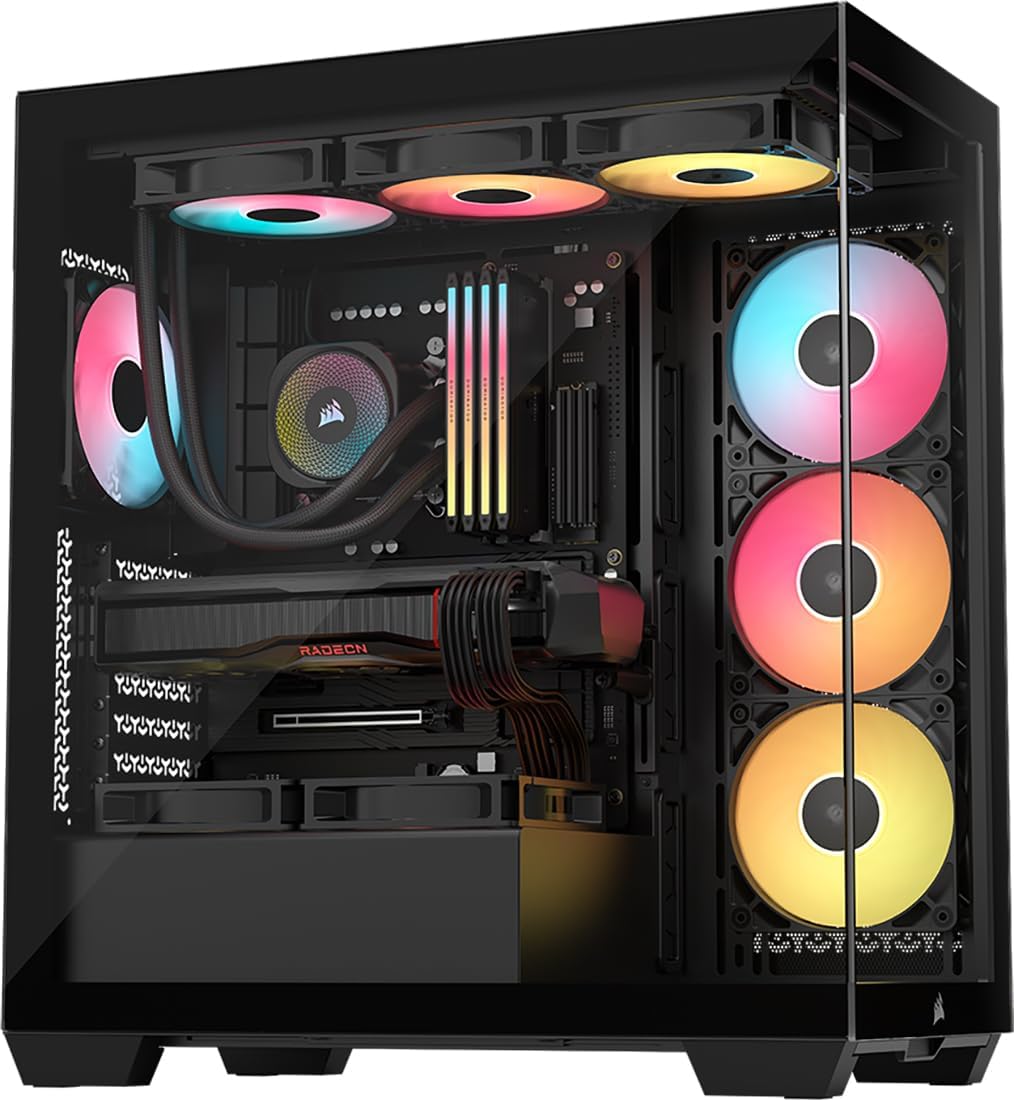
The MONTECH XR Panoramic combines ATX support, three included ARGB PWM fans, and a 420mm graphics card allowance. Its 4.7 rating reflects a well-rounded design that suits compact gaming systems and entertainment setups where both cooling headroom and visual presentation matter.
We may earn a commission when you buy through this link, at no additional cost to you.
The included layout uses two side-mounted reverse-blade fans with their illuminated faces directed inward and one rear fan. The chassis can ultimately support up to nine fans or a top-mounted 360mm radiator, allowing a builder to expand the cooling arrangement as hardware and cooling needs change.
Its panoramic tempered glass front and side panels present the internals clearly, while removable magnetic filters at the top, side, and bottom aid maintenance. The wood-grain I/O area is less common than the usual monochrome styling and may not appeal to every taste, but it gives the black enclosure a distinctive accent.
This case works well for gamers who want a compact mid-tower with strong hardware tolerances and coordinated lighting. Check CPU cooler, PSU, and radiator placement against the supplied clearance figures, and ensure the motherboard and lighting software can control the included ARGB fans.
The three-fan starting arrangement gives a new system immediate airflow and illumination, while support for up to nine fans leaves room for a more elaborate configuration. A top 360mm radiator can be added for builders who later move to liquid cooling.
Magnetic filters on three surfaces make it easier to remove accumulated dust without disturbing the entire chassis. Daily USB-C and two USB 3.0 ports place useful connections at the front of the system.
We may earn a commission when you buy through this link, at no additional cost to you.
The NZXT H6 Flow is a compact dual-chamber mid-tower with a 4.8 rating, three included 120mm fans, and a clean wraparound glass design. Its presentation is particularly polished for a smaller enclosure, while the divided internal arrangement aims to improve both thermal performance and visual organization.
We may earn a commission when you buy through this link, at no additional cost to you.
Wraparound glass panels provide a broad view of the internal hardware. Airflow-optimized perforations in the top and side panels add ventilation and assist with dust filtering, and three 120mm fans positioned at an effective angle provide cooling from the beginning.
Its compact nature means buyers should confirm motherboard and graphics card dimensions carefully. Although the listed information emphasizes the design and included fans more than explicit clearance figures, the product is best approached as a space-conscious build where each component needs to be planned rather than simply fitted by general category.
The H6 Flow is ideal for a small, visually cohesive system where clean cable routing and a tidy interior are priorities. It suits builders who can select components deliberately and want a modern white enclosure without sacrificing the basic airflow and fan support expected from a mid-tower.
The separated chambers help keep the build uncrowded and support a clean internal presentation. This arrangement is useful for compact systems because it defines where components and cables belong instead of leaving everything in one crowded volume.
The seamless glass wrap provides a strong visual centerpiece, while wide channels and straps simplify cable management. These features make routine access and future upgrades less cumbersome than in a case without dedicated routing space.
We may earn a commission when you buy through this link, at no additional cost to you.
The Cooler Master QUBE 540 stands out for its flexible orientation, capable of operating horizontally or vertically, and for broad motherboard and graphics card support. Its 4.4 rating is the lowest in this comparison, but the supplied design details show a case intended to serve demanding ATX and large E-ATX configurations.
We may earn a commission when you buy through this link, at no additional cost to you.
A full front mesh panel supports ventilation, and a pre-installed SickleFlow 120mm fan provides a useful baseline. The motherboard tray accepts ITX, ATX, and large E-ATX boards up to 11 inches wide, while the graphics card allowance reaches 415mm when the front fan is not installed.
That front-fan caveat is important because many builders add another intake after assembly. The reversible I/O panel and movable handles make repositioning easier, but users should consider whether horizontal placement or additional front cooling better fits their setup before finalizing the fan arrangement.
The QUBE 540 is worth considering for a compact ATX build with a very long graphics card, especially one that may change orientation. It provides useful flexibility and broad motherboard support, but buyers should compare their exact cooling plan against the stated GPU clearance condition.
A reversible I/O panel allows the case to be positioned horizontally or vertically without moving internal components. Movable handles add portability, making the chassis easier to reposition in a media cabinet or entertainment area.
Up to 415mm of GPU clearance accommodates many large modern cards. The maximum figure applies without the front fan, so any additional front intake should be treated as a deliberate layout decision rather than an automatic upgrade.
We may earn a commission when you buy through this link, at no additional cost to you.
The Cooler Master HAF II 500 is the premium airflow choice in this roundup, pairing a 4.8 rating with a substantial cooling system. Its Mighty40 arrangement uses two 220 x 40mm front intake fans and a 180 x 40mm rear exhaust fan, making it ideal for powerful hardware that benefits from high-volume airflow.
We may earn a commission when you buy through this link, at no additional cost to you.
Low-resistance front and rear openings help air move through the chassis, while the MasterRail system supports multiple fan and radiator sizes at the front and top. Split-level cable management creates routing room and accommodates the oversized rear exhaust position without needlessly obstructing the interior.
This is not the smallest traditional mid-tower in the group, so buyers seeking the smallest possible desk footprint may find it less suitable than a dedicated 33-liter enclosure. Its large fans also demand adequate clearance around the intake and exhaust openings, particularly when a radiator or complex tubing arrangement is added.
Choose the HAF II 500 when cooling capacity and premium hardware support outweigh a strict footprint requirement. The dual-mode GPU holder can stabilize one card or support two cards up to 3.6 slots thick each, while the flexible storage cage accommodates 3.5-inch and 2.5-inch drives in orientations determined by PSU length.
The 220mm front intakes move a large volume of air across the hardware, while the 180mm rear fan provides a broad exhaust path. This approach can be especially effective for demanding CPUs and graphics cards that produce substantial heat.
The dual-mode GPU holder can secure a single graphics card or hold two cards up to 3.6 slots thick each. This adds stability in builds where heavy components could otherwise place stress on the motherboard's PCIe slots.
We may earn a commission when you buy through this link, at no additional cost to you.
The CORSAIR 3500X RS ARGB is a well-rounded compact mid-tower with a 4.6 rating and a strong balance of visual design and cooling flexibility. It supports motherboard formats from Mini-ITX through EATX and includes three RS120-R ARGB fans for an immediately active cooling and lighting layout.
We may earn a commission when you buy through this link, at no additional cost to you.
The wraparound glass aesthetic gives the system a prominent display presence, while side, roof, and PSU fan mounting positions allow up to ten 120mm fans. Removable front and side tempered glass panels make the initial build and later component access more convenient.
Important clarification: only the three pre-installed fans are included, and other components shown in promotional imagery are not part of the package. Buyers expecting additional fans, radiators, or accessories should account for that before assembling a cooling plan.
This case is a good general recommendation for a compact ATX gaming system that needs multiple motherboard options and room to expand. It combines a polished panoramic appearance with useful fan flexibility, but it may appeal less to builders whose main priority is maximizing every cubic inch of a truly small enclosure.
Side, roof, and PSU mounting locations create multiple paths for additional 120mm fans. That flexibility lets builders begin with the included trio and expand only as their hardware and thermal needs require.
The front and side tempered glass panels can be removed for building and servicing. This reduces the need to work awkwardly around a fixed panel and makes the compact chassis easier to maintain.
We may earn a commission when you buy through this link, at no additional cost to you.
A successful compact case purchase depends on matching the enclosure to the exact hardware, confirming the required cooling layout, and choosing a form factor that suits the intended location and orientation.
Start with the largest and least flexible parts in the build: the graphics card, CPU cooler, power supply, motherboard, and radiator. Compare their listed dimensions with the case's clearance figures rather than relying on motherboard format alone. A long GPU, tower cooler, or unusually deep modular PSU can determine whether the system fits even when the motherboard does.
Record each critical dimension before purchasing, including thickness rather than just length for GPUs. In compact cases, a small amount of extra clearance can be valuable for cable bends and airflow.
ATX offers the widest component selection and is supported by many cases in this guide, while Micro-ATX can reduce the overall footprint. Mini-ITX is smaller still but requires more deliberate component selection. Also check whether the case supports back-connect motherboard headers if a clean, cable-free front appearance is important.
Use the largest format your hardware ecosystem requires. Moving to a smaller board solely for enclosure size can create incompatibilities with a preferred processor, graphics card, or memory kit.
Consider the included fans, radiator dimensions, mounting locations, and airflow path as a single system. A case may support a 360mm radiator but still have less room for cables, tubing, or a thick radiator. Large case fans can provide substantial airflow, while an AIO may offer a more compact internal arrangement.
Match cooling capacity to the heat generated by the processor and graphics card. Do not assume that the radiator number alone describes performance, and verify physical clearance around every mounting point.
Front-panel connections determine how conveniently you can attach everyday accessories. USB-C is increasingly useful, but compatibility depends on the motherboard header and the case's internal wiring. Pay attention to the number and type of USB ports rather than treating every USB label as equivalent.
Choose a panel layout that matches the ports you actually use. A clean exterior can be valuable, but it should not come at the expense of connector compatibility or accessibility.
Compact systems need deliberate cable routing, especially when using modular power supplies or back-connect motherboards. Look for an extended motherboard tray, wide routing channels, straps, and sufficient gaps behind the tray. Drive cages and mounting options should also align with the storage devices in the build.
Plan cable paths before installing the motherboard. Bundling excess cable behind the tray can improve appearance, but overstuffing the space may restrict airflow or make maintenance harder.
A case intended for horizontal display may require an optional stand, and rotating the system vertically can change which panels and connectors remain accessible. Compare the complete external dimensions with the intended shelf, cabinet, or desk location. Handles, feet, and optional stands can add to the footprint.
Verify whether the case's final orientation suits your cooling layout. Some models make this easier by using reversible panels, while others require a dedicated accessory or additional clearance.
Tempered glass and panoramic panels make a compact build more engaging, but good airflow and dust filtering should take priority if the system will operate in a dusty environment. Removable or magnetic filters are useful for routine cleaning. Also consider how easily the side or top panels open after the system is assembled.
Choose the presentation that supports long-term upkeep rather than appearance alone. A system that is easier to open and filter will generally be more pleasant to maintain.
The product listing may show fans, lights, or accessories that are not included. Check the written description and package notes before planning around a pictured component. Some cases include multiple ARGB fans, some include one or two large fans, and others require the buyer to supply the entire cooling arrangement.
Treat the package contents as part of the product specification. A case can offer excellent cooling potential while still costing more to populate with fans, filters, or optional display hardware.
Before assembling the system, lay out the case, review the included instructions, and identify every mounting position for the motherboard, power supply, graphics card, drives, fans, and radiators. Connect the required power, data, fan, and front-panel cables before installing large components, as access can become restricted later in a compact enclosure.
Route cables through the designated channels and use the supplied straps or clips to prevent them from interfering with fans. If the motherboard supports hidden connectors, use those connections where appropriate. Keep the GPU support bracket aligned with the manufacturer-provided holder, and confirm that no power cable is sharply bent at either connector.
For routine care, power down the computer and disconnect it before opening the chassis. Remove dust filters on the schedule recommended by the manufacturer or sooner in a dusty environment. Clean filters with gentle airflow or a dry method, avoid pushing debris into the case, and check that every fan remains unobstructed before closing the panels.
They can be, because cable space and component clearance are usually tighter than in a full-size tower. Tool-free panels, back-connect motherboard support, wide routing channels, and included fans can make a compact build much easier. Planning the parts and cable paths before assembly is the most effective way to avoid frustration.
Many can, but the maximum GPU length varies widely by model. The products in this guide list allowances ranging from 338mm to 420mm, with one case noting that its 415mm maximum applies without the front fan. Compare the exact card length, connector position, and any front cooling arrangement before buying.
A Micro-ATX case can save space and still provide capable cooling and storage options. The ASUS Prime AP201, for example, pairs a 33-liter footprint with 360mm radiator support and room for a 338mm graphics card. The trade-off is motherboard selection, so check CPU and graphics card availability for the smaller format.
Not necessarily. A well-ventilated compact case with suitable fans and radiator support can cool powerful hardware effectively. The Cooler Master HAF II 500 uses very large intake and exhaust fans, while other models use mesh panels and multiple mounting locations. Compare airflow paths, included fans, and cooling hardware rather than judging by volume alone.
Glass is useful for displaying internal components, particularly in a gaming or entertainment setup. It is less essential for a hidden office or media-center build. Choose a model that also offers effective ventilation and accessible dust filters so the visual design does not come at the expense of thermal performance or maintenance.
Mini-ITX produces the smallest board footprint, Micro-ATX offers a useful balance of compactness and expansion, and ATX provides the broadest component selection. The case listing must explicitly support the chosen format. CPU compatibility, memory layout, graphics card availability, and desired storage options should all be considered before reducing the board size.
Only if the manufacturer permits horizontal placement or the case includes a suitable stand. The Thermaltake Tower 300 requires an optional chassis stand for horizontal display, while the Cooler Master QUBE 540 is engineered for both orientations. Confirm the orientation, stand requirements, and panel accessibility before arranging the system in a cabinet.
That depends on the model. The Lian Li V100-ATX includes four ARGB fans, the MONTECH XR includes three, the NZXT H6 Flow includes three non-lit 120mm fans, and the CORSAIR 3500X RS includes three RS120-R ARGB fans. Other cases may include fewer fans or require the buyer to supply them.
The Lian Li V100-ATX is the most balanced overall pick because it combines four included ARGB fans, tool-less access, broad motherboard support, and generous GPU and CPU cooler clearance. The ASUS Prime AP201 stands out as the budget-focused option for Micro-ATX builders who want a 33-liter footprint without giving up large-radiator support, while the Cooler Master HAF II 500 leads the premium group with exceptional large-fan airflow.
Prioritize the dimensions of the exact hardware over the case category label, followed by cooling layout, motherboard format, and access. A compact enclosure works best when its clearance figures match the selected parts. Cable space, dust filtering, front connectivity, and the ability to open panels are also important for a system that will be maintained rather than assembled once and forgotten.
Prices, promotions, and availability can change over time, so review the current listing before making a final purchase. Confirm the package contents and compare the stated dimensions with your own components. With that final check completed, one of these ten cases can provide a compact, attractive home for a new PC.