
NZXT H5 Flow
4.7Editor score
Two 120mm fans included
Supports 360mm front radiators
Perforated PSU shroud airflow
Compact ATX mid-tower layout
Our PC Case for AM5 Build guide compares 10 mid-towers for airflow, compatibility, cooling, cable management, aesthetics, and easy installation.
Choosing a PC case for an AM5 build is more than selecting a stylish enclosure. The right mid-tower must accommodate your motherboard, graphics card, power supply, CPU cooler, and memory while directing cool air toward the components that need it most. It should also make installation easier and leave enough room for future upgrades.
This guide compares ten cases using the specifications and features listed for each model. We examine motherboard support, graphics-card clearance, radiator options, included fans, airflow design, cable-management provisions, exterior visibility, and the practical features that matter once the build begins. The list covers compact, mainstream, panoramic, modular, and premium designs.
The top selections illustrate the strongest compromises for different priorities, including a budget-conscious airflow option, a highly adaptable enthusiast case, and a premium dual-chamber design. Every product has its own strengths, so the right choice depends on your hardware, cooling plan, and preferred build style. Marketplace costs change, so check current listings before ordering.
4.7Editor score

4.7Editor score

4.6Editor score
This side-by-side comparison highlights the major differences among all ten cases, including included cooling, radiator capacity, ATX compatibility, graphics-card room, and the design features that affect installation and maintenance.


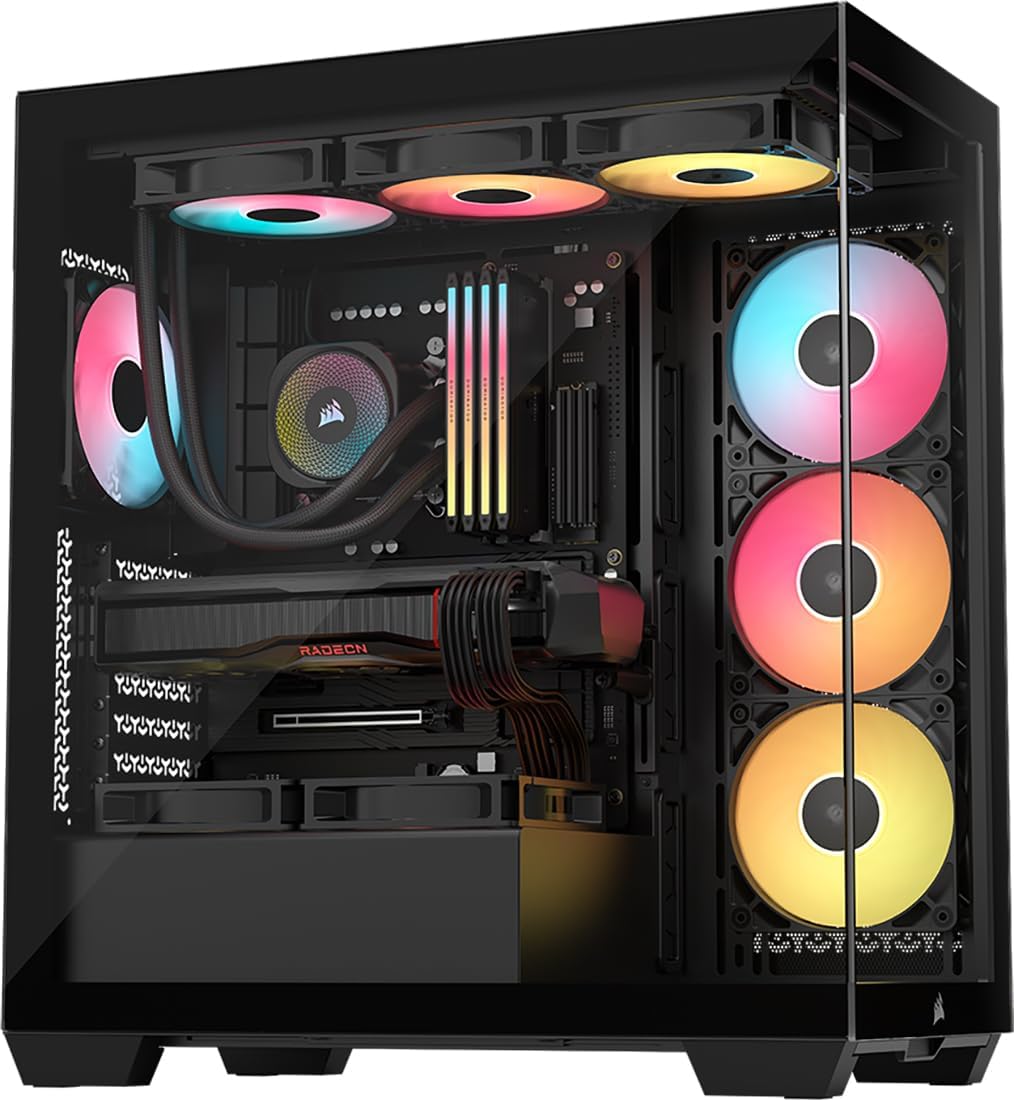


The Geometric Future M5 Black/Grey combines an enthusiast-oriented cooling layout with a substantial list of pre-installed equipment, earning it a 4.6 rating in the supplied data. Its most immediately attractive feature is the set of five 140mm ARGB PWM fans, which gives an AM5 system considerable airflow potential before the builder adds any extra cooling hardware.
We may earn a commission when you buy through this link, at no additional cost to you.
Cooling flexibility is a defining strength. The enclosure supports a 420mm radiator and up to ten 120mm fans, allowing a builder to use large liquid-cooling hardware, rely on the installed 140mm fans, or combine several approaches. Compatibility extends to E-ATX motherboards, graphics cards up to 460mm long, and modular power supplies up to 160mm, making it suitable for a Ryzen-based gaming or workstation build.
The tool-free tempered-glass side panel should make component access more convenient, while the 0.8–1.2mm steel frame provides a more robust structure than lightweight all-aluminum designs. A display window in the PSU shroud adds visual interest, although cable management will require deliberate routing. The five-fan configuration also means that buyers should verify motherboard controller headers, ARGB synchronization, and internal cable paths before assembling the system.
This M5 is a strong choice for builders who want a visually dramatic case with cooling hardware already installed. It is less attractive for someone seeking a small enclosure or a highly modular case system, but its roomy cooling support, long graphics-card allowance, and tool-free access make it especially practical for an AM5 build with an ambitious air- or liquid-cooling plan.
The support for a 420mm radiator is especially useful when an AM5 processor or high-end graphics card creates a substantial heat load. Five included 140mm ARGB PWM fans also provide a strong foundation for airflow, giving users options without treating every enclosure position as an empty mounting point.
Tool-free tempered-glass panels reduce the work required during initial assembly and later maintenance. A 460mm graphics-card limit provides useful margin for large modern cards, while E-ATX support expands the range of motherboards and power supplies that can be used.
We may earn a commission when you buy through this link, at no additional cost to you.
The Geometric Future M5 Black/Green offers the same high-capacity foundation as the Black/Grey version, with a color treatment that stands apart in a showroom or desk setup. Its 4.6 rating reflects a case that prioritizes pre-installed cooling, broad hardware compatibility, and an eye-catching glass-and-steel design.
We may earn a commission when you buy through this link, at no additional cost to you.
Five 140mm ARGB PWM fans provide generous airflow and a coordinated lighting effect from the start. The case can accept up to a 420mm radiator or ten 120mm fans, giving users considerable freedom when planning a custom cooling arrangement. Motherboard support extends to E-ATX, and the listed limits of 460mm for graphics cards and 160mm for modular power supplies provide practical room for performance hardware.
As with the related M5 variant, the main planning issue is the number and size of the included fans. A builder adding more cooling must confirm that the motherboard has enough fan and ARGB headers, or plan for an appropriate controller. The tool-free panels improve access, while the steel frame and tempered glass give the enclosure a more substantial appearance.
Choose the Black/Green edition if its styling matches the rest of the build better than the neutral alternative. It is particularly well suited to AM5 systems that pair a Ryzen processor with a powerful graphics card and want extensive cooling support without assembling every fan and radiator from scratch.
The black-and-green finish offers a more expressive option for builds that would otherwise use an all-black enclosure. The panoramic tempered-glass treatment keeps the internal lighting and component layout visible, allowing the color scheme to remain part of the finished system rather than just an exterior accent.
Large radiator support and five installed 140mm fans create a high ceiling for future cooling changes. This makes the enclosure useful for builders who may begin with air cooling and later add a larger liquid-cooling solution.
We may earn a commission when you buy through this link, at no additional cost to you.
The CORSAIR 4000D RS ARGB Frame stands out as the most adaptable case in this guide, combining a 4.7 rating with the unusual ability to change several case components. Its FRAME modular system lets builders replace the motherboard tray with billet aluminum or alter the front I/O panel as needs change, making it a long-term platform rather than a fixed arrangement.
We may earn a commission when you buy through this link, at no additional cost to you.
Three CORSAIR RS ARGB PWM fans are pre-installed in the front. They use daisy-chainable four-pin PWM connections, support Zero RPM operation at low loads, and connect through the motherboard's five-volt ARGB header. The InfiniRail mounting system allows sliding fan positions for targeted airflow, including mounting options for larger fans in the front and 140mm fans in the roof.
The 3D Y-pattern steel front panel is designed to permit airflow while reducing obstruction, which is a useful alternative to a fully solid decorative front. On the motherboard side, the internal panel can remain in place as a cable cover or be removed to create space for additional side-mounted fans. That versatility is useful when balancing a clean initial layout against the possibility of a more powerful GPU or CPU cooler.
The 4000D RS ARGB is recommended for an AM5 builder who wants a case that can evolve with the system. It is particularly compelling for users who appreciate organized cables, a strong included fan package, and the option to reconfigure mounting positions. Although optional FRAME components are not included, the standard configuration already covers the needs of most performance gaming builds.
The FRAME system is the defining feature because it makes the enclosure more configurable than a conventional fixed-layout mid-tower. Replacing or repositioning elements can be worthwhile when cable-management needs, storage preferences, or front connectivity priorities change during the life of the build.
The perforated Y-pattern front panel gives the case a functional appearance while maintaining a clear intake route. Combined with the convertible internal side panel, it allows builders to reserve additional fan positions for demanding components when a fully closed aesthetic is not the priority.
We may earn a commission when you buy through this link, at no additional cost to you.
The FOIFKIN F600 is built for builders who want as much cooling hardware as possible from the first installation. It carries a 4.6 rating and includes seven 120mm ARGB PWM fans, split between six reverse-blade and one forward-blade fan. That substantial package can provide immediate airflow in both intake and exhaust positions.
We may earn a commission when you buy through this link, at no additional cost to you.
Its dual-chamber architecture separates the hardware area from the power supply and drive area, helping manage heat and cables. The case can accommodate three 360mm radiators simultaneously, although the exact usable configuration depends on the remaining hardware and mounting positions. A 270-degree high-hardness tempered-glass panel creates an expansive view of the internals, while a front Type-C port supports modern accessories.
The listed hardware limits include support for ATX, micro-ATX, and ITX motherboards, graphics cards up to 400mm, and power supplies up to 200mm. It also provides two SSD positions and one HDD position. These specifications make the F600 flexible for an AM5 platform, but the dimensions of 420 by 285 by 430mm mean it is not a compact option for a small desk.
The F600 makes sense for a visually oriented gaming system that prioritizes lighting, glass, and a large number of pre-installed fans. Users should plan the header and controller arrangement carefully because seven ARGB PWM fans can exceed the available connectors on some motherboards. Subject to that planning, it is one of the most fully equipped cases in the roundup.
The seven-fan bundle saves the builder from having to select and install a complete cooling set immediately. Reverse fans can make the glass presentation more coherent, while the forward fan provides a conventional intake position for a balanced layout.
Support for three 360mm radiators creates substantial liquid-cooling potential. The dual-chamber design also helps isolate the power supply and storage area, reducing the need to treat every internal zone as one shared thermal space.
We may earn a commission when you buy through this link, at no additional cost to you.
The CORSAIR 3500X RS ARGB is built around a wraparound glass presentation while retaining useful airflow flexibility. Its 4.6 rating reflects a balanced package for AM5 systems that want a visually clean mid-tower, three included RS120-R ARGB fans, and enough mounting options to expand the cooling arrangement later.
We may earn a commission when you buy through this link, at no additional cost to you.
Side, roof, and power-supply fan positions can accommodate up to ten 120mm fans, giving the case much more expansion potential than the number of installed fans suggests. The included fans use standard five-volt ARGB and PWM connections for motherboard control. Removable front and side tempered-glass panels make the initial build and later inspections easier than with fixed panels.
One especially relevant feature is validation for ASUS BTF, MSI Project Zero, and Gigabyte Project Stealth motherboards, which keep cable connections on the rear of the motherboard. This allows the panoramic view to remain free of the cables normally visible above the board. The case supports motherboard formats from Mini-ITX through EATX, making it compatible with common AM5 board sizes.
The 3500X RS ARGB is a strong choice for a clean, windowed gaming build that does not need to have every fan position filled immediately. Those willing to add more cooling have ample options, although the stated capacity of three radiators can constrain a build that would benefit from a fourth or larger arrangement.
Compatibility with rear-connect motherboard designs is especially useful for showcase systems. Moving the visible cable connections behind the board preserves the intended glass view and helps maintain a more deliberate appearance during everyday use.
The enclosure offers several fan locations beyond the three included units. This makes it practical to begin with a basic setup, test component temperatures, and add fans where the build later shows a need for additional intake or exhaust.
We may earn a commission when you buy through this link, at no additional cost to you.
The Cooler Master HAF 500 Pro Bundle offers an unusual level of completeness for an AM5 build. Its 4.7 rating reflects the combination of a high-airflow case, an AM5-compatible Hyper 212 Halo CPU cooler, and a 650-watt Gold power supply in one coordinated package. This can simplify the first build considerably.
We may earn a commission when you buy through this link, at no additional cost to you.
The case itself includes two large 200mm ARGB fans at the front, a 120mm ARGB fan at the rear, and a rotatable 120mm GPU fan. Its mesh front panel and tempered-glass side panel balance open intake with component visibility. A 410mm graphics-card clearance limit provides room for large GPUs, including models associated with the RTX 5090 by the supplied specification.
The Hyper 212 Halo cooler is listed as compatible with AM5, AM4, LGA 1700, and LGA 1821, making it a sensible tower cooler for many Ryzen processors. The MWE 650W Gold unit provides an 80 Plus Gold-rated power option and is described as built for high-temperature resilience and quiet operation. Front connectivity includes two USB 3.2 Gen 1 ports and one USB 3.2 Gen 2 Type-C port.
This bundle is best for a first AM5 system where a builder wants a case, CPU cooler, and power supply without choosing each component separately. It is less flexible for an established build with a preferred power supply or a more specialized cooler. Within that bundle-oriented approach, however, it delivers a high rating and a notably complete set of core components.
Including the CPU cooler and power supply removes two major decision points from a new build. The package is particularly approachable for a Ryzen 7 system using a supported AM5 processor, while the Case remains a standard ATX mid-tower for other components.
The pair of 200mm front ARGB fans can move substantial air through the mesh panel. A rear exhaust fan and removable GPU fan add further control, giving the case a useful balance of intake, exhaust, and dedicated graphics-card cooling.
We may earn a commission when you buy through this link, at no additional cost to you.
The NZXT H5 Flow delivers a focused balance of size, airflow, and build convenience, supported by a 4.7 rating. It is the value-oriented selection in this guide because it provides two included 120mm fans, useful radiator capacity, and a compact ATX mid-tower footprint without relying on decorative features as its primary appeal.
We may earn a commission when you buy through this link, at no additional cost to you.
One fan is installed at the front and another at the rear, immediately establishing a sensible intake-and-exhaust arrangement. Ultra-fine mesh on the top, front, and side panels supports airflow while filtering dust. The perforated side and bottom sections of the power-supply shroud permit air to enter from two optional 120mm fans, although those fans are not included.
Liquid-cooling support reaches 360mm in the front and 240mm at the top, which is more than many similarly compact cases offer. Cable management is handled through wide routing channels, hooks, and straps. These features make the H5 Flow easy to build cleanly and practical to maintain, both important qualities for an AM5 system that may be upgraded over time.
The case does not include ARGB lighting, so it will not deliver the luminous presentation of several competing models. That is a minor compromise for many builders, particularly when the enclosure's airflow, compact dimensions, and restrained design are more important. The H5 Flow is an excellent choice for a clean first Ryzen build that needs solid fundamentals rather than maximum visual spectacle.
The H5 Flow concentrates on useful intake and exhaust positions without requiring a large chassis. Fine mesh across several panels supports airflow, while the shroud perforations add another potential route for air to reach the power-supply and lower-case region.
Wide channels, hooks, and straps are easier to work with than a dense maze of narrow openings. They help separate power, data, and front-panel cables during the first build and make later access less frustrating.
We may earn a commission when you buy through this link, at no additional cost to you.
The ASUS A31 combines mainstream ATX positioning with a dramatic dual-sided tempered-glass design, earning it a 4.7 rating in the supplied information. Its frameless, pillar-free construction is designed to provide a clear view of the internal components, making it appealing for an AM5 system that will be displayed rather than hidden beneath a desk.
We may earn a commission when you buy through this link, at no additional cost to you.
The case is advertised as compatible with 360mm AIO coolers and long graphics cards such as the RTX 5090 and RTX 4090. Its BTF hidden connector design accommodates motherboards that place connections on the back, allowing the visible side of the board to remain clean. That makes the A31 particularly interesting for users selecting an ASUS motherboard with a similar connection layout.
The 8-degree angled base serves both appearance and airflow. The stated design intent is to enhance air movement, increase the viewing angle, and amplify the effect of ARGB lighting. Unlike some cases in this list, the supplied data does not specify a bundle of pre-installed fans, so the exact out-of-the-box cooling configuration should be confirmed in the current listing.
The ASUS A31 is a good fit for a builder who values a wide display of the internals and owns or plans to use a compatible rear-connect motherboard. It also provides meaningful modern cooling and graphics-card headroom. As with any case, buyers should check fan positions, drive options, and front connectors against their exact hardware before finalizing the build.
Dual glass sides and a pillar-free design avoid the narrow structural interruptions common in display cases. The result is intended to showcase the motherboard, graphics card, cooler, memory, and lighting from more than one viewing angle.
Support for 360mm AIO coolers and long graphics cards makes the A31 relevant to current high-performance AM5 configurations. Rear-connect motherboard support is another useful feature, particularly for builders who want the glass view to remain free of visible cables.
We may earn a commission when you buy through this link, at no additional cost to you.
The HYTE Y50 RGB is designed for a coordinated light-themed build, with a 4.7 rating, a Snow White finish, and four included aRGB fans. It combines a three-piece panoramic glass design with a dual-chamber layout, making it a strong visual option for an AM5 system that uses pale or silver components.
We may earn a commission when you buy through this link, at no additional cost to you.
The included cooling set consists of one 120mm FE12RS aRGB fan and one 360mm FE12RTR aRGB reverse-blade unibody fan. Both use standard aRGB and PWM connectors, allowing them to be controlled through compatible motherboard headers. The 360mm reverse fan can provide a striking view from the side while directing air through the main chamber.
Compatibility with ASUS BTF, Gigabyte Stealth, and MSI Project Zero motherboards is another major benefit. These rear-connect designs keep cables behind the motherboard tray, supporting a cleaner panoramic view. The case also provides full-size slots for horizontally mounted graphics, allowing additional GPUs and more drive space than a compact layout might offer.
The large 360mm fan and strong white color scheme mean the Y50 RGB is not as neutral as a traditional black mid-tower. It is best for a deliberate themed build, particularly one that includes a rear-connect motherboard and a horizontal graphics card. Within that design direction, the case provides an unusually polished combination of lighting, visibility, and cable management.
The combination of a white enclosure, panoramic glass, and a 360mm reverse-blade fan creates a coordinated display effect. Standard aRGB and PWM connections make the included lighting easier to integrate with the rest of the system.
Support for three major rear-connect motherboard families keeps the visible motherboard side free of attached cables. This is particularly valuable in a panoramic case where even a small group of wires can interrupt the intended view.
We may earn a commission when you buy through this link, at no additional cost to you.
The ASUS TUF Gaming GT502 Horizon is the premium choice in this guide, combining a 4.6 rating with a sophisticated dual-chamber chassis. Its main benefit is physical separation of the CPU and graphics-card cooling zones, allowing each major heat source to receive airflow designed for its own position.
We may earn a commission when you buy through this link, at no additional cost to you.
Tinted tempered-glass panels at the front and side provide a broad, unobstructed view of the main chamber. The enclosure also offers a front USB Type-C port rated at 10Gbps, a modern convenience for compatible devices. Tool-free side panels open by pressing a button hidden at the rear, reducing the need for screws during assembly and routine maintenance.
A fully modular approach extends beyond the glass. Most panels and mounting components are detachable, which can simplify assembly and make the chassis more adaptable to different layouts. The dual-chamber structure is especially relevant to AM5 builds using a substantial Ryzen processor and a powerful discrete graphics card, because it creates more targeted cooling zones than a conventional single-chamber design.
The GT502 Horizon is recommended for builders who want a refined, expansive presentation and are willing to prioritize a more advanced chassis design. The supplied information does not state the number of pre-installed fans, so the final cooling configuration should be confirmed. Subject to that detail, it is a strong premium platform for a showcase AM5 system.
The divided chassis creates independent zones for the processor and graphics card. This can improve the organization of intake and exhaust airflow, particularly in a build that combines a high-power Ryzen chip with a large discrete GPU.
Tool-free side panels make it easier to reach internal components, while the removable modular parts simplify construction. A 10Gbps front Type-C port adds useful connectivity for compatible accessories and complements the case's modern design.
We may earn a commission when you buy through this link, at no additional cost to you.
The best case for an AM5 system is the one that fits the planned hardware, manages heat effectively, and remains convenient to assemble. Comparing motherboard format, graphics-card length, cooler height, radiator placement, drive needs, and connector availability prevents expensive mismatches.
In short, select a case that explicitly supports your chosen motherboard format.
In short, choose enough graphics-card clearance to leave room for the exact model you plan to install.
In short, plan a complete airflow layout and count every fan and radiator before buying the enclosure.
In short, verify cooler height and radiator position against the case's actual mounting layout.
In short, favor enough routing space to keep cables invisible without making maintenance difficult.
In short, check drive bays and front-panel ports before treating them as secondary details.
In short, balance appearance with easy access, effective filtration, and realistic servicing needs.
Before installing components, remove the side panels, lay out the included screws and hardware, and identify every fan, radiator, cable, and mounting point. Compare the motherboard, graphics card, power supply, storage, and CPU cooler with the case specifications. Confirm that standoffs match the board and that no cable or radiator blocks the intended component position. A quick compatibility check before assembly prevents the need to dismantle a partly completed system.
Install the power supply and storage first, then route the main cables behind the motherboard tray or through the nearest appropriate channels. Fit the CPU cooler and radiator before installing the graphics card if access is tight. Connect front-panel wires to the correct motherboard headers, and connect fans to the specified PWM and five-volt ARGB headers or an appropriate controller. Use the case's cable covers, straps, and tie-off points so that panels can close without forcing the wiring.
After the first startup, listen for unusual fan noise, check that all installed fans spin, and confirm that ARGB lighting responds to the motherboard controls. Monitor CPU and GPU temperatures under a realistic workload, then adjust intake and exhaust positions if one area runs warmer than expected. Clean dust filters periodically, keep the front and bottom intake paths unobstructed, and inspect cable connections whenever the case is opened. Use the removable panels and modular mounting features as intended rather than forcing components into incompatible positions.
ATX is a common and practical choice for AM5 builds because it supports standard ATX motherboards while remaining smaller than many full-tower cases. E-ATX support is useful for larger boards, while micro-ATX and Mini-ITX can reduce the overall footprint. The important point is that the case must explicitly support the exact motherboard format selected.
Not necessarily. CPU cooler selection depends on the processor, its thermal behavior, case clearance, noise preferences, and the build's cooling strategy. A 360mm-capable case offers future flexibility, but a capable tower air cooler may be sufficient for many systems. If using liquid cooling, verify radiator width, mounting position, tubing clearance, and fan orientation before ordering.
Modern graphics cards vary considerably in length and thickness, so the case's listed clearance should be compared with the exact card model. The FOIFKIN F600 is listed for cards up to 400mm, while the Geometric Future M5 reaches 460mm, giving more margin for very long models. Leave extra room for power connectors, backplates, and vertical mounting arrangements.
Reverse-blade fans can look more coherent through a glass panel because the illuminated face points toward the viewer. The FOIFKIN F600 includes six reverse fans, and the HYTE Y50 RGB includes a 360mm reverse-blade fan. They still need to be installed in the correct orientation to move air in the intended direction and avoid turbulence.
A rear-connect motherboard places headers and sockets on the back of the board, allowing the visible side to remain largely free of attached cables. The ASUS A31, HYTE Y50 RGB, and CORSAIR 3500X RS ARGB support specified rear-connect motherboard families. This is especially useful in panoramic cases where cable clutter can interfere with the hardware display.
No. Most cases are sold as empty enclosures, while the Cooler Master HAF 500 Pro Bundle in this guide includes a case, an AM5-compatible CPU air cooler, and a 650-watt Gold power supply. Most builders will still need to select a processor, graphics card, memory, storage, operating system, and any peripherals they want.
The right number depends on the cooling layout. The NZXT H5 Flow includes two useful 120mm fans, the CORSAIR 4000D RS ARGB includes three ARGB PWM fans, and the FOIFKIN F600 includes seven. More fans can improve airflow when correctly placed and controlled, but they also require power, headers, cable space, and appropriate intake or exhaust orientation.
A mesh front generally favors airflow, while a glass front emphasizes appearance and can make the interior more visible. The CORSAIR 4000D RS ARGB uses a perforated steel Y-pattern front, whereas the CORSAIR 3500X RS ARGB and ASUS TUF Gaming GT502 Horizon use panoramic glass. The best choice depends on whether maximum intake or the cleanest showcase appearance matters more.
The NZXT H5 Flow stands out as the best budget-oriented selection because it combines a compact ATX layout, two installed fans, useful radiator support, and straightforward cable management. The CORSAIR 4000D RS ARGB is the editor's choice for its exceptional FRAME modularity, flexible fan mounting, and strong airflow-focused design. For a premium build, the ASUS TUF Gaming GT502 Horizon offers independent cooling chambers, panoramic glass, high-speed front Type-C connectivity, and tool-free access.
Prioritize confirmed compatibility before appearance. Match the motherboard format, graphics-card length, CPU cooler height, radiator position, drive requirements, and front-panel connectors to the hardware you already own or intend to purchase. A rear-connect motherboard can produce a cleaner showcase build, while a dual-chamber or highly modular case can simplify future expansion. The other seven cases offer worthwhile alternatives, including larger fan bundles, panoramic displays, and multi-radiator capacity.
Marketplace availability and costs can change, and bundle contents may also evolve, so review the current listing before ordering. Confirm the exact accessories, included components, dimensions, and connector details shown for the selected model. With those checks completed, one of these ten cases can provide a practical and attractive foundation for a Ryzen-based AM5 system.