
Stylophone The Original Pocket Electronic Synthesizer
4.6Editor score
Stylus-controlled touch keyboard
Three-octave analog voice
Compact battery-powered design
Built-in speaker and headphone jack
Computer connection support
Discover the best Pocket Sized Synthesizer options, comparing portable sound, controls, sequencing, connectivity, speakers, and battery-powered creative
A pocket sized synthesizer turns compact hardware into an approachable way to explore melody, rhythm, sampling, and sound design. The strongest choices make musical ideas easy to trigger anywhere, combining distinctive voices, tactile controls, useful connectivity, and enough battery life for practice, travel, live performance, or spontaneous composition.
This guide compares ten compact instruments across sound engines, playable keys, touch surfaces, sequencers, effects, microphones, MIDI options, speakers, dimensions, and power requirements. The list includes traditional keyboard synths, FM workstations, stylus instruments, drum machines, bass devices, and sampling tools so each recommendation reflects a distinct creative approach.
Each pick highlights who should consider the product, the features that set it apart, and the compromises worth understanding before buying. Ratings reflect the supplied customer feedback, while specifications may vary by listing. Product listings and prices change frequently, so confirm the current details before making a purchase.
4.6Editor score

5.0Editor score

4.7Editor score
The table below highlights the main differences among all ten instruments, including their sound engines, control formats, sequencing capabilities, and connection options. It is designed to help you identify the most suitable compact synthesizer for melody-driven composing, beat making, bass performance, sampling, or portable MIDI work.



The Stylophone is a legendary pocket synthesizer that reduces the basic act of playing a note to sliding a metal stylus across a touch-sensitive surface. Its appeal comes from its unusual interface, compact body, and immediately recognizable analog character. Rather than recreating a conventional workstation, it offers a deliberately simple way to explore melody, vibrato, and electronic texture.
We may earn a commission when you buy through this link, at no additional cost to you.
Each segment of the touch keyboard produces a different note across three octaves, while the connected stylus makes it possible to glide between pitches with a natural sweeping motion. The built-in speaker makes the instrument self-contained, and the headphone socket supports private listening. A 3.5mm connection also allows the Stylophone to feed a computer or other audio equipment, giving simple ideas a path into a larger production workflow.
The main limitation is that the Stylophone does not offer the editing depth, sequencing, or sound storage associated with more advanced portable synthesizers. Its size is less than 12 centimeters wide, which is a major portability advantage, but users who want preset banks, chords, or MIDI control may find the single-note surface too restrictive. Disposable AA batteries are another consideration for regular use.
It is an excellent choice for beginners, children, travelers, and anyone who wants a low-friction introduction to synthesis. Fans of the original instrument and musicians who enjoy lo-fi, character-driven sounds will also appreciate its design heritage. For the best balance of accessibility, portability, and playful creativity, the Stylophone earns recognition as the top budget choice.
There is almost nothing between a user and a note. The flat touch surface, visible pitch divisions, and physical stylus create an intuitive relationship between hand movement and pitch, making the Stylophone especially welcoming for people who might feel intimidated by a dense synthesizer panel.
The instrument fits easily into a coat pocket and includes a built-in speaker for immediate playback. Headphone and line-level connections expand its usefulness, allowing the same distinctive voice to be recorded or processed with other equipment.
We may earn a commission when you buy through this link, at no additional cost to you.
The black M-VAVE Wireless Portable FM Synthesizer combines a conventional mini keyboard with a surprisingly deep FM engine. It offers six operators, 32 algorithms, 128 factory presets, a TFT display, effects, an arpeggiator, and a sequencer, all in a portable package. This makes it much more versatile than the simplest pocket instruments without reaching the physical size of a studio keyboard.
We may earn a commission when you buy through this link, at no additional cost to you.
Its 27 full-range silicone keys follow a familiar piano layout, so the learning curve is centered on sound selection rather than discovering an unfamiliar note surface. The FM engine lets operators function as carriers or modulators, and the supplied categories include pianos, strings, brass, basses, and electric synth sounds. SYSEX import support provides an additional route for bringing compatible sound banks into the instrument.
Creative tools extend well beyond basic presets. Six effects cover filter, reverb, delay, distortion, chorus, and phaser, while a seven-mode arpeggiator can be adjusted in real time. The 16-step sequencer supports note entry, recording, playback, and looping, with an LED that indicates the active step. USB MIDI, Bluetooth MIDI, and 3.5mm MIDI input can operate simultaneously for more flexible studio configurations.
This is a strong fit for a musician who wants full-size ideas in a compact instrument. It can serve as a practice keyboard, portable sound module, MIDI controller, or self-contained sequencing device. The feature density may feel excessive for absolute beginners, but buyers seeking versatility and portability will find that the additional controls provide considerably more creative range than a simple novelty synthesizer.
Six operators and 32 algorithm configurations provide the foundation for recognizable electric pianos, bells, basses, brass, strings, and more experimental tones. Real-time algorithm selection makes it possible to move between classic FM textures without navigating a large menu.
The sequencer turns the keyboard into a compact composition workstation, while three concurrent MIDI connections make it practical to control software and act as a sound module at the same time. That flexibility is especially useful for home producers and mobile performers.
We may earn a commission when you buy through this link, at no additional cost to you.
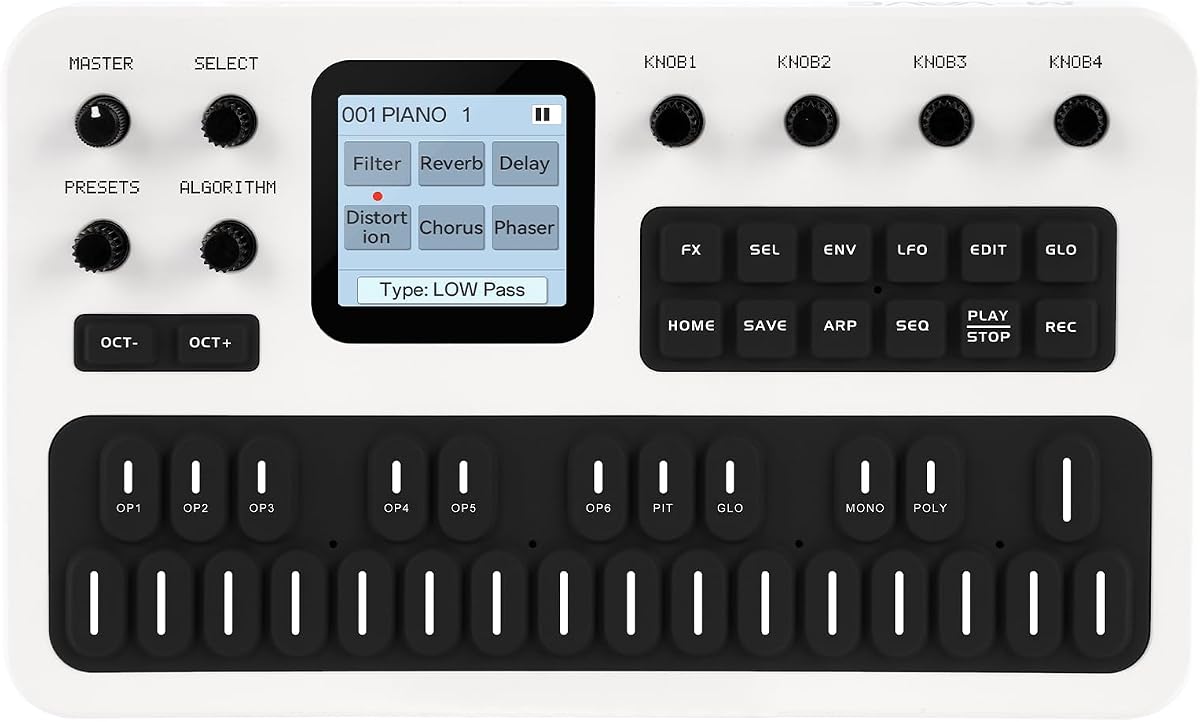
The white M-VAVE Wireless Portable FM Synthesizer offers the same ambitious feature set as the black version in a clean, highly visible housing. It is a miniature performance and production instrument rather than a novelty toy, with a proper piano-style layout, 27 full-range silicone keys, a color TFT screen, and a deep collection of FM synthesis tools.
We may earn a commission when you buy through this link, at no additional cost to you.
Six operators and 32 algorithms provide the central sound-design engine, and 128 factory presets make it possible to find strong starting points immediately. The preset bank spans familiar categories such as pianos, strings, brass, basses, and electric synths. Compatible FM SYSEX sound-bank import extends the possibilities, while separate controls for frequency, level, and feedback allow more detailed editing.
The built-in effects, arpeggiator, and 16-step sequencer are valuable for creating complete ideas rather than isolated notes. Sequencer operation includes note entry, recording, playback, and looping, and the step LEDs provide immediate visual feedback. Bluetooth MIDI, USB MIDI, and 3.5mm MIDI input can be used at the same time, which is impressive for such a compact device.
This model is ideal for a portable musician who wants recognizable keys, visual navigation, and studio connectivity. It may not replace a weighted full-size keyboard, and its compact silicone keys are not ideal for every playing style. Even so, it offers an unusually complete feature set for travel, busking, rehearsal, and mobile composition, making it an excellent alternative to the black edition.
The TFT screen gives users a clearer view of algorithm structure and sound-related settings than a collection of tiny indicator lights could provide. It makes experimentation more visual and reduces the need to memorize the location of every function.
The standard piano arrangement and 128 included sounds make the instrument approachable despite its advanced engine. Beginners can explore familiar timbres, while experienced players have enough modulation, sequencing, and MIDI capability to keep the device useful over time.
We may earn a commission when you buy through this link, at no additional cost to you.
The M-VAVE FM-1 stands out as the most complete pocket-sized synthesizer in this guide because it balances a recognizable mini keyboard, sophisticated FM synthesis, production tools, and genuine portability. It weighs 251 grams, measures 161.5 by 96.5 by 28.6 millimeters, and includes a rechargeable 2,000mAh battery rated for up to 12 hours of play.
We may earn a commission when you buy through this link, at no additional cost to you.
Its six-operator FM engine provides 32 algorithms and 128 factory presets, with SYSEX import for compatible sound banks. The 27 silicone keys span eight octaves, and 12-voice polyphony supports practical chord playing. A color TFT display visualizes algorithm structures and waveforms, while the controls support direct parameter editing without turning the device into a conventional desktop synthesizer.
The production tools are extensive. A seven-mode arpeggiator, 16-step sequencer with 16 independent sequences, and six effects—filter, reverb, delay, distortion, chorus, and phaser—cover common needs for beat creation and sound design. USB-C, Bluetooth BLE MIDI, and 3.5mm MIDI input can operate simultaneously, making the FM-1 useful with guitar multi-effects, DAWs, and external controllers.
Its main compromise is complexity. A new musician may find the number of features daunting, and the silicone keys do not offer the feel of a weighted stage keyboard. Even so, those limitations are modest compared with the combination of a rechargeable battery, built-in speaker, broad key range, deep FM engine, and flexible connectivity. It is the strongest overall recommendation for a portable instrument intended for both melody and production.
The FM-1 is small enough for a guitar case or backpack, yet its rechargeable battery and built-in speaker remove the need for external power or amplification. Automatic speaker muting when headphones are connected also makes the transition into focused personal practice convenient.
The combination of FM algorithms, independent sequences, an arpeggiator, effects, and simultaneous MIDI connectivity covers a wide production workflow. It can serve as a portable keyboard, sound module, controller, or small performance centerpiece depending on the setup.
We may earn a commission when you buy through this link, at no additional cost to you.
The Teenage Engineering Pocket Operator PO-12 specializes in rhythm rather than conventional keyboard performance. It combines synthesized drum sounds, sampled drum sounds, parameter locks, punch-in effects, and a compact sequencer in a device small enough to carry anywhere. That narrow focus makes it especially effective for beat makers who want results quickly.
We may earn a commission when you buy through this link, at no additional cost to you.
Its sequence-based workflow encourages rapid composition. Sixteen punch-in effects can be placed around the sequencer to alter or accent sounds, while 16 pattern chains allow short sections to be joined into longer arrangements. The control layout is intentionally minimal, concentrating attention on timing, variation, and the physical act of building a pattern rather than deep menu navigation.
The built-in speaker makes the device immediately usable, while the 3.5mm line output can connect to headphones, another Pocket Operator, or an external speaker such as the OB-4. Compatibility with related pocket-sized instruments is an important part of the platform's appeal, especially for users who want to build a small and unusual setup.
The PO-12 is not a substitute for a miniature melodic keyboard, and its compact controls are less suited to free-form playing. It also relies on two AAA batteries. Even so, for percussion, chiptune rhythm, and quick pattern-based composition, it is one of the most coherent pocket instruments available, offering a creative process unlike a miniature workstation.
Instead of forcing a drum machine into a keyboard layout, the PO-12 places sequencing and variation at the center of the interface. The result is immediate, tactile, and particularly effective for creating distinctive loops in a short session.
Pattern chaining, stereo output, and compatibility with other compatible pocket devices make this more than a standalone novelty. Users can connect the PO-12 to compatible gear to expand the available sounds and build coordinated sequences.
We may earn a commission when you buy through this link, at no additional cost to you.
The M-VAVE FM-1 Portable Digital Synthesizer presents a capable FM workstation in a battery-powered format. Its central selling point is the combination of a six-operator engine, 32 algorithms, 128 presets, a 16-step sequencer, a TFT color display, and a built-in speaker, all within a device designed for use away from a permanent studio or home keyboard.
We may earn a commission when you buy through this link, at no additional cost to you.
The factory library covers classic electric pianos, bells, basses, and other digital timbres, while SYSEX import offers a path to compatible sound banks. A dedicated algorithm control allows sounds to be changed quickly, and real-time knobs provide direct access to important parameters. This combination gives the instrument more personality than a simple preset-only device.
Creative sequencing is supported through note entry from the keys, a 16-step pattern workflow, and a visual display that helps users understand the current position. The arpeggiator includes seven modes, and six effects expand the range of the underlying voices. USB, Bluetooth, and 3.5mm MIDI can also be used simultaneously, supporting both controller and sound-module roles.
The compromises are typical of a compact instrument: the silicone keys are optimized for portability rather than expressive two-handed performance, and the editing interface cannot offer the screen area or control density of a full-size synthesizer. For a musician who prioritizes a broad sound palette, wireless MIDI, and battery independence, though, this M-VAVE FM-1 remains a flexible and capable portable option.
The 128-preset library provides immediate access to common FM categories, while the algorithm structure exposes the timbral relationships that make FM synthesis distinctive. Users can move from familiar electric pianos toward bells, basses, and more experimental sounds without changing devices.
Simultaneous USB, Bluetooth, and 3.5mm MIDI support makes it possible to integrate the FM-1 with software and hardware in ways that suit different setups. Its sound-module and controller capabilities provide more value than a standalone novelty keyboard.
We may earn a commission when you buy through this link, at no additional cost to you.
The orange M-VAVE Wireless Portable FM Synthesizer brings the same broad creative toolkit as the other black and white variants in a particularly eye-catching enclosure. It is designed for users who want a conventional mini keyboard layout, portable operation, and more sound-design depth than a simple teaching instrument can provide.
We may earn a commission when you buy through this link, at no additional cost to you.
Six operators, 32 algorithms, and 128 presets establish a strong FM foundation. The included sounds cover piano, strings, brass, basses, and electric synth categories, while SYSEX import allows compatible mainstream FM sound banks to be loaded. Individual operator frequency, level, and feedback adjustments provide deeper control for users who want to move beyond factory sounds.
A seven-mode arpeggiator, 16-step sequencer, and six effects broaden the range of musical results. Notes can be entered directly from the keys, and the sequencer supports recording, playback, and looping. Its LED indicators follow the current step, giving clear feedback without requiring the user to watch the display continuously.
The three-interface MIDI arrangement—USB, Bluetooth MIDI, and 3.5mm MIDI input—allows simultaneous use as a controller and sound module. This is a major advantage for musicians building compact production systems. The small silicone keys and limited screen size are less suitable for detailed performance or prolonged studio work, but they preserve the instrument's portability. The orange finish gives it a distinctive identity without changing its underlying capability.
The orange enclosure gives the instrument visible personality on a desk, stage, or in transit. It is a small aesthetic detail, but it makes the device feel more like a personal creative tool than a generic accessory.
Factory sounds and real-time algorithm selection provide a quick start, while editable operators, effects, and sequencing support deeper sessions. The same instrument can cover a first melody, an arpeggiated sketch, or a MIDI-controlled part in a larger arrangement.
We may earn a commission when you buy through this link, at no additional cost to you.
The Teenage Engineering Pocket Operator PO-20 Arcade is a compact synthesizer and sequencer centered on the sounds associated with classic arcade games and chiptune music. Its design is deliberately specialized, offering a small set of physical controls, an unusual sound character, and a pattern-based workflow that rewards experimentation.
We may earn a commission when you buy through this link, at no additional cost to you.
The instrument supports rapid beat making with synthesized arcade sounds, and its 16 punch-in effects can modify or emphasize notes as a sequence plays. Parameter locks introduce variation within patterns, while 128 patterns and 128 chords provide a substantial library for building complete pieces. These features make it more than a novelty sound box despite its minimal appearance.
A built-in speaker provides immediate playback, and the 3.5mm line output supports headphones, external speakers, and compatible pocket instruments. The stated output can deliver full stereo, preserving the playful character of the device. A folding stand, clock, and alarm-clock function further support its use as a compact everyday instrument.
The trade-off is specialization. There is no conventional keyboard for traditional melodic playing, the controls are extremely small, and the sound library is tied to an arcade-inspired palette rather than general-purpose synthesis. For musicians who love chiptune, game music, and left-field electronic composition, though, those limitations become part of the instrument's identity. It is the premium pick for a distinctive, highly portable creative workflow.
The PO-20 does not try to imitate a broad studio synthesizer. Its fixed sound palette, compact interface, and arcade-inspired engine concentrate attention on sequencing, timing, and variation, producing a result that larger instruments often struggle to imitate.
The 128-pattern and 128-chord libraries offer considerable material for building arrangements, and parameter locks make repeated phrases feel less static. Punch-in effects add another performance layer that can transform a simple sequence.
We may earn a commission when you buy through this link, at no additional cost to you.
The Teenage Engineering Pocket Operator PO-14 is a compact bass synthesizer and sequencer that concentrates on low-frequency musical ideas. With 15 synthesizer sounds, a micro drum, 16 punch-in bass-oriented play styles, and a compact sequencer, it offers a distinct alternative to a miniature keyboard for musicians interested in basslines, electronic patterns, and percussive low-end sounds.
We may earn a commission when you buy through this link, at no additional cost to you.
Its punch-in effects are particularly important because they introduce recognizable playing styles and rhythmic variations into a sequence. Users can build a basic bass pattern and then change its character without relying on a large editing interface. Sixteen pattern chains make it possible to combine shorter ideas into a more developed arrangement.
The built-in speaker and 3.5mm line output support both solo use and connections to headphones, external speakers, and compatible pocket equipment. As with the broader Pocket Operator line, the device runs on two AAA batteries, includes a folding stand, and offers clock and alarm-clock functionality, reinforcing its role as a compact personal music tool.
The PO-14 cannot satisfy a player who expects a keyboard range, weighted response, or broad instrument emulation. Its strength comes from specificity: it is built to make bass patterns quickly and distinctively. For electronic producers, beat makers, and anyone who wants a dedicated low-frequency sketch tool that fits in a pocket, it is a focused and satisfying recommendation.
The 16 bass-oriented punch-in styles allow performers to add movement and articulation to a sequence without navigating a large library. This makes the interface efficient for bassline experimentation, even though it does not offer general keyboard performance.
Pattern chains give short bass ideas a path into longer compositions, while the micro drum adds a complementary rhythmic layer. The result is a specialized sketchbook that can produce finished-sounding grooves in a small space.
We may earn a commission when you buy through this link, at no additional cost to you.
The Teenage Engineering Pocket Operator PO-35 speak turns vocal sampling into an approachable, portable creative process. A built-in microphone can capture environmental sounds, spoken phrases, or vocal textures, while a 3.5mm line input offers another recording source. Samples can be assigned to eight voice-character slots and then shaped with the built-in effects.
We may earn a commission when you buy through this link, at no additional cost to you.
The available characters—neutral, autotune, retro, noise, robot, fifth, vocoder, and synth—provide substantially different treatments of the captured material. Users can also transpose samples or change their scale, allowing a vocal fragment to become a pitched component of a melody. Eight effects add further opportunities to transform the sound before sequencing it.
Internal sample memory lasts up to 120 seconds, which is enough for short vocal phrases, found sounds, and compact musical ideas. The built-in speaker provides immediate review, and the 3.5mm connection supports headphones or external speakers. The compact sequencer allows captured material to be arranged rather than used only as an isolated effect.
The primary limitation is memory length, and the instrument is not designed for conventional polyphonic keyboard performance. Users should also consider the practical need to provide their own samples rather than relying on a large factory instrument library. For vocal experimentation, field recording, podcast sound effects, and melodic sampling, the PO-35 remains one of the most distinctive pocket synthesizers in the category.
The built-in microphone lowers the barrier to sampling, while line input supports instruments, playback devices, and other sources. Applying a voice character immediately gives the captured sound a musical role instead of leaving it as raw audio.
Neutral, autotune, retro, noise, robot, fifth, vocoder, and synth settings offer dramatically different results from the same recording. This makes the small set of sample slots more versatile than the headline memory figure might initially suggest.
We may earn a commission when you buy through this link, at no additional cost to you.
The right compact synthesizer depends on whether you want to play melodies, create patterns, perform bass, capture samples, or connect to a larger production setup. Evaluate the sound engine, control method, sequencing, power, output, and physical size together rather than focusing on a single headline specification.
A sound engine determines the character and range of sounds available. The Stylophone uses a simple analog-style voice controlled by a stylus, while the M-VAVE instruments use FM synthesis with six operators and multiple algorithms. The Pocket Operator models take specialized approaches, covering rhythm, arcade sounds, bass, and sampling. Consider whether you want immediate character from a limited palette or a broader engine that supports deeper sound design and preset loading.
Compact instruments differ sharply in how notes are selected. A piano-style keyboard with 27 keys supports chords and familiar musical patterns, although silicone keys have a different feel from weighted plastic or wooden keys. A stylus touch surface is highly intuitive but mainly suited to individual notes and glides. A button-based sequencer encourages pattern creation rather than expressive keyboard performance. Think about whether you want to perform melodies, construct grooves, or do both.
Sequencing turns a portable instrument into an independent composition tool. Basic 16-step sequencers are useful for short riffs and arpeggiated patterns, while pattern chaining and parameter locks provide more variation across longer arrangements. The M-VAVE models support note entry, recording, playback, and looping, whereas the Pocket Operators emphasize pattern-based workflows. Review the number of steps, the number of independent sequences, and whether parameters can change during playback.
A large factory library can make a new instrument immediately useful, particularly for beginners or users who want results without extensive programming. The M-VAVE FM-1 models include 128 presets and support compatible FM SYSEX imports. Specialized Pocket Operator instruments provide curated sounds instead, which can be more useful when a consistent character is the goal. Decide whether variety or focused curation matters more to your workflow.
MIDI turns a pocket synthesizer into part of a larger workstation. USB, Bluetooth MIDI, and 3.5mm MIDI input allow different kinds of integration, and some devices can use several interfaces simultaneously. Audio outputs matter too: a headphone socket helps with personal monitoring, while a line output can send sound to a recorder, interface, mixer, or external speaker. Check both input and output because a product with one does not necessarily support the complete workflow you have in mind.
Compact size only matters if the instrument can travel and operate where you need it. The M-VAVE FM-1 uses a rechargeable battery and can run for up to 12 hours according to the supplied details. The Stylophone uses three AA batteries, while the Pocket Operators use two AAA batteries. Consider battery logistics, charging access, standby behavior, speaker volume, and whether the dimensions fit your bag, guitar case, or travel setup.
A built-in speaker makes a synthesizer immediately playable without an amplifier. It is essential for spontaneous ideas, travel, busking, and demonstrations, although speakers are usually optimized for casual listening rather than high-volume performance. All of the instruments in this guide include some form of built-in audio playback. Consider whether automatic muting, headphone support, and stereo line output are useful additions in your particular setup.
A long feature list can be an advantage for an experienced musician and a disadvantage for a beginner. The M-VAVE FM-1 exposes deep FM, sequencing, MIDI, and effects features, while the Stylophone and PO-12 offer more immediate, specialized workflows. Read the controls rather than judging only by preset count. A device that excites you and matches your current experience is more likely to become a regular creative tool.
Begin by reading the instrument's controls and learning a small set of useful sounds. On keyboard models, try the supplied piano, strings, brass, bass, and synth presets, then change only one parameter at a time. Stylus instruments are easiest to learn through repeated glides, while sequencer-focused devices benefit from creating a short pattern before adding effects, pattern chains, or punch-ins. Keep the first session focused on discovering how each control changes the sound.
Set up a practical signal path before recording or performing. Use headphones for quiet practice, a line output for a recorder or mixer, and MIDI connections when the instrument needs to control software or other hardware. On devices with multiple MIDI interfaces, confirm which connection is carrying notes, program changes, or clock data. A built-in speaker is ideal for sketching ideas, but an external speaker or monitored recording chain will provide more control over the final result.
Protect the instrument by keeping the touch surface, keys, controls, and headphone socket free from dust, moisture, and accidental impact. Install batteries according to the polarity markings and remove them during long storage periods when appropriate. For rechargeable models, use a compatible charging cable and avoid leaving the instrument in a hot or damp environment. Firmware, sound-bank, and software updates should be installed through the manufacturer's official process whenever connectivity requires them.
The Stylophone Original is among the easiest choices because it uses a flat touch surface and a physical stylus rather than a dense control panel. Each touch area plays a note, so a new user can begin making sounds almost immediately. The PO-12 is also approachable, but its sequencer-focused workflow requires a little more interest in patterns and rhythm.
Many of the featured M-VAVE FM-1 models support USB MIDI, Bluetooth MIDI, and 3.5mm MIDI input, allowing them to work with compatible music software. The Stylophone also offers a 3.5mm connection for sending audio to a computer. Check the required connection type and software compatibility before buying, because MIDI control and audio recording are different functions.
A mini keyboard is better for melodies, chords, and direct musical performance because it uses a familiar arrangement of playable keys. A sequencer-focused device is better for building loops, drum patterns, bass grooves, and arrangements through step editing. Some buyers maintain both styles by choosing a keyboard model with a built-in sequencer, as the M-VAVE FM-1 does.
They can be well suited to intimate performances, busking, mobile setups, and studio sessions. Battery operation, compact dimensions, and built-in speakers make them easy to deploy. For louder venues, however, a line output or headphone connection to a dedicated amplifier or sound system will provide better level control and reliability.
FM synthesis uses operators that modulate one another to create tones, bells, electric pianos, basses, and many digital textures. The Stylophone offers a much simpler analog-style voice controlled by a stylus. FM models generally provide more algorithmic depth, while the analog-style instrument prioritizes immediate character and simplicity.
The Teenage Engineering Pocket Operator PO-35 is specifically designed around vocal and environmental sampling. It includes a built-in microphone, 120 seconds of sample memory, eight voice characters, and eight effects. It also supports transposition and scale changes, making captured sounds easier to integrate into melodic sequences.
No. Each featured product includes a built-in speaker for immediate playback, which is useful for practice, travel, and casual performance. Headphone and line outputs remain worthwhile when you need more volume, a cleaner recording signal, or connection to other equipment.
Storage needs depend on whether the instrument relies on factory presets, supports imported sound banks, or stores samples. The M-VAVE FM-1 models support compatible FM SYSEX imports, while the PO-35 has up to 120 seconds of sample memory. Check the documentation for supported banks, import limits, and storage behavior before loading extensive libraries.
The Stylophone Original is the most approachable and budget-friendly way to explore pocket synthesis, while the M-VAVE FM-1 is the strongest all-round choice for melodies, sequencing, sound design, and studio connectivity. The Teenage Engineering Pocket Operator PO-20 stands apart for a polished, premium approach to chiptune and arcade-inspired composition.
Prioritize the way you want to make music. Choose a familiar keyboard and deep FM engine for broad musical use, the PO-12 for rhythm-first composition, the PO-14 for bass patterns, or the PO-35 for vocal sampling. Also consider connectivity, built-in speaker quality, battery life, and the amount of on-device navigation you genuinely enjoy.
Product listings, included accessories, ratings, and prices can change over time, so review the current description before ordering. The supplied ratings and specifications provide a useful starting point, but the best instrument is ultimately the one whose workflow supports the music you want to create whenever inspiration arrives.