
CyberPower CP1500PFCLCD
4.5Editor score
1500VA, 1000W rated capacity
PFC-compatible sine wave output
Twelve protected NEMA outlets
Color LCD status display
Compare the best 1000W UPS battery backup options for computers, networking gear, home offices, and sensitive electronics, with ratings and key features.
A 1000W UPS battery backup can keep computers, networking equipment, and other essential electronics running during outages while protecting them from voltage fluctuations and surges. The right unit should offer adequate runtime, clean output, useful monitoring, and an outlet layout that fits your equipment without unnecessary complexity.
We compared ten products based on rated capacity, battery technology, output waveform, runtime information, outlet configuration, connectivity, monitoring features, safety protections, and practical usability. The list includes lead-acid and lithium models, desktop and tower designs, consumer-friendly options, and network-manageable units for more demanding setups.
Each pick below highlights the most useful reason to consider that model and the compromises involved. Ratings reflect the supplied customer feedback, while runtime and compatibility depend on your connected load, outlet environment, and operating configuration. Product availability and pricing can change, so confirm current details before buying.
4.5Editor score

4.8Editor score

4.8Editor score
This side-by-side comparison shows each unit's rated power, battery type, output quality, protection features, and monitoring capabilities so buyers can identify the most suitable model for their equipment and environment.




The CyberPower CP1500PFCLCD combines a genuine 1000W rating with a relatively feature-rich outlet layout, making it a practical choice for a home office or small equipment group. Its supplied rating is 4.5, and its standout features include PFC-compatible sine wave output, 12 NEMA 5-15R receptacles, a color LCD, two USB charging ports, and automatic voltage regulation.
We may earn a commission when you buy through this link, at no additional cost to you.
The 1500VA/1000W configuration is appropriate for desktop computers, workstations, routers, modems, network switches, and telecom equipment, provided the combined load remains within the unit's limits. Sine wave output improves compatibility with Active PFC and conventional power supplies, while AVR corrects minor voltage fluctuations without needlessly draining the battery. Six outlets provide surge protection only and the other six also supply battery power.
The color display is more informative than the basic LED indicators found on many compact models. It presents battery and power conditions and can tilt as much as 22 degrees, improving visibility in different placements. Two USB ports, including one Type-A and one Type-C, provide convenient charging for phones and tablets. The included PowerPanel Management software and three-year battery-inclusive warranty add support for owners who want more than simple surge protection.
The main compromise is battery technology. Unlike the lithium models in this guide, this CyberPower is a conventional lead-acid system that can require maintenance and eventual replacement. It is also a large 1500VA unit despite its 1000W maximum output, and a UPS should not be treated as a guaranteed runtime specification. This is still the most accessible choice for buyers who specifically need a full 1000W rating, abundant receptacles, clean output, and detailed monitoring without moving to a more specialized system.
The 12-outlet arrangement is unusually useful for a home office because it can separate essential equipment from surge-only accessories. Plugging a computer, network gear, and monitor into the battery-backed group can prevent them from shutting down immediately when utility power fails.
The adjustable color LCD provides a more useful operating picture than a handful of status lights. PowerPanel Management software also gives compatible systems a way to inspect conditions, making this model a stronger fit for users who want visibility into battery and power status.
We may earn a commission when you buy through this link, at no additional cost to you.
This white GOLDENMATE model combines a full 1500VA/1000W rating with lithium iron phosphate battery technology, making it one of the more forward-looking options in the guide. It carries a 4.4 rating and distinguishes itself through a pure sine wave inverter, eight protected outlets, communication shutdown support, USB charging, and a smart LCD.
We may earn a commission when you buy through this link, at no additional cost to you.
The LiFePO4 battery is stated to offer more than 10 years of use and over 3,000 charge cycles. That cycle-oriented design is valuable for a UPS because frequent outages and repeated battery transitions are precisely where conventional lead-acid systems accumulate wear. The built-in battery management system monitors operating conditions, while the upgraded cooling system includes a fan specified below 50 dB. The fan activates under heavier battery use.
Output is specified as pure sine wave, supporting Active PFC and conventional power supplies in computers, workstations, network devices, and telecom equipment. A communication port and supplied USB cable can allow a properly configured Windows PC, Mac, or NAS to initiate a safe shutdown. Two front USB ports provide a combined 10W for charging common mobile devices, and the LCD presents real-time power and battery information.
There are important operating limitations. This UPS accepts 90–140V AC input and is designed around standard 110V household service. Generator power may not satisfy its voltage, frequency, waveform, or grounding requirements, in which case the unit may remain on battery and not recharge normally. Buyers with generators or unusual utility service should confirm compatibility first. For everyone else, it is a compelling full-power lithium option with flexible charging and clean output.
A 3,000-plus cycle battery specification makes this model relevant to users who expect intermittent outages rather than one rare blackout. The LiFePO4 design also reduces the frequency of battery replacement compared with traditional lead-acid systems.
The communication port and included USB cable support safe-shutdown workflows on compatible computers, Macs, and NAS systems. This is particularly valuable for preventing file corruption when battery power is limited and an orderly shutdown is better than an abrupt loss.
We may earn a commission when you buy through this link, at no additional cost to you.
The gray GOLDENMATE offers a full 1000W output in a line-interactive lithium UPS format. Its supplied rating is 4.2, the lowest among these ten products, but that does not erase the practical strengths of a pure sine wave inverter, 51.2V 5.8Ah LiFePO4 battery, eight protected outlets, and USB-based shutdown support.
We may earn a commission when you buy through this link, at no additional cost to you.
The battery is specified to last more than 10 years and exceed 3,000 charge cycles, with no routine replacement or lead-acid-style maintenance expected. A battery management system monitors the pack, and an integrated safety function can halt charging and discharging if limits are exceeded. Automatic voltage regulation helps reduce the effect of outages, surges, drops, fluctuations, shocks, and unusually high or low voltage.
Its flexible outlet panel uses wider spacing so several differently shaped plugs can fit at once. This is a small design decision that can matter in a crowded power strip or workstation. A communication port and included cable allow a compatible Windows PC to shut down automatically. The front USB-C and USB-A ports share 10W of charging output, while the LCD and combined control switch provide operating information and alarm controls.
This model supports 90–140V AC input and is intended for standard 110V household service. As with the other GOLDENMATE units in this guide, generator output may not meet all input requirements and could leave the UPS in battery mode without proper recharging. Buyers should also consider whether a higher-rated product with a stronger customer-rating profile better fits a critical application. Otherwise, the battery longevity and spacious outlet design make this a solid full-output lithium option.
The wider spacing between receptacles is designed to accommodate multiple power cords at the same time. It is an understated feature that improves usability when the UPS must serve several desktop components with bulky plugs.
The integrated battery management system and protective cutoff are intended to support stable charging and discharging. For a unit intended to remain installed for years, those controls are as important as the nominal battery specification.
We may earn a commission when you buy through this link, at no additional cost to you.
This GOLDENMATE stands apart with its wall-mountable metal housing, full 1000W output, and automatic emergency light. It has a 4.3 rating and is aimed at buyers who want a neat installation, accessible outlet placement, and a lithium battery that can support more than 10 years of use and 3,000-plus charge cycles.
We may earn a commission when you buy through this link, at no additional cost to you.
The pure sine wave output is designed to support Active PFC and conventional power supplies in computers, NAS devices, monitors, routers, and other sensitive electronics. A transfer time below 10 milliseconds helps minimize disruption, while the battery system addresses outages, voltage drops, surges, and fluctuations. Eight NEMA outlets provide both surge protection and battery backup, and USB-C and USB-A charging ports deliver 10W combined.
The included screws allow the UPS to be mounted on a wall, reducing clutter around a workstation. Its automatic LED emergency light turns on when utility power fails, making it easier to see connections, locate equipment, or move safely in darkness. The light can be set to automatic operation or disabled through its dedicated switch. An LCD provides real-time battery and power status, and separate controls manage the display and buzzer.
A communication port and included USB cable support automatic safe shutdown for compatible Windows PCs, Macs, and NAS devices. As with the other GOLDENMATE models, the supported input range is 90–140V AC for standard 110V use. Generator power may not be recognized correctly. This model is especially attractive when mounting flexibility and emergency visibility matter more than having a compact desktop enclosure.
The built-in emergency LED is a meaningful convenience when a room is dark or equipment is located in a cabinet or behind furniture. It supplies immediate visibility while users check connections or move equipment to a safer location.
Pure sine wave output and a sub-10-millisecond transfer time make this UPS suitable for computers, NAS units, and monitors that benefit from stable AC output. The clean waveform also supports modern Active PFC power supplies.
We may earn a commission when you buy through this link, at no additional cost to you.
The ADMLi 1500VA/1000W LiFePO4 combines one of the guide's strongest ratings with a modern battery design and a genuinely full 1000W output rating. It supplies pure sine wave power, eight protected outlets, a monitoring LCD, and both USB-A and USB-C charging ports in a compact desktop-friendly enclosure.
We may earn a commission when you buy through this link, at no additional cost to you.
Its 25.6V 9Ah lithium iron phosphate battery is rated for more than 3,000 charge cycles under laboratory conditions. A smart battery management system monitors charging, discharging, and temperature to support stable operation. The pure sine wave inverter and transfer time of no more than 10 milliseconds are especially relevant to gaming PCs, desktop computers, NAS systems, monitors, routers, modems, and security equipment.
Automatic restart after a complete discharge is a thoughtful addition. Once utility power returns, the unit can resume output and allow connected equipment to come back online without requiring a physical interaction with the UPS. Surge and overload protection round out the core electrical safeguards, while the LCD provides important operating information and the USB ports handle everyday mobile-device charging.
Runtime remains the central caveat. The full 1000W figure describes maximum output, not how long the battery can sustain every connected device. Users must also account for laboratory conditions when comparing cycle claims. Even with those limitations, this is one of the most balanced choices here because it combines high customer feedback, modern battery management, clean output, automatic recovery, and a straightforward 1500VA/1000W platform.
Pure sine wave output and a fast transfer make the unit well suited to modern PCs, NAS systems, and networking equipment. The output is designed to provide a stable alternative when utility power becomes unreliable or disappears.
Automatic restarting after the battery has fully discharged is useful in unattended installations. Connected devices can resume receiving power once utility service returns, reducing the need for someone to be physically present at the UPS.
We may earn a commission when you buy through this link, at no additional cost to you.
The Everamp model is the premium construction choice in this guide, pairing a 4.8 rating with a 1000W maximum output, a lithium iron phosphate battery, and a dual-metal enclosure. Its specified runtime of up to 24 minutes at a 500W load and 25°C gives buyers a clearer sense of expected performance than headline capacity alone.
We may earn a commission when you buy through this link, at no additional cost to you.
The 25.6V 9Ah LiFePO4 battery is stated to offer more than 10 years of life and over 3,000 charge cycles. Smart battery management reduces maintenance demands, while the lithium cells provide long service life, high capacity, and lower weight than traditional lead-acid alternatives. The product information also notes that the battery avoids acid leakage and thermal runaway risk.
All eight outlets provide surge protection and battery backup, which simplifies load planning because buyers do not need to study a split outlet bank. The included USB cable can connect a PC, Mac, or NAS for an automatic shutdown signal through supported operating-system settings. A front LCD displays battery and power status, two LED indicators show normal operation or fault type, and USB-C and USB-A ports add convenient charging.
The premium qualities come with physical trade-offs. A heavy-duty transformer and dual-metal casing make this model heavier than many competitors, and five-sided cooling vents require enough room for airflow. The 24-minute runtime is a maximum under a specific 500W, 25°C test and will differ under other loads and temperatures. Buyers who prioritize rugged construction, useful runtime data, clean output, and extensive outlet support will find this model especially well considered.
Stating runtime at a defined 500W load and temperature gives buyers a useful baseline. It is still an ideal laboratory figure, but it is more informative than simply saying the unit has a 1000W maximum output.
Five-side cooling vents help dissipate heat from the heavier transformer and internal electronics. The design supports placement on a shelf, inside a cabinet, or beside other devices while maintaining an airflow path around the enclosure.
We may earn a commission when you buy through this link, at no additional cost to you.
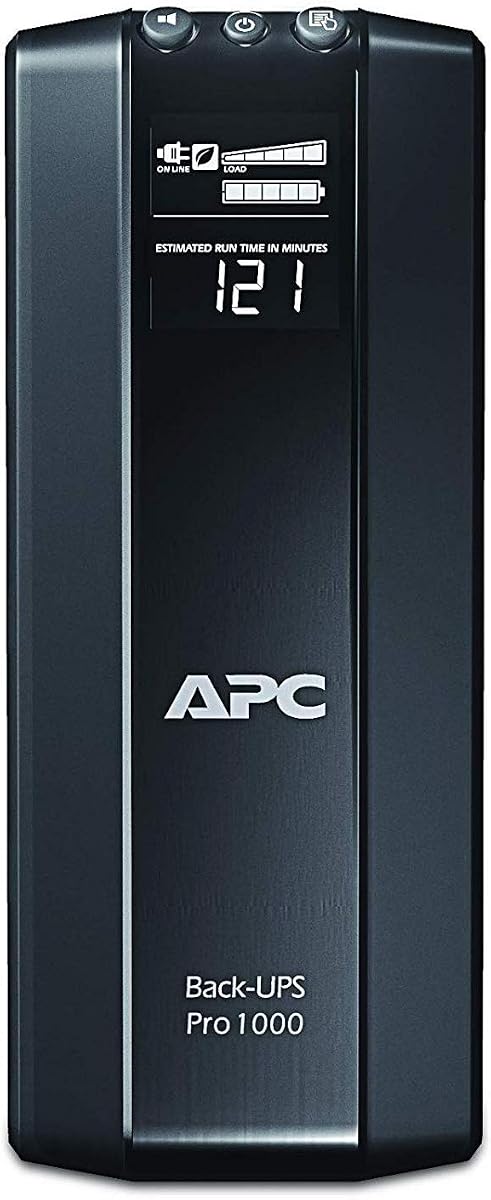
The APC Back-UPS Pro BR1000G is a well-established tower-style option for computers, external drives, routers, and consumer electronics. Its supplied rating is 4.6, and it combines eight protected outlets, automatic voltage regulation, and intelligent battery management in a straightforward enclosure.
We may earn a commission when you buy through this link, at no additional cost to you.
One important distinction is its output rating. Although it appears in a 1000W search, the BR1000G is rated at 1000VA and 600W. That makes it suitable for lighter equipment groups but not appropriate for a high-power workstation or system that actually needs a full 1000W. Four outlets provide battery backup and surge protection, while four additional outlets provide surge protection only.
Automatic voltage regulation maintains safer voltage conditions without using the battery for minor corrections. This can preserve backup capacity during brownouts and unstable line conditions. The intelligent battery management system is designed to optimize charging, performance, and service life, making the unit a straightforward option for a home office that needs continuity for networking and a desktop computer.
There is no LCD, pure sine wave claim, USB charging, or detailed shutdown communication in the supplied specifications, so it is not the most advanced option. It also does not satisfy a literal requirement for 1000 watts. Its appeal lies in a more compact, uncomplicated backup platform for modest loads. Choose it when 600 watts is enough and simple network protection matters more than high output capacity.
The BR1000G can maintain a wireless router and computer during an outage, helping preserve network connectivity for dependent devices. External drives and other electronics can also use the battery-backed section for protection.
Automatic voltage regulation corrects minor line instability without immediately moving the system to battery power. This approach helps retain backup energy for a genuine outage rather than using it for every small voltage fluctuation.
We may earn a commission when you buy through this link, at no additional cost to you.
The APC Smart-UPS SMC1000C combines a 5.0 supplied rating with remote monitoring and management features that distinguish it from basic home UPS systems. It is a 1000VA/600W line-interactive tower with pure sine wave output, eight NEMA 5-15R outlets, AVR, an LCD, and a SmartConnect Ethernet port.
We may earn a commission when you buy through this link, at no additional cost to you.
SmartConnect is the feature that makes this model especially interesting for small businesses and advanced home installations. Through cloud-based remote monitoring, users can check UPS status, perform firmware upgrades, conduct diagnostics, and receive proactive email notifications with recommended actions. That visibility is valuable when the unit protects equipment in another room, office, or unattended location.
The SMC1000C is positioned for entry-level servers, networks, retail point-of-sale systems, business VoIP equipment, and desktop computers. Its pure sine wave output is suitable for sensitive electronics, while automatic voltage regulation keeps output within user-selectable acceptable levels. Serial or USB connections can work with PowerChute Serial Shutdown software for graceful shutdowns that help protect data during longer outages.
This package also includes a 16GB USB storage drive. The important limitation is again the 600W maximum output, which falls short of a literal 1000W requirement. Network setup may also be more involved than for a basic LCD UPS. Even so, it is the strongest pick for users who prioritize remote supervision, orderly shutdown behavior, and a high customer-rating profile over maximum continuous wattage.
The SmartConnect port allows compatible systems to be monitored over a network connection. Cloud status information, diagnostics, firmware updates, and proactive notifications reduce the need for physical inspection after every power event.
Serial and USB shutdown options give supported systems a chance to power down in an orderly manner. That helps reduce data loss and file corruption when an outage is likely to outlast the available battery capacity.
We may earn a commission when you buy through this link, at no additional cost to you.
The APC Smart-UPS SMT1000 offers a balanced combination of pure sine wave output, eight fully protected outlets, an LCD, and network-management options. Its supplied rating is 4.3, and its 1000VA/700W capacity is more substantial than the 600W APC models in this roundup, though it still does not deliver a full 1000 watts.
We may earn a commission when you buy through this link, at no additional cost to you.
Pure sine wave output provides compatibility with Active PFC power supplies and sensitive electronics, making it a good fit for desktop systems, network devices, and related equipment. The eight outlets are listed as battery-backup and surge-protection receptacles, avoiding the inconvenience of dividing them into two groups. A solid-state AVR system boosts low input voltage and trims high voltage without operating on battery power.
The LCD provides operating information, while serial, USB, and optional Ethernet connectivity enable different management approaches. Output frequency can synchronize with mains, and the listed typical recharge time is three hours. This makes the SMT1000 a practical middle ground for users who want a recognized Smart-UPS platform and clean output without moving to a much larger installation.
Those strengths come with limits. The maximum output is listed as 700 watts in the main capacity description, with another specification giving 670 watts, so it is not a literal 1000W choice. The three-hour recharge period should also be considered when outages follow one another closely. Buyers seeking a full 1000W rating will find more suitable models elsewhere in this guide.
With all eight outlets providing battery backup and surge protection, users can distribute essential equipment without having to identify a protected subgroup. This is convenient in installations where every connected device is important during an outage.
Serial, USB, and optional Ethernet interfaces provide several ways to integrate the UPS with a computer or network. The options are useful for users who need local visibility as well as more centralized monitoring.
We may earn a commission when you buy through this link, at no additional cost to you.
The APC BX1500M is designed for a broad collection of home electronics and provides a 4.4 rating, ten protected outlets, and a stated runtime of up to 68 minutes at a 100W load. Its 1500VA/900W rating provides meaningful backup capacity, but it does not reach a full 1000 watts.
We may earn a commission when you buy through this link, at no additional cost to you.
Five outlets provide battery backup and surge protection, while another five provide surge protection only. Built-in coaxial and Ethernet surge protection extends the coverage beyond basic AC outlets. The stated runtime at a 100W load gives buyers a useful indication of how the unit can support a router, modem, computer, television, DVR, NAS, external drive, or smart-home device during a brief outage.
Automatic voltage regulation corrects low-voltage brownouts and surges without draining the battery, helping extend runtime for actual blackouts. The unit is also compatible with Active PFC gaming PCs. A replaceable APCRBC124 battery, sold separately, allows a serviceable battery replacement with minimal downtime, which is a meaningful advantage over sealed designs.
The LCD displays battery charge, estimated runtime, load capacity, and input voltage, providing unusually comprehensive information for a home-oriented UPS. ENERGY STAR certification indicates an efficiency level of 92% or higher. The main compromise is output: 900 watts is below the 1000W target, and the replacement battery is an additional purchase. It is still a versatile option for many homes, especially where more outlets and low-load runtime matter more than maximum continuous output.
The stated 68-minute runtime at a 100W load makes the BX1500M suitable for keeping essential connectivity and media devices alive during a short outage. Actual runtime changes with load, battery condition, and operating temperature, so the figure should be treated as a reference point.
Coaxial and Ethernet protection are valuable for connected home systems that may experience surges through lines beyond standard wall receptacles. The ten AC outlets and multiple protection layers create a broad protection package for varied equipment.
We may earn a commission when you buy through this link, at no additional cost to you.
A useful UPS purchase depends on more than a headline wattage. Capacity, waveform, battery chemistry, outlet count, monitoring, runtime, and electrical environment all influence whether a model will protect the equipment you actually own.
A product labeled 1000W should be capable of sustaining a combined continuous load up to 1000 watts, subject to its operating conditions. By contrast, units sold around 1000VA may deliver only 600 or 700 watts even though their apparent capacity can sound similar. Compare the maximum continuous output rather than using VA and watts as interchangeable labels.
Add the power requirements of the computer, monitor, network equipment, displays, and any peripherals that should remain operational. Check the startup demands of motors, older televisions, and other high-surge devices because peak requirements can exceed normal consumption. A UPS is better treated as a short-term continuity tool than as a permanent replacement for every household circuit.
Pure sine wave output closely resembles utility power and is the safest general choice for modern Active PFC power supplies, network storage, workstations, and other sensitive electronics. A PFC-compatible sine wave model can also serve these systems well. Modified sine wave output may be adequate for simple loads but is less suitable for sensitive or specialized equipment.
Traditional lead-acid batteries are familiar and serviceable, while LiFePO4 models are specified for substantially more charge cycles and long service life. Lithium systems can reduce replacement frequency and maintenance, but they require buyers to verify the manufacturer, input voltage, and warranty terms. For a replaceable lead-acid design, confirm that the correct battery is available for eventual servicing.
Maximum wattage tells you what the UPS can power, not how long it can do so. A model that offers a runtime estimate at a defined load, such as 500 watts or 100 watts, gives a more useful starting point. Actual runtime will vary with battery condition, temperature, and the power draw of connected equipment, so treat published figures as comparative guidance.
The total outlet count can be misleading if only part of the bank supplies battery power. Some models divide receptacles into battery-backed and surge-only groups, while others protect all outlets with backup. Count every device that must remain running and confirm which outlets receive power during an outage. USB-A and USB-C charging ports are useful additions but do not provide AC backup for larger equipment.
An LCD can show battery level, load, estimated runtime, and line status, making it easier to recognize a problem before equipment goes down. Communication ports and supplied cables may support automatic safe shutdown on compatible PCs, Macs, and NAS devices. Network-manageable models add remote diagnostics and notifications, which are especially useful for unattended offices and entry-level servers.
Consider the unit's size, outlet spacing, ventilation, noise, and mounting options. Wall-mounted models can reduce clutter, while dual-metal or ventilated enclosures may require more clearance. Also verify the supported AC input range. Several lithium models are designed for 90–140V input and standard 110V household service, and generator power may not satisfy their frequency, waveform, voltage, or grounding requirements.
Place the UPS on a stable, dry surface with adequate ventilation and space around the enclosure. If the model supports wall mounting, use the included hardware and confirm that the installation is secure. Connect the UPS to a correctly grounded outlet, allow it to charge fully, and identify which outlets receive battery backup before adding equipment.
Connect essential devices first, leaving capacity for startup demand and future needs. Route data and power cables so they do not become strained or disconnected accidentally. For a PC, Mac, or NAS, use the supplied communication cable and configure the relevant operating-system or UPS settings for automatic shutdown. Test the setup during a normal day by briefly transferring the UPS to battery mode and confirming that every essential device remains running.
Inspect the display periodically and replace the battery when the unit indicates a fault, especially if it has not been exercised under load. Keep the case vents clear, avoid exposing the UPS to heat or moisture, and use compatible equipment for any USB charging. For lithium models, follow the specified input-voltage and generator guidance; for lead-acid models, use only the appropriate replacement battery and follow the manufacturer's handling instructions.
No. VA measures apparent power, while watts measure real power, and the relationship depends on power factor and the connected load. A 1000VA UPS may have a maximum continuous output of 600, 700, 900, or 1000 watts, so its watt specification should be checked directly before purchase.
Runtime depends on the load, battery condition, and temperature. A 1000W unit running at or near its maximum will not provide the same runtime as one supporting a 100W router or monitor, so use any published runtime figure only as a reference for a comparable load.
It is highly beneficial for modern gaming PCs and other equipment with Active PFC power supplies. Pure sine wave output provides a cleaner transition than a modified waveform, while a confirmed PFC-compatible sine wave model can also be appropriate for many such systems.
Yes, provided the combined load remains within the UPS's supported output and the NAS, router, and switch use battery-backed outlets. Communication-compatible models can also signal the NAS to shut down safely before the battery is exhausted, reducing the risk of file corruption.
The lithium models in this guide are advertised as maintenance-free for long periods, with service lives of up to 10 years and cycle ratings above 3,000 under stated conditions. They still require correct installation, suitable input power, and periodic testing, and future replacement should still be considered at the end of their service lives.
Not every model is designed for generator-supplied power. Several GOLDENMATE products support 90–140V AC input for standard household service but warn that generator output may fail their voltage, frequency, waveform, or grounding requirements, potentially leaving the UPS on battery without recharging properly.
The listed USB-A and USB-C ports are primarily charging ports for phones, tablets, smartwatches, and other compatible devices. They should not be confused with the AC receptacles that provide surge protection or battery backup for computers and other equipment.
Keeping the UPS connected to a properly grounded outlet allows it to maintain its charge and remain ready for outages. Periodic testing and display checks are still important, because a plugged-in unit can develop a battery or charging problem that is not apparent until power is interrupted.
The CyberPower CP1500PFCLCD is the strongest general pick for buyers who need a genuine 1000W rating, PFC-compatible sine wave output, an LCD, and abundant outlets. The ADMLi stands out for its high customer rating, modern LiFePO4 battery, clean output, and automatic restart, while the Everamp takes the premium route with a dual-metal enclosure, all-outlet backup, and a clearly defined 500W runtime figure.
Prioritize the factors that directly affect your equipment: true continuous wattage, clean output, adequate battery-backed outlets, expected runtime at a realistic load, and safe-shutdown compatibility. LiFePO4 chemistry is attractive for frequent outages and long service life, while lead-acid units can be attractive when serviceability is important. The GOLDENMATE models add installation, alarm, cooling, and emergency-light variations that may suit particular spaces.
Finally, verify the current product details, supported input voltage, included accessories, warranty, and replacement-battery terms before ordering. Ratings, availability, and pricing can change, and published runtime or cycle figures depend on specific conditions. A careful load calculation and installation check will produce a more reliable result than selecting solely by the largest headline number.