
Nilight 90015A Battery Switch
4.7Editor score
On and off two-position operation
275A continuous at 12V
Waterproof housing and cover
Includes four mounting bolts
Our 12V Battery Disconnect Switch guide compares 10 options for fit, current handling, installation, durability, corrosion resistance, and dependable battery
A 12V battery disconnect switch gives vehicle and equipment owners a practical way to isolate a battery, reduce unwanted drain, and create a visible off position during storage or maintenance. The right model should match the battery-post style, provide adequate current capacity, and resist the electrical and environmental conditions found in its installation location.
This guide compares ten switches based on the information supplied for each product, including voltage compatibility, continuous and cranking ratings, terminal type, conductive materials, mounting options, and intended applications. The list covers top-post and side-post designs, single and dual switches, conventional manual controls, and a voltmeter-equipped option for added monitoring.
Each review explains the strongest reason to consider the product, along with the installation details and limitations that matter before purchase. The three leading picks emphasize pure-copper conductivity, heavy-duty construction, and useful voltage feedback, while the remaining options cover specific needs such as budget purchasing, removable controls, and flexible top-post mounting.
4.7Editor score

4.8Editor score

4.2Editor score
The table below compares all ten switches by terminal configuration, supported voltage, stated current capacity, and notable design features, making it easier to identify the model that fits a particular battery and installation.




The Joinfworld Top Post Battery Disconnect Switch is a conventional two-position manual isolator rated by the manufacturer for 250A DC continuous and 1,000A DC cranking. Its 4.2 rating reflects a generally positive market reception, while the top-post configuration and negative-side installation make it especially relevant to cars, RVs, boats, trucks, and battery banks with compatible posts.
We may earn a commission when you buy through this link, at no additional cost to you.
The switch uses ABS plastic around a copper battery clamp and tapered post, combining a simple on/off interface with conductive components intended for dependable electrical contact. Its stated 12V-to-48V range is broader than many competing designs, and the ability to stand alone or be locked with other switches adds flexibility for multi-switch installations.
The main limitation is that its mounting format is tailored to top-post batteries rather than side-post terminals. It also does not provide a voltage display or removable control knob. Those omissions are reasonable for a straightforward disconnect intended to isolate the negative battery connection, especially when straightforward operation is more important than monitoring features.
This is a sensible pick for an owner who wants a straightforward manual switch with ample stated current handling and broad application potential. Confirm the battery-post diameter, cable arrangement, and available clearance before buying, and install the switch on the negative side as described in the product information.
A stated 250A continuous rating and 1,000A cranking capacity provide useful headroom for many automotive and marine starting systems. The actual suitability still depends on the alternator, load demand, cable condition, and whether the switch matches the starting current of the equipment.
The negative battery clamp and tapered post are designed for installation on the negative terminal. This arrangement gives the user a clear physical indication when the battery is isolated and supports the product's stated purpose of limiting drain while stored.
We may earn a commission when you buy through this link, at no additional cost to you.
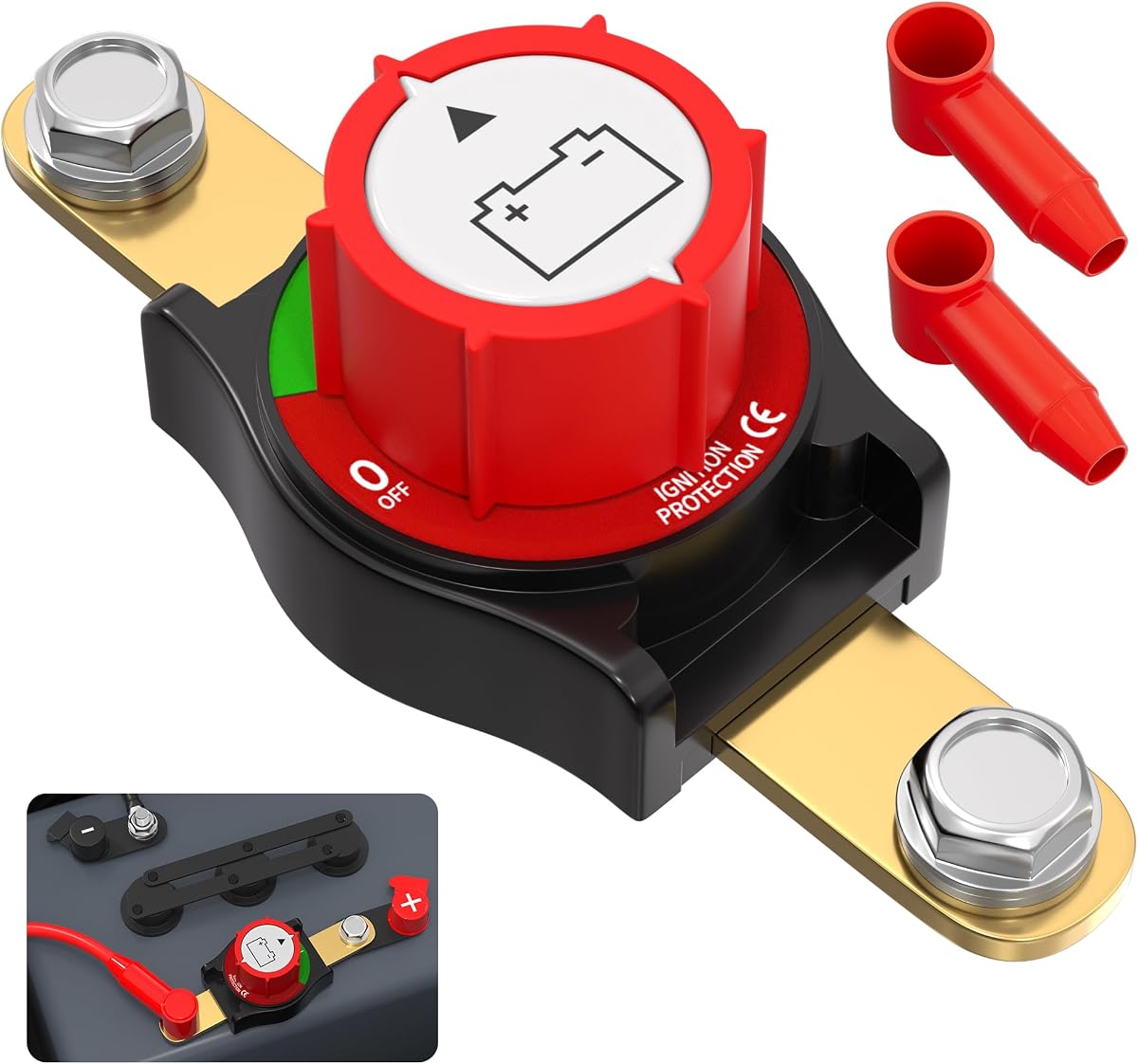
The Nilight 90015A combines a 4.7 rating with a simple on/off control and one of the stronger stated continuous-current figures in this group. It is a waterproof heavy-duty battery power cut switch for 12V-to-48V DC systems, with applications spanning cars, marine boats, RVs, campers, trailers, trucks, ATVs, UTVs, and battery banks.
We may earn a commission when you buy through this link, at no additional cost to you.
Its ABS housing is paired with a rear cover intended to insulate the terminals against short circuits. At 12V, the manufacturer states 275A continuous, 455A intermittent, and 1,250A momentary capacity, making the distinctions between sustained and short-duration loads particularly important when selecting it for high-output equipment.
The current figures are not interchangeable. A momentary rating does not mean the switch can continuously carry that amount, and the listed electrical performance is tied to 12V conditions. Its on/off design is otherwise uncomplicated, with no display or electronic controls to program, and four bolts are included in the package.
For most buyers seeking a capable, recognizable switch without paying for monitoring features, the Nilight is an attractive general-purpose recommendation. Verify terminal compatibility, cable size, and the clearance required around the rotary control, then follow the manufacturer's guidance for placement.
The difference between continuous, intermittent, and momentary ratings helps prevent overloading. Continuous capacity is the most conservative figure for sustained use, while the higher values describe shorter-duration events such as cranking and should not be treated as everyday operating loads.
A waterproof housing and rear terminal cover add confidence in wet or exposed installations. Secure the bolts properly, inspect the cable connections, and protect the switch from standing water or debris where practical.
We may earn a commission when you buy through this link, at no additional cost to you.
The BURMONG 275A Battery Disconnect Switch is designed for users who want a clear mechanical power cutoff across 12V, 24V, and 48V systems. It carries a 4.2 rating and a stated continuous current capacity of up to 275A, making it suitable for cars, trucks, RVs, marine boats, ATVs, campers, and battery banks.
We may earn a commission when you buy through this link, at no additional cost to you.
Its simple bolt-on design is operated through a clear 90-degree ON/OFF rotation. The switch typically mounts on the negative battery terminal, and its conductive clamp is described as solid brass or copper, paired with an ABS housing intended to resist corrosion in automotive and marine environments.
As with any universal product, compatibility requires verification rather than assumption. Buyers should inspect the terminal dimensions, cable hardware, nearby bodywork, and available operating clearance. The absence of a voltage display keeps the design simple, but users who want real-time battery readings must use a separate meter.
This model makes sense for seasonal vehicles, boats, RVs, and equipment that benefits from an obvious master power isolation point. It is especially relevant to owners focused on preventing parasitic drain during storage rather than adding integrated monitoring.
Opening the circuit during long parking or storage can reduce the small background draw associated with electronics, alarms, clocks, and control modules. This can help preserve battery charge, although it does not prevent all forms of battery deterioration.
The 90-degree rotation provides a visible and easily understood operating position. Because the switch is entirely mechanical, there is no separate control circuit to configure or electronic module that might add another potential failure point.
We may earn a commission when you buy through this link, at no additional cost to you.
This Pure Copper Two-Pack Battery Disconnect Switch provides two manual rotary switches for 12V and 24V systems. Its 4.0 rating indicates a generally favorable but less emphatic customer reception than the highest-rated products here, and its most distinctive feature is the inclusion of two switches in one package.
We may earn a commission when you buy through this link, at no additional cost to you.
The contact structure is described as pure copper, supporting high conductivity and low resistance while reducing voltage drop. The operating mechanism is deliberately mechanical: rotating upward cuts battery power, and rotating downward restores it. This gives users direct control without programming, extra control wiring, or a powered interface.
A significant drawback is the absence of a clearly stated continuous, intermittent, or cranking rating in the supplied information. Buyers should not assume that the switch is automatically suitable for a high-output starter or alternator simply because it is labeled heavy-duty. The 24V ceiling also makes it less versatile than several 48V-compatible alternatives.
The two-switch format can suit vehicles with multiple batteries, dual battery banks, or a need to place a disconnect in more than one location. It is also a straightforward option for a 12V or 24V setup where compact dimensions and pure-copper contacts are the main priorities.
Two independent switches give an installer more options than a single-switch package. They may be used on separate batteries or positioned according to cable routing and service access, depending on the vehicle's electrical layout.
Pure copper is used for the principal contact structure to promote stable current transfer. Correct tightening and clean contact surfaces remain essential because resistance can develop from corrosion, looseness, or poorly seated lugs.
We may earn a commission when you buy through this link, at no additional cost to you.
The Joinfworld Side Post Battery Disconnect Switch is tailored to vehicles and boats with side-post batteries. Its 4.2 rating accompanies detailed electrical specifications: 275A DC continuous for one hour, 455A DC intermittent for five minutes, and 1,250A DC cranking for ten seconds.
We may earn a commission when you buy through this link, at no additional cost to you.
Instead of relying on a standard battery clamp alone, it uses two M10 tinned copper studs and copper conductive sheets mounted with brackets. This arrangement is intended to connect directly to side-post batteries without additional connectors, which may save space and simplify the routing of battery cables.
The switch also has an ABS housing and a rear cover intended to insulate terminals against short circuits. Its suitability is tightly linked to terminal geometry and mounting space, however. The brackets must fit around the battery without contacting conductive surfaces, and the studs and cables require even tightening.
This is a strong option for a compatible side-post setup where cable routing is crowded and high starting loads are expected. Confirm the stud dimensions, battery layout, and hood clearance before purchase. It is less relevant to owners with top-post batteries unless they are willing to change the terminal arrangement.
The stated continuous, intermittent, and cranking figures include their recommended durations. These details make it easier to compare the switch with real starter and alternator demand, while also discouraging the use of short-duration cranking figures as continuous ratings.
Copper sheets and M10 studs create a direct connection to compatible side-post batteries. The bracket approach can reduce the need for extra terminal adapters, but correct positioning is important to prevent unintended contact.
We may earn a commission when you buy through this link, at no additional cost to you.
The Adjustable Top Post Battery Disconnect Switch stands out with a removable knob, adjustable mounting angle, and support for either direct clamp installation or connection through wire lugs. Its 4.4 rating indicates solid customer reception, and the product targets top-post batteries in conventional 12V vehicle systems.
We may earn a commission when you buy through this link, at no additional cost to you.
The housing is made from Nylon 66 with solid brass contacts. According to the supplied information, Nylon 66 is described as offering more than 30% greater strength and flame resistance than the ABS used in many similar products. The control offers ON, OFF, and removable-knob positions, allowing the user to take the knob away as a simple anti-theft measure.
Fitment is more prescriptive than with universal switches. The clamp is designed for negative posts measuring 15–17mm, or 0.59–0.67 inches. Adjustable mounting angles help accommodate tight engine compartments, but the battery post must still fall within the specified range. The stated 12V focus also makes it less attractive for higher-voltage systems.
This switch is a thoughtful choice for someone who values a visible physical lockout or removal control and has a compatible top-post battery. Verify the post diameter and cable arrangement before ordering, and avoid operating it while the engine is running.
Removing the knob after switching the battery off makes it more difficult for someone to restore power without the key-like component. It is a basic deterrent rather than a substitute for a comprehensive vehicle security system.
The adjustable angle can help the control face toward the user when the battery sits low or deep in a compartment. It also supports direct clamping or wire-lug connections, allowing the installer to select the arrangement that best suits the cable path.
We may earn a commission when you buy through this link, at no additional cost to you.
The Spurtar Battery Disconnect Switch combines a 4.5 rating with a 200A continuous and 1,000A intermittent specification. It is a manual on/off switch for 12V, 24V, and 48V DC systems and is positioned for heavy vehicles, boats, RVs, tractors, forklifts, motors, electric winches, and other high-current equipment.
We may earn a commission when you buy through this link, at no additional cost to you.
Its strongest practical feature is the included installation kit. The package contains the disconnect switch, two 3/8-inch copper lugs, two heat shrinks, and two rubber terminal insulator sleeves. These components support a cleaner custom connection and give the installer the pieces needed to finish cable termination and improve short-circuit protection.
The switch is described as operating smoothly with a clear click and no jamming, while the faceplate identifies ON and OFF positions. Its 200A continuous figure is lower than the 250A to 275A stated by several competitors, so demanding starter or alternator applications require careful comparison with the equipment's peak load.
This product is best for installers who value the supplied copper lugs and insulation accessories and need a robust manual cutoff across a wide voltage range. Its 4.5 rating and broad application support make it a strong all-round choice, even when another switch offers a higher nominal current rating.
The included lugs, heat shrinks, and rubber sleeves streamline the installation of a custom cable connection. These parts do not replace correct cable sizing, but they provide the principal termination accessories needed to complete the hardware installation.
The stated use cases include tractors, forklifts, off-road vehicles, and electric winches. Its 200A continuous rating remains meaningful, but the operator should compare that figure with the maximum steady current likely to pass through the switch.
We may earn a commission when you buy through this link, at no additional cost to you.
The Pure Copper 12V-48V Battery Disconnect Switch holds the highest customer rating in this roundup at 4.8. The two-pack includes manual rotary disconnect switches for common top-post battery systems, with stated compatibility across 12V, 24V, and up to 48V for cars, trucks, RVs, boats, tractors, and other battery-powered equipment.
We may earn a commission when you buy through this link, at no additional cost to you.
The battery clamp and primary current-carrying components are made from pure copper. This is central to the product's appeal because copper provides low resistance, stable conductivity, and greater ductility than brittle alloys, which can help the clamp tolerate repeated vibration. The stated instantaneous current capacity is 1,000A.
The biggest specification gap is the absence of a clearly stated continuous current rating. That makes 1,000A unsuitable as the sole basis for judging everyday load capacity. Buyers also need to confirm top-post dimensions and hood clearance because the design is not intended for side-post batteries. CE and RoHS certifications support the stated quality and materials, but they do not replace application-specific sizing.
This is the leading pick for buyers who prioritize pure-copper construction, vibration tolerance, a strong customer rating, and the flexibility of receiving two switches. It is especially useful for multi-battery or multi-location isolation. Before installation, verify the terminals, ensure the cables are rated for the load, and disconnect all loads before switching.
The copper clamp's ductility is especially relevant in vehicles and marine installations where road vibration, engine vibration, and movement can stress rigid connections. Tighten the clamp securely while avoiding overtightening that could distort the terminal or cable.
A two-pack provides useful options for dual-battery vehicles, battery banks, or installations requiring isolation at two points. Each unit installs directly to a compatible top-post terminal and operates without separate control wiring.
We may earn a commission when you buy through this link, at no additional cost to you.
The Malictele On/Off Side Post Battery Switch is a 275A, 12V-to-48V power-cut isolator designed for cars, vehicles, RVs, and boats with compatible side-post batteries. Its 4.4 rating indicates a favorable reception, and the removable-bolt design focuses attention on straightforward installation and maintenance.
We may earn a commission when you buy through this link, at no additional cost to you.
By connecting directly to the battery without requiring additional cables or connectors for the basic connection, the switch can simplify the installation process. Removable bolts also allow the unit to be detached more easily when maintenance or replacement is needed. The supplied information describes this arrangement as improving connection stability and helping reduce poor electrical contact.
The product information provides less detail about housing and conductive materials than several competing listings, so buyers cannot compare exact material composition from the supplied facts. It also offers no voltage display, removable security knob, or stated intermittent or cranking ratings. Those omissions matter when the switch will handle unusually high starting loads.
This is a good match for a side-post installation where direct attachment and serviceability are priorities. Confirm the terminal spacing, bolt reach, and cable clearance before purchase. For basic storage isolation and dependable on/off control, it offers a practical combination of 275A capacity and removable hardware.
The side-post design is intended to connect directly to the battery, reducing the number of separate adapters needed for a basic installation. Existing cable lugs may still have to be transferred, so the exact terminal layout should be inspected first.
Removable mounting bolts make it easier to loosen and remove the switch when it must be inspected or replaced. Keeping the mating surfaces clean and tightening the hardware evenly helps preserve a low-resistance connection.
We may earn a commission when you buy through this link, at no additional cost to you.
The Joinfworld Top Post Battery Disconnect Switch with LED Voltmeter adds one genuinely useful feature that most competing products lack: a digital voltage display. It carries a 4.2 rating and provides a two-position on/off control for 12V-to-48V systems, while the actual operating specification extends across DC 5V-to-60V systems.
We may earn a commission when you buy through this link, at no additional cost to you.
The display lets the user check battery voltage immediately after turning the switch on. According to the product information, the display does not drain the battery when turned off, preserving the switch's core storage function. Electrical specifications include 250A DC continuous and 1,000A DC cranking, with a two-way circuit and a negative battery clamp and tapered post.
The ABS housing and copper clamp follow the construction pattern of the standard Joinfworld switch, while the voltmeter adds complexity and makes this the most monitoring-focused product in the group. It is still limited to top-post batteries and offers no continuous rating above 250A. Users should also avoid expecting the display to replace periodic independent battery testing.
This is the premium pick for owners who want power isolation and immediate voltage visibility in one control. It is especially useful in boats, RVs, and stored vehicles where checking electrical condition without another meter is convenient. Confirm post compatibility and clearance, and select a heavier-gauge cable arrangement when required by the equipment.
Turning the switch on reveals the current battery voltage directly on the rotary control. This provides a convenient preliminary indication of system state, though a dedicated battery tester may still be needed for a more complete health assessment.
The manufacturer states that the LED display does not consume battery power when the switch is off. That feature preserves the practical value of the disconnect during long-term storage, when an always-on monitor would work against the goal of reducing drain.
We may earn a commission when you buy through this link, at no additional cost to you.
The most useful battery disconnect switch is not simply the one with the largest headline current figure. Terminal fit, installation access, sustained load requirements, environmental exposure, and the desired level of user control should all be considered before making a selection.
Choose a purpose-built model that matches the terminal geometry closely. Confirm fitment rather than assuming a universal switch will adapt perfectly.
Prioritize continuous capacity for normal operation, then confirm that the starting rating covers brief high-current events.
Prefer copper or brass contacts, then ensure the installation is clean, secure, and correctly sized.
Confirm the switch supports the highest system voltage present in the installation, including any linked battery banks.
Plan the control position and cable path before tightening anything, ensuring the switch remains accessible and protected.
Choose a housing suited to the environment and inspect it regularly for moisture, corrosion, cracks, or heat damage.
Add a voltmeter for visibility or a removable knob for deterrence, but neither replaces sound battery and security practices.
Check what is included, but separately confirm that cable size, lugs, and fasteners suit the battery and load.
Before installation, turn off the engine, shut down connected equipment, and remove the negative battery connection before handling the battery and cables. Position the switch where the ON and OFF positions remain visible and the control cannot contact metal parts. Connect the battery cable or lug to the switch as directed, restore the negative connection, and tighten the fasteners evenly. Avoid routing the cable across sharp edges, hot exhaust components, moving belts, or areas where it may be abraded.
Use the switch only after the vehicle or equipment is fully off. Turn the control to OFF before disconnecting the battery and confirm that sensitive systems have shut down. Do not operate the disconnect while the engine is running because the sudden interruption of charging current can create electrical transients and damage electronics. When returning the system to service, switch the disconnect on and confirm that the display, if present, shows a reasonable voltage before starting the engine.
For long-term storage, turn off the switch and periodically inspect the battery, terminals, cables, and switch housing. Clean corrosion with appropriate methods, keep the mounting hardware tight, and confirm the ON/OFF position is clearly visible. A disconnect reduces parasitic drain but cannot prevent battery aging, self-discharge, or damage from extreme temperature. Recharge or maintain the battery according to its manufacturer's guidance during extended storage.
Installing the switch on the negative side is the conventional approach for most automotive battery isolators because it reduces the risk of a energized positive lead being handled accidentally. Some specialized applications use a positive-side or multi-point arrangement, so follow the wiring design appropriate to the equipment. Confirm that the switch and cables are rated for the voltage, steady load, and brief starting current.
A disconnect can help preserve stored battery charge by reducing parasitic drain from electronics, alarms, control modules, and other low-power circuits. It cannot prevent all self-discharge or the chemical aging that reduces battery capacity. Periodic charging, suitable storage temperature, and routine battery inspection remain important, especially for batteries stored for months.
No. Operating a disconnect while the engine or charger is running abruptly interrupts current and may damage electronic modules, create voltage spikes, or cause a sudden loss of power. Shut down the engine, disable chargers and connected loads, and only then move the switch to the OFF position.
The continuous rating should comfortably cover the equipment's maximum sustained current, while the momentary or cranking rating should cover brief starter events. Do not rely on a large starting figure as if it were a continuous rating. Cable gauge, alternator output, motor load, connection quality, and the manufacturer's instructions can also limit safe performance.
Top-post batteries have terminals that project upward from the battery surface, while side-post batteries have recessed or outward-facing threaded terminals on the side. Measure the terminal diameter or thread size and inspect the available space. The Joinfworld side-post model specifies M10 studs, while the adjustable top-post model fits 15–17mm posts, so dimensions should guide the final decision.
It depends on the wiring arrangement and how the batteries are connected. In a parallel battery bank, a common positive-side master disconnect may isolate both batteries, while separate switches can provide more selective control. In a series bank, the switch must accommodate the combined voltage and current. Follow a proper battery-isolation diagram and use cables and connections rated for the arrangement.
A switch with a waterproof housing and protected terminals can be well suited to a marine installation, provided it is mounted away from persistent standing water and the electrical rating is adequate. Salt water accelerates corrosion, so stainless-compatible hardware, clean connections, protective cable sleeves, and routine inspection are especially important. A product labeled for marine use should still be installed according to its instructions.
Disconnecting the battery removes standby power from alarm modules, clocks, radio presets, window controls, and other electronics that may require constant memory. This can be normal when the battery is fully isolated for maintenance or storage. Check the vehicle manufacturer before assuming the reset indicates a failed switch or a wiring problem.
The Pure Copper 12V-48V Battery Disconnect Switch is the strongest all-around recommendation, combining a 4.8 customer rating, pure-copper current-carrying components, a 1,000A instantaneous specification, and two included switches. The Nilight 90015A is the best budget-oriented choice for its 4.7 rating, 275A continuous specification, protected housing, and simple two-position operation. The Joinfworld voltmeter model earns the premium position because it adds visible battery-voltage monitoring to a capable 250A continuous switch.
For every other installation, prioritize terminal compatibility before current capacity. Top-post and side-post products are not automatically interchangeable, and no current rating compensates for a switch that cannot physically fit the battery. After confirming fit, compare sustained load requirements with continuous current, brief starting demand with momentary ratings, and the environment against the housing and terminal protection. Access, cable routing, and included installation hardware can make a meaningful difference in the finished installation.
Product availability and prices can change, so confirm the current listing and all dimensions before purchasing. Check the battery-terminal size, system voltage, cable gauge, clearance, and manufacturer instructions at the time of purchase. With those details aligned, a properly installed disconnect can provide reliable isolation, reduced storage drain, and greater control over maintenance and security.