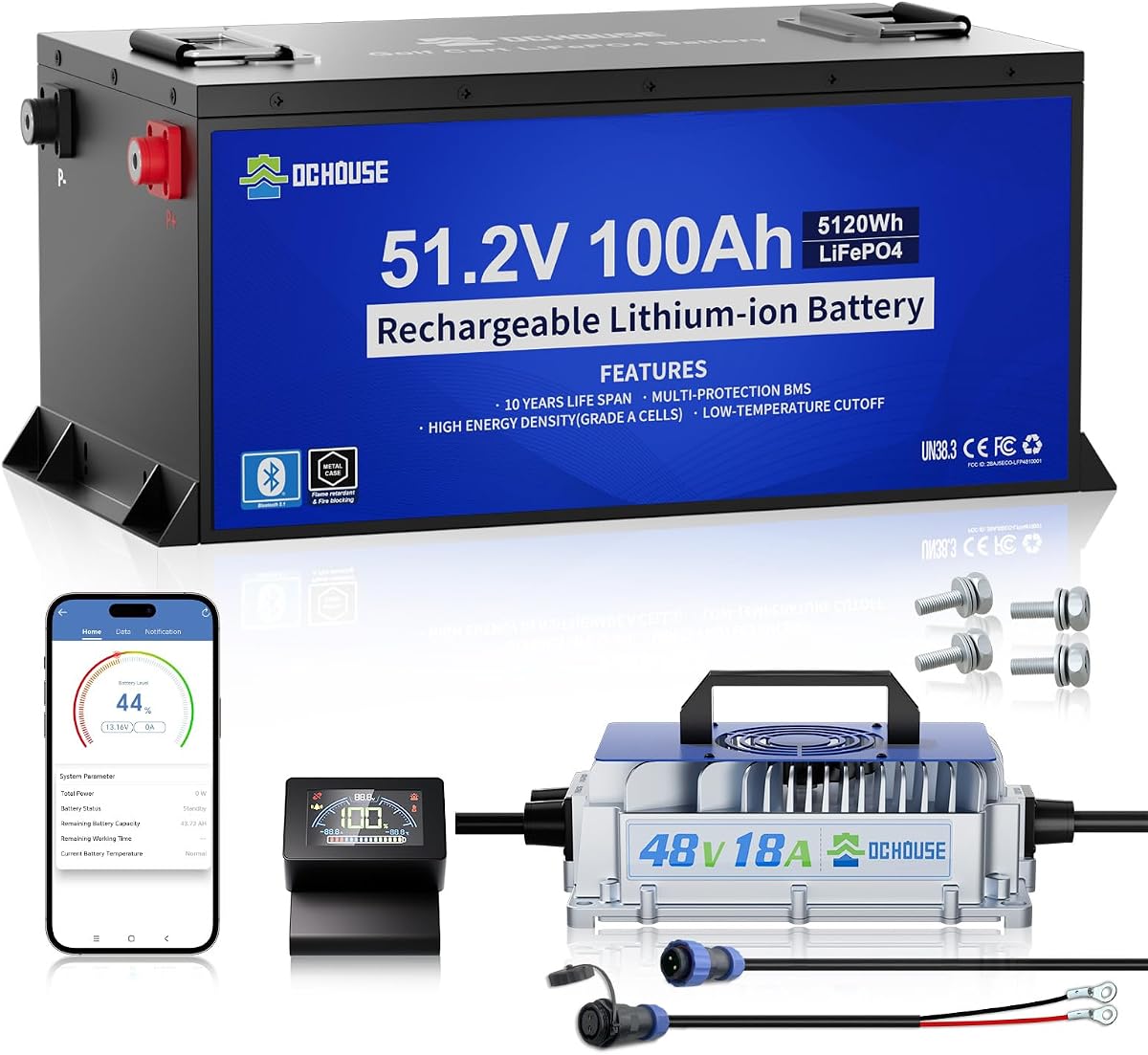
DC HOUSE Metal Case 48V 100Ah Lithium Golf Cart Battery Kit
4.8Editor score
Metal enclosure and fixtures
200A smart BMS protection
Charger and monitor included
Our 48V LiFePO4 Battery guide compares ten top models for capacity, power, cycle life, safety, monitoring, expandability, fit, and installation in 2026.
A 48V LiFePO4 battery can replace a bulky bank of lead-acid batteries with a lighter, more efficient, and easier-to-monitor energy source. The best model depends on runtime, motor demand, available space, charging setup, and whether the battery serves a golf cart, RV, boat, solar system, or home backup.
We compared the ten featured batteries using their stated capacity, energy density, BMS protection, cycle life, discharge capability, communications, dimensions, expansion options, and included accessories. The list covers both ready-made golf cart systems and more compact batteries intended for stationary storage, recreation, and off-grid use.
Each review explains where a product stands out and where its trade-offs may affect a particular installation. Specifications and configurations can change, so confirm dimensions, controller compatibility, charger requirements, and current pricing with the seller before purchasing.
4.8Editor score

4.6Editor score

4.8Editor score
This side-by-side comparison highlights the major differences in capacity, continuous power, cycle life, monitoring, expansion, and physical design, helping readers identify the most suitable battery for their equipment and installation.


The TEMGO 48V 51.2V 100Ah LiFePO4 Lithium Golf Cart Battery earns a 4.6 rating and stands out as the most complete general-purpose golf cart upgrade in this list. It combines a 100Ah battery, a 58.4V 18A charger, a 2.8-inch touch display, a retention strap, and Bluetooth-enabled monitoring in one package.
We may earn a commission when you buy through this link, at no additional cost to you.
Its headline performance figures are a 200A continuous discharge rating and a 600A peak for three seconds, with maximum power stated at 10.24kW. The battery management system is described as protecting against overcharging, over-discharging, short circuits, and temperature extremes, while the LCD and companion app provide real-time status information.
The product is also designed for expansion. Up to four batteries can operate in parallel, taking the stated usable capacity to 20.48kWh. That flexibility makes it useful for solar storage and off-grid systems, although buyers should not assume it can replace any existing lithium setup without checking communication requirements.
The important limitation concerns compatibility. It works with most 48V carts using a standard controller, but it is not compatible with carts originally equipped with lithium batteries that require CAN communication. Buyers should verify controller voltage and the full battery system before ordering, while owners of a conventional 48V lead-acid cart may find this one of the most balanced upgrade packages.
The included charger, touch display, retention strap, and mobile connectivity remove much of the guesswork from a conversion. That convenience is particularly valuable for installers who want a consolidated kit rather than a standalone battery.
A 200A continuous rating supports demanding cart loads, while four-unit parallel operation creates a path to considerably larger off-grid capacity. That makes the battery more versatile than a simple drop-in replacement.
We may earn a commission when you buy through this link, at no additional cost to you.
The DC HOUSE Metal Case 48V 100Ah Lithium Golf Cart Battery Kit has a 4.8 rating and offers one of the strongest all-in-one presentations at the accessible end of the category. It combines the battery, an 18A charger, and a wireless Bluetooth LCD monitor in a package designed as a straightforward replacement for a bank of lead-acid batteries.
We may earn a commission when you buy through this link, at no additional cost to you.
Power comes from a 200A BMS, 2C discharge capability, and a stated 250A continuous output with a 670A peak for half a second. The metal case and metal fixtures are intended to limit swelling and physical damage, while a one-key safety switch provides an accessible way to reduce power consumption when the cart is not being used.
The monitoring arrangement is unusually useful. The multipage display and mobile page can show capacity, voltage, and fault information. A reserved communication port also allows a separately purchased wired monitor, giving owners flexibility in how they monitor the system.
The trade-off is physical fit. Battery compartments vary among Yamaha, EZ-GO, Club Car, and other carts, and the manufacturer notes that modifications may be necessary. A wired monitor is not included, and the battery and charger may arrive separately, but the metal construction, complete kit, and 4.8 rating make this a compelling budget-focused conversion option.
The steel case and metal mounting fixtures distinguish this model from many ABS-enclosed competitors. The construction is intended to resist bumps, collisions, and the cell-swelling problems associated with some lithium battery installations.
The included Bluetooth display makes operating information available without repeatedly checking the battery. App support expands that visibility, while the reserved port preserves the option of a wired installation.
We may earn a commission when you buy through this link, at no additional cost to you.
The ECO-WORTHY Cubix100 48V 200Ah LiFePO4 Lithium UL9540 Server Rack Battery carries a 4.7 rating and targets sophisticated home and off-grid energy systems. Its certifications for UL9540, UL1973, and California Energy Commission listing make it one of the most formally safety-certified products in the guide.
We may earn a commission when you buy through this link, at no additional cost to you.
The 200Ah 51.2V unit provides 10.24kWh of nominal energy, with the listing describing it as usable for emergency outages, daily home backup, and solar-powered cabins. Its vertical server-rack format helps conserve space, and up to 32 units may be paralleled to reach a stated 163.8kWh, giving large installations considerable scaling room.
Integrated CAN and RS485 interfaces support communication with a broad range of solar inverters. Bluetooth and WiFi also enable monitoring through the ECO-WORTHY app, allowing users to view operating information without depending on a physical display.
This is not positioned as a compact golf cart battery, and its size makes careful rack planning necessary. It is also among the costliest products in the comparison. Even so, the combination of recognized certifications, advanced communications, large expansion potential, and a ten-year limited warranty makes it the premium choice for professionally planned energy storage.
UL9540, UL1973, and California Energy Commission listing distinguish this system from batteries that offer only internal BMS protection. Those credentials are especially relevant for stationary residential and commercial energy storage.
CAN, RS485, Bluetooth, and WiFi create several ways to integrate and monitor the battery. This is valuable for owners using compatible hybrid solar inverters or remote energy-management systems.
We may earn a commission when you buy through this link, at no additional cost to you.
The ECO-WORTHY Powermega 48V 314Ah LiFePO4 Battery has a 4.8 rating and is the largest-capacity model featured. Its 16.07kWh energy rating is intended for whole-home backup, extended outages, and demanding off-grid systems where minimizing the number of parallel batteries is valuable.
We may earn a commission when you buy through this link, at no additional cost to you.
The active balancing 200A BMS is designed to keep cells working evenly, improving charging consistency and reducing long-term capacity loss. Safety features include an external two-pole circuit breaker and integrated aerosol fire-suppression modules, while genuine Grade A cells form the battery core.
Operation and maintenance are supported by a seven-inch HD touchscreen, WiFi, Bluetooth, RS485, and CAN connectivity. Integrated wheels and M8 high-current terminals simplify handling and installation despite the product's substantial size.
The main drawback is logistical. The battery is shipped securely on a pallet by truck, so the delivery address must accommodate freight handling. The capacity and safety equipment also make it better suited to a fixed installation than a mobile application. For buyers building a large, professionally planned storage system, however, it delivers exceptional scale and integration.
A 16.07kWh unit reduces the number of batteries required for a large system. Up to 15 units can be paralleled, creating a stated maximum configuration of 241kWh.
The internal BMS, external breaker, grade-A cells, and aerosol suppression system provide several layers of protection. Those features suit installations where thermal-runaway mitigation is especially important.
We may earn a commission when you buy through this link, at no additional cost to you.
The LOSSIGY 48V Lithium Battery Golf Cart Conversion Kit receives a 4.6 rating and focuses on high burst power in a self-contained 48V package. Its 200A smart BMS is described as delivering a 1000A peak for three to five seconds, an aggressive figure for carts operating on hills, rough terrain, or loaded fairways.
We may earn a commission when you buy through this link, at no additional cost to you.
Automotive grade-A cells provide the energy foundation, and the manufacturer states at least 4000 cycles. The built-in BMS protects against high and low temperatures, short circuits, over-current, and overload, addressing the most common concerns associated with high-output lithium installations.
Compared with a traditional series of lead-acid batteries, the single self-contained unit is easier to install, transport, and remove. The package also includes a charger and monitor, reducing the number of accessories that need to be sourced separately.
Matching the controller and electrical system remains essential. A very high peak rating does not guarantee compatibility with every cart, and the battery should be installed only where the controller, wiring, and connector system can safely handle the load. For correctly matched high-power installations, it is a focused and capable conversion choice.
The stated 1000A peak gives the controller additional current for brief acceleration or climbing demands. This headroom can be valuable when the cart carries passengers, equipment, or steep terrain.
One enclosed battery replaces a lengthy group of lead-acid units. The result is less weight, a smaller footprint, and fewer inter-battery connections to inspect.
We may earn a commission when you buy through this link, at no additional cost to you.
The OGRPHY 51.2V 105Ah lithium battery has a 4.5 rating and is one of the most accessory-rich golf cart options in the guide. It arrives with an 18A charger, touch LCD monitor, and a 200A high-performance BMS, giving owners the core components needed for a lithium conversion.
We may earn a commission when you buy through this link, at no additional cost to you.
Its 5.37kWh energy capacity is slightly higher than most 48V 100Ah alternatives. The battery is rated for 10.24kW sustained output and a stated 51.2kW peak for three to five seconds. OGRPHY also states that it can run a 3kW motor cart for 50 miles under its testing conditions, although real-world range will vary.
Grade A LiFePO4 cells form the core, and the listing says those cells carry UL certification. A five-year warranty and around-the-clock customer service provide additional support, while the touch display makes operating information easier to read at a glance.
The range figure and peak output should be treated as manufacturer-stated performance rather than a universal guarantee. Cart weight, terrain, speed, payload, controller behavior, and stopping losses can all alter results. Still, for a correctly equipped 48V system, the combination of capacity, monitoring, power, and a five-year warranty is attractive.
A 105Ah rating raises the battery's nominal energy to 5.37kWh. The extra capacity can improve runtime on carts that repeatedly climb, carry passengers, or travel over uneven terrain.
Including a charger and touch display simplifies the initial setup. Owners can check battery status from the cart and avoid having to select a separate charging system immediately.
We may earn a commission when you buy through this link, at no additional cost to you.
The 48V 100Ah Lithium LiFePO4 Battery for RV, Camper, Boat holds a 5.0 rating and focuses on portable energy rather than high-current golf cart use. At a listed 79 pounds, it is presented as a manageable option for RVs, campers, marine applications, and small solar installations.
We may earn a commission when you buy through this link, at no additional cost to you.
Automotive grade-A LiFePO4 cells support consistent output, while a 100A smart BMS provides overcharge, over-discharge, overcurrent, and short-circuit protection. The stated cycle count exceeds 4000, and the listing describes a service life of up to ten years under appropriate operating conditions.
The battery supports parallel connections for capacity expansion, but not series connections. That limitation makes it straightforward to build a larger same-voltage bank, though it does not support higher-voltage configurations.
Its 100A BMS is lower than the 200A systems offered by several golf cart models, so it is not the right choice for demanding traction loads. For RVs, boats, trolling motors, solar storage, and home backup, however, the combination of low weight, broad application support, and easy expansion is compelling.
The listed 79-pound weight makes the battery easier to handle than a large stationary bank. That portability is useful for RV owners who need meaningful capacity without accepting the weight of multiple lead-acid batteries.
Parallel support lets owners add matching batteries as storage needs grow. The absence of series support is worth noting, but it keeps the installation simple for common 48V applications.
We may earn a commission when you buy through this link, at no additional cost to you.
The VATRER POWER 48V 100Ah Lithium LiFePO4 Battery has a 4.7 rating and combines a high stated cycle count with polished monitoring features. Its 16 automotive grade-A prismatic cells are arranged to provide 5.12kWh of energy, and the product is described as compliant with UL1973 and certified by Intertek ETL.
We may earn a commission when you buy through this link, at no additional cost to you.
A built-in touch display gives users direct access to battery information, while a companion app extends visibility to a phone. The one-touch on/off control also functions as a circuit breaker, automatically shutting the battery down when load current becomes excessive.
Two positive and two negative terminals help distribute current, reduce heat, and reduce the stress of concentrating current through a single connection. The 100A BMS provides overcharge, over-discharge, overcurrent, and short-circuit protection, with high-temperature charging cutoff and low-temperature discharge protection.
The 5000-cycle claim is among the strongest in the guide, but actual service life depends on depth of discharge, temperature, charging discipline, and load. The 100A rating also makes this battery better suited to moderate loads than sustained high-current golf cart work. For backup, solar, or moderate mobile applications, its monitoring and dual-terminal design are the main attractions.
The touch display, app, and one-touch breaker make operating information and shutdown control accessible. These features reduce the need to interpret basic electrical indicators manually.
Dual terminals of each polarity can lower resistive losses and improve heat distribution. This is a practical electrical advantage in high-current installations.
We may earn a commission when you buy through this link, at no additional cost to you.
The GrenerPower 48V 51.2V 25Ah Group 24 battery earns a 4.8 rating and is designed for compact, moderate-power applications. Its 1.28kWh-class capacity and 23.67-pound weight make it easier to install than a full-size 100Ah unit in RVs, boats, cabins, and small solar systems.
We may earn a commission when you buy through this link, at no additional cost to you.
A 50A BMS supports a stated maximum output of 2560W and provides protection against overcharge, over-discharge, overcurrent, short circuits, and high temperature. The battery can replace four 12V 25Ah lead-acid units or two 24V 25Ah lithium batteries, reducing the number of components in a 48V installation.
Up to four units can be paralleled, creating a 100Ah pack. The manufacturer states as many as 15000 cycles at 60% depth of discharge, though actual life will vary with operating temperature, charge maintenance, and depth of discharge.
The explicit restriction against motive power is essential. It must not be used in golf carts, starter applications, climbing equipment, power tools, or manned vehicles. Within its intended stationary and auxiliary uses, it is a compact and capable 48V option, provided the installation uses a suitable 58.4V lithium charger.
The 25Ah format provides useful 48V power without the footprint and weight of a 100Ah installation. It is well suited to backup loads, electronics, and auxiliary RV or marine circuits.
Four parallel units provide a straightforward path to a 48V 100Ah pack. This makes it possible to start with a smaller system and expand as storage requirements increase.
We may earn a commission when you buy through this link, at no additional cost to you.
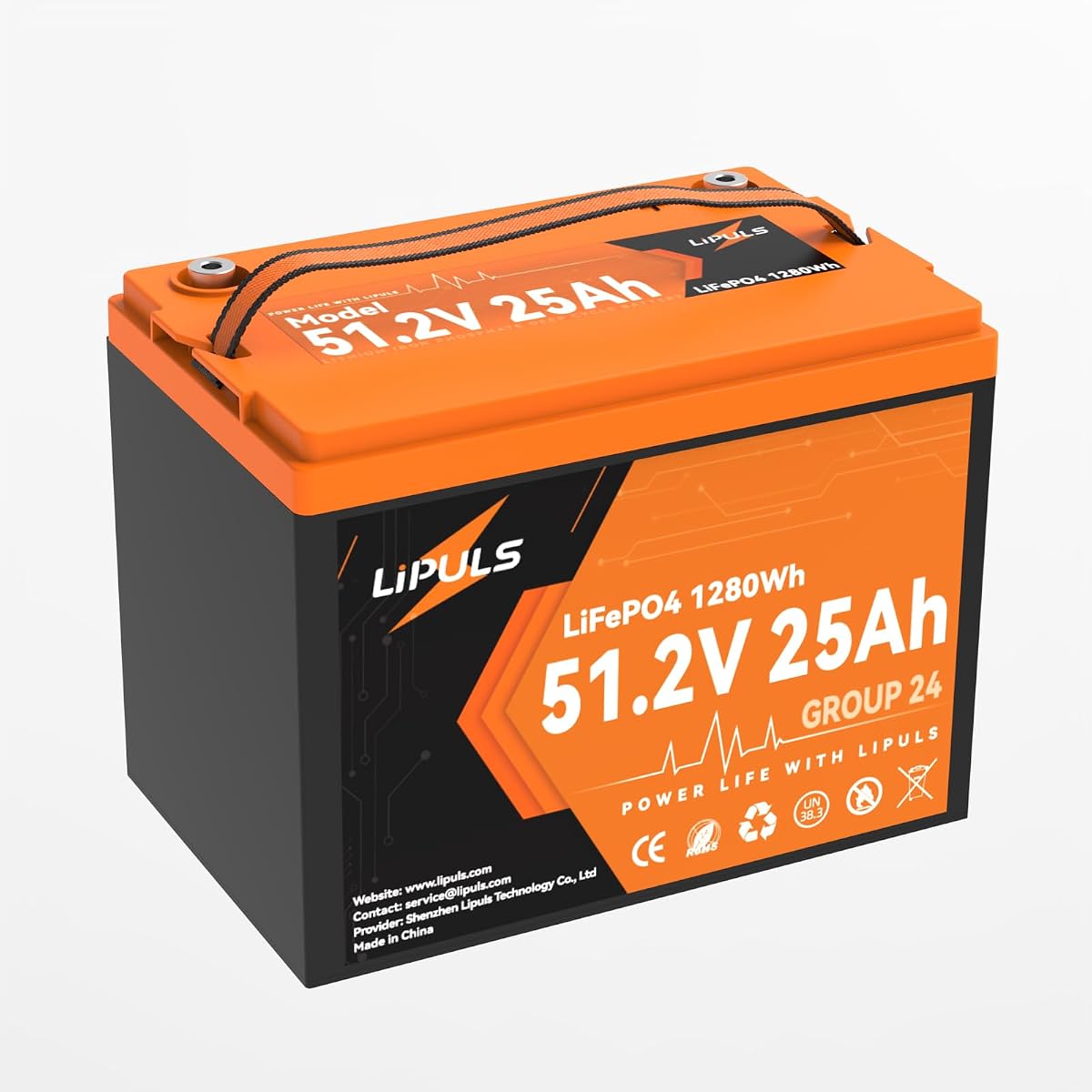
The LiPLUS 51.2V 25Ah LiFePO4 Battery has a 4.4 rating and offers a standard Group 24 approach to building a 48V system. Its stated dimensions and weight allow it to fit layouts designed around Group 24 batteries, simplifying replacements involving multiple 12V or 24V units.
We may earn a commission when you buy through this link, at no additional cost to you.
The battery contains A-grade cells and uses a 50A BMS to protect against overcharging, over-discharging, overcurrent, short circuits, and high temperature. Its 1280Wh energy capacity is appropriate for fishing, camping, wheelchairs, RVs, off-grid solar, and home energy storage, according to the listing.
The stated cycle range of 4000 to 15000 cycles and service life of up to ten years make it attractive for regular deep-cycle use. Charging should occur between 32 and 113 degrees Fahrenheit, while discharge operation extends from -4 to 140 degrees Fahrenheit, subject to the stated cell-surface limit.
This is a deep-cycle battery, not a starter battery, and the 50A BMS makes it unsuitable for high-traction use. Its lower rating than several competitors may reflect a more compact market position, but the standard Group 24 format, broad use cases, and familiar electrical architecture make it a practical entry for RV and mobile-storage builders.
Using the BCI Group 24 minimum size simplifies physical planning. It is particularly attractive where replacing a bank of smaller batteries with one 48V unit would improve handling and reduce component count.
The listed charging and discharge ranges help owners avoid operating the cells outside their intended envelope. Matching the environment to those limits is essential for protecting battery life.
We may earn a commission when you buy through this link, at no additional cost to you.
The right 48V LiFePO4 battery depends on more than nominal voltage. Capacity, power output, physical fit, communications, charger compatibility, expansion method, and intended application should all influence the decision.
Battery capacity determines how much energy can be stored before the usable portion of the pack is exhausted. A 25Ah 51.2V battery offers 1.28kWh, while a 100Ah unit offers 5.12kWh and the 314Ah Powermega provides 16.07kWh. Higher capacity extends runtime but also increases size, weight, charging time, and the amount of energy that must be accommodated by the inverter, charger, and wiring. For backup systems, estimate the daily load in kilowatt-hours and add sensible operating margin. For carts and trolling motors, consider starting demand, terrain, payload, and repeated use rather than relying on Ah alone.
A battery's continuous rating indicates the load it can support over an extended period, while peak ratings cover short acceleration or motor-starting events. Golf cart selections in this guide include 200A BMS systems, with stated peaks ranging from 600A to 1000A for several seconds. Compact 25Ah batteries use 50A BMS systems and are better matched to auxiliary loads. A high peak number is not useful if the cart controller, cables, or connectors cannot accept it, so assess the entire electrical system and avoid exceeding a battery's continuous rating.
The battery management system protects cells from overcharge, over-discharge, overcurrent, short circuits, and unsafe temperatures. Some models add low-temperature charging cutoffs, high-temperature protection, a one-key switch, an external circuit breaker, active balancing, or fire-suppression modules. These safeguards do not eliminate the need for correctly rated fuses, cables, ventilation, and compatible chargers, but they add another layer of control. For stationary residential systems, formal safety certification such as UL9540 or UL1973 can be particularly important when local authorities, insurers, or integrators evaluate the installation.
A nominal 48V LiFePO4 battery typically operates at 51.2V when fully charged and requires a charger designed for that chemistry. Several golf cart kits include a 58.4V 18A charger, while the compact 25Ah product recommends a dedicated 58.4V 5A or 10A lithium charger. Do not assume a lead-acid charger is safe for lithium chemistry, and do not use a charger designed for a different battery voltage. Verify the charger output, connector, charge profile, and automatic cutoff behavior before connecting it to the battery.
Battery dimensions are often more restrictive than the electrical specifications. Golf cart compartments vary by make, model, and year, so a 48V 100Ah battery that fits one cart may not fit another. Measure the available length, width, and height, including cable clearance and the retention system. For RVs and boats, check whether the battery must meet Group 24 dimensions. Also consider whether the compartment can be serviced, ventilated, protected from water, and secured against movement. A 25Ah Group 24 unit may fit where a 100Ah system cannot.
Touch displays, Bluetooth apps, WiFi, CAN, and RS485 can make a battery easier to manage. Basic Bluetooth monitoring may be enough for a golf cart, while home-energy users may need inverter communication for optimized charging and grid interaction. Check whether the communication protocol is supported by the exact inverter, and verify whether app setup, firmware, or a separate monitor is required. A wired monitor is not always included even when a wireless display is provided, so clarify the contents of the package before installation.
Stated cycle counts are best treated as comparative guidance because real life depends on depth of discharge, temperature, charging habits, current, and battery age. Products in the guide range from 4000-plus cycles to as many as 15000 under specified conditions. A deeply cycled solar bank should avoid prolonged low state of charge, while a lightly used backup battery may spend much of its life at a high state of charge. A battery with a stated five- or ten-year service life is not automatically superior if the planned application calls for different discharge depth or operating temperature.
Parallel expansion is the most common way to increase 48V capacity, and the featured products support between two and thirty-two units depending on the model. A larger bank can improve runtime but also requires matching communication settings, charge coordination, and conductor sizing. CAN and RS485 support may allow a battery to communicate with a compatible hybrid inverter, but communication alone does not guarantee that every operating mode will be supported. Before expanding a system, confirm the manufacturer's permitted configuration, parallel limits, cable guidance, and inverter communication requirements.
Before installation, identify the battery's voltage, capacity, terminal arrangement, communication requirements, and intended role. Measure the compartment, secure the battery with an appropriate restraint, install cables with suitable lugs, and confirm that the charger and controller or inverter are designed for 48V LiFePO4 operation. Do not assume a lithium battery is a direct replacement for every lead-acid installation.
Charge the battery with the specified 58.4V-compatible lithium charger and avoid exposing it to charging temperatures outside the manufacturer's stated range. Use the BMS, app, or display to monitor state of charge, voltage, current, and fault information. When expanding a bank, use compatible batteries, observe the stated parallel limit, and check every connection for tightness and signs of heating.
For longevity, keep the battery from prolonged deep discharge, avoid exposing it to extreme heat or moisture, and reconnect any retention system after maintenance. Inspect terminals and cables periodically, keep the enclosure clean and dry, and address unusual heat, odor, swelling, or fault messages promptly. Recycle or dispose of lithium batteries through an approved battery-recycling program rather than household waste.
Usually, yes, when the cart uses a compatible 48V controller and the battery's communication requirements match the installation. A standard 48V lithium battery is often suitable for a conventional lead-acid cart, but it may not work with a cart that expects CAN communication. Verify controller voltage, connector type, cable size, and battery dimensions before converting.
Most 48V LiFePO4 batteries use a 51.2V nominal chemistry and need a compatible 58.4V lithium charger. Some products in this guide include an 18A charger, while the compact 25Ah model recommends a 5A or 10A charger. Do not use a charger merely because it has a similar plug or a 48V label.
LiFePO4 chemistry is generally well suited to stationary storage, but safety depends on the entire system. Look for a capable BMS, correctly rated breakers and conductors, suitable ventilation, and recognized certifications such as UL9540 or UL1973 for permanent residential installations. Local electrical requirements and fire-code considerations should also be reviewed.
A 48V 25Ah unit stores about 1.28kWh, while a 48V 100Ah unit stores about 5.12kWh. The 100Ah model therefore provides roughly four times the energy, supports much higher loads, and usually weighs more. The 25Ah option is better for smaller loads and easier installations, while the 100Ah version suits longer runtime and more demanding equipment.
Most can be connected in parallel to increase Ah capacity while retaining the same 48V nominal voltage, but each model has a stated parallel limit. Connect only compatible batteries, use the recommended cable and connection procedure, and confirm that the charger and inverter can manage the enlarged bank. Series connection is not supported by every model and should never be assumed.
The label voltage describes the battery's nominal level, while a charged 51.2V LiFePO4 battery can read higher than that. Its voltage changes with state of charge, current, temperature, and the number of cells in series. Use the BMS or monitoring app to interpret the reading rather than judging battery health from the terminal voltage alone.
Bluetooth is convenient but not universally required. It can show state of charge, voltage, faults, and operating history without removing the battery or using separate meters. CAN or RS485 may be more important for a home inverter, while a simple stationary application may not require app connectivity. Choose the interface that adds useful visibility to your particular system.
Store it in a dry, secure, temperature-controlled location away from combustible materials and direct extreme heat. Use the manufacturer's storage-charge recommendations, inspect the terminals periodically, and avoid leaving a deeply discharged battery in storage for long periods. Because self-discharge is relatively low, following the specified storage charge remains important for maintaining capacity and balancing.
The TEMGO 48V 51.2V 100Ah battery is the strongest overall choice for a conventional golf cart upgrade because it combines substantial power, Bluetooth monitoring, a touch display, a charger, and four-unit expansion. The DC HOUSE 100Ah metal kit offers the best budget package, while the ECO-WORTHY Powermega 314Ah stands apart as the premium high-capacity choice.
For stationary storage, the ECO-WORTHY Cubix100 200Ah deserves attention for its safety certifications and inverter communications. RV, marine, and compact users should compare the 25Ah Group 24 models with the GrenerPower 100Ah battery, paying close attention to the 50A versus 100A BMS limits and the explicit restrictions against traction use.
Before purchasing, verify physical dimensions, controller or inverter compatibility, communication protocols, charger specifications, and parallel expansion limits. Product configurations and prices can change, so review the current listing and seller information before placing an order.
