
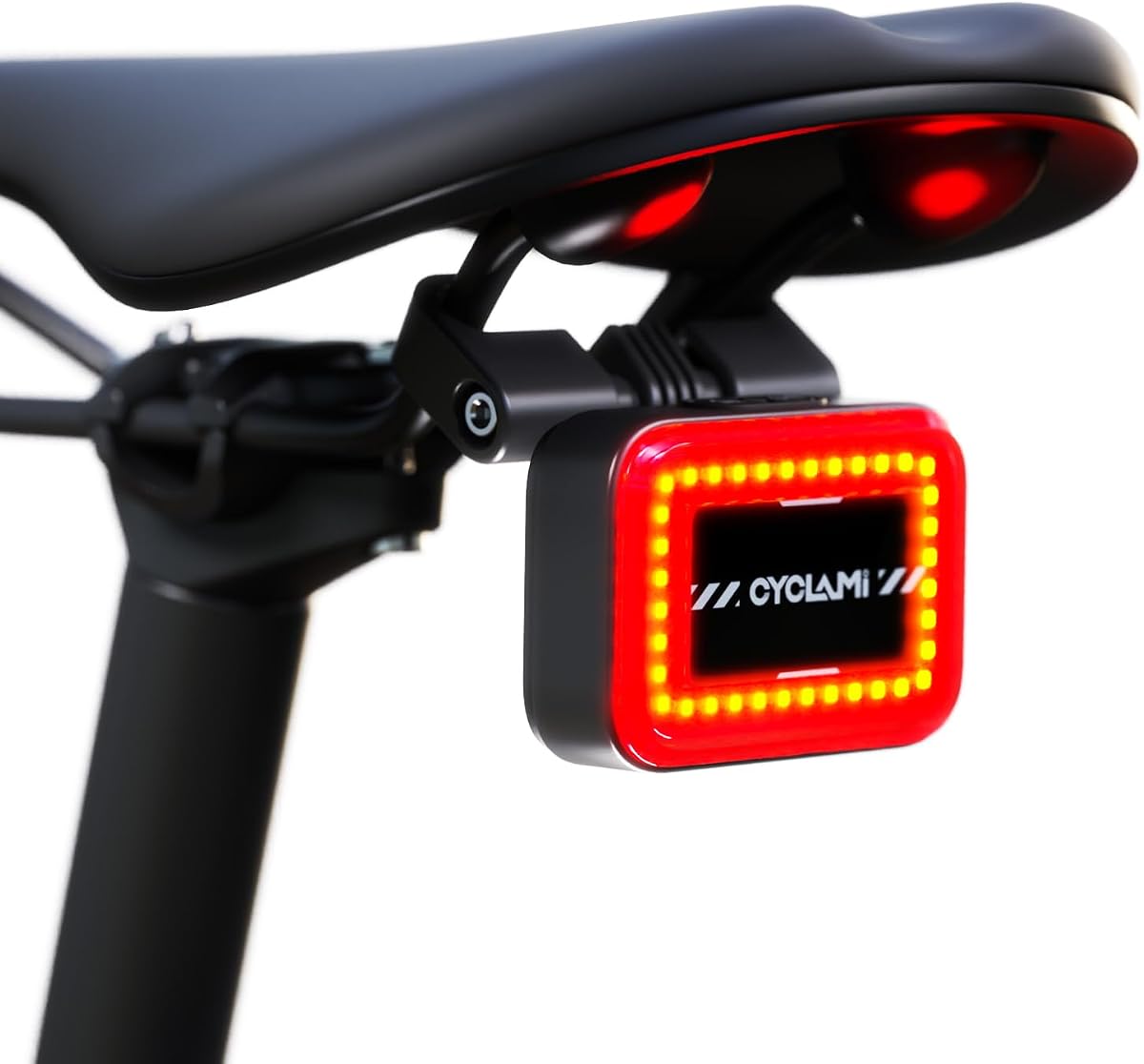
Bike Tail Light 24GHz Radar Sensor
5.0Editor score
Radar detects traffic behind
Dual red beam outputs
Audible and visual warnings
Eight selectable lighting modes
Our Bike Radar Tail Light guide compares ten models for radar range, lighting, alerts, battery life, mounting, and everyday cycling safety.
A bike radar tail light combines a conventional rear lamp with a sensor that detects vehicles approaching from behind. The best units add audible or visual warnings, automatic braking flashes, broad visibility, and useful cycling-computer connectivity, helping riders recognize traffic without repeatedly turning around.
We compared all ten products using the supplied specifications, focusing on radar range, detection angle, lighting output, warning methods, operating modes, battery endurance, weather resistance, mounting options, and device compatibility. The guide covers established cycling brands, app-connected options, and more affordable standalone radar lights.
Each review reveals which riders are most likely to benefit from a particular model, along with important compromises involving range, connectivity, or runtime. Ratings and specifications can change over time, and product prices fluctuate, so shoppers should confirm the latest listing details before making a purchase.
5.0Editor score

4.8Editor score

4.3Editor score
The comparison below highlights the major differences in detection range, lighting capability, rider alerts, and connectivity, helping you identify the model that best matches your bike, computer, and riding conditions.




The COOSPO TR70 combines a 70-lumen tail light, rear radar, automatic braking detection, and extensive device connectivity in one package. Its 4.5 rating reflects a balanced mix of long battery life, multiple lighting modes, and useful compatibility options. The radar can identify approaching vehicles within 140 meters, while the light's 220-degree visibility helps drivers see the rider from a broad range of angles.
We may earn a commission when you buy through this link, at no additional cost to you.
Its strongest selling point is the range of ways it can communicate with a rider. Pairing with a Garmin cycling computer, COOSPO CS500 or CS600, or the COOSPORIDE app allows real-time information such as vehicle distance and speed to appear on a screen. For riders who do not want to look back, this is considerably more informative than a basic audible warning. The unit also flashes automatically when a vehicle approaches and produces an instant high-beam alert during sudden braking.
The seven modes—Low, High, Breathing, Day Flash, Night Flash, Group Ride, and Radar-Only—make it possible to adapt the output to daylight, darkness, traffic, and group riding. Its stated runtime of up to 40 hours is excellent for longer tours, although the exact result will depend on which mode and features are active. IPX7 waterproofing offers stronger water protection than many competing products rated only IP64 or IPX6.
The main compromise is that some of the most impressive functionality depends on a compatible display or app. A rider without a Garmin computer or suitable COOSPO device may not see the full distance-and-speed information. The product must also be charged before first use, and the manufacturer advises against fast charging. Even so, the combination of long runtime, app flexibility, broad visibility, and a responsive radar makes the TR70 an excellent general-purpose recommendation for road, mountain-bike, and commuter riders.
A compatible computer or app can display the distance and speed of an approaching vehicle. This turns the TR70 from a simple warning lamp into a more informative rearview tool for busy roads and mixed traffic.
The advertised runtime of up to 40 hours reduces charging anxiety for commuters and touring riders. Radar-only and flash settings can also help riders balance awareness against battery consumption.
We may earn a commission when you buy through this link, at no additional cost to you.
The Garmin Varia RTL515 pairs a conventional rear light with a radar capable of detecting vehicles up to 153 yards, or 140 meters, behind the rider. It carries a 4.8 rating, the highest among the products in this guide, reflecting its mature combination of dependable alerting and well-established device support. Its vertical housing is designed for straightforward mounting on most road bicycles.
We may earn a commission when you buy through this link, at no additional cost to you.
The biggest strength is the variety of places warnings can appear. Compatible Garmin Edge computers, certain Garmin wearables, the dedicated radar display, and smartphones using the Varia app can provide visual and audible notifications. The app can also display graphics showing approaching cars and integrate with third-party services such as Ride with GPS, allowing radar information to appear alongside mapping data.
Visibility is another major advantage. The tail light is advertised as visible from up to one mile in daylight, helping motorists recognize the cyclist earlier. Peloton mode uses a lower-intensity flash for group rides, reducing the chance that the rear light will distract riders following closely behind. That makes the RTL515 more than a commuter safety device; it is also a well-considered group-riding accessory.
The main drawback is the relatively short six-hour runtime in solid mode, although day flash can last up to 16 hours. Riders seeking the longest possible radar-only endurance may find the newer RearVue 820 more capable. Nevertheless, the RTL515 offers an exceptionally mature combination of range, smartphone support, wearable integration, and mapping compatibility, making it a strong choice for riders already invested in Garmin or compatible cycling apps.
Compatible Edge computers, smartphones, and supported wearables give riders multiple ways to receive warnings. This flexibility is useful when your preferred cycling computer changes or when you also want alerts on a watch.
Peloton mode provides a lower-intensity flash intended for riders following close behind. It helps preserve the tail light's presence without creating unnecessary glare within a group.
We may earn a commission when you buy through this link, at no additional cost to you.
The iGPSPORT SR mini is built around a 160-meter radar range, the longest stated figure among the products reviewed. It can detect vehicles within a 45-degree angle and track as many as eight vehicles simultaneously. Its 4.3 rating reflects a capable combination of extended detection, multiple lighting patterns, and unusually broad compatibility with iGPSPORT, Garmin, Wahoo, and Bryton devices.
We may earn a commission when you buy through this link, at no additional cost to you.
The product is particularly attractive to riders who do not want to remain inside one manufacturer's ecosystem. It works with several listed iGPSPORT computers, including the BSC200S, BSC300T, BSC500, BiNavi Series, and iGS800, as well as the iGPSPORT App. It also supports compatible Garmin, Wahoo, and Bryton computers and smartwatches that use standard radar protocols.
The tail light has a wide 220-degree visibility angle and is advertised as visible from up to one mile. Multiple patterns cover steady, peloton, pulse, day flash, night flash, and radar-only use, allowing the rider to tailor output to the ride. A built-in sensor also detects braking and raises brightness, giving trailing road users a clearer indication that the cyclist is slowing.
The stated endurance is up to 20 hours in light mode or 25 hours in radar-only mode, with USB-C charging, low-battery brightness management, and automatic sleep and wake behavior. The radar-only figure makes sense for longer rides where preserving battery matters more than keeping the lamp illuminated. Although the compatibility list is broad, riders should verify their exact computer or watch model before buying. For anyone seeking long range and flexible device support, the SR mini is a compelling all-round choice.
Tracking multiple vehicles at once gives riders a more complete picture of traffic behind them. The extended range also provides more time to interpret an approaching vehicle's direction and assess the developing situation.
Support for major cycling-computer brands makes the SR mini useful for mixed equipment. Buyers should still confirm that their specific model supports the relevant standard radar protocol.
We may earn a commission when you buy through this link, at no additional cost to you.
The Bike Tail Light 24GHz Radar Sensor offers an approachable introduction to rear radar technology, with a 5.0 rating, a 230-foot detection distance, and a 56-degree horizontal coverage area. It combines a 58-lumen far beam, a lower 16-lumen near beam, and a built-in buzzer, giving the rider both visual and audible warnings without requiring a cycling computer.
We may earn a commission when you buy through this link, at no additional cost to you.
Its dual-beam design is especially useful because the two outputs serve different riding contexts. The brighter far beam is intended to help motorists spot the cyclist from a greater distance during solo riding, while the near beam provides a less intense option for group cycling. That thoughtful distinction separates this model from many single-output rear lights that offer little flexibility.
The unit also includes a red flash and buzzer alert that activates automatically during deceleration, effectively adding a brake-warning function. Eight lighting modes cover steady, fast flash, slow flash, warning flash, breathing flash, and running patterns. Its 800mAh battery recharges by USB Type-C in approximately two hours and is rated for up to eight hours of runtime.
This is not the longest-range or most advanced product here, and the 230-foot radar distance is modest compared with 140- to 160-meter models. It also lacks the detailed vehicle-distance and speed information offered by app-connected lights. Even so, its high rating, self-contained alerts, adjustable lighting, IP64 protection, and low 0.08-pound weight make it a strong value for riders wanting basic rear awareness without another screen or complicated setup.
The built-in buzzer means the light can alert the cyclist without a separate computer or phone. This keeps the product straightforward for commuters who prefer a dedicated rear safety device.
Switching between 58-lumen and 16-lumen beams allows riders to balance long-distance visibility with a less distracting output. The lower setting is particularly useful when another cyclist is riding close behind.
We may earn a commission when you buy through this link, at no additional cost to you.
The Garmin Varia RearVue 820 represents a premium approach to rearview awareness, combining advanced radar tracking with a high-output tail light. Its 4.3 rating is complemented by features that go beyond simply detecting a vehicle: compatible displays can show whether the vehicle is small, medium, or large, its movement, and the threat level associated with its approach.
We may earn a commission when you buy through this link, at no additional cost to you.
The tail light provides visibility from up to 2 kilometers, or 1.24 miles, according to the supplied specifications. That reach helps the cyclist become visible well before a driver reaches them. Four standard patterns—day flash, night flash, solid, and peloton—cover common conditions, and the Varia app adds the ability to create custom patterns for a more personalized setup.
Radar endurance is another standout. The RearVue 820 can operate for up to 30 hours in radar-only mode, while day flash is rated for up to 24 hours. Same-speed tracking is designed to maintain awareness of vehicles following at a similar pace or attempting to pass, although the feature may be unavailable at slower speeds or when the radar view is obstructed.
A distinct braking pattern communicates slowing or stopping, while a connected Edge computer, Garmin smartwatch, or smartphone app can provide audible and visual warnings. The trade-offs are cost and a mounting detail: the Varia seat rail mount kit is sold separately, although the unit does mount to a seat post. For riders who prioritize sophisticated threat information, long battery life, and polished Garmin integration, the RearVue 820 is the most advanced option in this guide.
Vehicle size, movement, and threat level can appear on a compatible display, giving riders more context than a generic proximity alert. That makes the system particularly useful on roads with mixed traffic.
Thirty hours in radar-only mode supports long rides, while custom light patterns let riders create a lighting signature suited to their preferences. The rear light and radar can therefore be configured around different riding environments.
We may earn a commission when you buy through this link, at no additional cost to you.
The 60M Radar Tail Light is a compact standalone unit centered on 24GHz millimeter-wave detection, audible warnings, and a responsive brake light. It has a 4.2 rating and weighs only 54 grams, making it easy to carry and unobtrusive on a road bike, mountain bike, or commuter bicycle.
We may earn a commission when you buy through this link, at no additional cost to you.
The radar detects cars from as far as 60 meters and motorcycles from 30 meters, with a 54-degree detection angle. Its warning system grows more urgent as traffic closes: one beep is emitted at 60 meters and two beeps at 10 meters. A vibration-sensing feature helps activate the device when riding begins, reducing unnecessary power use while the bicycle is stationary.
Visibility is handled by 40 COB LEDs with a stated range of up to 500 meters. A high-precision brake sensor raises brightness by 20 percent during braking. Five lighting patterns include steady, fast flash, slow flash, breathing, and SOS, with stated runtimes ranging from three to six hours. The rugged aluminum-alloy and polycarbonate housing carries an IP64 rating for resistance to rain, dust, and impacts.
The product's clear advantage is portability and simple operation, not advanced vehicle analytics. It does not offer a screen-based distance display, so its warnings remain more general than those of app-connected models. Motorcycles are detected at a shorter distance than cars, and some lighting modes provide less runtime than the 23-hour figure available from a more expensive connected model. Even so, the compact dimensions, dual mounting arrangement, and clear audible escalation make this a practical choice for riders who prioritize immediate warnings.
A single beep at longer range and a double beep at close range communicate urgency without requiring a display. Riders can remain focused ahead while still hearing when a vehicle reaches a more critical distance.
The 6.2 by 4.2 by 2.4-centimeter unit can attach to a seatpost or seatpost rail. Its low mass makes it especially suitable for riders who prioritize a clean, unobtrusive rear profile.
We may earn a commission when you buy through this link, at no additional cost to you.
The RAVEMEN NT201 is an 80-lumen rear radar light designed for riders who already use an ANT+-compatible cycling computer. It detects vehicles from behind at distances up to 140 meters for vehicles traveling between 10 and 160 kilometers per hour. The 4.0 rating reflects a capable sensor, wide light output, and straightforward computer integration.
We may earn a commission when you buy through this link, at no additional cost to you.
A key convenience is the absence of a complicated app requirement. Once paired with a compatible computer, visual and audible warnings are delivered directly through the display. The tail light is advertised as visible for up to 1.6 kilometers, or approximately one mile, while its wide viewing angle increases the chance that motorists will recognize the rider from different positions.
Six lighting modes include high, low, slow flashing, warning flashing, daytime warning, and pulse. Stated endurance reaches 23 hours in slow-flashing mode and 16 hours in the brightest 80-lumen warning-flash mode. A dynamic brake sensor triggers the bright light during deceleration, while a motion sensor supports automatic sleep and wake-up behavior.
The principal requirement is a compatible ANT+ computer; without one, the radar's detailed warning functions may not be fully accessible. Mounting supports round and aero seatposts up to 4.5 centimeters wide, as well as saddle rails, but the charging cover should be tightened before riding because the product carries IPX6 rather than a higher waterproof rating. For a rider seeking a high-output light and uncomplicated ANT+ connection, the NT201 is a strong middle-ground option.
The NT201 avoids the setup complexity of app-centered systems by using a compatible bike computer as the primary display. This is convenient for riders who already rely on ANT+ accessories.
Motion-based sleep and wake behavior helps conserve energy when the bike is unattended. Lighting modes then offer a practical balance between long endurance and strong daytime visibility.
We may earn a commission when you buy through this link, at no additional cost to you.
The Wahoo Fitness TRACKR Radar Tail Light integrates rear radar, adaptive lighting, and Wahoo's cycling ecosystem in a road-oriented design. Its 4.2 rating reflects smooth integration with ELEMNT bike computers, the Wahoo App, compatible computers, and fitness watches. The radar detects approaching cars up to 150 meters, or 164 yards, behind the bicycle.
We may earn a commission when you buy through this link, at no additional cost to you.
In-ride notifications provide timely awareness without requiring a separate phone or bulky remote. The TRACKR also increases luminosity during braking, making deceleration easier for following drivers to notice. A continuous flash pattern activates when a car enters the detection zone, providing a visible and audible sense of an approaching threat.
Several features make the unit convenient for regular use. Mode memory restores the last-used lighting configuration between rides, while a battery-extender mode reduces luminosity when no vehicle is detected. That energy-saving approach is useful on long rides with intermittent traffic. Settings can be adjusted through the Wahoo App, including options intended to support regional traffic regulations, and ANT+ Smart Light Control offers hands-free management from an ELEMNT computer.
The Wahoo system is most compelling for riders already using ELEMNT hardware, although the product also supports compatible computers and watches. Its 150-meter range is shorter than the iGPSPORT SR mini's stated 160 meters, and detailed configuration depends on the Wahoo ecosystem. With its sleek design, mode memory, adaptive behavior, and close integration, the TRACKR is an excellent premium match for Wahoo-equipped cyclists.
Direct integration with ELEMNT computers and the Wahoo App keeps radar information and controls within an established platform. It avoids the need to juggle a separate display or configuration workflow.
The battery-extender mode lowers output when no vehicles are detected, while mode memory avoids repeated adjustments between rides. These features make the TRACKR practical for long-distance cycling.
We may earn a commission when you buy through this link, at no additional cost to you.
The 24GHz Active Alert Light combines rear radar, an audible warning system, a 40-LED brake lamp, and vibration wake-up in a very compact package. It has a 3.9 rating and a stated 1.9-ounce weight, making it one of the lightest products here. Its 24GHz radar covers 60 meters across a 54-degree angle.
We may earn a commission when you buy through this link, at no additional cost to you.
Alerts escalate through dual tones: one beep indicates a vehicle at 60 meters, while two beeps warn of traffic at 10 meters. Rapid light flashes provide a visual indication as well. The radar is designed for vehicle speeds between 10 and 120 kilometers per hour, and its group-riding filtering attempts to separate relevant road traffic from same-speed teammates.
The lamp provides 500 meters of stated visibility and has five modes: steady, fast flash, slow flash, breathing, and SOS. A high-precision brake sensor activates the bright red light during sudden stops. Runtime is the primary weakness, ranging from three to six hours depending on the mode. The 1000mAh battery charges fully by USB-C in approximately two hours.
Its vibration wake-up function activates the unit when riding begins, and an IP64 aluminum-alloy and polycarbonate shell is designed to withstand rain, dust, and impacts. Both seatpost and saddle-rail mounts are included, adding flexibility across road bikes, mountain bikes, and e-bikes. The compact size and broad warning suite are appealing, but the short runtime and modest radar range make it better suited to shorter rides than the higher-end connected alternatives.
Dual-tone warnings communicate distance while rapid flashing adds a visual cue. This multi-sensory approach helps the product remain noticeable in noisy or visually distracting riding environments.
The tiny housing and included rail and seatpost options allow a clean installation. Automatic vibration wake-up avoids the need to remember a manual activation step before every ride.
We may earn a commission when you buy through this link, at no additional cost to you.
The MagicShine SEEMEE R300 prioritizes exceptional rear-light output, with 300 lumens and a stated 270-degree beam. It is rated to be visible from up to 2,400 meters, or approximately 1.49 miles. Its 3.9 rating does not lead the list, but the product offers an unusual combination of powerful lighting, radar, long battery life, and extensive group-riding features.
We may earn a commission when you buy through this link, at no additional cost to you.
The ANT+-compatible radar detects approaching vehicles up to 140 meters through a 35-degree rearview area. Compatible bike computers provide real-time visual and audible warnings, allowing riders to monitor traffic without turning around. The narrower detection sector should be understood alongside the exceptional width of the light itself: the lamp helps drivers see the cyclist, while the radar helps the cyclist see approaching vehicles.
A 3350mAh battery provides up to 100 hours in an energy-saving flash mode with the radar turned off. Vibration wake-up, memory functions, and a dedicated peloton mode make the unit easy to manage over repeated rides. The dual-button interface allows independent adjustment of radar and lighting behavior, while a brake sensor provides another way to communicate slowing or stopping.
The aluminum-alloy housing weighs 3.99 ounces and carries an IPX6 waterproof rating. A tool-free quick-release fits most seatposts, and the claimed two-hour Type-C charging time is useful for turnaround. The main caveat is that 100-hour figure applies to a flash mode with radar off, so riders seeking maximum radar endurance should not interpret it as continuous radar runtime. Nevertheless, the R300 is ideal for riders who prioritize outstanding visibility and long battery life.
A 300-lumen output and 270-degree beam create a large visible signature around the rear of the bicycle. This is especially valuable during night commutes, poor weather, and rides along roads with limited lighting.
Independent dual-button control lets riders manage lighting and radar settings separately. That flexibility supports a bright light for visibility while conserving radar power, or vice versa, according to the ride.
We may earn a commission when you buy through this link, at no additional cost to you.
The right bike radar tail light depends on your riding environment, display ecosystem, and desired balance between detection range, lighting output, endurance, and everyday convenience.
A longer radar range gives a vehicle more time to approach before the cyclist receives a warning. The products reviewed span from 230 feet, or roughly 70 meters, to 160 meters, with several clustered near 140 meters. Range is only one part of the equation: detection angle matters too, because a narrow beam may concentrate detection in one direction but miss vehicles entering from a sharp curve or another part of a junction.
Consider both the stated distance and the road geometry you ride. A 60-meter system can be useful on a straight commute, while 140 to 160 meters is generally more reassuring on open roads, descents, and routes with limited shoulder space. Treat the maximum figure as a best-case specification rather than a guarantee under every condition.
A radar light must also make the cyclist visible. Outputs in this guide range from a 16-lumen near beam to 300 lumens, while claimed visibility distances vary accordingly. Beam width is equally important because a highly directional light may leave the rider less visible from the side. Products with 220- or 270-degree coverage offer a broader safety envelope than conventional narrow rear lamps.
Choose output based on daylight, darkness, weather, and group-riding needs. Brightness is most useful at night and during poor visibility, while a lower or peloton mode can prevent glare for riders immediately behind. Daytime flash patterns also improve conspicuity without relying on maximum sustained output.
The most useful warning system is one that fits the way you already navigate. Connected models can show vehicle distance, speed, movement, or threat information on a cycling computer, while standalone products rely on tones, flashing patterns, or vibration. Garmin, Wahoo, iGPSPORT, and ANT+ compatibility differ significantly among the options, and a model that supports a brand generally does not guarantee support for every device within it.
Check the exact computer, watch, and phone model before purchasing. If you do not own a compatible bike computer, a self-contained light with a buzzer may be more practical and dependable than an advanced device that cannot display its alerts.
Runtime is closely tied to light output, flash frequency, and whether the radar remains active. Advertised maximum figures often refer to the most economical mode, so a light promising 100 hours in flash mode may deliver far less when the radar is continuously running. Riders should compare a realistic operating mode rather than only the headline number.
USB Type-C charging is now standard across the list and is convenient for travelers who carry the same cable as their phone or computer. Fast charging is convenient, but the COOSPO TR70 specifically advises against it. For long tours, consider models with radar-only endurance, automatic sleep, vibration wake-up, or battery-extender modes.
Radar tail lights are exposed to rain, road spray, mud, vibration, and occasional impacts. IPX6 ratings indicate resistance to powerful water jets, while IPX7 can withstand temporary immersion. IP64 products are protected against dust and splashing water but offer less protection against heavy rain. While none of these products should be deliberately submerged, a higher rating provides more confidence in harsh seasons and frequent wet-weather commuting.
Also consider the housing material and overall construction. Aluminum alloy can aid heat dissipation and add durability, while a replaceable mount or easy-to-remove design can discourage theft. Charging covers must be properly closed, particularly on products whose ports are exposed.
A radar light needs a stable, unobstructed rear position. The products reviewed support combinations of round seatposts, aero posts, and saddle rails, but the exact dimensions and included hardware matter. A post that is too wide may not fit a clamp designed for a narrower diameter, while a rail mount may be preferable on a bike whose seatpost has limited space.
Look for a secure quick-release system that can be removed easily and reinstalled without tools. An obstructed radar view can reduce detection performance, so avoid placing the unit behind bags, fenders, or accessories. Position the light where drivers can see it and the sensor has a clear rearward view.
Group rides create a different alerting challenge because teammates move at similar speeds and may repeatedly trigger a radar. Peloton modes, same-speed tracking, and filtering features can reduce unnecessary alerts, while lower-intensity lighting prevents riders behind from being dazzled. These features are valuable for clubs, event riders, and anyone who regularly rides close to another bicycle.
For solo road riders, precise threat information and longer range may take priority. Urban commuters may instead appreciate compact construction, audible warnings, and broad visibility. Match the feature set to your normal riding position rather than assuming the most advanced model is automatically the most suitable.
Automatic brake sensing can make a rear light more useful by increasing brightness or changing the flash pattern when the rider slows. This communicates an action to following drivers, but its effectiveness depends on sensor reliability, mounting stability, and how well the light is aimed. A manual brake-light input may still be useful in some riding styles.
Review the number and behavior of lighting modes. Steady, daytime flash, night flash, breathing, pulse, SOS, peloton, and radar-only modes each serve a different purpose. A product with clear, accessible controls is generally more satisfying than one that hides frequently used settings in a complicated app.
Begin by fully charging the light through its USB Type-C port, then check that the radar and lamp activate correctly. Pair the device with a compatible cycling computer, watch, or app before relying on its digital alerts. Familiarize yourself with the controls while the bicycle is stationary, including how to change light modes, activate the radar, enable group-riding features, and test brake detection.
Mount the unit securely on a round or aero seatpost or an appropriate saddle rail. Keep the rearward radar area clear of bags, clothing, fenders, and other obstructions. After installation, confirm that the light points rearward, sits firmly, and does not sway. If the product includes a charging-port cover, close it fully before riding in wet conditions.
Recharge the light between long rides and clean the lens with a soft, damp cloth. Avoid harsh chemicals, abrasive surfaces, and immersion beyond the stated waterproof rating. Inspect the mount and charging cover periodically, because vibration and repeated removal can loosen fittings. Firmware or app updates may improve functionality or compatibility, so keeping the relevant software current is worthwhile for connected models.
A normal rear light makes the cyclist visible to other road users, while a bike radar tail light also detects vehicles approaching from behind. Some radar lights add audible warnings, and compatible computers or apps may display vehicle distance, speed, or threat information. The two functions work together to improve both visibility and awareness.
No, compatibility depends on the product and the specific display. The reviewed devices support combinations of Garmin, Wahoo, iGPSPORT, Bryton, ANT+, and app-based connections, but support is not universal. Check the manufacturer requirements for your exact computer, watch, or phone, including the radar protocol and any required software updates.
The useful range depends on road speed, traffic density, visibility, and curve frequency. Models around 140 to 160 meters provide more warning time on open roads, while a shorter-range unit may still be useful on familiar commuting routes. Detection angle also matters, so consider where vehicles can approach from rather than focusing only on the maximum distance.
They can be, particularly when the product offers a peloton mode or filters same-speed riders. A lower-intensity flash can reduce glare for cyclists following closely, while smarter radar filtering can limit irrelevant alerts. Riders should still test group behavior in a controlled setting and understand the manufacturer's specific tracking limitations.
Weather-resistance ratings differ across the products reviewed. IPX6 and IPX7 models offer stronger water protection than IP64 models, though every manufacturer's care instructions should still be followed. Charging covers should be closed securely, and the light should not be submerged because its rating is designed to protect against rain and splashes, not deliberate underwater use.
Most models include an accelerometer or dedicated brake sensor that detects deceleration and changes the light output. The brighter flash or unique pattern tells following drivers and riders that the cyclist is slowing. Accuracy can be affected by installation stability, rough roads, or overly sensitive settings, so the behavior should be tested before relying on it in traffic.
Charge it fully before long rides and whenever the low-battery indicator appears. Frequent commuters may top it up regularly, while riders using low-power or radar-only modes may need to charge much less often. Advertised maximum runtimes usually represent a specific mode, so actual use will vary with brightness, flash rate, radar activity, and temperature.
No. Radar and alerts help reduce blind spots, but they are tools that support awareness rather than replacements for safe riding behavior. Continue to signal, obey traffic rules, watch for hazards, and use appropriate caution around intersections, driveways, parked vehicles, and fast traffic. A radar alert should prompt appropriate awareness and a safe response.
The best overall choice is the COOSPO TR70 because it balances a 140-meter radar, 70-lumen output, seven lighting modes, IPX7 protection, app and Garmin compatibility, and up to 40 hours of stated operation. The Garmin Varia RTL515 stands out for mature device integration, while the RearVue 820 is the premium option for detailed threat tracking and extensive customization.
For riders seeking the least expensive path into rear radar, the 24GHz Radar Sensor Light provides audible and visual warnings, multiple beams, and eight modes without a computer. Buyers with established ecosystems should consider the Wahoo TRACKR for ELEMNT integration or the iGPSPORT SR mini for broad multi-brand compatibility and a 160-meter detection range.
Prioritize compatibility, realistic battery life, detection geometry, and visibility rather than selecting on one headline specification alone. Confirm that the light fits your bicycle and works with your chosen display, then read the latest product listing and user feedback. Product prices and availability change frequently, so check current details before ordering.


