
DREO Tower Fan for Bedroom
4.5Editor score
Twenty-six-foot-per-second airflow
Ninety-degree smooth oscillation
Twenty-eight-decibel sleep mode
A cheap cooling fan can make a desk, bedroom, or small room feel noticeably more comfortable without requiring a large appliance. The most useful model combines steady airflow, adjustable speed controls, manageable noise, and enough portability to move between spaces. Form factor matters too, since tabletop, pedestal, tower, and USB models serve very different spaces.
This guide compares ten affordable cooling fans using the specifications and customer feedback supplied for each product. The comparison covers airflow design, noise claims, oscillation, timers, remotes, portability, safety features, and room coverage. It includes compact personal fans, adjustable pedestal models, and larger tower fans, so readers can compare practical features rather than rely on vague cooling claims alone.
The selections show that the best inexpensive fan is not necessarily the smallest or most powerful model. Number one offers versatile tabletop airflow, while other picks emphasize bedroom silence, narrow-space portability, broader oscillation, or simple mechanical operation. Ratings, features, and availability can change, and online prices fluctuate, so readers should verify the current listing before purchasing.
4.5Editor score

4.6Editor score
4.5Editor score
As an Amazon Associate we earn from qualifying purchases.
The table below compares all ten models by form factor, airflow capabilities, controls, and practical extras, making it easier to identify the right affordable fan for a desk, bedroom, office, or shared living area.



The Honeywell TurboForce HT900 is a compact air circulator with a 4.6 rating, making it a strong all-around choice for inexpensive personal cooling. Its appeal comes from a simple combination of three speeds, a 90-degree pivoting head, and a design intended to move air across desks, nightstands, and small rooms.
We may earn a commission when you buy through this link, at no additional cost to you.
The aerodynamic turbo design is the model's defining feature. According to the supplied information, it can provide noticeable air movement from as far as 25 feet away, while the head can be adjusted to direct that flow toward a seated person, a bed, or another part of a room. Its tabletop size also means it can be repositioned easily when focused airflow is more important than broad oscillation.
The HT900 is marketed as 25 percent quieter than comparable fans, which is a meaningful benefit for office use, study sessions, and sleep. Its trade-offs are the absence of a timer, remote control, and automatic oscillation. Some buyers may also prefer a tower fan for especially narrow floor spaces, although the small housing gives this model fewer placement restrictions.
This is the strongest recommendation for someone who wants affordable, direct airflow without a complex control panel. It works particularly well for a home office, bedside table, kitchen counter, or small living room. Choose it if adjustable direction and dependable basic operation matter more than scheduling features.
The 90-degree tilting head allows the user to redirect the fan as the sun moves, a workspace changes, or someone shifts position. It is a simple alternative to automatic oscillation and works especially well when a concentrated stream of air is preferable.
Three speed settings cover gentle background circulation and stronger personal cooling. The stated quietness makes the HT900 suitable for offices, study desks, and bedrooms where a louder appliance could be distracting.
We may earn a commission when you buy through this link, at no additional cost to you.
This 13-inch tower fan offers a generous feature set for shoppers seeking more control than a basic desk fan. It carries a 4.3 rating, delivers air at up to 24 feet per second, and includes three speeds, two oscillation angles, and a programmable 12-hour timer.
We may earn a commission when you buy through this link, at no additional cost to you.
Dual oscillation is a useful distinction. A 60-degree setting can maintain focused airflow around a desk or bed, while the wider 110-degree mode spreads air across a larger portion of a room. That makes the model adaptable to both personal cooling and broader circulation, while the stated 25-to-45-decibel operating range accommodates both quiet rest and stronger daytime use.
The main limitation is that it offers more complexity than a simple three-knob circulator. The control panel, timer, and multiple airflow settings may take a little more adjustment, and buyers sensitive to noise should note that the upper end of the stated range is less suitable for sleep. Its listed 13-inch height is compact but may provide less vertical presence than a full-size tower.
This fan is a good fit for dorm rooms, apartments, offices, and bedrooms where a small footprint and programmable operation matter. It is especially suitable for someone who wants focused daytime airflow and wider evening circulation without taking up the footprint of a 28- or 30-inch tower.
The 60-degree angle supports a tighter, more personal stream, while the 110-degree setting covers a broader area. This flexibility lets one fan serve a desk during work hours and a bedroom or sitting area at night.
The programmable 12-hour on-and-off function reduces the need to return to the controls manually. It is a useful feature for readers who want consistent airflow through sleep or for part of the workday.
We may earn a commission when you buy through this link, at no additional cost to you.
The Amazon Basics Air Circulator is a straightforward table fan designed for bedrooms, offices, kitchens, and other compact rooms. Its 4.3 rating reflects a practical feature set: three speeds, a 90-degree variable tilt head, seven-inch blades, and a compact body that measures 11.1 inches wide, 6.3 inches deep, and 10.9 inches high.
We may earn a commission when you buy through this link, at no additional cost to you.
The rear-mounted control knob keeps operation intuitive. Users can select off, low, medium, or high without navigating a digital display, while the tilting head directs airflow toward a desk, bed, or sofa. At three pounds, the fan is also easy to carry between rooms, making it more flexible than a fixed pedestal design.
Its limitations are equally straightforward. There is no timer, remote, or automatic oscillation, and the traditional exposed-blade format may concern readers who want a bladeless tower. The stated 35-watt power rating is modest, though the fan is intended to provide comfortable air movement rather than replace whole-room air conditioning.
The Amazon Basics model is a sensible recommendation for a user who values uncomplicated controls, compact dimensions, and easy portability. It is less suitable for people who require a sleep timer, remote operation, or wide automatic airflow across a large room.
The housing is sized to occupy little table or floor space, while its low weight makes it easy to move between a home office, kitchen, and bedroom. This portability is useful in apartments where each room has different cooling needs.
A rear-mounted knob provides immediate access to three speed levels. The absence of unnecessary modes makes this fan a good choice for anyone who prefers direct mechanical control over programming and touch interfaces.
We may earn a commission when you buy through this link, at no additional cost to you.
The DREO Tower Fan is the most feature-rich bedroom option in this group, earning a 4.5 rating and a place among the top picks. It combines an airflow speed of up to 26 feet per second, 90-degree oscillation, four speeds, three operating modes, and an eight-hour timer in a slim housing.
We may earn a commission when you buy through this link, at no additional cost to you.
Its bedroom focus is backed by a stated 28-decibel operating level, making it appealing for light sleepers and quiet workspaces. Normal, Sleep, and Natural modes allow the user to choose between straightforward cooling, a lower-disturbance setting, and a more natural airflow pattern. The tower can project air as far as 33 feet, according to the supplied product information.
The trade-offs are minor. Its eight-hour timer is shorter than the 12-hour timers offered by some compact tower competitors, and buyers interested in highly personalized display settings may find the listed controls less elaborate. The product also occupies more visual space than a conventional desk fan, although its slender profile is designed to remain relatively unobtrusive.
Choose the DREO model for a bedroom, office, or living room that needs a mixture of strong airflow, broad coverage, and quiet operation. It is the premium pick here because it balances modern features with a relatively space-conscious design rather than relying on a single headline specification.
The stated 28-decibel operation and dedicated Sleep mode make this tower a strong bedroom candidate. It is particularly relevant for readers who want steady background cooling without choosing a high-speed setting all night.
Wide oscillation and a stated 33-foot airflow reach allow the fan to serve a larger room than a basic personal model. Four speeds and three modes make it adaptable to both concentrated and distributed cooling.
We may earn a commission when you buy through this link, at no additional cost to you.
The Lasko 2520 is a traditional pedestal fan built for people who want more height and range than a compact desk model can offer. It has a 4.3 rating, three quiet speeds, wide-area oscillation, a tilt-back head, and an adjustable height that extends to 47 inches.
We may earn a commission when you buy through this link, at no additional cost to you.
The key benefit is mechanical flexibility. Raising or lowering the head allows the airflow to be aimed across a seated area or toward a different part of the room. Wide-area oscillation then distributes that airflow over a larger area, making the fan practical for living rooms, shared workspaces, and other spaces where a small personal fan would need constant repositioning.
Its disadvantages are related to size and function. A pedestal design needs more clearance than a tabletop model, and the simple three-speed interface does not include a timer, sleep mode, remote, or display. The product is also described as plastic and imported, with no-tool assembly, which makes setup simple but does not provide advanced features.
The Lasko 2520 is a good recommendation for a household that wants one familiar fan capable of serving several seating positions. It is especially helpful for readers who prefer a conventional pedestal design, visible mechanical controls, and the ability to direct air at different heights.
The fully adjustable stand lets users raise the fan for broad room circulation or lower it for seated cooling. This flexibility is particularly useful in rooms where people sit at different levels or the strongest need for airflow changes during the day.
Three speeds, tilt-back positioning, and wide-area oscillation cover the essential functions without an electronic panel. Users who value reliable, direct controls may find this design preferable to a feature-heavy tower fan.
We may earn a commission when you buy through this link, at no additional cost to you.
The Amazon Basics 28-Inch Tower Fan is a straightforward circulating fan for enclosed rooms that need steady air movement. It has a 4.1 rating, a slim tower profile, three speed settings, 60-degree oscillation, and mechanical controls positioned on top of the stand.
We may earn a commission when you buy through this link, at no additional cost to you.
Its selling point is uncomplicated operation. The controls allow quick adjustments to fan speed and oscillation without navigating menus, while the tower format maintains a relatively narrow footprint. That makes the model appropriate for bedrooms, home offices, living rooms, and other areas where a conventional pedestal fan would occupy more space.
The 4.1 rating is the lowest in this roundup, so prospective buyers should consider it against the stronger customer feedback attached to several alternatives. The supplied specifications do not list a timer, remote, sleep mode, or digital display. Its 35-watt power rating and 60-degree oscillation are useful, but this is not the most feature-rich configuration available.
The Amazon Basics tower remains a reasonable choice for someone who wants a familiar, uncomplicated fan with simple top-mounted controls. It is most appropriate when basic cooling and space-efficient storage matter more than remote operation, detailed displays, or advanced sleep programming.
The 27.8-inch tower body provides a floor-standing option without the broad base of a traditional pedestal fan. It can be moved when needed or stored more neatly in a closet or beside a desk.
Speed and oscillation can be adjusted from the top of the stand. For users who do not need timers, remotes, or multiple modes, this direct interface offers a shorter learning curve and fewer controls to manage.
We may earn a commission when you buy through this link, at no additional cost to you.
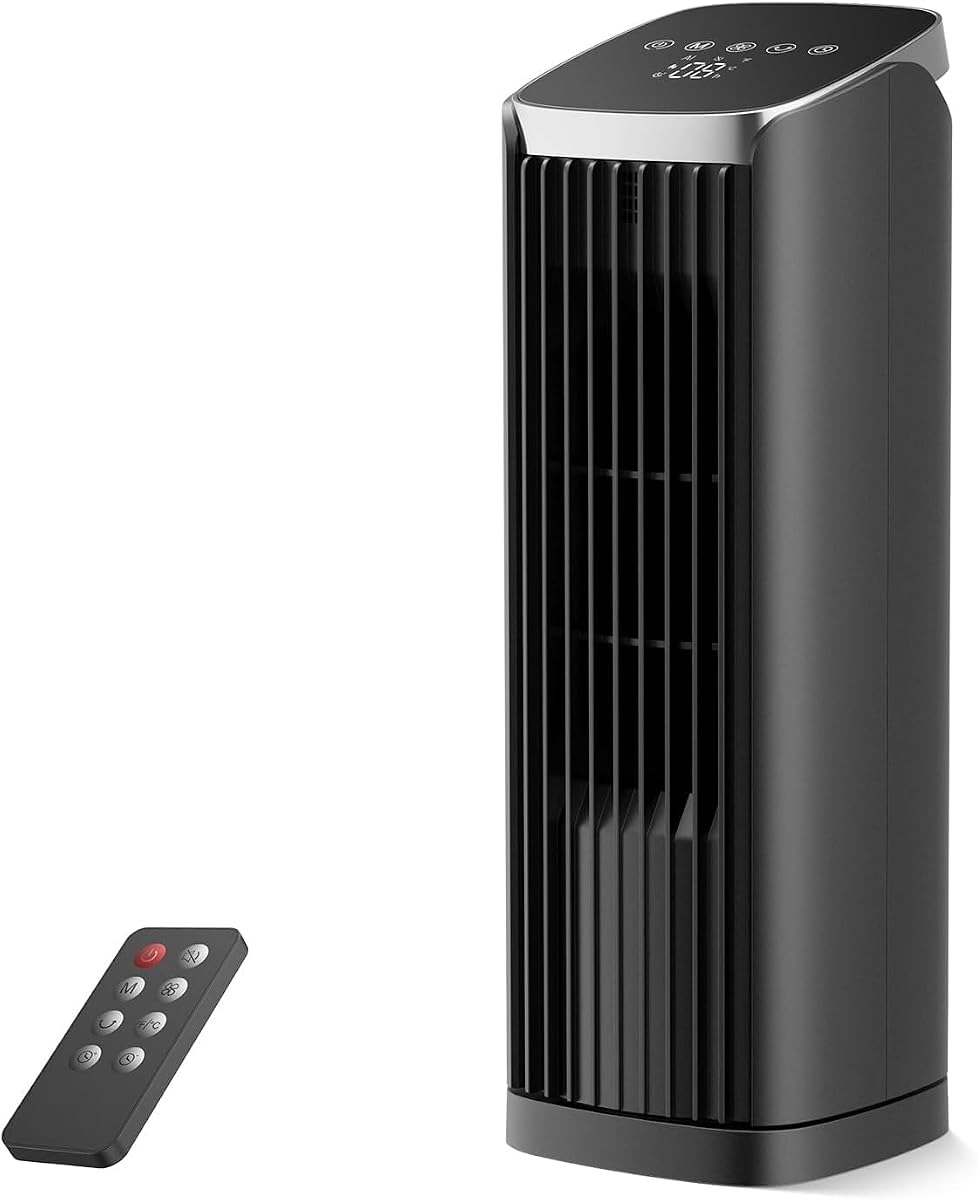
The Personal Tower Fan with Remote combines a 13-inch format with modern controls, earning a 4.4 rating. It provides four speeds, Nature and Normal modes, adjustable 60- and 110-degree oscillation, a remote control, an LED display, and a programmable 12-hour timer.
We may earn a commission when you buy through this link, at no additional cost to you.
Convenience is the main attraction. A remote allows users to change airflow without approaching the fan, while the display provides visible status information. The 13-inch body and built-in handle also make it practical for desks, nightstands, countertops, and rooms where a full-size tower would be inconvenient.
The stated airflow reaches 17 feet per second, which is lower than the strongest tower models in the guide. Noise is specified at 36 to 50 decibels, so the quietest operating level is more appropriate for sleep than the highest setting. Users focused on forceful air movement over a large room may prefer one of the taller designs.
Choose this model for someone who wants remote convenience and a schedule in a compact appliance. It is particularly useful in offices, study rooms, and bedrooms where changing settings from bed or desk is a priority.
The included remote handles speed, mode, oscillation, and timer adjustments, while the LED display communicates the selected settings. This is helpful in offices and bedrooms where reaching the fan repeatedly would be inconvenient.
At 13 inches tall, the fan fits common nightstands and desks without occupying a large floor area. A carrying handle further supports movement between a home, office, dorm, or travel setup.
We may earn a commission when you buy through this link, at no additional cost to you.
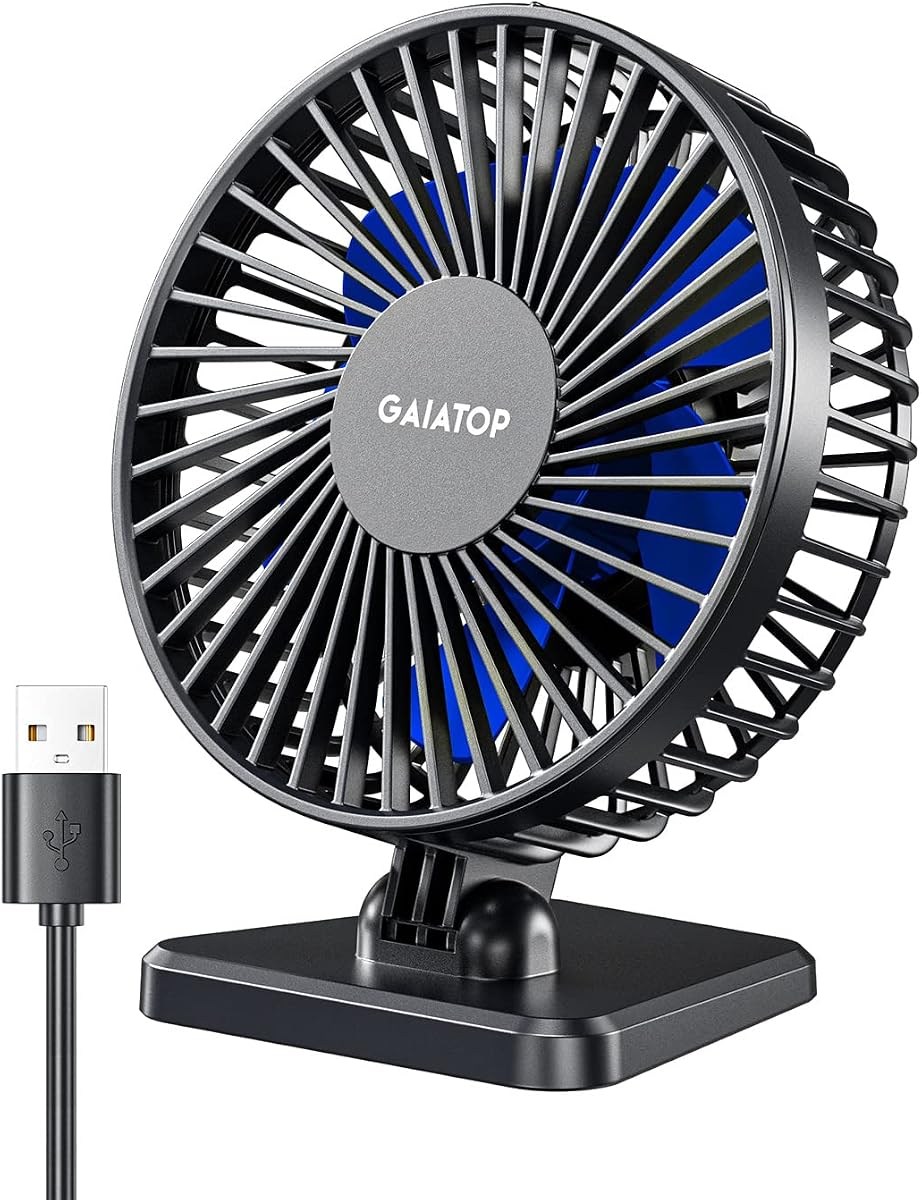
The Gaiatop USB Desk Fan is the lightest and most travel-ready model in the comparison, with a 4.5 rating and a listed weight of less than eight ounces. Its compact classic design is intended for home, office, car, outdoor, and travel use where carrying a larger fan would be inconvenient.
We may earn a commission when you buy through this link, at no additional cost to you.
Power comes through USB, making the fan compatible with computers, laptops, mobile power banks, AC adapters, and suitable car chargers. Three speed settings are controlled by pressing the power button, while the head rotates vertically from zero to 30 degrees. That range is modest compared with the broad oscillation offered by tower fans, but it is useful for fine-tuning a personal breeze.
The main limitation is dependence on a suitable power source. A USB fan does not operate independently unless connected to an appropriate supply, and the highest setting requires a 5V/1A source according to the supplied information. There is no timer, remote, sleep mode, or automatic oscillation.
This is the best budget pick for readers who need a small personal fan for a laptop desk, car, hotel room, or office. It is not designed to cool a large room, but it delivers the most portable and uncomplicated option in the guide.
Compatibility with laptops, power banks, AC adapters, and suitable car chargers makes this model flexible across work, travel, and everyday use. Readers should confirm that their chosen power source supports the required output, especially on the third speed.
A sub-eight-ounce body and compact housing make this fan easy to carry in a bag or reposition around a desk. The vertical adjustment provides enough directional control for focused personal airflow.
We may earn a commission when you buy through this link, at no additional cost to you.
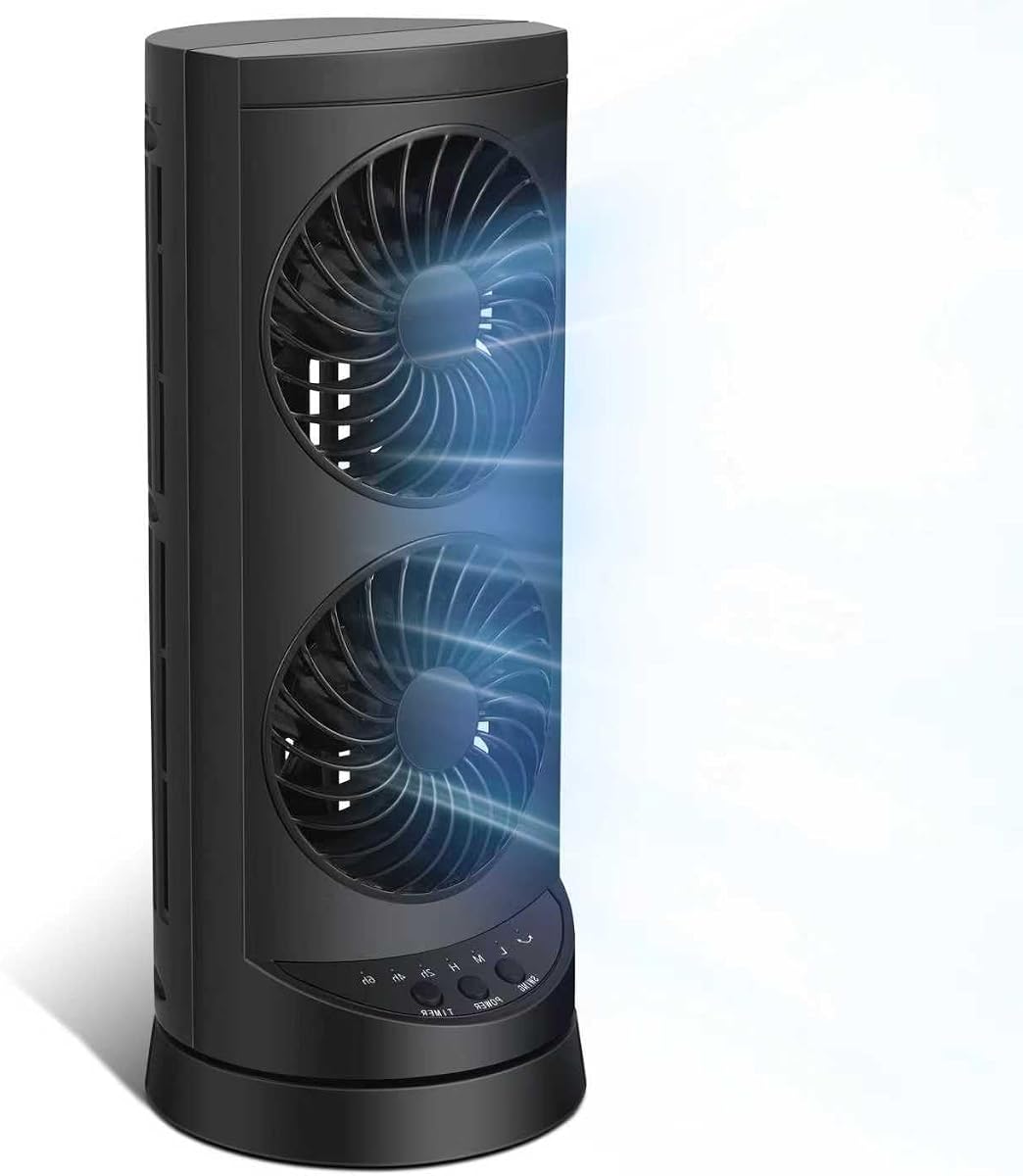
The PNTCK 13-Inch Tower Fan combines a compact bladeless design with four speeds, four modes, a remote control, and a 12-hour timer. Its 4.0 rating places it toward the lower end of this group, but the supplied specifications present several attractive qualities for a compact fan.
We may earn a commission when you buy through this link, at no additional cost to you.
Its stated airflow reaches 24 feet per second, while the listed 24-decibel operating level supports use in bedrooms and quiet work areas. The 70-degree oscillation spreads air across a meaningful area, and the included remote allows changes without approaching the unit. A 12-hour timer adds scheduling flexibility, while the AI mode is described as adjusting airflow automatically to match room temperature.
The AI feature is not explained in enough detail to determine how it compares with the explicit normal, sleep, or natural modes found on some alternatives. The 4.0 rating also warrants a closer comparison before purchase, and the 70-degree oscillation is narrower than the 90- and 110-degree ranges on several competing towers.
The bladeless construction and fine grille may appeal to households with children or pets, while the three-pound listed weight and carrying handle support portability. This model is best for readers who prioritize a quiet compact design, remote operation, and safety-oriented construction over having the widest possible oscillation.
The bladeless structure and fine grille are intended to reduce contact with exposed spinning blades. This design can be reassuring in a family room, although normal caution around any electrical appliance is still appropriate.
Four speed settings and four modes offer more adjustment than a basic three-speed fan. The remote and 12-hour timer make the unit practical for readers who want to set up a fan and leave it running for an extended period.
We may earn a commission when you buy through this link, at no additional cost to you.
The PELONIS 30-Inch Tower Fan is a bedroom-oriented model with a 4.2 rating, a stated 30-decibel operating level, three speed settings, and wide 90-degree oscillation. Its slim 6.8-inch by 7-inch body and 29.7-inch height offer a tall presence without a bulky base.
We may earn a commission when you buy through this link, at no additional cost to you.
The 90-degree oscillation helps distribute air across a room rather than concentrating it in one narrow direction. A fully adjustable height allows the airflow to be aligned with different furniture or occupants, while the built-in handle and 7.16-pound listed weight make the tower easier to move between an apartment, dorm, office, or studio.
The most notable limitation is the timer. It can be programmed in 20-minute increments only up to 120 minutes, which is less useful for overnight scheduling than the 8- or 12-hour timers offered by several competitors. There is also no remote, display, sleep mode, or AI mode listed for this model.
The included one-year manufacturer warranty adds a layer of confidence that can be valuable when selecting a replacement appliance. This fan is a solid recommendation for readers who prioritize wide oscillation, adjustable height, simple three-speed control, and a stated quiet operating level for a bedroom.
The 90-degree sweep directs the fan's output across a broader area than a fixed-head model. This is useful in a bedroom where one side may be warmer or where the goal is steady circulation rather than a narrow stream.
Adjustable height lets users align the tower with a bedside, couch, or desk, and the integrated handle assists with relocation. These details make the fan more adaptable within a compact apartment or multipurpose workspace.
We may earn a commission when you buy through this link, at no additional cost to you.
The right inexpensive fan depends on where it will be used, how much noise is acceptable, and whether portability or room-wide coverage matters more. Comparing form factor, airflow range, controls, and practical extras helps narrow the field without paying for features that will never be used.
A tabletop or air-circulator design is best for directing a focused stream of air toward one person, a desk, or a bed. These models tend to be compact and easy to aim, but they usually lack broad automatic coverage. A tower fan distributes air vertically and often supports larger oscillation angles, making it better for a bedroom, office, or living room. A pedestal fan provides the greatest height range and works well in shared spaces, while a USB personal fan is intended for close-range cooling and travel.
In short, choose a compact model for one workstation and a tower or pedestal model for a room. Consider the space where the fan will stand before deciding on size.
Airflow speed figures can help distinguish concentrated cooling from broader circulation, but they should not be treated as room-size guarantees. Models quoting speeds around 24 to 26 feet per second are designed to move air more forcefully than the 17-foot-per-second personal tower or basic table fans. Directional circulation, oscillation, and tower height also influence how a breeze is distributed throughout a space.
Prioritize a strong airflow claim when the fan must cool several people. For one desk or a bedside table, a smaller unit with directional tilt may be sufficient and more convenient.
Noise specifications are most useful when they include a range or a mode designed for rest. The DREO model lists 28 decibels, the PELONIS model lists 30 decibels, and the compact tower in second place starts at 25 decibels but may reach 45 decibels at stronger settings. The Gaiatop model remains below 50 decibels even with strong wind, while the remote-controlled personal tower may reach 50 decibels.
For light sleepers, prioritize the quietest stated setting and use a lower speed overnight. Anyone sensitive to motor hum should also consider whether a bladeless tower may produce a different sound profile from a conventional blade fan.
Simple models with mechanical knobs or buttons are useful when a basic three-speed control is sufficient. Tower fans add value when they include a remote, LED display, multiple modes, or a programmable timer. These extras make it easier to change airflow after getting into bed or settling into a desk, but they also add electronic complexity that some users may not need.
Match the interface to your habits rather than choosing the most buttons. Simple controls suit a temporary fan, while remotes and timers are valuable for unattended daily operation.
Oscillation determines how much of a room receives moving air. The DREO and PELONIS towers offer 90-degree oscillation, the PNTCK model offers 70 degrees, and the Amazon Basics 28-inch tower uses 60 degrees. Two compact personal towers go further with selectable 60- and 110-degree ranges. A tilting head is different: it lets the user redirect the fan manually but does not move on its own.
Choose wide oscillation for shared rooms and fixed or manually tilted airflow for a single work area. Make sure the oscillation range is sufficient to distribute air beyond the immediate desk or bed.
Portable fans should be easy to carry, place, and power. The Gaiatop model weighs less than eight ounces and runs through common USB sources, making it ideal for a laptop desk, car, or travel bag. Compact tower fans often include carrying handles, while the Amazon Basics desk fan weighs three pounds. Larger pedestal and tower models prioritize room coverage but need more floor space and are less convenient to transport.
Check the power source before purchasing a USB fan. For larger models, consider outlet placement and cord reach so the fan can sit where airflow is most useful.
A timer lets a fan run for a defined period without continuous supervision. The two compact tower models with programmable operation support 12-hour settings, the DREO tower includes an eight-hour timer, and the PELONIS tower can run for up to 120 minutes. Simpler table and pedestal models generally do not include a timer. A remote can add convenience, but it is less essential for a compact fan that can be reached easily.
Long timers are especially useful overnight, while shorter timers suit temporary work sessions. Choose scheduling only if it will improve your routine, as it is not a substitute for a good airflow design.
Traditional blade fans may require routine cleaning, while bladeless towers keep the moving blade out of sight. Remote controls and displays add electronic parts that may be more sensitive to moisture or impact, and USB models require a compatible supply. The Lasko pedestal fan and Amazon Basics desk fan use straightforward mechanical designs, while the DREO, PELONIS, and PNTCK models include more substantial motors and covered housings.
For a frequently moved fan, choose a simple design that is easy to wipe down. For a stationary bedroom appliance, prioritize a stable base, low stated noise, and a timer that matches your sleep schedule.
Place the fan on a stable, level surface with adequate clearance around the housing. For a tabletop model, position it near the person who needs cooling and use the tilt control to direct the stream. Tower and pedestal fans should have open space in front of them, while USB fans should be connected to a compatible power source before being switched on.
Start with the lowest speed and increase it only as needed. Use oscillation or a wider airflow mode for shared rooms, and reserve the highest setting for hot periods or spaces where stronger air movement is needed. Running a fan at a moderate setting can often provide satisfactory comfort without creating unnecessary noise or power consumption.
Unplug the appliance before cleaning it. Use a soft, slightly damp cloth to wipe the exterior, and avoid spraying liquid directly onto switches, vents, grilles, or electrical connections. Do not allow water to enter the motor housing. For USB models, disconnect the cable before wiping the surface, and check the manufacturer's instructions for any additional care requirements.
The most affordable category generally includes small USB desk fans and compact personal models with basic three-speed controls. The Gaiatop USB Desk Fan in this guide is the clearest budget-oriented option because it is lightweight, portable, and compatible with common USB power sources. Buyers should still check the current listing and consider whether they need room-wide airflow rather than personal cooling.
A small fan can make a bedroom feel more comfortable by creating airflow across the sleeper, even if it does not lower the actual room temperature. Its effectiveness depends on placement, airflow range, and noise. Compact tower models with oscillation, quiet modes, and timers are generally more suitable for overnight use than a basic fan aimed at one fixed area.
A tower fan is usually better for distributing air through a room because of its vertical form and wide oscillation. A table or air-circulator fan is often more practical for a desk, nightstand, or one seated person because it is smaller and easier to aim. The best choice depends on whether focused personal airflow or broader coverage is your priority.
Lower noise is generally more suitable for sleep, and the quietest model in this comparison is the compact tower claiming 25-decibel operation. Other bedroom-oriented models list 28 or 30 decibels, while some personal fans can become considerably louder at higher settings. For the best chance of restful use, choose a low speed or sleep mode and test the fan in the intended position.
Fans primarily cool people by moving air across the skin and increasing sweat evaporation. They may feel effective even when the room's temperature does not change. A fan can also improve circulation, but it is not a substitute for air conditioning when a room remains dangerously hot or humidity is excessive.
A USB fan can work in a car when connected to a suitable charger that supports the required output. The Gaiatop model is compatible with car chargers and other USB supplies, although the supplied information specifically notes that the third speed requires a 5V/1A source. Check the vehicle's available ports and avoid obstructing the driver's view or controls.
Oscillation is important when the fan should cool more than one location. A 90-degree sweep covers a broad area, while 60 or 70 degrees is better suited to a compact zone. If you only need airflow at one desk or bedside, a manually tilting head may be sufficient and can offer more precise control.
A timer is useful when you want the fan to stop automatically after sleeping, working, or leaving a room. Models with 8- or 12-hour timers offer greater scheduling flexibility than a 120-minute setting. If the fan will only run while someone is present, its timer may be less important than airflow strength, noise level, and compact size.
The Honeywell TurboForce HT900 is the strongest general recommendation because it combines a high customer rating, three speeds, a tilting head, and a compact body suited to desks and small rooms. The DREO Bedroom Tower Fan stands out as the premium option through its stronger airflow, wide oscillation, multiple modes, and quiet bedroom positioning, while the Gaiatop USB Desk Fan is the most portable and budget-friendly selection.
Prioritize based on the way the fan will be used. Choose a table fan for focused personal airflow, a compact tower for a desk or nightstand, a larger tower for wider bedroom coverage, and a pedestal fan when height adjustment is essential. Noise specifications, oscillation range, timers, and power requirements can matter more than headline fan speed once the initial choice has been narrowed down.
Customer ratings and product details can change over time, so confirm the current specification and customer feedback before ordering. Online prices also fluctuate, making it worthwhile to compare the final listing with the features that matter most in your room rather than choosing solely by the lowest available amount.