Tadeto 30–130 dB Meter
4.5Editor score
±2.0 dB stated accuracy
0.1 dB display resolution
Backlit four-digit display
Fast and slow response
Our Decibel Meter guide compares 10 top models for accuracy, weighting modes, displays, logging, alarms, portability, and noise checks at home and work.
A decibel meter turns an invisible environmental issue into a clear numerical reading, making it useful for checking household noise, comparing audio equipment, monitoring appliances, assessing workspaces, or investigating traffic and construction sounds. A useful model should combine dependable measurement specifications with an understandable display, practical controls, and a form factor suited to where you need to listen.
This guide compares ten decibel meters across their published measurement ranges, accuracy, frequency response, A- and C-weighting options, response modes, displays, recording functions, alarms, power options, and included accessories. The list covers simple handheld instruments, color-screen models, a data logger with computer connectivity, and a wall-mounted unit, with each review highlighting meaningful advantages and trade-offs.
Each numbered review explains who the meter suits and which use benefits it offers most. We also provide a side-by-side comparison, practical buying guidance, operating and care advice, and answers to common questions. Product configurations and availability can change, so readers should verify the current specifications, package contents, and seller listing before making a final purchase.
4.5Editor score

4.7Editor score

4.2Editor score
The table below compares the ten decibel meters by core measurement features, display capabilities, recording functions, and practical extras, making it easier to identify the model that matches your monitoring needs.


The TopTes TS-501B in orange combines a 30–130 dB range, ±1.5 dB stated accuracy, and a generously sized 2.25-inch backlit LCD in a straightforward handheld package. It holds a 4.5 rating, and its strongest appeal is the combination of readable display, familiar controls, and measurement tools without requiring a computer or complicated setup.
We may earn a commission when you buy through this link, at no additional cost to you.
A- and C-weighting make the meter useful across both general environmental noise and more mechanical or intense sound sources. MAX and MIN modes preserve the highest and lowest observed levels, while data hold freezes the current reading for easier inspection. The stated 30–8,000 Hz frequency range covers common environmental and industrial applications, and the non-slip housing improves handling during repeated checks.
The meter is battery operated, includes an automatic power-off function, and displays a low-battery reminder. Its package contains the TS-501B, three AAA batteries, a user manual, and a carry case, which makes it a fairly complete setup for home, office, school, workshop, or factory checks. The lack of logging and computer export is a limitation when documenting changing conditions over time, but most users will not need that capability.
This TopTes is an attractive all-around choice for someone who wants a large screen, straightforward measurements, and both frequency-weighting modes in a portable format. It is particularly useful for checking noisy neighbors, appliances, home theaters, automobiles, and workplace equipment. Its balanced feature set makes it easier to recommend than a bare-bones model without making it feel like a specialized logging instrument.
The 2.25-inch backlit display presents measurements clearly in dim rooms, while the hold function keeps a reading visible while you reposition the microphone or write down notes.
Switching between A and C weighting lets users compare how the meter responds to everyday environmental sound and stronger mechanical or industrial noise.
We may earn a commission when you buy through this link, at no additional cost to you.
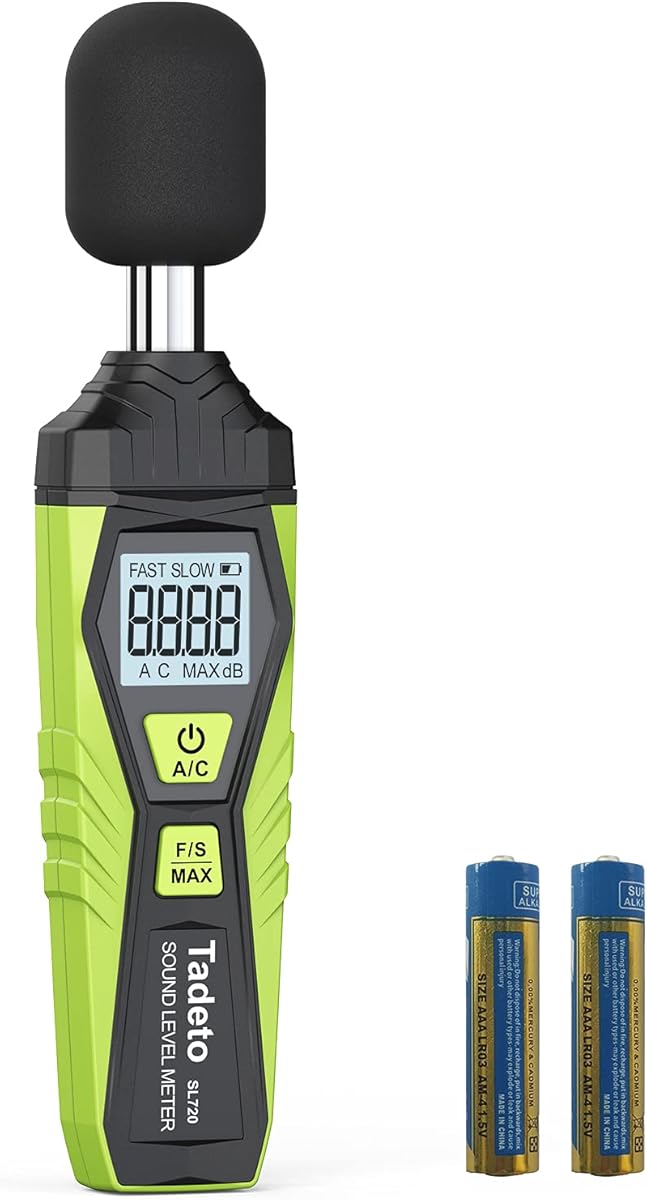
The Tadeto digital sound level meter is a portable 30–130 dB instrument with a 4.5 rating and an emphasis on essential monitoring functions. Its four-digit backlit LCD shows readings at 0.1 dB resolution, while the stated ±2.0 dB accuracy is adequate for general environmental checks, equipment comparisons, and educational or household use.
We may earn a commission when you buy through this link, at no additional cost to you.
The meter includes A- and C-weighting, allowing users to select between an ear-oriented mode for lower-level environmental noise and a linear-oriented mode for more intense mechanical sounds. FAST response uses a 0.125-second time constant for general measurements, while SLOW response uses a one-second time constant for environments with larger changes in sound levels.
Its lightweight construction makes it convenient to carry between rooms, jobsites, vehicles, or offices. The backlit display remains readable in dark areas, and a low-voltage icon warns the user when battery replacement is needed. Compared with higher-end options, it does not offer documented PC export, extensive storage, or a more advanced alarm system, but those omissions are reasonable for a straightforward value-focused meter.
Choose the Tadeto when you need an uncomplicated decibel meter for occasional household, office, school, factory, automotive, or audio checks. It provides the most commonly needed response settings and weighting modes without adding a color interface or data logger. For comparing appliances, checking room ambience, or getting a general idea of sound levels, it is a practical, budget-conscious instrument.
The selectable response speeds help users capture short changes with FAST mode or average more stable conditions with SLOW mode, making the meter adaptable to different surroundings.
A four-digit, 0.1 dB-resolution display and built-in backlight make quick readings easier during nighttime monitoring or in dim utility spaces.
We may earn a commission when you buy through this link, at no additional cost to you.
The DURFICST color-screen sound level meter delivers a 30–130 dB range, ±1.5 dB stated accuracy, and 0.1 dB resolution. Its 4.6 rating is among the stronger figures in the group, while the color display distinguishes it from conventional monochrome handheld models and adds visual clarity for users who want more than a basic number.
We may earn a commission when you buy through this link, at no additional cost to you.
Its condenser microphone has a stated frequency range of 31.5 Hz to 8 kHz. A- and C-weighting support environmental and industrial measurements, while dB and SONE units give users both a sound-level measure and a perceived-loudness option for music, instruments, and audio-system checks. FAST and SLOW response settings can be matched to changing and steady noise, respectively.
MAX and MIN recording, data hold, a windbreak ball, soft rubber wrapping, and a cloth carrying case make the device more practical for repeated portable use. It lacks documented PC connectivity and automatic record export, so it does not serve as a formal data logger. The supplied information also gives less detail about the included batteries and overall package configuration than some competing listings.
This DURFICST model is well suited to users who appreciate a colorful screen and want broad measurement flexibility without moving into computer-connected logging. It works for home theaters, offices, classrooms, factories, music practice, and general environmental monitoring. The combination of accuracy, unit choices, response controls, and peak tracking makes it an appealing middle ground between basic meters and specialist data recorders.
The ability to switch between dB and SONE broadens the meter's usefulness, allowing users to consider measured sound level alongside perceived loudness in music and acoustic settings.
Soft rubber wrapping, an anti-slip handheld form, a windbreak ball, and an included cloth case support comfortable use during indoor or outdoor checks.
We may earn a commission when you buy through this link, at no additional cost to you.
The Goldeep SL750A has the highest listed rating in this comparison at 4.7, paired with a 30–130 dB range and ±1.5 dB stated accuracy. It combines a clear LCD, A- and C-weighting, dB and SONE units, FAST and SLOW response, and MAX/MIN tracking in a bright orange portable design.
We may earn a commission when you buy through this link, at no additional cost to you.
Its weighting modes are designed for different environments: A-weighting addresses ordinary environmental sound, while C-weighting is intended for machinery, equipment, and other intense sources. The dB unit supports sound-intensity checks, whereas SONE offers a way to evaluate perceived loudness for music, instruments, and audio systems. This flexibility makes the meter relevant to more than one kind of user.
MAX and MIN tracking helps capture peaks and lower points over a period, and the hold function supports careful reading. A clear LCD, anti-slip grip, and windbreak ball improve everyday handling. The package includes the meter, two AAA 1.5-volt batteries, and a user manual. It lacks documented data export and threshold-based alarms, so serious long-term studies remain better served by a dedicated logger.
For most home, office, workshop, classroom, construction-site, factory, or audio-system checks, the Goldeep provides an unusually complete combination of functions. It is also a good option for users who want SONE readings in addition to standard decibels. Its strong rating, stated accuracy, and broad feature coverage make it one of the most versatile choices in the group.
A- and C-weighting let users adapt the reading method to ambient sound, machinery, traffic, or other stronger sources instead of relying on a single measurement curve.
MAX and MIN modes preserve the highest and lowest values encountered, helping users identify brief peaks that a single instantaneous reading might miss.
We may earn a commission when you buy through this link, at no additional cost to you.
The green TopTes TS-501B shares the 30–130 dB range, ±1.5 dB stated accuracy, 2.25-inch backlit LCD, and A/C-weighting foundation of the orange model. Its defining addition is the ability to display temperature and humidity, giving users a little more environmental context when investigating room conditions, equipment behavior, or changing indoor sound conditions.
We may earn a commission when you buy through this link, at no additional cost to you.
MAX/MIN measurement and data hold remain useful for capturing peak and minimum values or freezing a reading for reference. The 30–8,000 Hz frequency range and A/C modes support checks involving communities, home theaters, audio systems, cars, workshops, schools, offices, and factories. A condenser microphone provides the sensing element, while the large backlit display keeps values readable in dim surroundings.
Three AAA batteries, a user manual, and a carry case are included. The meter also offers automatic power-off and a low-battery indicator, which helps avoid unexpected shutdowns during monitoring. As with the other TopTes offering, there is no documented PC logging or export, and the temperature and humidity function does not replace a dedicated environmental instrument.
This version is a sensible choice when sound readings need to be considered alongside room temperature or humidity, such as in a home theater, office, classroom, or workshop. It may be less compelling for users seeking alarms or recorded data, but its large display and otherwise complete measurement package make it a practical option for routine checks.
Temperature and humidity readings can provide useful context when comparing how a space, appliance, or audio setup behaves under different environmental conditions.
The included batteries, manual, and carry case reduce the number of extra items needed for routine portable monitoring at home or work.
We may earn a commission when you buy through this link, at no additional cost to you.
The RISEPRO HT-80A is a direct, no-frills digital sound level meter with a 30–130 dB range and ±1.5 dB stated accuracy. It has a 4.4 rating and includes MAX/MIN recording, data hold, automatic power-off, and a backlit display, covering the core functions needed for quick checks at home, in a business, during studies, or in industrial settings.
We may earn a commission when you buy through this link, at no additional cost to you.
Type A frequency weighting models the way the human ear is more sensitive to lower-intensity sound, making the meter appropriate for many environmental measurements. Its stated 31.5 Hz–4 kHz frequency range covers common audible applications, although it is narrower than several other models in this comparison. FAST time weighting uses a 125-millisecond response for changing readings.
The black carrying pouch and presentation box make storage and gifting straightforward. Although the model is smaller in scope than dual-weighting or data-logging options, the limited feature set also keeps the controls easier to understand. Users who mainly need to monitor ambient levels, compare appliances, check a workspace, or capture brief peaks may find this approach preferable to a denser interface.
Choose the HT-80A if your measurements are primarily general environmental noise and you value clear hold and peak functions without needing C-weighting, SONE units, alarms, or computer export. It is a practical option for students, families, and casual users, while professionals needing broader frequency coverage or multiple weighting curves may prefer a more specialized model.
A single Type A weighting curve, 125-millisecond FAST response, and a wide 30–130 dB range simplify the process of checking everyday environmental sound levels.
Data hold freezes the current value, and the backlight helps users read the display in darker rooms without losing their place.
We may earn a commission when you buy through this link, at no additional cost to you.
The DANOPLUS data logger is the most specialized model in this roundup, offering up to 43,000 stored records, computer viewing, Excel export, and real-time measurement. Its 4.2 rating is lower than several simpler meters, but the feature set is clearly aimed at users who need a documented trail of changing noise conditions rather than only a quick spot check.
We may earn a commission when you buy through this link, at no additional cost to you.
The 30–130 dB range and ±1.5 dB accuracy sit alongside A/C frequency weighting, adjustable FAST/SLOW response, and a DC output that expresses the measured noise value in voltage. A color screen provides a line chart, analog bars, date, time, and detailed status information. The display also shows the current reading and helps users visualize changes over the measurement period.
A three-color light alarm provides green, yellow, and red indicators for low, medium, and high levels, with a manually adjustable threshold. USB charging and PC connectivity make it possible to review, export, analyze, and print compatible data. The stated compatibility covers Windows 7, 10, and 11, and the 1,000 mAh rechargeable battery takes about 1.5 hours to charge.
This is the most appropriate option for environmental studies, workplace monitoring, equipment testing, or other scenarios that benefit from a chronological record. Its color alarm also makes it useful as a visible threshold monitor. The tradeoff is greater complexity and a need to manage charging, software, and file export, so buyers who only need an occasional reading may find one of the simpler handheld meters more convenient.
Recording up to 43,000 readings allows users to review how sound varies across a session instead of relying only on a single instantaneous number.
Green, yellow, and red indicators make the current alarm state easy to understand, while manual threshold settings let users define the level relevant to the task.
Excel export, PC viewing, and printing support deeper review and make recorded information easier to incorporate into a structured monitoring workflow.
We may earn a commission when you buy through this link, at no additional cost to you.
The SW-525A is designed around a different use case from most handheld entries: fixed noise monitoring in a location where the sound level can be observed continuously. Its wall-hanging format, large red LCD, and audible alarm function make it more appropriate for a workshop, utility area, office, classroom, or other space that benefits from a persistent visual indicator.
We may earn a commission when you buy through this link, at no additional cost to you.
The published 30–130 dB range covers quiet ambient conditions through much louder environments. The large red screen should be easy for a user to see from a short distance, while the alarm adds an audible cue that a reading may have crossed a relevant level. The product has a 4.4 rating, though the supplied listing offers very little technical detail beyond the display and alarm.
A fixed installation can be more useful than a handheld meter when you want to monitor the same source continuously, identify whether a recurring sound occurs, or avoid repeatedly setting up equipment. The trade-off is portability. It is also difficult to evaluate advanced capabilities such as logging, weighting modes, response speed, or accuracy from the available product information, so buyers should review the current manual and listing carefully.
The SW-525A makes the most sense for users who need a stationary sound indicator rather than a comprehensive portable measuring tool. It may suit a fixed installation in a home, shop, office, school, or similar environment, especially when an alarm is helpful. Buyers needing portable checks, detailed reporting, or broad measurement controls should choose one of the handheld models instead.
The wall-mounted format allows continuous observation from a fixed point, which is useful when noise levels change while a person is doing other work.
A large red display provides immediate visual feedback, and the alarm function adds an audible signal for monitoring situations where the screen may be out of view.
We may earn a commission when you buy through this link, at no additional cost to you.
The Tadeto alarm meter combines a 30–130 dB range, ±1.5 dB stated accuracy, and both audible and visual alarms in a portable digital instrument. Its 4.3 rating places it behind the highest-rated general-purpose models, but the alarm-focused feature set distinguishes it for users who need to be notified when sound becomes unusually high.
We may earn a commission when you buy through this link, at no additional cost to you.
Five adjustable measurement ranges offer more control over the operating interval than meters with a single fixed range. A- and C-weighting support environmental and mechanical noise checks, while MAX/MIN measurement and data hold help retain useful readings. The backlit LCD includes a low-voltage indicator so the user can replace batteries before the meter stops functioning.
FAST and SLOW response settings allow the meter to follow changing or relatively stable conditions. The product is intended for noise engineering, product quality control, health-related sound checks, studies, and general work or home monitoring. It does not document computer connectivity or export, so the functions are centered on immediate observation rather than long-term record analysis.
This model is a strong candidate for workshops, offices, schools, factories, and homes where an audible or visual threshold signal is valuable. It offers more range selection than the basic Tadeto model and maintains A/C weighting, data hold, and peak tracking. The lack of logging and the lower 4.3 rating are the main considerations, but they do not diminish its usefulness for live threshold monitoring.
Audible and visual alarms make the meter useful when a user cannot continuously watch the display or wants immediate notice of elevated sound.
Five adjustable measurement ranges give users more control over the interval in which the meter operates, complementing the FAST and SLOW response controls.
We may earn a commission when you buy through this link, at no additional cost to you.
The FNIRSI FDM-02 combines a 30–130 dB range with ±1.5 dB accuracy in a compact, rechargeable design intended for home and work. It has a 4.4 rating and a two-inch IPS screen with light and dark themes, giving it a modern visual presentation that should be easy to read in different environments.
We may earn a commission when you buy through this link, at no additional cost to you.
A/C weighting, FAST response at 125 milliseconds, and SLOW response at one second cover common measurement needs. Curve mode displays 30 seconds of sound changes, which is particularly useful for home theater tuning, speaker matching, subwoofer placement, or television and soundbar calibration. The device can also track TV, speaker, kitchen appliance, toy, and pool-pump noise.
Users can set high and low thresholds, view the 30 most recent alarms, and check the real-time noise category on screen. The built-in condenser microphone supports A and C weighting, while the 1,500 mAh rechargeable battery, auto-off, and sleep functions support regular use. The carrying case makes the lightweight meter easier to transport, although there is no documented PC export or extensive logging workflow.
This FDM-02 is particularly attractive for consumers monitoring home electronics, speakers, appliances, parties, construction, traffic, and nearby bars. Its curve display and threshold history offer more context than a basic instantaneous meter without reaching the complexity of a full data logger. It is a smart choice for users who value a polished screen, rechargeable power, and audio-system optimization features.
The 30-second curve view makes changes in sound level easier to observe, supporting speaker comparison, subwoofer placement, and home theater calibration.
A 1,500 mAh battery, auto-off, and sleep functions reduce charging frequency while helping preserve energy during intermittent monitoring.
Users can set upper and lower thresholds and review the 30 latest alarms, providing a brief history of noteworthy sound events.
We may earn a commission when you buy through this link, at no additional cost to you.
A suitable decibel meter should match the type of noise, the environment, and the amount of documentation you need. Review the measurement specifications first, then consider weighting, response controls, display quality, alarms, power, and portability.
Most of the featured models cover 30–130 dB, a broad interval that can accommodate quiet rooms, normal conversation, household appliances, audio systems, and many industrial sources. Published accuracy varies between ±1.5 dB and ±2.0 dB. A tighter stated tolerance can be preferable when comparing equipment or tracking small changes, although the microphone, environment, placement, and operating method also influence real-world results.
Choose a range that covers your expected conditions and pay attention to the stated accuracy figure. A ±1.5 dB specification is well represented in the group, while a ±2.0 dB specification may still be sufficient for general environmental checks.
Frequency weighting changes how the meter evaluates sound across the audible spectrum. A-weighting is intended to reflect the ear's sensitivity to lower-intensity sound and is useful for ambient noise, offices, schools, traffic, and ordinary household checks. C-weighting is more linear and is better suited to machinery, motors, equipment, aerospace, and other stronger or lower-frequency industrial sources.
If you may monitor both household and mechanical noise, select a model that supports both A and C modes. If your needs are limited to general environmental levels, Type A weighting may be sufficient, as in the RISEPRO HT-80A.
Response speed determines how quickly a meter follows changing sound. FAST response, commonly using a 0.125-second time constant, captures short events and fluctuations, making it useful for traffic, impacts, intermittent equipment, and rapidly changing conditions. SLOW response, commonly using a one-second time constant, provides a steadier view of relatively stable sound.
For regular use, having both settings is valuable. Choose FAST for peaks and changing sources, and SLOW when you want a less reactive reading from a consistent source. Always keep the selected mode consistent when comparing several measurements.
The display determines how easily you can obtain and interpret a reading. Large backlit LCD screens remain practical in dim rooms, while color IPS screens can make graphs, categories, and alarm states easier to distinguish. Resolution also matters: a 0.1 dB display offers finer numerical detail than a model that does not specify its increment. SONE units add perceived-loudness information for musical and audio work.
Prioritize a screen you can read quickly, especially if measurements are taken in poorly lit areas. Color and curve displays are useful for visual analysis, but a clear backlit numeric display may be sufficient for most household and workplace checks.
Data hold freezes the current reading so it can be inspected without the number disappearing. MAX and MIN functions record the highest and lowest values observed during a measurement period. These features are especially useful when the microphone cannot remain perfectly still, when a brief sound event occurs, or when comparing several appliances over time.
Look for both hold and peak tracking if you need a record of changing conditions. For full historical analysis, consider the DANOPLUS logger, which stores readings and supports computer viewing and Excel export.
An alarm can provide immediate notice when sound reaches a selected level. Audible alerts are helpful in workshops and industrial settings, while visual indicators can be easier to notice from a distance or when hearing protection is in use. The Tadeto alarm meter includes both audible and visual alarms, and the DANOPLUS offers configurable three-color status lights.
Choose an alarm model when continuous threshold monitoring matters more than portable documentation. For basic comparisons, data hold and MAX/MIN functions may be enough, and they avoid adding unnecessary complexity to the controls.
A data logger preserves a chronological sequence of measurements, allowing users to identify periods of elevated noise, compare operating cycles, and export results for analysis. The DANOPLUS stores up to 43,000 records and supports viewing and Excel export through a compatible Windows PC. It also includes date and time information, a line chart, and analog bars.
Logging is valuable for workplace studies, equipment diagnostics, and documented monitoring projects. It is less essential for a quick appliance comparison or one-time room check, and it generally involves more setup than a simple handheld meter.
Battery type affects convenience. AAA-powered meters are easy to carry and replace, while a rechargeable battery reduces recurring battery purchases. Automatic power-off, sleep, and low-battery indicators help preserve operating time. Portability also depends on grip, display size, carry case, wind protection, and overall dimensions rather than weight alone.
For regular mobile use, look for a stable grip, protected microphone, and included case or batteries. For fixed monitoring, a wall-hanging format such as the SW-525A may be more useful than a compact handheld design.
Begin by selecting the correct frequency weighting and response mode for the environment. Use A-weighting for most general ambient sound and C-weighting for stronger machinery or industrial sources. Choose FAST for changing or brief sounds and SLOW for relatively steady conditions. Before taking a reading, let the meter settle in the intended position and avoid obstructing its microphone with a case, hand, or protective cover.
Place the microphone at a consistent distance and height from the sound source, and keep that position unchanged when comparing readings. For a room average, take several measurements in different positions rather than relying on a single point. Note the date, time, equipment state, selected weighting, and response mode so the results can be reproduced and compared meaningfully.
After use, switch off the meter and remove the batteries if it will be stored for an extended period, especially when using the automatic power-off feature. Keep the microphone and windbreak clean and dry, protect the display from impact, and store the device in its case. Recharge models should be kept within sensible temperature conditions and charged before long monitoring sessions.
A 30–130 dB range covers a wide variety of household, office, classroom, and industrial conditions. Most of the featured meters use this range. The display resolution of 0.1 dB also gives more numerical detail, but it should not be confused with the stated accuracy of the entire instrument.
A-weighting is the more practical choice for general environmental sound, including conversation, traffic, appliances, offices, and schools. C-weighting is better for machinery, motors, and stronger low-frequency or industrial sources. A dual-weighting model gives you more flexibility if you will monitor both categories of sound.
FAST response reacts quickly and is better for brief, changing, or fluctuating sound. SLOW response provides a steadier result for conditions that remain relatively consistent. Using the same response setting for every comparison makes the readings more meaningful.
A decibel meter measures the level reaching its microphone, but it generally cannot identify what produced the sound by itself. Comparing readings while different appliances or devices operate can help isolate likely sources. For complex acoustic diagnosis, specialist equipment and professional analysis may be necessary.
A display with 0.1 dB resolution can show small numerical changes, but the meter's overall stated accuracy remains the more important limitation. Do not treat a last-digit difference as meaningful when it falls within the manufacturer's stated accuracy, measurement conditions, or other sources of variation.
A logger is most useful when you need to preserve many readings, analyze changing noise levels, or export results for a report. For occasional appliance comparisons or a quick room check, a handheld meter with data hold and MAX/MIN tracking is usually more convenient. The DANOPLUS model is the clearest dedicated logging option in this guide.
Fresh batteries, the correct charger for rechargeable models, a user manual, and the supplied carrying case are the most useful basics. Keeping a small notebook or phone for noting location, time, weighting, and response settings can also make later comparisons easier. A protective case is valuable for field use.
You can use one, but readings may be affected if protective covers or environmental barriers change how sound reaches the microphone. Keep the microphone unobstructed and follow the manufacturer's guidance. For accurate hearing-risk assessment or workplace compliance, use calibrated equipment and appropriate professional methods.
The TopTes TS-501B in orange offers the strongest general-purpose balance of a large backlit display, ±1.5 dB stated accuracy, A/C weighting, MAX/MIN tracking, and a ready-to-use package. The Tadeto basic meter serves as a straightforward value option, while the DANOPLUS data logger is the specialized choice for users who need stored readings, computer export, threshold alerts, and a visual record of changing conditions.
Prioritize the features your actual monitoring task requires. General household and office users should consider a backlit display, both weighting modes, and response controls; fixed-location users may prefer a wall-mounted alarm display; music and home-theater users may value SONE units or curve views; and documented workplace studies benefit most from logging and export. Accurate comparison also depends on consistent microphone placement and settings.
Before ordering, check the current listing, package contents, technical specifications, battery requirements, and return terms to confirm that the selected model still matches your needs. Product features, configurations, and seller offers can change, and current prices should always be checked on the linked listing rather than assumed from an earlier review.