
Taylor Digital Wireless Indoor Outdoor Thermometer and Barometer with Timer
4.1Editor score
Wireless 200-foot remote sensor
Barometric history and forecast
Large easy-to-read LCD display
A digital barometer measures atmospheric pressure and turns it into useful information about changing weather. The best models add clear trend indicators, forecasts, humidity readings, remote sensors, alarms, and timekeeping, making them useful at home, outdoors, or in controlled environments.
We compared all 10 products by examining their measurement functions, displays, sensor support, forecasting features, alarms, power options, and intended applications. The list covers standalone indoor devices, wireless home weather stations, atomic-clock models, and a portable multifunction instrument.
Each review identifies the strongest feature, useful limitations, and the type of buyer most likely to benefit. Product ratings reflect the supplied customer feedback, while specifications and compatibility details come from the listed product information; prices and retail listings can change.
4.1Editor score

4.7Editor score

4.1Editor score
As an Amazon Associate we earn from qualifying purchases.
The comparison below highlights each product's core format, measurement coverage, display style, and connectivity so buyers can quickly distinguish a dedicated barometer, a home weather station, and a portable field instrument.


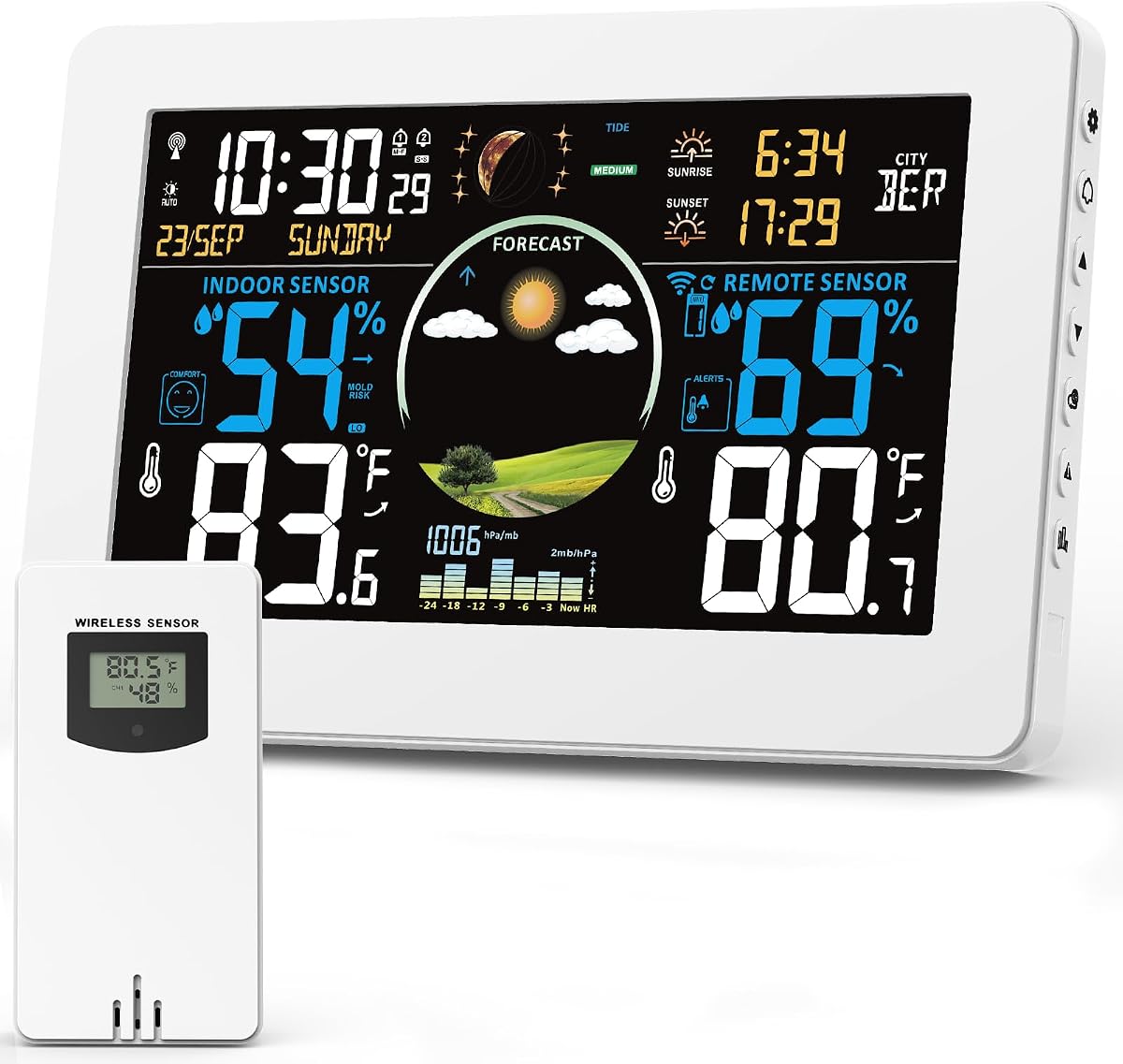
The Newentor Weather Station Wireless Indoor Outdoor Thermometer, Black, 1Sensor earns a 4.3 customer rating and stands out as a versatile home climate display. It combines barometric pressure with indoor and outdoor temperature, humidity, a 12-to-24-hour forecast, time, alarms, moon phase, and other information on one large color LCD.
We may earn a commission when you buy through this link, at no additional cost to you.
Its strongest feature is the combination of an easy-to-read display and flexible sensor support. The console can work with up to three remote sensors, although the package includes one, allowing users to expand coverage across rooms, patios, or outdoor locations. A pressure-based forecast, daily high and low records, customizable alerts, and a seven-to-10-day calibration period make it more useful than a basic pressure display.
Power flexibility is another advantage. The included DC adapter supports a continuous backlight for bedside or living-room viewing, while battery operation engages an energy-saving mode that illuminates the display for approximately 15 seconds. The trade-off is that batteries are not included, and the unit's broad collection of features may take some time to configure.
This is a strong recommendation for someone who wants barometer functionality integrated into a full-featured home weather station rather than a standalone instrument. It is particularly appropriate for users who value a large display, wireless sensors, dual alarms, and forecast information in one package.
Instead of limiting the display to pressure, this model presents a broad environmental overview. Temperature, humidity, forecast, calendar information, alarms, and moon phase remain available together, reducing the need for separate household instruments.
Three-channel capacity allows the display to grow with the user's monitoring needs. Continuous adapter power suits frequent viewing, while battery mode reduces energy consumption when the backlight is not needed.
We may earn a commission when you buy through this link, at no additional cost to you.
The Traceable Calibrated Digital Barometer has a 4.7 customer rating, the highest among the ten products listed. It is designed for users who need more than a casual forecast display, combining pressure, temperature, and relative humidity in an instrument with a documented NIST-traceable calibration certificate.
We may earn a commission when you buy through this link, at no additional cost to you.
The four-line LCD provides current conditions, a bar graph for pressure tendencies, and the time of day. The device automatically stores minimum and maximum readings each hour for retrieval over a 24-hour period. High and low audible and visual alarms can be configured for pressure, temperature, and humidity, making it suitable for monitoring a laboratory, plant area, workshop, or other controlled environment.
Optional software adds the ability to capture real-time measurements from up to eight barometers on a PC. Those readings can be viewed, printed, merged into reports or spreadsheets, and sent to a personal device. The included wall mount, flip-open stand, and three AAA batteries make the instrument versatile, although users interested in advanced data management must add the optional software.
The Traceable model is the leading choice for laboratories, professional monitoring, or any application where calibration traceability matters. It is less ornamental than a color home console, but its alarms, historical records, and multi-instrument software support make it the most purpose-built instrument in this roundup.
The included NIST-traceable certificate gives users a documented reference for the instrument's calibration. That is a meaningful advantage when pressure, temperature, or humidity data will inform repeatability-focused work.
Hourly minimum and maximum records create a convenient 24-hour history without requiring continuous manual note-taking. Optional PC software extends the instrument to organized multi-device collection, review, and reporting.
We may earn a commission when you buy through this link, at no additional cost to you.
The 308-1417 Wireless Barometric Pressure Weather Station with WWVB Time, 330ft carries a 4.3 rating and emphasizes the history behind a forecast. Its defining feature is a barometric pressure graph with a 24-hour view, which lets users examine whether pressure is rising, falling, or remaining stable.
We may earn a commission when you buy through this link, at no additional cost to you.
A changing forecast display is paired with tendency indicators, while the console provides indoor and outdoor temperatures, humidity, minimum and maximum records, and customizable alerts. The included weather-resistant remote sensor transmits over a stated range of 330 feet when unobstructed. Atomic self-setting time and calendar functions add convenience, including an automatic daylight-saving reset option and selectable United States time zones.
The console operates on three AA alkaline batteries, and the temperature and humidity sensor uses two additional AA batteries, neither set included. Because the system is battery operated, it can be moved around the home more freely than a permanently connected display. The pressure forecast still depends on local atmospheric behavior and appropriate station calibration.
Buyers who want a barometer to support a broader wireless climate system should give this model strong consideration. It is especially appealing to users who value a visible pressure graph, reliable time synchronization, and an included remote sensor without needing a color screen.
A 24-hour graph gives the display more analytical value than a single numeric pressure reading. Seeing the direction and pace of change can make a pressure-based forecast easier to interpret.
The weather-resistant sensor supplies outdoor temperature and humidity while the console keeps the information close at hand. A stated 330-foot unobstructed range offers practical flexibility for many homes and workspaces.
We may earn a commission when you buy through this link, at no additional cost to you.
The DreamSky Weather Station Indoor Outdoor Thermometer Wireless, Atomic Clock receives a 4.4 rating and prioritizes readable everyday weather information. Its large color display presents prominent figures for indoor and outdoor temperature, forecast conditions, atomic time, date, year, and calendar day, making it suitable for users who want quick visual access.
We may earn a commission when you buy through this link, at no additional cost to you.
The station supports three outdoor sensor channels, with one sensor included, and offers high and low temperature alerts. It synchronizes with the WWVB atomic signal and automatically adjusts for daylight-saving time. A personal forecast predicts conditions over the next 12 to 24 hours after a seven-day calibration period based on local pressure.
Five backlight levels make it easier to tune brightness for different rooms and times of day. The console runs on electricity with battery backup and includes a USB port for charging. On backup power alone, the display lights for 10 seconds and then dims, which helps conserve power during outages. The main limitation is that the backup batteries are not included.
This DreamSky model is a good match for households seeking a large, attractive display combined with atomic timekeeping and remote climate monitoring. It offers a particularly balanced package for a bedroom, kitchen, home office, or living area where visibility matters.
Large numbers and a colorful interface reduce the effort involved in checking the forecast or indoor conditions. Five brightness settings let users move between bright daytime visibility and a gentler nighttime appearance.
Automatic WWVB synchronization and daylight-saving adjustment remove repeated manual clock setting. Manual time remains useful in locations where the atomic signal cannot be received.
We may earn a commission when you buy through this link, at no additional cost to you.
The Digital Barometer Weather Forecast Clock, Thermometer Hygrometer has a 4.3 rating and delivers a focused, uncomplicated approach to pressure monitoring. Its four-inch display combines time, indoor temperature, humidity, local barometric pressure, pressure trend, and weather icons without requiring a complex multi-sensor setup.
We may earn a commission when you buy through this link, at no additional cost to you.
Local pressure is an important distinction. Because the unit measures pressure at its current location, readings may differ from weather applications or airport reports that display pressure corrected to sea level. Manual calibration through the front buttons allows users to align the reading with a trusted local reference when appropriate.
The interface is easy to operate because the main settings, including time, temperature units, pressure units, and calibration, are accessible from the front. A short press of the backlight button illuminates the screen for approximately 10 seconds. The forecast icons are based on pressure changes, and users should allow roughly 24 to 48 hours after setup or relocation for the trend to stabilize.
This model is a practical choice for users who want a dedicated digital barometer rather than a full wireless weather station. Its simple controls, local measurement approach, and flexible placement make it appropriate for a home office, protected garage, workshop, RV, or boat cabin.
Showing the station's actual local pressure avoids implying that every reading should match a sea-level-corrected forecast. The manual calibration control provides a way to reconcile the display with a reliable reference.
Front-accessible settings reduce the need to pick up and turn the unit around. Its integrated stand and wall-mount format support both a countertop and an elevated viewing position.
We may earn a commission when you buy through this link, at no additional cost to you.
The BTMETER BT-100WM Handheld Anemometer, Wind Speed Meter, Digital Barometer has a 4.1 rating and offers a distinctly portable form of barometric measurement. Unlike a stationary home console, it combines wind speed, wind temperature, wind chill, relative humidity, dew point, barometric pressure, and altitude in a handheld instrument.
We may earn a commission when you buy through this link, at no additional cost to you.
Wind speed is measured across 0.67 to 67.1 mph with a stated accuracy of plus or minus 5 percent, and the device can display speed in mph, feet per minute, kilometers per hour, meters per second, or knots. Atmospheric pressure can be shown in inches of mercury, hectopascals, or millibars. These broad unit options make the tool useful for sailing, kite flying, drone operation, hunting, shooting, and HVAC testing.
The barometer function can log 16 groups of pressure data for comparison and analysis alongside temperature, humidity, and height. A backlit display supports day or night use, while automatic shutdown after 10 minutes of inactivity helps preserve battery life. The trade-off is that its button-based handheld operation is less convenient for permanent, glanceable monitoring than a home weather station.
This BTMETER is the top choice for buyers who need portability and environmental measurements beyond pressure. It is particularly useful for field activities where wind, altitude, and current atmospheric conditions are more relevant than an elaborate indoor forecast display.
Wind, chill, dew point, humidity, and altitude readings turn the instrument into a compact environmental tool. That breadth of measurement is the central reason to consider it over a stationary display.
Sixteen stored pressure groups provide a way to compare readings at different moments or locations. The log is small but practical for users who want a record beyond the current display.
We may earn a commission when you buy through this link, at no additional cost to you.
The Indoor Outdoor Thermometer Wireless Weather Station 330ft Sensor has a 4.2 rating and focuses on frequent remote updates. It uses a Swiss-made high-precision Sensirion sensor and transmits temperature and humidity data every 30 seconds from a stated range of up to 330 feet.
We may earn a commission when you buy through this link, at no additional cost to you.
The display includes current indoor and outdoor conditions, a real-time forecast, a barometer reading, and a barometric history chart. That combination helps users connect a short-term pressure trend with changing conditions. The console can support up to three sensors on separate channels, although the package includes one outdoor sensor and a USB cable.
Temperature specifications are listed at plus or minus 0.5 degrees F, with humidity accuracy stated at plus or minus 2 percent. The 4.5-inch display uses bold black information and offers three backlight brightness levels when connected to USB power. It can stand on a table or mount to a wall. Its limitations include the absence of atomic time and a lack of included backup batteries.
Users who value fresh readings and compact wireless monitoring will find this model appealing. It is particularly useful for checking a garage, nursery, greenhouse, patio, or other area where frequent environmental updates matter more than elaborate timekeeping.
Frequent transmissions make the remote readings feel current. This is useful in spaces where conditions can change quickly and a delayed value would be less informative.
The small display avoids the visual bulk of larger weather consoles while retaining pressure history and forecast information. Three-channel support allows users to expand beyond the included sensor when needed.
We may earn a commission when you buy through this link, at no additional cost to you.
The La Crosse Technology S77925-INT Wireless Color Weather Station earns a 4.4 rating and combines a polished color display with practical barometric functions. Dynamic forecast icons and trend arrows are paired with a 24-hour historical pressure graph, providing both a quick interpretation and a more detailed view of recent conditions.
We may earn a commission when you buy through this link, at no additional cost to you.
The station monitors indoor and wireless outdoor temperature and humidity, stores high and low records that reset daily, and supports custom alerts for both temperature and humidity. Dew point and heat index views add useful context for weather awareness. Its atomic self-setting clock offers 12- or 24-hour formats, an alarm, snooze, daylight-saving reset, and seven time-zone settings.
The console is designed for constant AC-powered display with adjustable backlight settings. Three AA alkaline batteries can provide backup if power is lost, while the display then uses a power-saving backlight mode. Batteries are not included. The remote sensor and optional add-on sensors also use batteries, and forecast icons should be allowed seven to 10 days for barometric calibration.
This La Crosse Technology model is well suited to a home office, living room, or similar space where appearance and information density matter. It offers a balanced package for buyers who want the pressure graph and forecast history of a serious station in a colorful home-oriented format.
Dynamic icons and trend arrows make pressure interpretation approachable. The graph underneath gives interested users a more detailed view of how the current trend developed.
Dew point and heat index add information beyond basic relative readings. Custom high and low alerts make the display more responsive to conditions that matter in a particular room or location.
We may earn a commission when you buy through this link, at no additional cost to you.
The Weather Station Wireless Indoor Outdoor Digital with Remote Sensor holds a 5.0 customer rating, the highest supplied score in the group. Its most noticeable feature is the large 7.5-inch HD VA screen, which offers wide viewing angles, strong static contrast, and clearly divided areas for key environmental data.
We may earn a commission when you buy through this link, at no additional cost to you.
The console displays indoor and outdoor temperature, humidity, time, date, weather forecast, and barometric pressure. A 12-hour personal forecast analyzes pressure trends and is designed to make hyperlocal predictions for nearby conditions. The system requires a seven-to-10-day calibration period before reaching its described forecasting potential. It supports up to three sensor channels, with one remote sensor included.
Atomic clock synchronization covers the seven major North American time zones and supports automatic daylight-saving adjustment. Manual setup remains available where the signal is weak. Five display brightness levels adapt the screen to different lighting, while adapter power keeps it continuously illuminated. On battery power, a tap activates the backlight for 15 seconds before it turns off. Remote sensor batteries are not included.
The top customer rating should not be mistaken for independent testing, but it does indicate strong supplied feedback. The model is a compelling choice for users who want a large, modern, information-rich display with remote sensing and a pressure-based forecast.
The 7.5-inch VA panel is large enough to read comfortably from across a room. Its partitioned layout and broad viewing angles make the station practical for common household spaces.
Pressure-based predictions become more useful after the console has remained in place long enough to learn local conditions. Allowing the stated calibration period avoids judging the forecast too early.
We may earn a commission when you buy through this link, at no additional cost to you.
The Taylor Digital Wireless Indoor Outdoor Thermometer and Barometer with Timer has a 4.1 rating and offers a straightforward combination of temperature monitoring, pressure trends, and forecast indicators. Its large LCD keeps indoor and outdoor temperatures and barometric information visible at a glance.
We may earn a commission when you buy through this link, at no additional cost to you.
The included wireless remote sensor transmits temperature data over a stated 200-foot range, making the display useful for patios, garages, greenhouses, nurseries, and other spaces where users do not want to go outside to check conditions. Barometric history and forecast indicators show changing pressure and help support planning for outdoor activities.
Temperature ranges are broad: the indoor specification covers 32 to 122 degrees F, while the outdoor specification reaches from -4 to 140 degrees F with alkaline batteries or -40 to 158 degrees F with lithium batteries. The console can be mounted on a wall or placed on a countertop or desk. The trade-off is that it offers less integrated information than color models and does not emphasize humidity.
For a buyer seeking an uncomplicated barometer with a remote temperature sensor, the Taylor model remains a sensible choice. Its clear display and flexible placement options serve basic household and workspace monitoring well without requiring attention to a complex setup.
Pressure history and forecast indicators translate changing atmospheric conditions into a useful at-a-glance reference. This keeps the barometer function approachable for everyday household use.
Wall mounting, desktop placement, and a 200-foot remote sensor cover several common monitoring arrangements. Broad temperature specifications also make the unit adaptable to ordinary seasonal conditions.
We may earn a commission when you buy through this link, at no additional cost to you.
The right digital barometer depends on whether you need a simple indoor trend display, a complete home weather system, calibrated monitoring equipment, or a portable field instrument. Pressure accuracy, display clarity, data history, connectivity, alarms, and power requirements should guide the decision.
A standalone indoor barometer is ideal when the main goal is to follow local pressure and a basic forecast without remote sensors. A home weather station adds indoor and outdoor temperature, humidity, time, alerts, and sometimes atomic synchronization. Portable instruments suit users who need wind, altitude, or field measurements, while calibrated models are better suited to laboratories and controlled environments.
A useful digital barometer should make pressure trends understandable and, when necessary, allow calibration against a trusted reference. Local absolute pressure may differ from sea-level-corrected values shown by weather services, so a direct numerical comparison is not always meaningful. Forecast quality also improves when the instrument remains stationary long enough to adapt to local conditions.
Forecast icons are convenient summaries, but the underlying pressure graph is often more informative. Look for minimum and maximum records, tendency indicators, and a 24-hour history when you want to understand how conditions are developing. Remember that pressure-based forecasts describe probable changes and should not be treated as a replacement for official weather warnings.
Wireless sensors allow a console to monitor outdoor conditions while remaining indoors. Compare the stated unobstructed range with the intended placement, noting that walls, doors, floors, and obstructions can reduce effective transmission distance. Three-channel models offer more flexibility, but additional sensors may need to be purchased separately.
Large numbers and clear organization are especially valuable for bedside, kitchen, office, or workshop use. Front-accessible settings simplify calibration and unit changes. A backlight improves nighttime reading, while adjustable brightness helps prevent a display from being distracting in a dark room. Color screens add visual appeal but are not required for accurate pressure monitoring.
Adapter-powered models provide a constant display and generally use a rechargeable or replaceable backup battery during outages. Battery-powered units are easier to relocate and often reduce energy use by dimming the screen. Check whether required batteries are included, because many weather stations require separate cells for the console and each remote sensor.
High and low alerts can be valuable for protecting plants, monitoring equipment, or tracking conditions in a workshop. Pressure, temperature, and humidity alarms offer the broadest coverage, while hourly minimum and maximum records help with reviewing recent changes. Choose the alarm types and storage duration that match the way the instrument will actually be used.
Atomic time synchronization and automatic daylight-saving adjustment reduce clock maintenance and are useful on display models intended to sit on a wall or desk. Dedicated lab or portable instruments may not need this feature. A timer can be equally useful in applications where users need reminders for watering, ventilation, equipment checks, or another scheduled task.
Place the console in a stable, representative location away from direct sunlight, heat sources, air-conditioning vents, and drafts. For an indoor-only unit, an interior wall or sturdy shelf is generally more useful than a window ledge. For a remote sensor, position it outdoors in a protected location that allows air movement while limiting direct rain, snow, and prolonged sunlight.
After setup, leave the unit in place for the calibration period stated in its instructions. Review the pressure history before relying heavily on forecast icons, and compare the local pressure reading with a trusted reference if you intend to calibrate it. Learn the trend indicators, set meaningful high and low alarms, and select temperature, pressure, and humidity units that make sense for your routine.
Keep the display and sensor surfaces clean with a soft, dry cloth. Avoid spraying cleaner directly onto the unit or allowing liquid to enter openings. Replace batteries on a regular schedule, particularly in remote sensors, and install fresh cells together when accuracy or transmission becomes inconsistent. Recalibrate or reset the station after a major relocation, and periodically verify that the clock, alerts, and wireless data remain synchronized.
A digital barometer measures atmospheric pressure and usually displays the result in a unit such as inches of mercury, hectopascals, or millibars. Many models also measure temperature and humidity. Pressure trends are more useful for anticipating change than a single reading taken at one moment.
A home barometer may show absolute local pressure, while many weather apps and airport reports use pressure corrected to sea level. The two values can therefore differ even when they describe the same atmosphere. Comparing trends over several hours is usually more meaningful than comparing the numbers directly.
Calibration time varies by model, with several listed products indicating a period of roughly seven to 10 days. A dedicated local-pressure model may need about 24 to 48 hours to stabilize after setup or relocation. Keep the unit in the same location during this period for the best chance of developing an accurate local trend.
A barometer can show changing pressure and provide general short-term forecast indications, but it is not a substitute for official weather alerts. Rapidly falling pressure may suggest deteriorating conditions, yet local storms can develop unpredictably. Check official forecasts and emergency notifications when potentially hazardous weather is possible.
A remote sensor is useful when you want to monitor outdoor temperature, humidity, or pressure conditions from inside. Indoor-only models are simpler and often sufficient for tracking local pressure trends. A wireless system is more valuable in a greenhouse, nursery, garage, workshop, or for judging conditions before an outdoor activity.
Absolute pressure is the pressure measured at the instrument's actual elevation. Sea-level pressure is an adjusted value intended to create a comparable baseline across different elevations. A device that reports local pressure and permits manual calibration is especially useful when its readings need to be aligned with a local reference.
No. Compatibility depends on the manufacturer's protocol, channel arrangement, and display model. Some listed stations support multiple channels, but the included sensor count is often one and extra sensors may be sold separately. Confirm compatibility and frequency requirements before purchasing additional sensors.
Keep the unit in a stable location, avoid heat and air-conditioning drafts, and allow the full stated calibration period to pass. Review the pressure graph in addition to the forecast icon, and avoid moving the device every time conditions seem wrong. Keeping the remote sensor clean and weather-protected also helps the associated temperature and humidity readings remain useful.
The Traceable Calibrated Digital Barometer is the strongest choice for precision-oriented monitoring because it combines pressure, temperature, and humidity with calibration traceability, alarms, stored history, and optional PC data collection. The Taylor model offers a more straightforward home option, while the BTMETER BT-100WM is the most capable portable field instrument in the group.
Prioritize the features that match your actual environment. Home users may value a large display, remote sensors, atomic time, and readable pressure history. Controlled-environment users should emphasize calibration, alarms, and downloadable records, while outdoor users need wind, altitude, logging, and portable construction.
Before purchasing, check the current product listing for included accessories, battery requirements, sensor compatibility, and the most up-to-date specifications. Retail availability and prices can change, so confirm that the selected model still matches your measurement and placement needs.