
VIVOSUN P4
4.3Editor score
Stepless speed adjustment
Low-noise EC motor
130 CFM airflow
A grow tent inline duct fan controls the movement of air through a tent, helping regulate heat, humidity, odors, and stagnant conditions around plants. A capable unit should provide steady airflow without excessive noise, while offering controls and duct dimensions that suit the size and layout of your growing space.
We compared ten inline fans and complete filtration kits based on airflow, motor type, noise level, speed controls, environmental sensing, duct compatibility, mounting hardware, and intended applications. The list includes basic 4-inch models, sensor-driven fans, 6-inch high-output units, and bundles that combine a fan with carbon filtration and ducting.
Each review identifies the feature that makes a product most useful in a grow tent and explains any practical trade-offs. The top picks cover affordable, balanced, and premium options, while the comparison chart helps narrow the field. Prices and availability can change, so confirm current details before purchasing.
4.3Editor score
4.3Editor score
4.8Editor score
As an Amazon Associate we earn from qualifying purchases.
The chart below compares all ten options by their most important design features, including rated airflow, duct diameter, motor technology, noise, controls, and whether odor filtration is included.


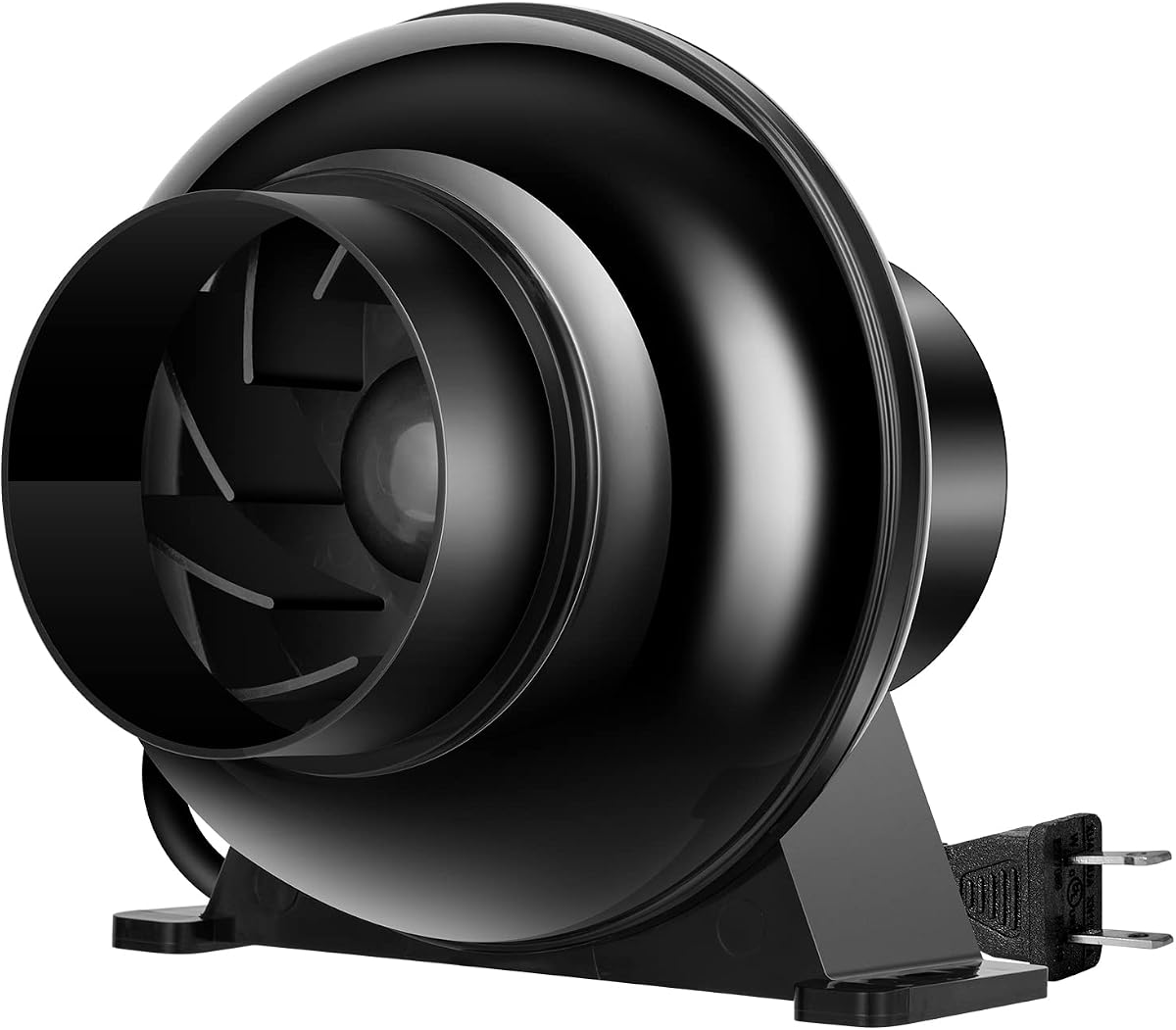
The VIVOSUN P4 is a straightforward 4-inch inline fan rated to move up to 130 CFM while operating at approximately 26 dBA. It is especially attractive for smaller grow tents and controlled indoor spaces where low noise, compact construction, and gradual airflow adjustment matter more than maximum output.
We may earn a commission when you buy through this link, at no additional cost to you.
Its upgraded EC motor is designed to combine useful airflow with low energy consumption and reduced heat. The stepless regulator is a meaningful advantage over basic on/off models because it allows a grower to match ventilation to changing conditions rather than operating at one aggressive setting throughout the day. The housing uses ABS plastic, while the impeller uses PBT blades intended to resist deformation.
The 130 CFM rating is lower than that of several competing 4-inch models, so buyers with large tents or long runs of restrictive ducting may find that it needs to work harder. It also arrives as a fan only, meaning an odor-control setup requires a separate carbon filter and compatible ducting. These limitations keep it from competing with larger or fully bundled systems.
Despite those trade-offs, the P4 is a strong budget selection for a compact tent, propagation room, or ventilation project that needs quiet, continuously adjustable airflow. It is particularly convincing for users who value low noise and straightforward mounting more than maximum cubic feet per minute or integrated filtration.
A listed noise level of 26 dBA makes the P4 suitable for occupied rooms and tents where continuous circulation should not create excessive background sound. The EC motor also supports efficient operation, making variable control a practical way to balance comfort and ventilation.
The stepless control gives the user a continuous range rather than a small set of fixed settings. Its housing can be mounted on a wall or ceiling or incorporated into an inline duct arrangement, giving small grow spaces more installation flexibility.
We may earn a commission when you buy through this link, at no additional cost to you.
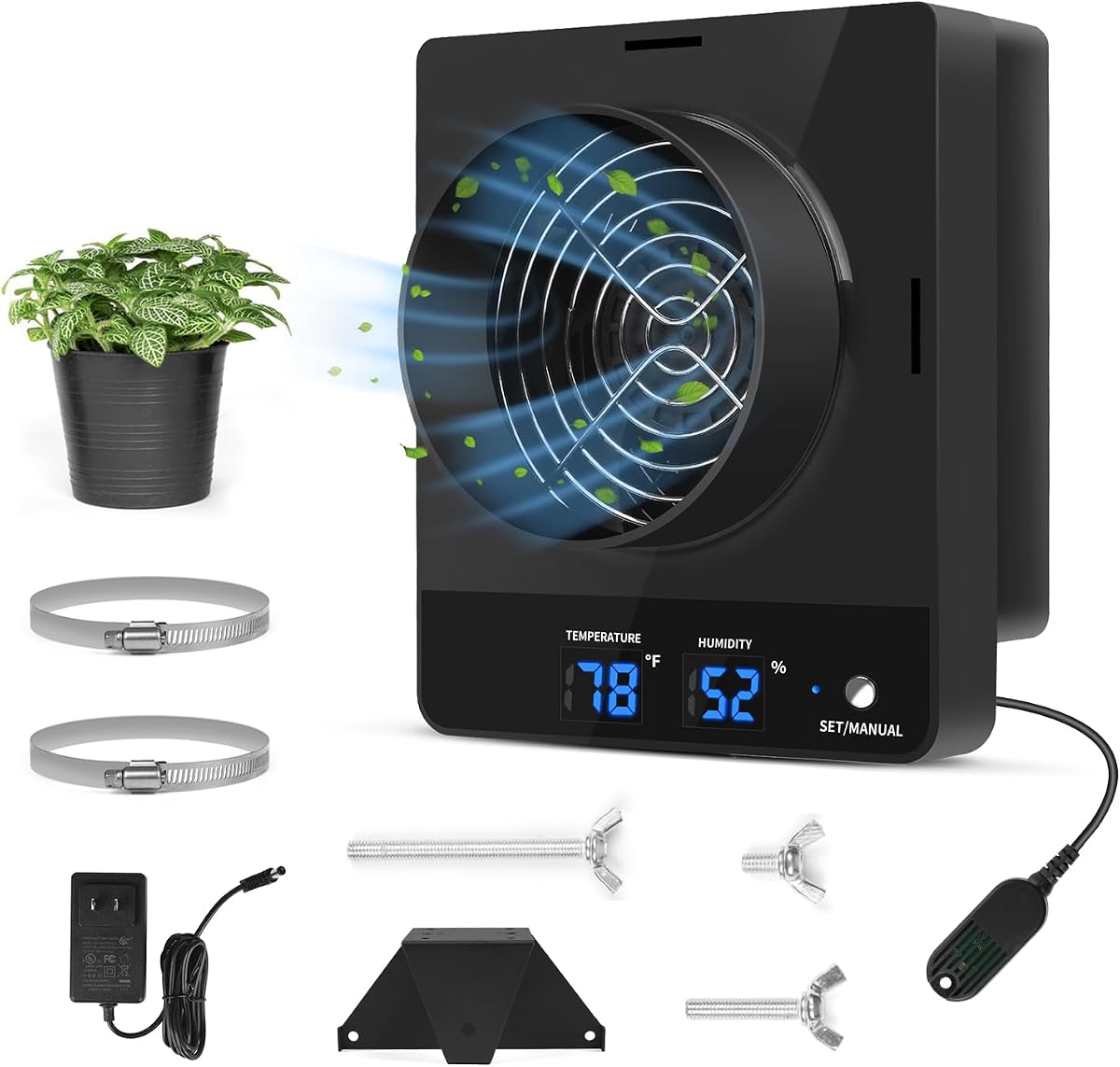
This 4-inch smart inline fan stands apart through automatic temperature and humidity sensing. It can display current readings on an LCD, accept user-defined thresholds, and activate the fan when environmental conditions exceed those settings. Its 4.1 rating reflects a useful feature set, though the lack of a published airflow figure makes capacity harder to compare directly.
We may earn a commission when you buy through this link, at no additional cost to you.
Temperature settings span 50–140°F and humidity settings cover 1–99% relative humidity. A short press of the set button starts manual operation without erasing automatic parameters, while holding the button enters automatic mode. This combination gives users a way to override the fan temporarily without rebuilding the entire configuration.
The sensor must be inserted and positioned where it can measure the relevant part of the tent, so automation is only as accurate as its placement. Unlike bundled filtration systems, this model is focused on moving air and monitoring conditions; it does not include a carbon filter. Its low-voltage DC design and included stainless steel brackets and screws support adaptable installation.
This is the most interesting choice for growers who want the fan itself to respond to environmental changes instead of relying on a separate controller. It is best for tents, mushroom rooms, labs, and small greenhouses where a readable display and automatic threshold control add more value than a known peak airflow number.
The automatic mode starts and stops the fan as readings move beyond the chosen limits. This can reduce unnecessary runtime while helping maintain a more consistent environment, provided the sensor is placed in a representative location.
The display shows real-time temperature and humidity and keeps programmed values visible. That makes the unit easier to configure than a basic controller and allows quick verification of the tent's current conditions.
We may earn a commission when you buy through this link, at no additional cost to you.
The VIVOSUN D4 combines a useful 195 CFM airflow rating with a compact 4-inch format and a 4.3 customer rating. It is a well-rounded option for medium grow tents that need more movement than a basic booster but do not require the capacity of a 6-inch system.
We may earn a commission when you buy through this link, at no additional cost to you.
Its motor spins at 2,500 RPM, and a flow deflector focuses the air stream while reducing turbulent energy to keep the listed noise level at 30 dB. Both flanges connect to vent hose through locking tabs, which makes the physical setup relatively straightforward. The 5.9-foot cord also provides some freedom when locating a wall or ceiling outlet.
The D4 uses an AC motor rather than the PWM-controlled EC motors found in some competing products. That distinction may matter for users focused on energy efficiency or very fine low-speed control. It also does not include a speed controller, so the operating level is more basic than the options with stepless or multi-speed regulation.
For most growers seeking a dependable standalone 4-inch inline fan, the D4 is an excellent overall compromise. Its detachable housing, impeller, and blades simplify cleaning, while its airflow and relatively restrained noise make it suitable for routine tent ventilation and broader room use.
A 195 CFM rating gives the D4 more headroom than many 4-inch boosters while retaining compatibility with common tent ducting. That makes it a useful middle ground for growers who want compact installation without settling for minimal airflow.
The impeller and blades detach from the housing for cleaning, helping remove accumulated dust and residue. This practical design supports more consistent performance and makes periodic upkeep less awkward.
We may earn a commission when you buy through this link, at no additional cost to you.
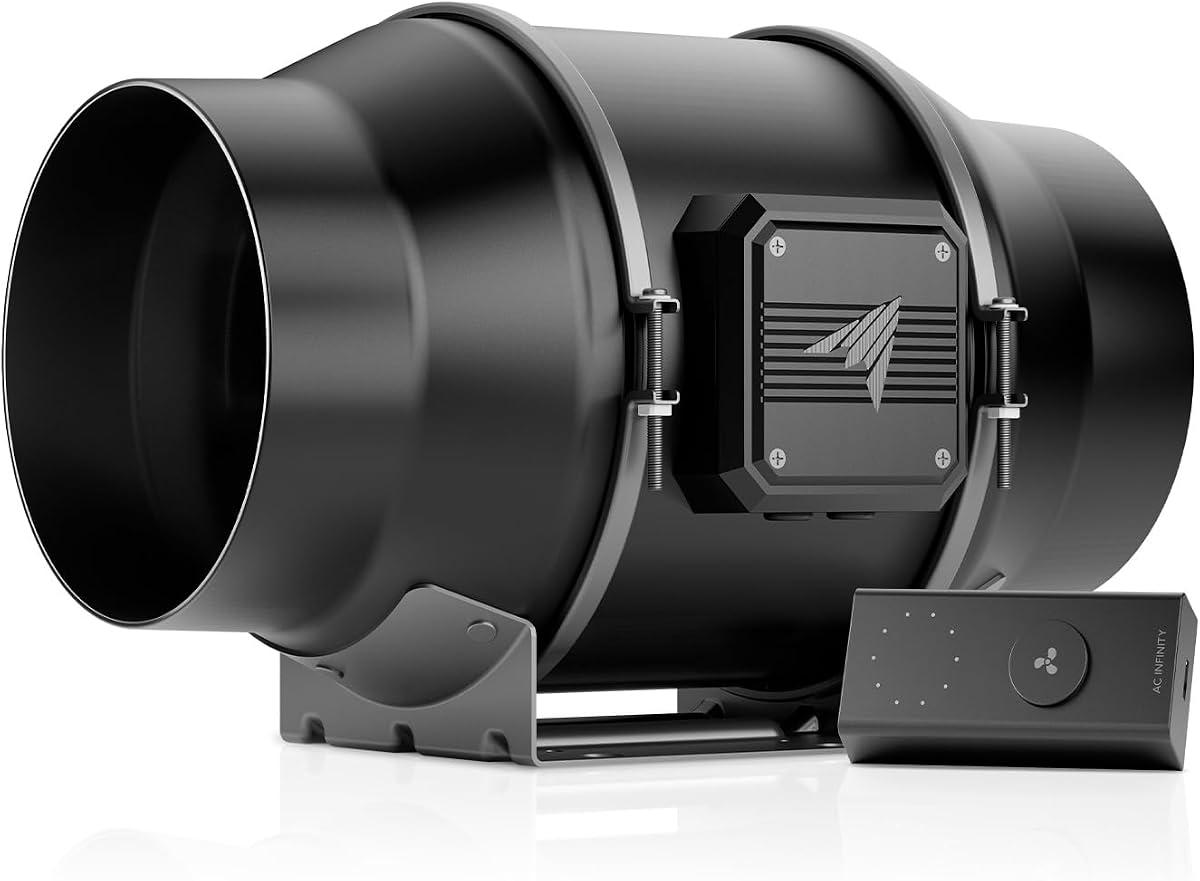
The AC Infinity CLOUDLINE S6 is the strongest premium performance option in this group, pairing a 4.8 rating with a rated airflow of 402 CFM. Its 6-inch format makes it most appropriate for larger tents or installations where a smaller 4-inch fan would need to push against more resistance.
We may earn a commission when you buy through this link, at no additional cost to you.
A PWM-controlled EC motor provides ten settings through the included wired controller and can also work with compatible UIS controllers for programmed operation. The mixed-flow design, stator blade, and hydrodynamic wind circles are intended to maintain delivery in higher-resistance duct arrangements, while dual-ball bearings support long service life.
The listed noise level is 32 dBA, which remains practical for a grow space even while delivering much more air than smaller models. Buyers must account for the larger housing, 6-inch ducting, controller placement, and a higher-tier budget. The product also does not include a carbon filter, so odor control remains an additional system decision.
For a large tent or a user who wants sophisticated programmable airflow, the CLOUDLINE S6 offers the most advanced feature set here. It is the premium pick for buyers who value capacity, fine speed selection, controller ecosystem support, and a strong customer rating over the lowest possible purchase cost.
The 402 CFM rating gives the S6 substantially more capacity than the 4-inch models in the guide. That makes it a stronger choice for large floor areas, long duct runs, and growers who want one fan to move a meaningful volume of air.
PWM control and ten speed levels allow the airflow to be matched to environmental needs more closely than a simple on/off unit. Compatibility with UIS controllers extends the options for users who already manage tent equipment through that system.
We may earn a commission when you buy through this link, at no additional cost to you.
This complete 4-inch filtration kit is designed for growers who want the fan, carbon filter, ducting, coupler, and speed control as one coordinated setup. Its 190 CFM inline fan provides substantial movement for a compact tent while the included 12-inch high-carbon filter targets odors and chemicals.
We may earn a commission when you buy through this link, at no additional cost to you.
The activated-carbon media is described as RC 412 Australian virgin charcoal with an IAV of 1200+. A removable pre-filter cloth is stated to block 99% of particles, helping keep the carbon bed cleaner, while double-sided galvanized steel mesh gives the filter a durable open structure for airflow.
The 12-inch filter and bundled eight-foot ducting may require more tent space than a small inline-only installation. Restrictive filters also create additional static pressure, so actual performance depends on maintaining secure connections and avoiding kinks or sharply compressed ducting.
This kit is a compelling choice for users starting from scratch who want odor control without assembling each component separately. It is especially convenient for hydroponic rooms, indoor grow tents, closets, basements, and other areas where exhaust air needs both movement and filtration.
Bundling a high-carbon filter with the fan makes this a more complete intake or exhaust solution than a standalone inline unit. The thick carbon bed and pre-filter are intended to manage both smell-producing compounds and particles that could otherwise reach the carbon.
The included eight-foot duct, rubber coupler, speed controller, and reinforced filter flanges reduce the need for separate parts. Secure connections help limit leakage around the filter, while a rigid flange helps maintain the intended airflow path.
We may earn a commission when you buy through this link, at no additional cost to you.
The Voltset 4 Inch is notable for claiming 280 CFM from a compact 4-inch housing. That is among the higher airflow ratings among the standalone 4-inch models reviewed, making it attractive for growers who want strong output without changing to 6-inch ducting.
We may earn a commission when you buy through this link, at no additional cost to you.
Its 2,200 RPM motor uses a copper core to promote heat dissipation and durability. The listed 30 dBA noise level and integrated noise-reduction technology help make the fan more practical for workshops, grow tents, and other occupied spaces where a much louder motor would be distracting.
Quick-release clips and universal mounting brackets simplify attachment to compatible ducting and walls. However, the product description does not identify an included speed controller, so users who need gradual output adjustment will need to confirm the available controls before installation. It also provides no activated-carbon stage for odor removal.
The Voltset is a good fit for a medium tent or workshop that prioritizes airflow and straightforward mounting over automatic sensing or integrated filtration. Its claimed continuous-operation durability and high output also make it a more specialized choice than low-power boosters.
The 280 CFM specification gives this fan an advantage over many competing 4-inch units. It may be particularly useful in tents already equipped with 4-inch ports, provided the duct route is not excessively long or restrictive.
Quick-release clips allow the housing to connect securely to compatible hose, while universal brackets simplify wall mounting. These details can reduce assembly time compared with a kit that requires separate clamps or improvised supports.
We may earn a commission when you buy through this link, at no additional cost to you.
The VIVOSUN T4 is a thoroughly equipped 4-inch filtration system that pairs an AeroZesh inline fan with an E12 speed controller, carbon filter, and eight feet of ducting. Its 4.6 rating is the second highest among the listed products, and its 210 CFM fan provides a solid balance of movement and manageable noise.
We may earn a commission when you buy through this link, at no additional cost to you.
The E12 controller offers ten PWM-selected speeds, remembers the previous setting after a restart, and provides three on/off cycle modes. It can also be integrated with the VIVOSUN app system for remote control, giving users more operational options than a basic knob or fixed-speed switch.
The carbon filter uses RC 412 Australian virgin charcoal with an IAV above 1200 and a 38 mm carbon bed. Included rope hangers assist installation, while the aluminum ducting uses a PET layer between protective layers and comes with stainless clamps for secure connections.
This bundle is ideal for a grower who values a complete, controllable setup and wants a single purchase to cover the principal components. The app, cycle modes, and memory function add flexibility, although buyers should ensure the associated app and controller are compatible with their setup before installation.
Ten speed levels, three cycling patterns, and previous-setting memory offer several ways to tailor fan behavior. PWM control is particularly useful for balancing airflow, noise, and energy use over different periods of the growing cycle.
The 38 mm carbon bed provides a larger media volume than many compact filters. Together with the stated IAV and galvanized support structure, it is intended to provide useful odor control without restricting the intended air path.
We may earn a commission when you buy through this link, at no additional cost to you.
The Hon&Guan 4-Inch Air Filtration Kit combines a 130 CFM inline fan, variable speed controller, 10-inch carbon filter, eight feet of ducting, and a rubber coupler. Its 4.5 rating reflects a well-regarded bundle, while the 26 dBA operating level makes it especially quiet.
We may earn a commission when you buy through this link, at no additional cost to you.
The fan provides enough airflow for small tents and controlled indoor gardens while allowing the user to reduce output when full-speed ventilation is unnecessary. The activated-carbon section uses RC 48 lightweight carbon with a stated IAV of 1200+ and a 38 mm bed, helping remove unpleasant smells as air passes through the filter.
The included duct has an aluminum-foil and PET construction supported by a steel-wire helix. According to the product data, this three-layer structure helps preserve its shape and resist rips or pinholes, which is useful for maintaining consistent airflow over time.
This kit is a sensible option for a small tent or indoor garden that needs quiet movement and odor control in a coordinated package. Its primary limitation is the 130 CFM fan rating, which is lower than the outputs of several competing 4-inch options and may be insufficient for a larger space.
At 26 dBA, the included fan offers one of the lowest stated noise levels in the guide. That makes this bundle attractive when ventilation must run for long periods in a space where excessive mechanical noise would be distracting.
The layered foil, PET, and steel-wire construction is designed to resist collapsing and punctures. Maintaining that shape helps avoid airflow loss during long runs and reduces the likelihood of a kink forming behind the filter.
We may earn a commission when you buy through this link, at no additional cost to you.
The Hon&Guan Booster Fan is a compact 4-inch unit designed to move 130 CFM while drawing no more than 6 watts. Its 26 dBA noise level and 4.3 rating make it a practical option for extending airflow through a duct run or supplying modest ventilation in a small tent.
We may earn a commission when you buy through this link, at no additional cost to you.
The upgraded DC motor spins at 4,500 RPM and is paired with a variable speed controller. That allows users to trade some output for lower noise when conditions do not require maximum movement. The fan is also rated at 165 Pa of air pressure, a figure that can be relevant in restrictive installations.
Its 130 CFM capacity is modest compared with higher-output 4-inch options, and it does not sense or control temperature, humidity, or odor. The removable plastic blade and body make maintenance easier, but the need to purchase a separate filter may be inconvenient for odor-sensitive grows.
The Hon&Guan is best suited to boosting an existing ventilation route, improving circulation in a compact room, or adding quiet airflow with low energy use. It is less suitable as the sole high-output exhaust solution for a large tent or a complete odor-control system.
The six-watt maximum consumption keeps the operating demands modest. Combined with variable control, that allows growers to select only the airflow needed at a given moment rather than running the motor continuously at maximum output.
The blade and body can be removed for cleaning, helping prevent buildup from reducing performance. Its compact dimensions also make it useful in tighter spaces or when a fan needs to be inserted partway along a ventilation route.
We may earn a commission when you buy through this link, at no additional cost to you.
The VEVOR 6-Inch delivers a rated 400 CFM, placing it among the highest-capacity products in this guide. It is a strong choice for large grow tents, hydroponic rooms, basements, and other spaces that need substantial exhaust, dehumidification, or heat removal.
We may earn a commission when you buy through this link, at no additional cost to you.
A high-quality AC motor drives the fan at a listed 34 dBA noise level. Manual controls allow the output to be adjusted to different ventilation requirements, while the stated energy savings make the motor more efficient than conventional AC designs. The noise figure is still relatively restrained, although it is higher than the quietest options in the comparison.
The package includes hang-up slings, non-vibration rubber mats, and straps, allowing the fan to be suspended or mounted on a wall. Rubber isolation helps reduce vibration transfer, which can be valuable when the unit is attached near a tent frame or other lightweight structure.
The VEVOR is a practical high-capacity exhaust fan for users who already have 6-inch ducting or are building a new system around it. It does not include carbon filtration, and the manual control is less programmable than the EC-based systems in the guide, but its airflow and installation accessories offer strong value for large-space ventilation.
The 400 CFM rating can move a large volume of air through a substantial tent or room. This capacity reduces the need to force a smaller fan through long or restrictive duct runs, where airflow commonly falls.
Hanging slings, straps, and rubber mats provide several installation options. The isolation components can help limit vibration transferred through the housing, supporting more stable operation when the fan is suspended inside a growing area.
We may earn a commission when you buy through this link, at no additional cost to you.
Choosing an inline duct fan starts with matching the unit to the tent, duct route, environmental goals, and acceptable noise level. The most important factors are airflow capacity, diameter, control method, filtration, and installation quality.
The fan's inlet and outlet must match the duct diameter used throughout the installation. Most products in this guide use 4-inch ducting, which is common for smaller tents, while the AC Infinity CLOUDLINE S6 and VEVOR use 6-inch connections. Matching sizes is essential because an adapter or improvised transition can reduce airflow and make secure sealing more difficult.
Airflow is commonly expressed in cubic feet per minute, or CFM. The options here range from 130 CFM to more than 400 CFM, but the figure alone does not reveal real performance in every installation. A restrictive carbon filter, long hose, sharp bends, compressed flex duct, and poorly sealed joints can all reduce the air reaching the tent.
Small tents and propagation spaces may operate effectively with a compact 4-inch fan around 130 CFM. Medium spaces can benefit from models near 190 to 280 CFM, while large tents often justify 6-inch options rated near 400 CFM. The exchange rate of tent volume, intended temperature range, humidity targets, and supplemental intake all influence the required rate.
EC and DC motors generally support efficient, adjustable operation, while AC motors are often straightforward and can provide strong airflow. Manual knobs offer basic control, stepless regulators provide smooth adjustment, and PWM controllers may include multiple speeds, cycle modes, memory, or smart-device integration. The smartest sensor is only useful when it can be placed where it measures the conditions that matter.
Noise matters in tents inside bedrooms, offices, or living areas. Products in this guide list levels from 26 to 34 dBA, but the perceived result also depends on duct vibration, mounting materials, speed, and room acoustics. Flexible duct can transmit motor noise and rattle, so securing it and adding isolation at the fan can improve the overall installation.
An inline fan moves air but does not inherently remove odor. A complete filtration kit adds activated carbon, a pre-filter, ducting, and sometimes a controller. Carbon filter size matters because a larger bed can offer more media and lower pressure, while a smaller filter may be easier to fit but restrict airflow. Filter media also requires replacement after it becomes saturated.
Look for sturdy flanges, locking tabs, clamps, brackets, rubber couplers, and enough cord length to reach a suitable outlet. Hanging hardware can simplify installation, but a securely mounted unit may vibrate less. Inline ducting should be supported along its length to prevent sharp bends and unnecessary strain on the fan connections.
Dust and residue can reduce airflow and imbalance a fan over time. Removable impellers, blades, or housings are easier to clean than sealed assemblies. Regular inspection also allows growers to check for loose clamps, damaged wiring, blocked filters, and irregular fan movement before these issues affect the growing environment.
Begin by confirming that the fan port matches the tent's ducting, then install the unit in a straight section where possible. Secure every clamp and support the duct so its weight does not pull on the housing. For a filtered exhaust, place the carbon filter in the intended path and keep the fan and filter connections airtight. If using a sensor, position the probe in the growing area rather than directly beside the fan where incoming air could distort the reading.
Start the fan at a low setting and increase speed gradually. Listen for rubbing, vibration, rattling, or changes in motor tone, and inspect the installation if airflow seems weak. Use controller cycles or automatic thresholds when they match the tent's needs, but continue checking actual conditions because a filter can become restricted and sensor placement can affect accuracy. Keep intake and exhaust openings clear and avoid crushing flexible duct behind the fan.
Inspect the housing, blades, filter, and connections regularly. Clean removable blades according to the manufacturer's instructions, and disconnect power before servicing any part. Replace or service the activated carbon when odor control declines, and wash or replace the pre-filter if it becomes clogged. Check that clamps remain tight, rubber mats have not hardened, and the fan continues to run smoothly before the next growing cycle.
The correct size depends mainly on tent volume, duct length, and the amount of heat and humidity that must be moved. A 4-inch unit is common for smaller and medium tents, while 6-inch models are often better for large spaces or restrictive duct runs. Match the fan to the tent's existing port diameter and avoid using a much smaller fan than the system was designed around.
A carbon filter is necessary when odor control is a priority, particularly in a tent located near living spaces. The inline fan provides movement, while activated carbon helps adsorb odor-causing compounds. Carbon filters add pressure and need replacement when saturated, so growers should account for both airflow loss and ongoing maintenance rather than treating the fan and filter as one indivisible component.
For a tent inside or next to occupied rooms, a lower listed noise level is generally more comfortable. Models in this guide range from 26 to 34 dBA, but installation noise can differ because loose ducting may rattle and rigid connections may transmit vibration. Flexible supports, secure clamps, and rubber isolation can materially improve perceived sound.
An inline fan can help by exchanging warm, humid air with cooler, drier air, but it cannot remove moisture by itself. It must have a path for replaced air to enter the tent, and the incoming air must actually be drier than the air inside. Filter media also creates resistance, so carbon-filtered exhaust systems may need enough fan capacity to maintain useful airflow.
Many grow tents are more effective with an exhaust fan because it pulls stale, warm air out and creates a consistent path for replacement air to enter. A filtered intake setup can also work, especially when the outside air is cleaner than the tent air. Whichever approach is chosen, openings must be configured so air can move through rather than being blocked by multiple sealed or competing systems.
Not always. Continuous operation can provide stable circulation, but automatic thresholds, timer cycles, and adjustable speeds may reduce unnecessary energy use. The best setting depends on plant stage, external conditions, tent temperature, and humidity targets. Frequent switching is generally less of a concern than a poorly selected airflow rate or a clogged filter.
The restriction may come from a saturated carbon filter, crushed or kinked ducting, a disconnected clamp, a blocked intake, or a fan that has accumulated dust. First inspect the entire route from the tent to the outside rather than only the motor. If the fan sounds strained or moves slowly after cleaning, it may need inspection or replacement.
No. Some products include a stepless regulator, variable controller, multi-speed PWM controller, or automatic environmental control. Others are designed only to run at a fixed speed. Check the package contents and the manufacturer's specifications before ordering, especially if the tent already uses a programmable environmental controller or an AC Infinity UIS controller.
The VIVOSUN P4 is the strongest budget option for small spaces because it combines 130 CFM airflow, 26 dBA operation, and stepless control. The VIVOSUN D4 offers the most balanced standalone choice at 195 CFM, while the AC Infinity CLOUDLINE S6 serves larger systems with 402 CFM, ten-speed control, and a 4.8 rating.
Prioritize duct compatibility, realistic airflow, and the controls your growing routine actually requires. Complete filtration bundles such as the VIVOSUN T4, Hon&Guan 4-Inch Kit, and 4-Inch Air Filtration Kit make odor control easier, while the smart sensor fan is valuable when automatic temperature and humidity response is the priority.
Finally, check the current listing details and availability before ordering. Duct size, included accessories, controller functions, and manufacturer information can change, and a complete, sealed setup is essential for getting the performance you expect.