
Foxelli MX20 Headlamp
4.7Editor score
Up to 45-hour runtime
Five white and red modes
IPX5 water resistance
Includes three AAA batteries
Glove-friendly single button
Compare the best headlamp for hiking and camping, including brightness, battery options, waterproofing, comfort, lighting modes, and hands-free features.
A headlamp for hiking and camping should provide dependable illumination without interfering with the movement, comfort, or safety of the wearer. Important considerations include usable brightness, beam control, battery flexibility, water resistance, fit, and simple controls that remain practical when both hands are occupied.
The products in this guide were compared using the supplied specifications and customer ratings, with attention to lighting modes, power options, runtime, weight, adjustability, durability, and outdoor versatility. The list covers rechargeable models, battery-powered options, compact choices, and higher-output headlamps suited to different trip styles.
Each review highlights the features that matter most for trails, campsites, backpacking, evening tasks, and emergencies. Ratings reflect the supplied product data, while practical trade-offs help distinguish general-purpose tools from specialized designs. Product availability and pricing can change, so readers should confirm current details before purchasing.
4.7Editor score

4.8Editor score

4.4Editor score
This side-by-side comparison organizes all ten headlamps by output, power, water resistance, weight, and control features, making it easier to match a lighting tool to a specific hiking or camping routine.



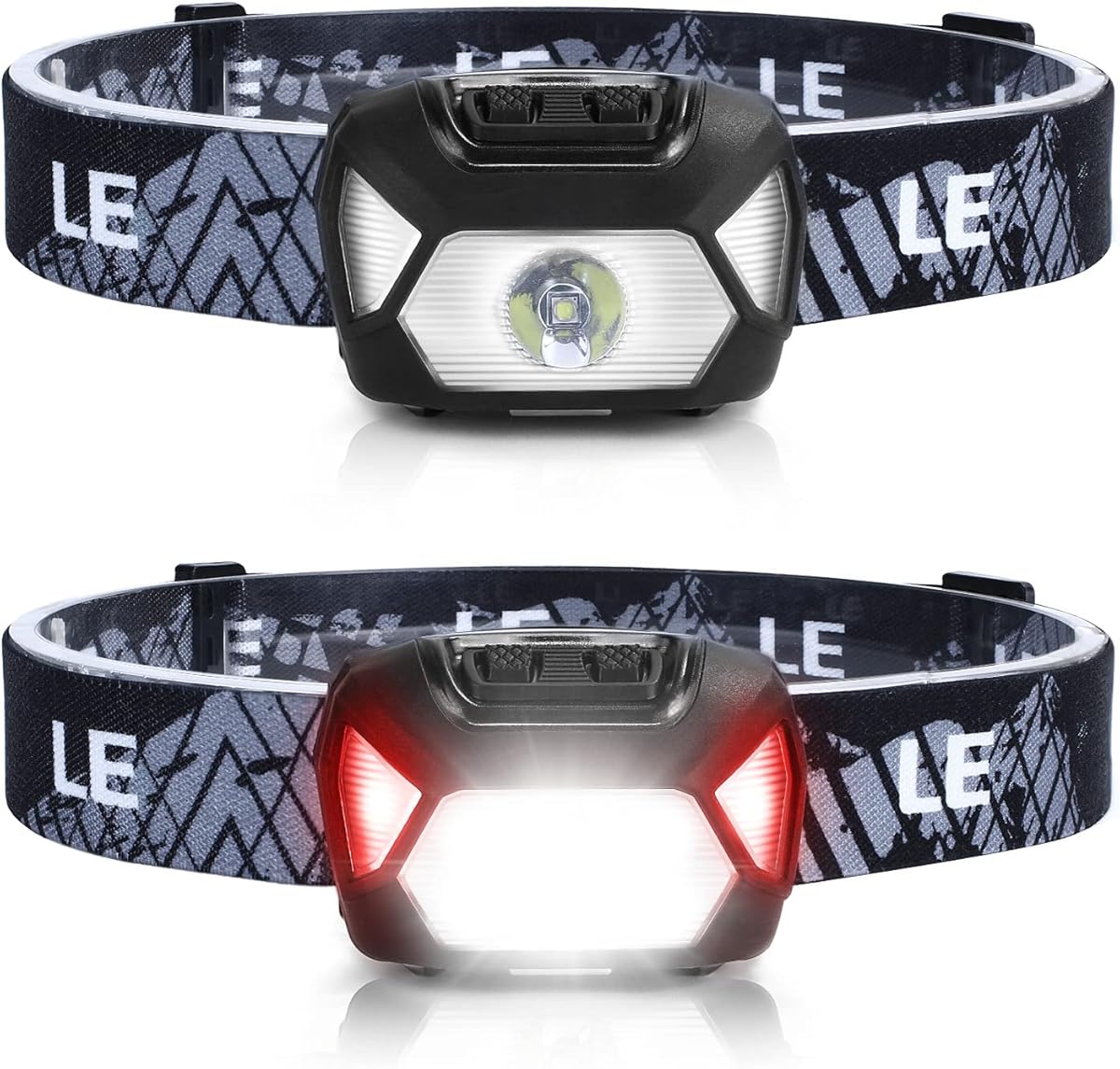

The LHKNL Rechargeable Headlamp earns a 4.5 rating and combines a compact 1.87-ounce design with a generous set of controls for trail and campsite use. Its standout qualities are the long-press shutdown, motion-sensor operation, red illumination, and eight available lighting modes, all of which make the lamp unusually flexible for the money.
We may earn a commission when you buy through this link, at no additional cost to you.
The built-in 1500mAh battery can charge while the light remains in operation, a practical feature when access to power is limited. Strong and weak main and side beams cover everything from close-up tent tasks to broader path illumination. A battery indicator helps prevent an unnoticed loss of power, while the stated four-to-ten-hour runtime reflects the different settings and use conditions.
The head rotates 60 degrees and uses an adjustable elastic band, helping place the beam where it is needed without repeatedly moving the lamp. Its motion sensor is valuable when a hiker is handling trekking poles, cooking equipment, or campsite gear with dirty hands. The trade-off is its IPX4 rating, which is intended more for rain and splashes than the deeper water exposure permitted by higher-rated models.
This is a sensible choice for general-purpose hikers, families, and campers who value multiple controls in a lightweight package. It is less compelling for expedition users who require full submersion protection, but for ordinary trails, backpacking, evening chores, and emergency kits, its combination of rechargeability, sensor control, red light, and multiple beams is difficult to overlook.
The LHKNL model is best treated as a versatile generalist rather than a specialist technical lamp. It gives users several practical ways to control the beam without demanding frequent attention to tiny buttons, and its low weight suits those who prefer to carry less equipment.
The motion sensor lets users switch the main or side beam on and off with a wave, reducing the need to touch the lamp while wearing gloves or handling food, cookware, or trail equipment. The long-press function provides a direct way to shut the light off from any mode.
Strong and weak main and side beams, red illumination, and SOS red strobe allow the headlamp to serve both ordinary tasks and signaling needs. The range makes it useful for reading inside a tent, following a path, and remaining visible in an emergency.
We may earn a commission when you buy through this link, at no additional cost to you.
The Blukar 2000-Lumen Headlamp has a 4.5 rating and emphasizes versatility through stepless dimming, a selectable motion sensor, and a combination of XPG and COB lighting technology. It is a solid all-round option for hikers who want one lamp to handle narrow illumination, wide campsite light, red light, and hands-free operation.
We may earn a commission when you buy through this link, at no additional cost to you.
A long press changes brightness from full output down to 30 percent, providing finer control than a simple stepped adjustment. Five standard modes cover XPG white, COB white, both white emitters together, COB red, and red strobe. Three additional sensor modes allow the user to control selected white-light settings by waving a hand in front of the lamp.
The 1200mAh internal battery recharges through USB-C, and the supplied cable makes it straightforward to replenish from compatible power sources. Its removable, washable, breathable band improves long-term hygiene and fit. The lamp pivots 45 degrees, allowing the beam to be directed down toward the trail or toward a campsite task. At 2.96 ounces, it is heavier than the smallest models but still compact enough to fold into a pocket.
The main limitation is the IPX5 water-resistance rating, which is appropriate for rain and sprayed water but does not imply full submersion protection. The integrated battery also cannot be exchanged in the field. Even so, these limitations are reasonable for campers who prioritize rechargeable convenience, broad mode selection, and adjustable brightness over disposable-battery flexibility.
Blukar’s offering fits well for weekend hikers, joggers, dog walkers, and campers who want tactile light control. The ability to reduce output gradually is particularly useful when a full beam feels unnecessarily glaring in a tent or while looking at a close-range map.
Stepless adjustment from 100 percent to 30 percent lets users select a comfortable level for reading, cooking, repairing gear, or walking a trail. This is useful when fixed low and high settings do not provide the right balance between visibility and glare.
The sensor modes are particularly helpful when both hands are occupied. Regular button modes preserve white flood, white spot, combined white, red, and strobe options, giving the headlamp more than one way to serve different outdoor needs.
We may earn a commission when you buy through this link, at no additional cost to you.
The BLACK DIAMOND Cosmo 350 carries a 4.6 rating and combines 350 lumens with unusually strong environmental protection. Its IP67 rating allows operation after submersion in water up to one meter for 30 minutes when properly closed, making it a confident choice for wet trails, coastal weather, and unpredictable camping conditions.
We may earn a commission when you buy through this link, at no additional cost to you.
Power flexibility is another defining advantage. The headlamp runs on three included AAA batteries or the rechargeable BD 1500 Li-ion battery. That lets campers choose disposable cells for simplicity or add a rechargeable system for repeated trips. The simple button interface provides dimming, strobe, and red night-vision settings for close tasks, navigation, and preserving dark adaptation.
Its low-profile body and adjustable headband are designed to remain stable and comfortable during hiking, climbing, or running. The supplied specifications describe a balanced, compact form intended for long-term wear. The trade-off is that the rechargeable battery and its charger are separate purchases, so buyers who prefer USB charging will need to account for that additional component.
This model is particularly compelling for hikers who encounter heavy rain, snow, or water-heavy environments and want a headlamp without compromising protection. It also makes sense for anyone who prefers the availability and interchangeability of AAA batteries. For campers who want an integrated rechargeable design and do not need IP67-level durability, one of the other rechargeable choices may be simpler.
The Cosmo 350 delivers a balanced mix of output, protection, and power options. It is not the lightest model in the group, and it is not the highest-output option, but the trade-offs are offset by a mature combination suited to dependable outdoor use.
The Cosmo 350 is built for conditions beyond occasional splashes. Its IP67 rating permits continued operation after specified submersion, although the lamp should be fully dried before storage or charging.
Included AAA batteries make the headlamp ready for immediate use, while compatibility with the BD 1500 Li-ion battery creates an option for regular rechargeable travel. The choice can also depend on what battery reserves a camper already carries.
We may earn a commission when you buy through this link, at no additional cost to you.
The BLACK DIAMOND Storm 500-R has a 4.4 rating and offers the highest maximum output in this comparison at 500 lumens. That makes it particularly attractive for hikers who regularly navigate rough, unlit trails, camp in remote locations, or want additional reach when searching a campsite after dark.
We may earn a commission when you buy through this link, at no additional cost to you.
Its integrated 2400mAh lithium-ion battery provides a substantial power reserve without a pack of disposable cells. The micro-USB charging arrangement allows users to replenish the lamp through a compatible cable. Full-strength, dimming, strobe, and red night-vision modes create several useful levels for distant navigation, close campsite work, signaling, and preserving night vision.
The durable housing is intended to withstand heavy rain, snow, and challenging outdoor environments. An adjustable headband and compact profile should remain relatively stable during active use, while the higher-output lamp gives users more light than most alternatives. The main trade-off is that the Storm 500-R uses micro-USB rather than the more broadly used USB-C format found on several competing models.
Buyers should also note the 4.4 rating, which is solid but not the highest among the listed products. More output does not automatically make a headlamp better for every task, and those seeking the lightest possible design may prefer lower-output alternatives. For demanding trail use, however, the combination of 500 lumens, dimming, and a large rechargeable battery is difficult to dismiss.
This is a strong recommendation for experienced hikers and campers who prioritize brightness and rechargeable endurance over minimal weight. It is especially suitable for technical trails, night travel, and campsite search tasks where broad visibility is valuable.
The full-output setting reaches farther into the darkness than the other models in the guide. It is useful on unlit paths, around large campsites, or during roadside and vehicle-side emergencies where a wider view of the surroundings is useful.
The 2400mAh battery supports a rechargeable routine that avoids disposable batteries on repeated trips. Because it is integrated into the lamp, users benefit from a compact assembly but cannot exchange cells independently in the field.
We may earn a commission when you buy through this link, at no additional cost to you.
The Foxelli MX20 has a 4.7 rating and distinguishes itself with a stated runtime of up to 45 hours. That endurance makes it a logical choice for long backpacking routes, multi-day camping trips, and anyone who wants to carry a reliable light without worry about finding a charging point.
We may earn a commission when you buy through this link, at no additional cost to you.
A single glove-friendly button controls a broad selection of white and red modes, including SOS and strobe functions. The body tilts 45 degrees, helping users aim the beam at nearby objects without bending their neck. Its elastic headband is adjustable and ergonomically designed, while the listed 3.2-ounce weight includes the batteries.
The headlamp uses three AAA batteries, and three ENERGIZER batteries are included according to the supplied information. That makes it immediately usable for camping or hiking without a separate charging setup. The trade-offs are the absence of rechargeable-battery compatibility and an IPX5 rating that is designed for splashing or sprayed water rather than full submersion.
This model is a strong fit for campers who value long runtime and simple controls over modern charging convenience. The included batteries also make it a practical emergency or vehicle-kit purchase. Hikers traveling with very limited pack space may find its battery-equipped weight less convenient than an ultralight rechargeable model, but the endurance advantage can outweigh that concern.
Foxelli’s headlamp is an excellent traditional all-rounder. It provides the essential elements—bright white light, red illumination, emergency signaling, adjustable aim, and exceptional stated runtime—without forcing users to manage cables or built-in charging electronics.
The long stated runtime is the defining benefit for extended trips. Users can carry fewer replacement batteries, making the MX20 attractive for remote routes, group kits, and emergency preparations where conserving space matters.
The glove-friendly control simplifies operation in cold or wet conditions. White modes handle routine visibility, while red, SOS, and strobe options support signaling and night-vision-sensitive tasks.
We may earn a commission when you buy through this link, at no additional cost to you.
The Blukar Three-Light Headlamp earns a 4.6 rating and stands out for its combination of multiple emitters, a rotating zoom lens, and broad mechanical adjustment. It is a useful option for campers who want one lamp to move between focused trail lighting and broad campsite illumination.
We may earn a commission when you buy through this link, at no additional cost to you.
Its T6 and XPE light sources produce an even, stable beam across several configurations. The main lens can be rotated to choose between flood and spotlight behavior, while the head tilts 90 degrees to aim light at the ground, a tent wall, or a work area. Five modes combine the main white light, side white light, all white lights, flashing white light, and main red light.
The rear red light provides an additional visibility signal in dark outdoor environments. USB-C charging is included, and the integrated battery takes approximately five hours to recharge. IPX6 protection gives it resistance to heavy water exposure, and the stable elastic band can be worn on the head or attached to a compatible helmet.
The main compromises are a built-in, non-removable battery and the absence of a motion sensor. Users who need sensor control may prefer another Blukar model, while anyone unable to recharge during a trip may prefer disposable batteries. The trade-off is a headlamp with unusually adaptable optics and a strong set of physical light sources.
This Blukar is best for general camping, hiking, repair work, and activities where zoom and broad tilt are more valuable than field-replaceable batteries. Its multiple light sources also make it appealing for users who previously carried separate spot and flood lights.
Rotating the lens changes the beam shape, while the 90-degree tilt positions the light precisely. Together, these controls let one headlamp cover distant trail markers, immediate footing, and hands-level campsite tasks.
The red light on the back adds another layer of visibility when moving outdoors in darkness. It complements the main red mode and may be useful when a group is moving together through a campsite or along a trail.
We may earn a commission when you buy through this link, at no additional cost to you.
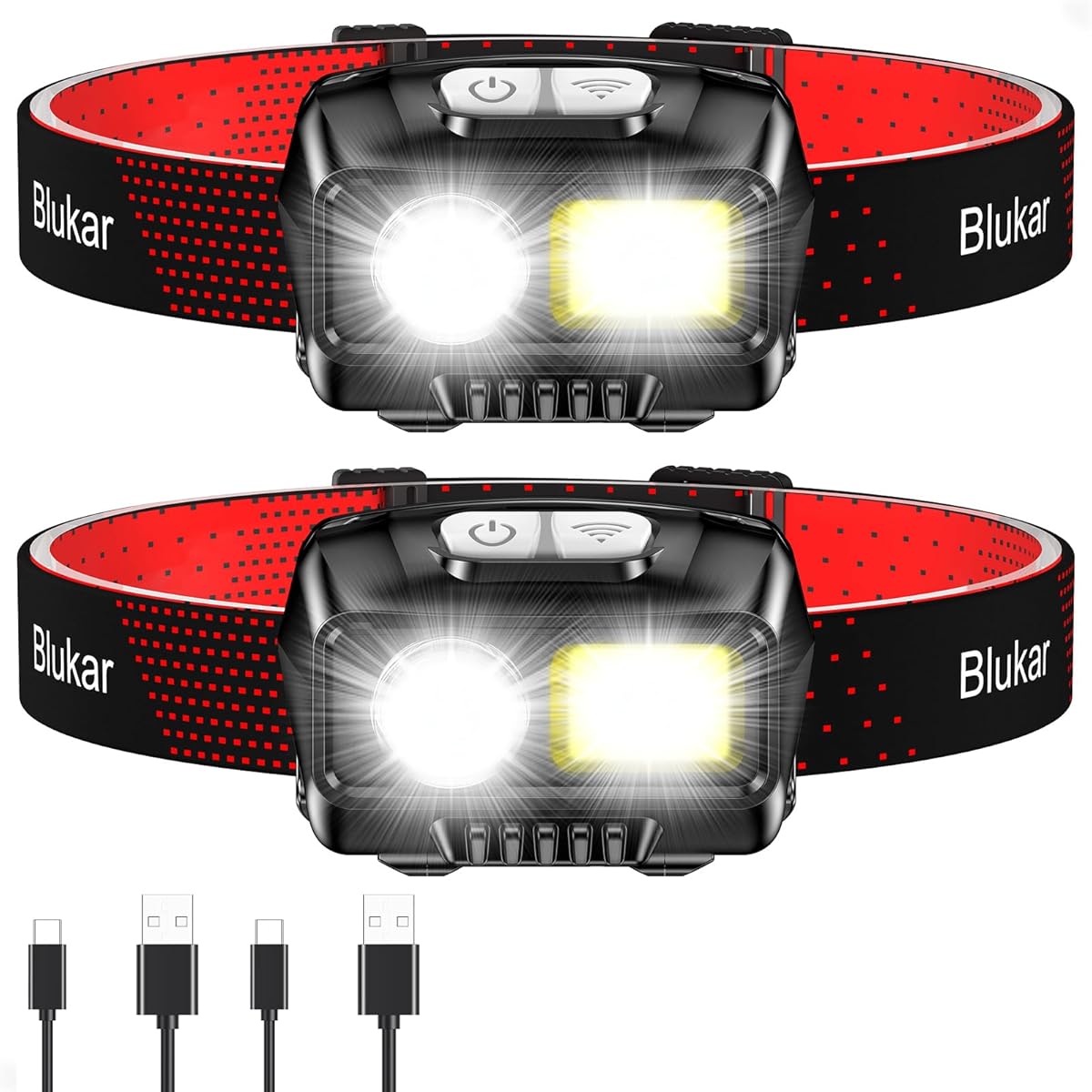
The Blukar Two-Pack Headlamp has a 4.6 rating and includes two rechargeable lamps, making it convenient for couples, families, hiking partners, or campsite kits that benefit from having more than one light. Each headlamp combines XPG and COB LED technology to support both spotlight and floodlight needs.
We may earn a commission when you buy through this link, at no additional cost to you.
Continuous dimming adjusts brightness from 100 percent to 30 percent, while eight modes cover white spot, white flood, combined white, red, red SOS, and three motion-sensor white-light configurations. The sensor responds to a wave within 15 centimeters, allowing users to switch the lamp on or off without touching it when both hands are occupied.
Each light uses a 1200mAh battery and charges through the included USB-C cable. The supplied information lists approximately 2.5 to three hours for a full charge and describes different runtimes for XPG and COB combinations. The 45-degree adjustment and detachable, washable headband improve practical use across different head sizes and activities.
Its IPX5 rating handles rain, snow, sprayed water, and dust but does not offer full submersion protection. As a two-pack, it also occupies more storage space than a single headlamp, which may matter in weight-conscious backpacking. Nevertheless, having a second light can provide redundancy and let one lamp be charged while the other remains in use.
The Blukar Two-Pack is particularly suitable for group outings and households that want matching rechargeable lights. Its mode flexibility, sensor operation, and wide-to-narrow beam options make it more versatile than a basic single-purpose headlamp.
Two matching lamps allow partners or family members to carry identical equipment, while providing a backup if one unit develops a problem. They can also alternate charging during a multi-day trip without leaving the group without illumination.
The combination of XPG and COB emitters supports different beam shapes, while sensor modes remove the need to touch the switch repeatedly. Continuous brightness control helps avoid glare during close work or quiet campsite hours.
We may earn a commission when you buy through this link, at no additional cost to you.
The Lepro Two-Pack Headlamp holds a 4.6 rating and offers a straightforward battery-powered design with six lighting modes. The supplied specifications state up to 1300 lux and a beam reaching 400 feet, making it appealing for campers who want dependable visibility without carrying charging cables.
We may earn a commission when you buy through this link, at no additional cost to you.
High and low spotlight, high and low flood, a red steady mode, and a red flashing mode cover common outdoor tasks. The lamp tilts 45 degrees to reduce the need to crane the neck, and the removable, washable elastic band fits adults, children, hard hats, and helmets. Its listed weight is 1.94 ounces without batteries.
The included features emphasize resistance to splashing, spraying, cold, heat, and ground impacts. The 45-degree mechanism is designed to stay fixed during running and hiking, reducing the chance that the beam will shift unexpectedly. Its main disadvantage is that batteries are not included, so buyers must add compatible cells before the lamps are ready to use.
There is also no rechargeable option. That can be a meaningful limitation for travelers seeking to minimize disposable battery waste, though the simplicity of AAA-style power is valuable during emergencies or on trips where battery availability matters more than charging convenience. As a pair, the lamps are well suited to families or hiking partners.
The Lepro Two-Pack is a practical option for people who prefer familiar disposable-battery operation and a broad choice of beam settings. It works especially well as a shared camping kit, vehicle emergency supply, or pair of lights for short recreational outings.
Spotlight modes concentrate the beam for distance, while flood modes spread illumination across a wider nearby area. Choosing between high and low settings helps balance visibility, comfort, and battery use.
The removable elastic band and 45-degree tilt make the headlamp suitable for helmets and hard hats as well as direct head wear. This broadens its use for climbing, trail work, and job-site activities.
We may earn a commission when you buy through this link, at no additional cost to you.
The BLACK DIAMOND Spot 400 has a 4.6 rating and provides 400 lumens with a choice of disposable or rechargeable power. It is a versatile pick for hikers who want more output than a basic trail lamp while retaining the option to begin a trip with the included AAA batteries.
We may earn a commission when you buy through this link, at no additional cost to you.
The simple interface offers multiple brightness settings and proximity modes, including full-power spotlight, softer ambient light, and red night vision. These controls let users match the beam to trail navigation, reading, repair work, walking, running, skiing, hunting, and emergency tasks without forcing every activity into one fixed output.
The housing is described as rugged and waterproof for use in rain, snow, and challenging outdoor conditions. An adjustable headband and low-profile construction promote stable, comfortable wear. The optional BD 1500 Li-ion battery and charger are sold separately, meaning the rechargeable path requires an additional purchase.
The lack of a detailed numerical water-resistance rating in the supplied information is worth considering for anyone exposed to heavy spray or submersion. It is not an obvious choice for travelers committed to USB-C charging because the rechargeable upgrade uses a separate battery system. Even so, the flexibility to use either power source is a meaningful advantage over single-design lamps.
The Spot 400 is best for hikers and campers seeking a capable all-purpose beam with user-selectable proximity lighting. It is especially appealing to people who want to begin with standard batteries and decide later whether a rechargeable battery belongs in their kit.
Full-power illumination is available for dark trails, while dim and proximity settings provide softer light for cooking, reading, or working around camp. Red mode supports activities where preserving dark adaptation is useful.
The included AAA batteries make the lamp immediately available for standard trips. Owners who expect repeated use can add the compatible rechargeable battery and charger, while travelers who prefer disposable cells can leave the system as supplied.
We may earn a commission when you buy through this link, at no additional cost to you.
The Nitecore NU20 Classic carries the highest supplied rating at 4.8 and offers an exceptional balance of output, weight, charging speed, and outdoor durability. Its 1.34-ounce construction makes it the lightest headlamp in this guide, while 360 lumens provide enough output for hiking, camping, running, and emergency visibility.
We may earn a commission when you buy through this link, at no additional cost to you.
The main white LED offers three brightness levels, supplemented by SOS, beacon, a soft reading light, and an auxiliary red mode. That selection covers route illumination, quiet map reading, low-disruption campsite tasks, and signaling. A battery indicator helps users monitor remaining power, which is valuable when runtime planning matters.
USB-C charging restores the battery in just over an hour, a major convenience for campers who can top up during a lunch stop or at home before a trip. Low-mode runtime reaches a stated 97 hours, making the lamp especially efficient for long periods of low-output use. Its rugged PC body is rated IP66 for waterproof and dust protection and is described as resistant to one-meter impacts.
The main trade-offs are the absence of disposable-battery compatibility and maximum output below the 400- and 500-lumen models. Users who require very long-distance illumination may prefer a higher-output headlamp. For ultralight hikers, however, the NU20 Classic compensates for those figures with its exceptionally low weight and efficient runtime.
This is the strongest overall recommendation in the guide for hikers who want minimal weight without sacrificing useful lighting options, fast charging, or environmental protection. It also works well as an everyday trail, running, travel, and emergency light.
At 1.34 ounces, the NU20 Classic reduces the burden of carrying a lamp on long hikes. Its low-profile design should also feel unobtrusive during walking, running, camping chores, and overnight travel.
USB-C recharging takes just over an hour, while low mode can run for a stated 97 hours. This combination supports repeated trips and makes the lamp well suited to hikers who use low illumination for many hours.
We may earn a commission when you buy through this link, at no additional cost to you.
The right headlamp balances output, power, protection, weight, and controls according to the way it will be used. Comparing these factors prevents a feature-rich model from becoming unnecessarily heavy or a minimal model from lacking the runtime needed on a remote trip.
Maximum lumens indicate the lamp’s highest potential output, but actual usefulness also depends on beam shape, stability, dimming, and control options. A bright flood beam illuminates a campsite or tent interior evenly, while a focused spot helps identify distant trail markers or obstacles. Some models combine both, while others include red light for preserving night vision and strobe patterns for signaling.
Choose a model with enough output for the darkest environments you expect without making close-range work unnecessarily harsh. Dimming is valuable because a lower setting can improve battery efficiency and reduce glare inside tents.
Rechargeable headlamps are convenient for frequent trips because they reduce disposable-battery use and can often be replenished through USB-C. Disposable AAA models remain appealing for emergencies and trips where carrying spare cells is simpler. Dual-fuel designs offer additional flexibility, although their rechargeable battery systems may be separate purchases.
Compare stated runtimes by mode rather than looking only at the largest number. Maximum-output runtime is usually much shorter than low-mode runtime, and sensor or combined-emitter settings can also change consumption.
Water-resistance ratings describe exposure levels, not simply whether a lamp can handle light rain. IPX4 is oriented toward splashes, IPX5 protects against sprayed water, IPX6 handles heavier water jets, and IP67 adds protection for specified submersion. A waterproof housing and secure battery door are also important because trail use often involves rain, mud, and accidental drops.
Match the rating to the environment. Casual hikers may be well served by IPX4 or IPX5, while coastal campers, river guides, and severe-weather travelers should consider stronger IP66 or IP67 construction.
Headlamp weight becomes noticeable over long distances, particularly when batteries, a housing, and spare power must all be carried. Compact models weighing around one to two ounces are well suited to backpacking and fast hiking. Higher-output rechargeable units often weigh more because they contain larger integrated batteries and more robust electronics.
Do not compare weight without considering batteries. Some listed figures include cells, while others describe the lamp alone. The correct balance depends on whether minimizing pack weight or eliminating disposable batteries matters more.
A secure, comfortable headband prevents bouncing and keeps the beam aimed where the user intends. Adjustable or removable elastic bands are useful because head sizes and headwear vary. The lamp should also tilt downward or rotate to shift the beam without requiring the wearer to lower their head or strain the neck.
Helmet compatibility is another useful consideration for climbers, trail workers, and cyclists. Try the band over a hat or hood, since bulky layers can alter fit and cause the lamp to sit too high or slip forward.
Simple one-button operation is easy to use in gloves, darkness, rain, or while both hands are occupied. Motion sensors can provide a hands-free way to switch selected modes on and off. Long-press shutdown is useful because it avoids cycling through every mode, and separate red illumination can be valuable around a campsite or during nighttime travel.
Avoid choosing a complicated interface solely for its feature count. The best controls are those you can understand quickly and operate reliably while focusing on the trail rather than the lamp.
Check the charging connector, required cable, and whether a battery is included. USB-C offers broad compatibility with modern power banks and wall adapters, while micro-USB may require a dedicated cable. A detachable and washable headband is helpful for hygiene after long trips, and helmet compatibility may matter for climbing or technical work.
Also consider whether the battery is removable. An integrated cell creates a compact design, but a replaceable battery can provide redundancy when a trip extends beyond the stated runtime.
A trail commuter may prioritize low weight and rechargeability, while a camper may care more about red modes and long low-mode runtime. Runners need a stable beam that does not bounce, and households may prefer a two-pack that supplies matching lights for multiple people. Emergency kits often benefit from including batteries or a secondary light.
Choose the product around your most likely activity rather than a hypothetical extreme. A two-pack, long-runtime disposable model, and high-output rechargeable model may all be excellent choices, but they solve different problems.
Before a trip, learn the selected modes, charging procedure, and waterproof rating rather than waiting until darkness to explore the controls. Fit the headband over the clothing or hat you expect to wear, adjust it evenly, and tilt the lamp so the beam points slightly downward while walking. Check that the strap sits securely without excessive tension.
Use the lowest practical brightness for close tasks and familiar trails, saving higher output for unfamiliar terrain, search activities, and emergencies. Red light can reduce glare and help preserve night adaptation, while strobe modes should be reserved mainly for signaling or situations where increased visibility is essential. A motion sensor should be tested only after confirming how manual shutdown works.
After use, remove dirt and moisture from the lamp and band, especially around the battery compartment and controls. Allow any wet headlamp to dry fully before charging or storage. Keep contacts clean, recharge according to the manufacturer’s instructions, and carry spare batteries or a backup light for remote trips when runtime is uncertain.
The Nitecore NU20 Classic stands out for ultralight weight, 360 lumens, and up to 97 hours in low mode. Hikers who need greater maximum reach may prefer the 400- or 500-lumen BLACK DIAMOND options. The best choice depends on whether reduced carried weight or stronger distance illumination matters more for the route.
A rechargeable headlamp is usually more convenient for regular trips because it can be recharged at home and many models use USB-C. Disposable AAA batteries can still be preferable for emergency kits, very remote travel, or users who prefer carrying spare cells. Dual-fuel models provide both forms of flexibility.
IPX5 means the headlamp is protected against water sprayed from any direction. It is suitable for rain, splashing, and ordinary wet outdoor conditions, but it is not designed for complete submersion. Travelers entering water or operating in severe weather should consider a model with a higher IPX rating or IP67 protection.
A moderate output is often sufficient on familiar, well-maintained trails, while brighter illumination helps on unlit paths and around complex terrain. The guide includes models from 350 to 500 lumens, as well as lower-output lamps with efficient modes. Consider beam pattern and runtime along with the maximum lumen figure.
Yes. Red illumination is less disruptive to dark adaptation and can be useful for reading, checking equipment, or moving quietly around camp. It should not automatically replace white light for detailed tasks or route navigation, but it adds useful low-light visibility without the same harsh glare.
Only wash it if the manufacturer specifically permits cleaning, because elastic materials, stitching, and attached lamp parts may have different care requirements. Several models in this guide have removable, washable bands. Remove the lamp housing first, follow the care instructions, and let the band dry fully before use.
Motion operation can be convenient, but it is not a substitute for proper environmental protection. Choose a model whose water-resistance rating matches the conditions and confirm how the sensor behaves when moisture is present. Manual controls remain important because a user may need to disable the sensor or select a specific mode.
Store it in a dry, temperature-stable place and follow the manufacturer’s charging instructions before and after extended storage. Remove any batteries if the product uses removable cells. Keeping a small amount of charge and avoiding extreme heat, cold, or damp storage can help preserve long-term battery performance.
The Nitecore NU20 Classic is the strongest overall choice because it combines the highest supplied rating with exceptionally low weight, 360 lumens, fast USB-C charging, and a 97-hour stated low-mode runtime. The Foxelli MX20 is a compelling budget-oriented option for long trips, while the BLACK DIAMOND Storm 500-R provides the highest listed maximum output and a large rechargeable battery.
Prioritize according to the conditions you will actually face. Ultralight hikers should examine weight and fit, technical trail users may want a focused beam and stronger output, and campers should consider red modes, low-mode endurance, and simple controls. Battery format, waterproofing, included accessories, and helmet compatibility can be as important as the headline lumen figure.
Ratings and specifications offer a useful starting point, but product details and pricing can change. Before purchasing, confirm the current listing, package contents, charging requirements, battery status, and warranty information. A complete kit with dependable controls and adequate runtime is usually more valuable than adding features that will never be used.