
MeLE Quieter DL N150 16GB 512GB
5.0Editor score
Dual native Intel I226-V
Completely fanless silent chassis
16GB memory and NVMe storage
Explore the 10 best Mini PC for Opnsense options, comparing Ethernet ports, processors, memory, cooling, expansion, storage, and firewall suitability.
A Mini PC for Opnsense can provide a compact, energy-conscious foundation for routing, firewalling, VPN access, and network segmentation. The strongest candidates combine capable Intel or AMD processors, multiple wired network interfaces, dependable cooling, and enough memory and storage for OPNsense installation, logging, and future expansion.
The products in this guide were compared using the specifications supplied for each system. We examined processor capability, Ethernet controller type and port count, RAM and storage options, thermal design, supported networking functions, display connectivity, physical footprint, and the degree to which each appliance can grow as a home lab or small-office router changes.
Each review explains who benefits most from the particular balance of features. Some products emphasize affordability, others prioritize silent fanless operation or an unusually large number of network ports, and a few are barebones or partially configured systems that require additional components. Product listings and configurations can change, so verify current details before purchasing.
5.0Editor score

4.3Editor score

4.6Editor score
The comparison below highlights the processors, wired networking, memory, and storage configurations that distinguish these ten OPNsense-capable mini PCs. The list includes ready-to-configure systems, fanless firewall appliances, flexible N150 platforms, and a barebones AMD AM4 base.




The BOSGAME E5 16GB 512GB combines a Ryzen 3 5300U processor, 16GB of DDR4 memory, and a 512GB PCIe 3.0 NVMe drive in a compact desktop. Its 4.6 rating reflects a generally favorable product history, and the supplied specifications make it a practical OPNsense platform for users who want more conventional mini-PC flexibility than a fixed-purpose firewall appliance provides.
We may earn a commission when you buy through this link, at no additional cost to you.
Networking is the most relevant strength. Two Realtek RTL8125 RJ45 ports support 2.5GbE, making the system well suited to gigabit fiber, a high-speed NAS, or a modern home lab where faster links may be useful. The eight-thread Ryzen processor has ample capacity for routing, VPN services, DNS filtering, and a selection of lightweight packages, while 16GB of RAM gives OPNsense considerable room for caching and background activity.
Storage and display support broaden the appeal. The included NVMe drive gives OPNsense a fast system disk, an additional M.2 2280 PCIe slot allows a second drive to be added, and dual SODIMM sockets permit memory expansion up to 64GB. The computer can also operate three independent 4K displays through HDMI, DisplayPort, and full-function USB-C, which is useful for a local management dashboard.
The main compromise is cooling. Unlike a dedicated fanless firewall, the E5 uses an optimized fan and copper heat pipes, so it may produce more sound than a silent appliance. It also has only two physical network ports. Even so, this is one of the strongest balanced choices for a reader who wants capable general-purpose hardware for OPNsense without moving to a multi-port specialty chassis.
Choose this model when you want a Ryzen-powered mini PC with substantial memory, fast storage, and 2.5GbE networking, while retaining the ability to use it for more than routing. It is particularly suitable for home users, remote workers, and small labs that value flexibility and do not need six dedicated firewall interfaces.
The dual Realtek RTL8125 2.5GbE interfaces are a meaningful step above basic 1GbE mini PCs. They are particularly appropriate for fiber, NAS transfers, and trunked network arrangements where a single gigabit connection would otherwise become the limiting factor.
Unlike a locked-down router, the E5 can run OPNsense and other supported operating systems. Its Ryzen 3 5300U processor also gives it enough general-purpose performance for a separate management workstation, virtual machine host, or lightweight server role.
We may earn a commission when you buy through this link, at no additional cost to you.
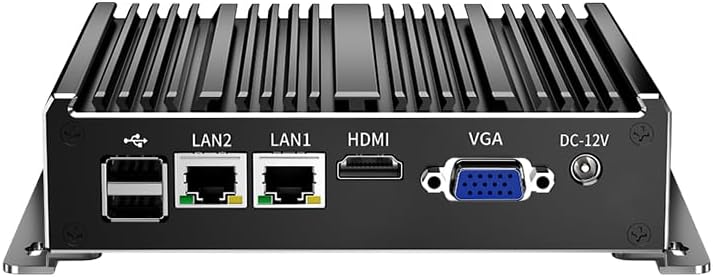
The Glovary N150 Firewall Mini PC is the most purpose-built OPNsense option in this group. It has six 2.5GbE ports based on Intel i226-V controllers, a fanless aluminum body, AES-NI support, and 8GB of DDR5 memory. Its 4.3 rating makes it a credible all-around choice for a router with several wired network segments.
We may earn a commission when you buy through this link, at no additional cost to you.
Six ports create room for a thoughtful topology without requiring multiple USB Ethernet adapters. A typical configuration could place one interface on the upstream network, use another for the main LAN, and reserve additional ports for a guest network, VPN client, lab segment, or backup path. Intel i226-V controllers are especially attractive for users who value native driver support and consistent 2.5GbE behavior.
The Intel N150 provides four cores, four threads, a 6MB cache, and a maximum clock speed of 3.6GHz. That is sufficient for OPNsense routing, firewall rules, VPN services, DNS tools, and typical package installations. The system includes 128GB of NVMe storage, one DDR5 SODIMM slot, and two M.2 2280 positions, making it easier to increase memory and separate system data from logs or other storage.
Its fanless construction is useful in an office, living area, or network cabinet because it avoids the noise and moving-part wear associated with a small active fan. The enclosure can accept a 12-volt four-pin fan if additional cooling becomes necessary, although a fanless setup is preferable where silence matters. The 128GB system drive and 8GB of memory are the main limitations, so buyers with intensive logging or many services should plan an upgrade.
This is the best general recommendation for someone who wants a dedicated firewall appliance rather than a general mini PC adapted for the role. Its six native 2.5GbE interfaces, storage expansion, and low-power processor cover the needs of advanced home networks and small offices particularly well.
Native multiport networking eliminates much of the need for external adapters and reduces complexity around virtual switches or USB-to-Ethernet bridges. It also makes this system easier to dedicate to segmented networks, remote-access links, and lab experiments.
The fanless aluminum design is a meaningful advantage for an appliance that may run continuously near a desk or television. It also reduces the number of moving components, although adequate placement and ventilation remain important.
We may earn a commission when you buy through this link, at no additional cost to you.
The BOSGAME E5 8GB 256GB uses the same Ryzen 3 5300U platform as the higher-memory model, but pairs it with 8GB of DDR4 and a 256GB M.2 drive. Its 4.6 rating and strong processor specification make it an appealing entry point for OPNsense users who do not need to run many demanding packages.
We may earn a commission when you buy through this link, at no additional cost to you.
The four-core, eight-thread Ryzen processor is a capable foundation for a firewall, particularly when compared with older dual-core embedded processors. Two Realtek RTL8125 2.5GbE ports support modern wired networks, while dual SODIMM slots allow the included memory to be expanded. A second M.2 2280 PCIe slot provides an easy way to add storage without replacing the system drive.
This configuration is well suited to a home network with one WAN interface and one LAN interface. It can also handle common OPNsense functions such as stateful firewalling, NAT, DHCP, DNS services, and a single VPN connection with room to spare. The system's general-purpose operating system support means it can be repurposed for office software, media tasks, or a lightweight virtualization host later.
The lower base memory and smaller included drive are the main disadvantages relative to the 16GB version. Users who plan to retain extensive logs, run multiple VPN instances, use intrusion detection, or operate more demanding applications should upgrade memory or storage. Active cooling also makes it less discreet than a fanless firewall appliance.
This E5 is best for buyers who recognize the value of a capable Ryzen platform but can add RAM or storage when needed. It offers a particularly useful combination of processor headroom, dual 2.5GbE networking, and conventional desktop flexibility.
The Ryzen 3 5300U offers more parallel processing than the older dual-core options in this guide. That headroom is helpful when OPNsense handles encryption, VPN traffic, DNS filtering, and background logging at the same time.
Two memory sockets and a spare M.2 position prevent the initial configuration from becoming a permanent limit. Buyers can add capacity gradually according to the services and logging volume their network actually requires.
We may earn a commission when you buy through this link, at no additional cost to you.
The MeLE Quieter DL N150 16GB 512GB combines two native Intel I226-V 2.5GbE controllers with a fanless 0.34-liter enclosure. Its perfect 5.0 rating reflects an especially strong supplied customer history, while the generous 16GB memory and 512GB NVMe drive make it one of the best-prepared compact firewalls in this guide.
We may earn a commission when you buy through this link, at no additional cost to you.
Native Intel controllers are a central benefit for OPNsense users. The supplied specifications highlight support for VLANs, link aggregation, and PXE boot, all of which can simplify integration into a professional or homelab network. The N150's four cores and four threads are suitable for routing, encrypted VPN services, firewalls, and other common gateway workloads.
Silent operation is equally important. A fully fanless thermal system removes fan noise, dust intake, and moving-part failure points, making the unit appropriate for a bedroom, office, media area, or network cabinet. The stated power consumption is approximately 6W at idle and under 12W at full load, which suits an appliance expected to remain active continuously.
The trade-off is interface count. Two Ethernet ports are enough for a conventional router arrangement but do not support the multi-segment design that the six-port Glovary model enables. There are also no SFP+ uplinks. However, for a two-port topology, native Intel controllers, expandable memory, and a large NVMe drive can be more important than maximum physical port count.
This MeLE model is the premium pick for users who want a polished, silent, energy-efficient OPNsense appliance with strong general-purpose headroom. It is especially suitable for a two-gigabit home connection, compact office gateway, or quiet homelab where the system will operate continuously near people.
Using two Intel I226-V controllers avoids some of the driver uncertainty that can accompany less common Ethernet hardware. It also gives an OPNsense installation direct access to features such as VLAN tagging, aggregation, and PXE workflows.
A fanless enclosure is more than a convenience for a router. It eliminates the primary moving component, reduces noise in living spaces, and suits installations where the appliance operates unattended for long periods.
We may earn a commission when you buy through this link, at no additional cost to you.
The Origimagic C4 Plus is a general-purpose mini PC with enough capability to serve as an OPNsense router. Its Ryzen 5 3501U processor offers four cores and eight threads, 8GB of expandable DDR4 memory, a 256GB M.2 SSD, and two RTL8111H RJ45 ports. Its 4.5 rating makes it a credible option when 1GbE networking is sufficient.
We may earn a commission when you buy through this link, at no additional cost to you.
The Ryzen 5 3501U uses the Zen+ 12nm architecture and reaches a maximum clock speed of 3.7GHz. The supplied description positions it above Intel N150 and N100-class processors for general tasks, which gives OPNsense comfortable headroom for VPN processing, DNS, and a moderate set of services. Memory can be increased to 32GB, and an additional NVMe drive can be installed.
Dual 1GbE ports cover the basic requirements of a router with separate WAN and LAN connections. They are also appropriate for a secondary management segment or simple guest network. The C4 Plus includes Wi-Fi 5 and Bluetooth 5.0, a useful set of connectivity options for a flexible desktop, although wired Ethernet remains the important feature for firewall use.
Its main limitation is that both Ethernet ports top out at 1,000Mbps. Users with multigigabit fiber or networks that regularly move large files may feel constrained, especially when comparing this model with dual 2.5GbE alternatives. The 8GB starting memory is adequate for typical OPNsense installations but is less generous than the MeLE 16GB configuration.
The C4 Plus is best for a user who wants more general-purpose processing power than a basic embedded appliance but does not need multigigabit links. It also works well for a small office or home network that pairs OPNsense with occasional desktop productivity tasks.
Four cores and eight threads provide a useful margin for firewall rules, encrypted connections, and network services. The system can also serve as a compact general-purpose computer when it is not acting as the primary gateway.
Support for auto power-on and Wake-on-LAN is useful when the router is installed in a cabinet or another less convenient location. These features complement the practical choice of two dedicated RJ45 ports.
We may earn a commission when you buy through this link, at no additional cost to you.
The N2840 Industrial Mini PC is built around a Celeron N2840 and two gigabit Ethernet interfaces, but its defining feature is industrial connectivity. The supplied specifications list two RS232 serial ports that can be switched to RS485, along with optional Wi-Fi and 4G module support. Its 3.7 rating is the lowest in this group, so buyers should approach it as a specialized platform.
We may earn a commission when you buy through this link, at no additional cost to you.
The dual-core, dual-thread N2840 operates at up to 2.58GHz with a 7.5W TDP and 1MB cache. It is compatible with OPNsense, Linux, Windows, ESXi, and OpenWrt according to the supplied data. For basic routing, firewalling, and a small number of lightweight services, the processor is workable, though it offers less headroom than the Ryzen and N150 systems in this list.
Two Realtek gigabit LAN ports provide the essential WAN and LAN connection pattern. The industrial serial interfaces are much more interesting for specialized use, including equipment control, telemetry, legacy peripherals, and lab environments. Auto Power On, Wake on LAN, GPIO, and PXE support make the system easier to deploy as an unattended network appliance.
Memory and storage are less flexible than on most modern competitors. The system includes 8GB of DDR3L, one memory socket, one SATA connector, and one mSATA Mini PCIe position. The older platform also means users should be realistic about intensive VPN throughput, logging, and package-heavy firewall configurations.
This is not the strongest general OPNsense recommendation, but it can be the correct choice when serial hardware or industrial integration matters more than processor speed. It is best suited to specialist networks, embedded labs, and legacy equipment that cannot be connected through ordinary USB Ethernet adapters.
The switchable RS232 and RS485 interfaces distinguish this system from ordinary office mini PCs. They can connect the router to embedded devices or legacy infrastructure that lacks modern Ethernet interfaces.
Auto power-on, Wake-on-LAN, PXE, and GPIO options support remote and embedded deployment. Combined with a fanless chassis and a low-power processor, they make the unit practical for specialized cabinets and technical environments.
We may earn a commission when you buy through this link, at no additional cost to you.
The Celeron N2840 Firewall is a focused soft-routing appliance with two Realtek RTL8111H gigabit ports, 4GB of DDR3L memory, and a 64GB mSATA SSD. Its 4.4 rating is solid for a specialized older platform, and its fanless design keeps it suitable for a small router role with modest service requirements.
We may earn a commission when you buy through this link, at no additional cost to you.
The N2840 has two cores, two threads, 1MB of cache, a 2.58GHz maximum clock speed, and a 7.5W TDP. The supplied specifications identify OPNsense, Linux, Windows, ESXi, and OpenWrt as compatible platforms. That flexibility lets the appliance serve as a basic router, firewall, or lightweight virtual-machine host, provided expectations remain appropriate for the older processor.
The two RJ45 ports are the core of the design, and both use Realtek RTL8111H controllers. A separate 2.5-inch SATA bay can hold an SSD or hard disk in addition to the included mSATA drive, while the single DDR3L socket accepts compatible modules. The fanless chassis avoids fan noise and supports deployment near a television, office desk, or home network cabinet.
The 4GB starting memory is the most important limitation. It may be adequate for basic OPNsense use, but it leaves less margin for intensive logging, multiple VPN sessions, and additional packages. The 64GB system drive is also modest, although the available SATA expansion makes storage growth straightforward.
This appliance suits a buyer who wants a simple, dedicated firewall and does not need multigigabit networking or heavy inspection services. It is more appropriate as a straightforward dual-port router than a powerful enterprise edge, particularly when future memory and storage expansion are part of the plan.
The dedicated WAN-and-LAN layout is easy to understand and configure. It suits users who want a clean firewall appliance without the complexity or expense of a larger multi-interface network system.
The combination of mSATA and a 2.5-inch SATA bay allows logs or other data to reside outside the system drive. That separation can simplify backups, maintenance, and recovery when the firewall is used more intensively than its base configuration suggests.
We may earn a commission when you buy through this link, at no additional cost to you.
The N150 SFP+ Firewall is the most ambitious networking design in this guide. It combines an Intel N150 processor, two 10GbE SFP+ interfaces based on the Intel 82599ES family, and three 2.5GbE i226-V ports. It ships without RAM or SSD, and its 3.8 rating means buyers should evaluate the complete configuration carefully.
We may earn a commission when you buy through this link, at no additional cost to you.
The SFP+ connections are the centerpiece. They allow the router to use compatible fiber or copper transceiver modules, making the appliance relevant to users with 10Gbps infrastructure, high-capacity NAS systems, or advanced home labs. The three additional 2.5GbE ports are useful for separate LAN segments, VPN links, management access, and local services.
The N150 has four cores, four threads, a 6MB cache, a 3.6GHz maximum clock speed, and a 6W TDP. AES-NI support is valuable for encrypted network traffic, while the included platform supports OPNsense, Linux, Windows, ESXi, and OpenWrt. Auto power-on, Wake-on-LAN, GPIO, and PXE make the unit practical for remote or rack-oriented deployment.
This is a barebones system. A compatible DDR5 SODIMM and an M.2 2280 PCIe 3.0 x1 SSD must be added separately, and the correct memory and transceiver choices depend on the desired network design. The advanced interfaces therefore do not create a complete solution by themselves. The 3.8 rating also warrants attention to driver and operating-system compatibility before committing to a specialized setup.
This firewall is the strongest option for technically experienced users who genuinely need 10GbE SFP+ connectivity. It is less suitable for a simple home router, where the Glovary or MeLE systems provide a more self-contained configuration, but it offers the most future-facing network interface arrangement in this roundup.
Two SFP+ ports make this appliance unusual among compact firewalls. They can support advanced aggregation, high-speed storage paths, or segmented networks without relying on external adapters, subject to compatible transceiver support.
Because no memory or storage is included, users can choose capacities based on expected logging and services. That flexibility is valuable to experts, but it also makes this product less convenient for a first-time OPNsense installer.
We may earn a commission when you buy through this link, at no additional cost to you.
The MeLE Quieter DL N150 8GB 256GB offers a compact, fanless OPNsense platform with two native Intel I226-V 2.5GbE ports. It has a perfect 5.0 supplied rating, 8GB of DDR4 memory, 256GB of eMMC storage, an empty M.2 2280 NVMe slot, and a microSD card slot.
We may earn a commission when you buy through this link, at no additional cost to you.
The Intel N150 provides four cores, four threads, and a 6MB cache, which is suitable for the normal duties of a home or small-office firewall. The dual I226-V controllers support VLANs, link aggregation, and PXE boot according to the supplied information. This gives the system the same high-quality wired interface foundation as the larger-memory MeLE configuration.
Fanless operation is a central advantage. With no moving fan, the appliance can remain quiet in a living area and avoids a common source of long-term failure. Its stated power consumption of approximately 6W at idle and under 12W at full load also suits a continuously running network role. The included VESA mount makes it easy to place behind a display or under a desk.
Unlike the 16GB model, this version uses 256GB of eMMC for the base system. Storage can still be expanded through the empty M.2 2280 NVMe position, which is useful for logs or alternate system media. The 8GB memory can be upgraded to 32GB, and the microSD slot adds another option for removable storage.
This is a compelling quiet router for users whose topology needs only two native network ports. The perfect rating and strong networking details make it easier to recommend than the similarly sized alternatives, while the upgrade paths keep it from feeling severely constrained.
The fanless 0.34-liter enclosure is well suited to a router that must sit near a television, desk, or bedroom. Silent operation makes the appliance easier to integrate into everyday surroundings.
An empty NVMe slot, upgradable SODIMM, and microSD reader give this compact system more flexibility than its small size suggests. A buyer can add fast storage for logs or increase memory as the firewall's workload grows.
We may earn a commission when you buy through this link, at no additional cost to you.
The ASRock DeskMini X300 is a barebones 1.92-liter mini PC that provides a flexible foundation for an OPNsense installation. It supports AMD Socket AM4 Ryzen 5000, 4000, 3000, and 2000 series processors up to 65W. Its 4.3 rating reflects a well-specified platform, but it requires several major components to become a complete router.
We may earn a commission when you buy through this link, at no additional cost to you.
The standout feature is upgradeability. Two DDR4 SODIMM slots support up to 128GB of memory with compatible processors, while two Ultra M.2 positions accommodate NVMe SSDs and two 2.5-inch bays accept hard drives or SATA SSDs. RAID 0 and RAID 1 are listed as supported storage configurations, which is unusual for a compact general-purpose mini PC.
Networking is simpler than in the dedicated firewall appliances. The system has one Dragon RTL8125BG 2.5GbE port, so OPNsense users who need distinct WAN and LAN interfaces will need an additional network adapter. Display support through HDMI, DisplayPort, and VGA allows a three-screen management setup, while a front USB-C port and additional USB connections aid maintenance.
Because the product is a barebone kit, a compatible CPU, DDR4 memory, storage, and operating system must be supplied separately. The included power adapter is rated for 120W. A 65W Ryzen processor is supported, but buyers should check the official CPU list and use components compatible with the intended cooling, firmware, and operating system.
The DeskMini X300 is not the simplest OPNsense choice, but it offers the most freedom to build a powerful, serviceable network appliance. It suits a technically confident buyer who wants a high-capacity storage platform, a strong processor, or the option to reuse the machine for demanding server tasks later.
The broad AM4 processor range lets the buyer match performance to the intended workload. A lower-power CPU may suit a basic router, while a faster supported Ryzen chip can provide additional headroom for VPN services and more demanding OPNsense packages.
Two NVMe positions and two 2.5-inch bays are unusually generous for a 1.92-liter chassis. They support a dedicated system disk, separate log storage, mirrored data, or a mixture of fast and high-capacity drives.
We may earn a commission when you buy through this link, at no additional cost to you.
Choosing an OPNsense mini PC is primarily a question of matching the hardware to the network, services, and operating environment. Port count, Ethernet speed, memory, storage, cooling, and remote-management features matter more than graphics performance or a conventional desktop feature set.
Start by drawing the intended network topology. A conventional router needs one WAN interface and one LAN interface, but VLANs, VPN clients, guest networks, test segments, and fail-over links can require additional ports. The Glovary N150 provides six native 2.5GbE interfaces, while the N150 SFP+ platform offers two 10GbE SFP+ and three 2.5GbE ports. The MeLE and BOSGAME systems provide two ports, which is enough for a simpler arrangement but may require adapters later.
A gigabit interface remains appropriate for many homes and offices, but 2.5GbE is useful with multigigabit fiber, fast NAS transfers, and backbone links between wired segments. Intel I226-V is used in the Glovary, MeLE, and SFP+ models, while BOSGAME uses Realtek RTL8125 and the ASRock uses RTL8125BG. Confirm that your modem, switch, and attached devices also support the selected speed rather than assuming every component can negotiate it.
Basic OPNsense routing can function with modest memory, but additional packages, several VPN instances, intrusion detection, caching, and extensive logging all benefit from more headroom. The 16GB MeLE configuration is the most generous ready-to-use option here, while the 8GB systems are adequate for many standard installations. Both MeLE models support expansion to 32GB, and the BOSGAME E5 supports up to 64GB. The ASRock barebone can accept as much as 128GB with compatible components.
The system drive holds OPNsense, configuration data, and logs. Heavy logging, packet retention, and locally installed services can consume space quickly, so a dedicated drive or separate log volume is useful. The BOSGAME E5 includes an additional M.2 slot, the Glovary has two M.2 positions plus SATA, and the ASRock supports two NVMe slots and two 2.5-inch bays. The MeLE 8GB model also offers an empty M.2 slot, making a later storage upgrade straightforward.
A fanless enclosure is quieter, avoids moving-part failure, and works well in living spaces or network cabinets. Active cooling may handle sustained heavy loads more effectively, and the BOSGAME E5 uses an optimized fan with copper heat pipes. Several fanless models also support optional fans. Whichever design you choose, leave clearance around vents and avoid placing the appliance inside a closed or poorly ventilated enclosure.
A firewall may be installed in a cabinet, closet, or another inconvenient location. Auto Power On, Wake-on-LAN, and PXE support simplify recovery and image deployment. These functions appear on multiple products in the guide, including the N2840 models, the N150 SFP+ appliance, the Origimagic C4 Plus, and the ASRock platform. They are particularly useful when the router is managed remotely or powered on after an outage.
OPNsense is primarily a network workload, so Ethernet features and memory often matter more than graphics. Display support can still be useful for a local dashboard, with the BOSGAME, MeLE, and ASRock systems supporting multiple displays. AES-NI is valuable on the Glovary and N150 SFP+ models for hardware-assisted encryption. Wi-Fi is less central to a wired firewall, although the BOSGAME and Origimagic systems include wireless connectivity for general-purpose use.
Ready-configured appliances are convenient, while barebones products let you choose memory, storage, and sometimes a processor. The N150 SFP+ model has no RAM or SSD, and the ASRock DeskMini X300 requires a compatible CPU, DDR4 memory, storage, and operating system. Check the official CPU support list for the ASRock, confirm the DDR5 or DDR4 module type for each appliance, and verify that your preferred OPNsense release supports the chosen network controllers.
Begin by identifying the OPNsense installation media and the correct boot method for the chosen system. Connect the WAN and LAN interfaces according to your network plan, configure the target port assignments in the BIOS where applicable, and confirm that the storage device is detected. For barebones and partially configured models, install the required memory and storage before attempting the operating-system installation.
After installing OPNsense, assign each physical interface to its intended role, complete the initial console setup, and establish access to the web interface before disconnecting any critical link. Update the firmware and packages, set accurate time synchronization, and review default firewall, DNS, DHCP, and remote-access settings. Test each network segment and document which physical port serves each function so future maintenance is straightforward.
For ongoing care, keep the appliance in a ventilated position and periodically check that fans, if present, are operating correctly. Track available memory and storage, maintain a current configuration backup, and export logs to a separate volume when the system disk is small. OPNsense installations are generally straightforward to maintain, but regular backups and tested recovery procedures are more valuable than routine tinkering with a production firewall.
No, but dedicated firewall mini PCs are often easier to deploy because they provide multiple native Ethernet ports, a compact fanless case, and relevant boot features. A general mini PC with two fast Ethernet ports can also work well for a simple WAN-and-LAN arrangement. The best choice depends mainly on your port count, services, storage, and remote-management needs.
Eight gigabytes is generally sufficient for basic routing, firewall rules, DHCP, DNS services, and a modest number of VPN connections. It provides less comfortable headroom for heavy logging, intrusion detection, numerous packages, or multiple demanding services. Users with growing requirements should choose 16GB or a barebones system that supports future memory expansion.
It is unnecessary when the internet connection, switches, servers, and clients remain within Gigabit Ethernet limits. It becomes valuable with multigigabit broadband, fast NAS transfers, or high-speed wired backbones because it can move more data than a Gigabit interface. A 2.5GbE firewall is most useful when the rest of the path supports the same speed.
Fanless operation is often preferable for a quiet home installation because it eliminates fan noise and moving-part wear. It is especially suitable for a network cabinet, office, or living area. The system still needs adequate ventilation, and an optional fan may be worthwhile if a powerful processor is operated under sustained heavy load.
Technically possible, but a firewall normally needs at least separate WAN and LAN connections. With one native port, a USB Ethernet adapter or another compatible network interface would be needed, which can add cost, complexity, and driver considerations. A native two-port model is usually more convenient and reliable for a primary gateway.
Check the number and speed of physical interfaces, the network controller family, available RAM, and storage expansion. Intel I226-V appears in several of the higher-speed options, while the Glovary model offers six native 2.5GbE ports. Also verify whether the additional ports are intended for LAN segments, VPNs, aggregation, or high-speed uplinks.
Most home networks are handled comfortably by modern low-power processors, including the Intel N150 and Ryzen 3 5300U. Faster or more capable processors become more relevant with multiple VPNs, heavy filtering, high connection counts, intrusion detection, and extensive logging. Match the processor to the workload rather than selecting on graphics performance.
Many general-purpose mini PCs in this guide support Linux, Windows, and other environments in addition to OPNsense. This makes it possible to repurpose the hardware for a small server, management workstation, or virtual-machine host. Dedicated multiport firewall appliances are more specialized, while the BOSGAME, MeLE, and ASRock systems generally offer broader flexibility.
The Glovary N150 Firewall stands out as the most balanced dedicated appliance, with six Intel 2.5GbE ports, a fanless aluminum enclosure, and room for memory and storage expansion. The MeLE Quieter DL 16GB 512GB is the premium choice for silent operation, native Intel controllers, and generous ready-to-use memory, while the BOSGAME E5 16GB 512GB provides the strongest budget-oriented mix of Ryzen performance, 2.5GbE, and conventional mini-PC flexibility.
For a simple two-port router, prioritize the native Intel controllers, memory capacity, and expansion options found in the MeLE models. For multiple VLANs, VPN links, or segmented networks, the six-port Glovary system is easier to deploy. The N150 SFP+ appliance and ASRock DeskMini X300 suit technically experienced users who need specialized 10GbE interfaces or want to assemble a highly customized platform.
Before ordering, verify the current component list, supported operating-system version, network-controller compatibility, and expansion requirements. Product configurations can change, so compare the live listing carefully and make sure the selected model includes the ports, memory, and storage needed for your intended OPNsense installation.