
Tapo Smart Water Leak Detector
4.6Editor score
One-second detection response
Hub-triggered audible alarm
IP67 water-resistant housing
Smart water leak detectors provide early warnings about dripping pipes, appliance failures, pooled water, and other moisture risks that can become expensive before they are discovered. The most useful systems combine responsive probes, audible alarms, dependable radio coverage, and smartphone notifications that work while you are away.
We compared the included sensors, connectivity, alarm capabilities, environmental ratings, placement options, and smart-home features across ten products. The guide covers standalone sensors, hub-based systems, cable probes, and one automatic whole-home shutoff device, helping readers match protection to their home layout and monitoring needs.
Each pick highlights a different practical advantage, from flexible multi-sensor coverage to compact placement and automatic water control. Product ratings and feature availability can change over time, and prices fluctuate frequently, so confirm the current listing and technical details before making a final purchasing decision.
4.6Editor score
4.5Editor score

3.9Editor score
As an Amazon Associate we earn from qualifying purchases.
The table below compares all ten systems by alert method, detection design, connectivity, range, and monitoring scope, making it easier to identify the option that fits a specific home.


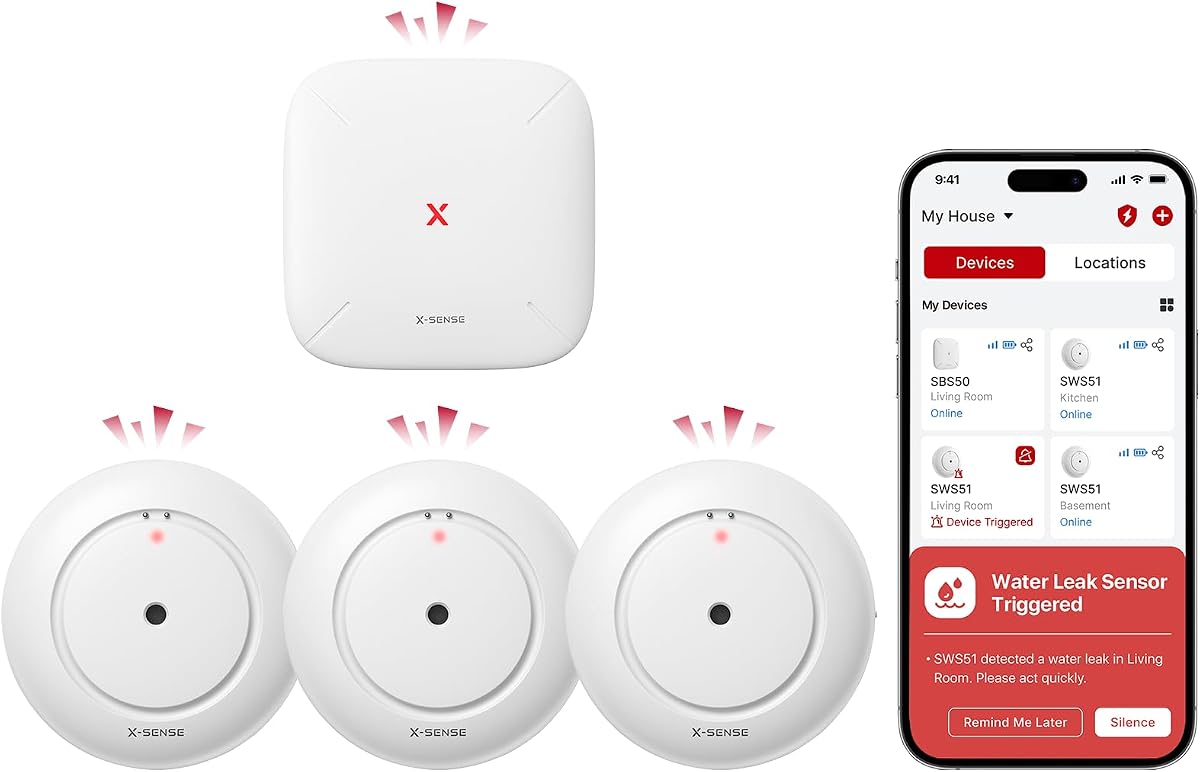
The X-Sense SWS54 is a three-sensor Wi-Fi kit built for households that want broad leak coverage without relying on a separate branded water shutoff. It carries a 4.5 rating and stands out for its generous open-area range, dual 120 dB alarms, and sensors that detect both drips and shallow pooled water.
We may earn a commission when you buy through this link, at no additional cost to you.
Each sensor uses two upper probes for dripping water and four lower probes to identify pooling as shallow as 0.4 mm. The included base also sounds an alarm, while app notifications reach as many as 12 users. Reminder options for 10 or 30 minutes and 2, 6, or 12 hours make it easier to manage an active alert without losing the alert record.
Its trade-off is that this is a coordinated hub-and-sensor system rather than a single independent puck. It connects only to 2.4 GHz Wi-Fi, and a complete three-sensor installation requires careful placement around appliances, plumbing fixtures, and utility areas. The stated 1,804-foot range applies in open areas, so walls and floors will reduce real-world reach.
This is a strong all-around choice for larger homes, basements, garages, and multiple wet areas. Buyers who value long range, generous sensor quantities, loud local warnings, and shared phone access are likely to find it more compelling than a minimal single-sensor system.
The six-probe arrangement makes the kit more versatile than a simple moisture puck. Upper probes respond to drips from above, while lower probes detect shallow water gathering on a surface around appliances or plumbing connections.
App sharing for up to 12 users and configurable reminder delays help ensure that a leak warning reaches someone who can act. The base and sensors sounding together adds an audible layer when the phone is not immediately available.
We may earn a commission when you buy through this link, at no additional cost to you.
The Moen Flo Detector is a three-pack of Wi-Fi-enabled water and moisture sensors with a 4.5 rating, a 3.6 rating, and a design centered on reach rather than maximum probe count. Its most distinctive feature is the included 48-inch extension cable and remote sensing disc, which can extend into narrow or awkward areas.
We may earn a commission when you buy through this link, at no additional cost to you.
The sensors are designed for constant monitoring and deliver real-time notifications through the Moen Smart Water Network app. Multiple detectors can be connected for wider coverage, and each unit can operate independently or be paired with the Flo Smart Water Monitor and Shutoff when that separate device is available.
The most important limitation is ecosystem dependence. Core leak notifications are straightforward, but remote sensing, multi-device management, and shutoff integration are most compelling for people already invested in Moen's water-management platform. Its 3.6 rating is also the lowest among the listed products, although ratings alone do not reveal why individual customers were satisfied or dissatisfied.
This option makes the most sense for monitoring a water heater, washing machine, basement, or tight installation space where a conventional puck cannot sit. It is a strong fit for Moen users and a practical way to combine discrete sensors with optional whole-home flow protection.
The extension cable and remote disc are especially useful beneath sinks, behind appliances, and inside cabinets where a sensor body would be inconvenient. This allows the main unit to remain accessible while the moisture-sensitive end reaches the risk area.
You can begin with leak monitoring alone and later add the separately sold Flo Smart Water Monitor and Shutoff. That flexibility makes the detector approachable while preserving a path toward automatic water control.
We may earn a commission when you buy through this link, at no additional cost to you.
The X-Sense SWS0A41 combines four wireless sensors with a base station and a 4.5 rating. Its defining advantage is physical placement: each sensor is only 0.7 inches thick and 3 inches in diameter, allowing it to fit beneath appliances, beside fixtures, and inside tight corners.
We may earn a commission when you buy through this link, at no additional cost to you.
Like the SWS54, it uses two top probes and four bottom probes to identify dripping water and pooling as shallow as 0.4 mm. A flashing red indicator and a base alarm rated up to 100 dB provide local warnings, while app alerts keep owners informed away from home. The app also supports testing, low-battery notices, history viewing, muting, and temporary reminders.
Its wireless range is listed at up to 1,700 feet in open areas, which is suitable for outbuildings and distant rooms but should not be interpreted as the same distance through dense construction. It also requires a 2.4 GHz network. Compared with the three-sensor SWS54, this package trades some alarm volume and stated range for a slimmer form and one additional sensor.
This is a particularly good fit for homes where installation space is the primary obstacle. Anyone monitoring several cabinet interiors, mechanical rooms, or appliance-adjacent spaces can benefit from the four-pack and compact profile, while users wanting the strongest stated open-area range may prefer the SWS54.
The 0.7-inch thickness makes the sensor easier to slide behind a washing machine, under a sink cabinet, or beside a pipe than a thicker puck-style detector. It preserves coverage without demanding a large patch of floor space.
Users can test the device, review alarm history, change notification timing, and receive low-battery warnings from the app. The temporary reminder choices are particularly useful after a leak has been addressed but the sensor still needs drying or servicing.
We may earn a commission when you buy through this link, at no additional cost to you.
The Tapo T300 earns a 4.6 rating and focuses on fast detection, simple placement, and integration with the Tapo Hub. Its six sensitive probes are positioned on the top and bottom, allowing the detector to identify both dripping water and leaks that accumulate underneath.
We may earn a commission when you buy through this link, at no additional cost to you.
The detector can trigger its siren in as little as one second and can also activate the hub's alarm for additional sound throughout the home. Phone notifications arrive when a leak or low battery condition is detected, and the local alarm is adjustable to 90 dB. A single press silences the local siren after the user reaches the sensor.
The required hub is the main compromise. It adds another device to install, power, and keep connected, although it may already be part of an existing Tapo smart-home setup. Battery life is stated at up to three years, with actual duration depending on use and environment, and the replaceable AAA cells make maintenance straightforward.
The T300 is an appealing choice for people already using Tapo or willing to add the hub for broader alarm coverage. It offers one of the quickest stated responses in this guide, a strong customer rating, and an IP67 housing suited to humid and dusty locations.
A one-second trigger target can provide valuable extra time during a fast drip or initial pooling event. Six probes improve directional coverage, while the dual-sided layout allows the sensor to be useful in more than one orientation.
The local 90 dB alarm is designed to alert people nearby, while the hub can sound as well. This layered approach is useful in basements, utility rooms, and other locations where a sensor alarm could otherwise be difficult to hear.
We may earn a commission when you buy through this link, at no additional cost to you.
The TECKNET Wi-Fi Water Leak Detector is a straightforward two-sensor system that connects directly to a 2.4 GHz Wi-Fi network without a separate hub. It has a 4.2 rating and provides app notifications, a 120 dB adjustable alarm, and six-probe detection across each sensor.
We may earn a commission when you buy through this link, at no additional cost to you.
Two top probes watch for dripping water, and four bottom probes identify pooling in either direction. The Tuya Smart app sends push notifications when water is detected, while low-battery reminders help maintain the included AAA batteries. The stated battery life reaches two years, depending on operating conditions and usage frequency.
Its simplest advantage is also its main constraint: no hub is needed, but the package contains only two sensors. That may be sufficient for two high-priority locations, though broader household coverage will require additional units. It also supports only 2.4 GHz Wi-Fi, and optional SMS or phone-call notifications require a third-party subscription service.
This detector is well suited to renters, condo owners, and homeowners who want straightforward app alerts without building a larger hub system. Choose it when the two included sensors can be placed strategically and loud local alarms plus basic push notifications meet your needs.
Because no additional gateway is required, setup is streamlined around the Tuya Smart app and a compatible 2.4 GHz network. This reduces the number of components to install and maintain.
The adjustable alarm reaches 120 dB, making it appropriate for utility rooms, laundry areas, and kitchens where an early warning should be noticeable. A visual indicator and app notification provide additional alert paths.
We may earn a commission when you buy through this link, at no additional cost to you.
The RUIKORING WD71 is a three-pack of compact leak sensors paired with a Tuya Smart gateway and carries a 4.5 rating. It combines six-probe detection, app push notifications, local alarms, and a gateway that can support up to 24 WD71 sensors for broader monitoring.
We may earn a commission when you buy through this link, at no additional cost to you.
The sensor measures 2.8 inches across and 1.1 inches thick, making it portable enough for corners and other inconvenient placements. Its local alarm is adjustable up to 120 dB, and the gateway can produce a separate 90 dB warning. App controls include alarm history, muting, volume adjustment, device sharing, and automatic arming or disarming schedules.
One important detection rule is that at least two bottom probes must be triggered, which helps reduce false alarms but can also affect sensitivity in very small puddles. The gateway's stated range is 328 feet in open areas and typically around 150 feet indoors, so positioning matters. Push notifications are free, while optional SMS and phone alerts use a third-party service.
The WD71 is a good middle ground for buyers who want more than a few isolated sensors but do not need dozens of locations immediately. Its expandable architecture, scheduling, and reusable sensor design are especially useful for families managing a growing list of leak-prone areas.
The included gateway can pair with up to 24 WD71 sensors. That makes it possible to start with three and expand selectively toward full-home monitoring as new risk areas are identified.
Automatic arming and disarming can prevent nuisance interruptions, such as during periods when water is intentionally running. Weather-related exceptions and night scheduling are especially relevant for households using the device near outdoor-facing plumbing.
We may earn a commission when you buy through this link, at no additional cost to you.
The Moen Flo Shutoff is fundamentally different from the other products in this guide because it installs on the main water line and can automatically stop the flow. With a 3.9 rating, it targets whole-home protection for owners who want protection even when a small leak would be difficult to locate quickly.
We may earn a commission when you buy through this link, at no additional cost to you.
The device monitors flow, pressure, and temperature continuously. Daily MicroLeak tests look for abnormalities, and FloSense technology learns the home's normal water patterns to identify issues such as running water or small leaks. Users can monitor, manage, and shut off water remotely through the Moen Flo app.
This level of protection requires more planning than placing a battery-powered sensor. Installation involves the main water supply, the device may require professional setup, and the system is more appropriate for owners who understand the potential consequences of automatic shutoff. It also does not provide the same point-of-leak placement information as a nearby moisture sensor.
The Flo Shutoff is best suited to a serious whole-home risk-management strategy, particularly in properties where an unnoticed leak could affect several floors or expensive furnishings. It is the premium choice for automatic intervention, while the Moen detector products in this guide provide more localized monitoring.
Unlike an alert-only product, the Flo Shutoff can stop the main water supply when it identifies a qualifying abnormal condition. That can limit the amount of water released before someone reaches the property.
FloSense technology adapts to a household's ordinary usage. That contextual understanding helps the system distinguish familiar water activity from potential leaks or a continuously running fixture.
We may earn a commission when you buy through this link, at no additional cost to you.
The METAK WD61 system includes a 2.4 GHz Wi-Fi gateway and six sensors, offering a broad starting set for monitoring a home. It has a 4.2 rating and includes top-drip and four bottom-flood probes on each WD61 sensor for coverage of common leak patterns.
We may earn a commission when you buy through this link, at no additional cost to you.
The gateway can pair with up to 24 compatible sensors and has a stated maximum transmission range of 328 feet. Sensor alarms offer four volume levels reaching 120 dB, while the gateway provides five volume levels up to 100 dB and 32 selectable ringtones. The Tuya Smart app also supports naming devices, remote controls, and alert customization.
Compatibility requires attention. The W13 gateway supports WD61 sensors but cannot expand to WD60 models, so buyers should avoid assuming every similarly styled sensor is interchangeable. The gateway uses 2.4 GHz Wi-Fi, and while app push notifications are free, SMS and phone-call alerts are handled through a paid third-party service.
This package is attractive for buyers who want immediate coverage in several rooms and the option to expand to 24 sensors. It is particularly useful for basements, bathrooms, laundry rooms, kitchens, and other areas mentioned in the product information, provided the buyer accepts the Tuya-based gateway ecosystem.
Starting with six sensors can cover more high-risk locations without requiring a series of separate purchases. Each sensor can be named in the app, making it easier to identify the source of a notification.
Thirty-two ringtones and five gateway volume levels allow the audible warning to be tailored to the household. Different choices may help residents recognize a leak alert more quickly or reduce unnecessary disruption.
We may earn a commission when you buy through this link, at no additional cost to you.
The Kidde WiFi Water Leak Detector and Freeze Alarm is a compact, battery-powered device for people who want both moisture and cold-related monitoring. It has a 3.9 rating and stands apart from the other picks by detecting freezing conditions at 37 degrees Fahrenheit or following a rapid temperature drop.
We may earn a commission when you buy through this link, at no additional cost to you.
Wi-Fi connectivity sends smartphone notifications to the user and selected friends or family. The product also supports Amazon Alexa, Google Home, iPhone, and Android devices, making it accessible to people with established smart-home routines. Setup involves downloading the Kidde app, scanning the device's QR code, and following the guided instructions.
Two AA batteries are included, and the small housing fits beside dishwashers, refrigerators, water heaters, toilets, or under sinks. Its limitation is environmental: a freeze monitor is useful in garages, basements, and unheated spaces, but it may create unwanted warnings in normally cold locations. The product also offers one sensor rather than a multi-sensor kit.
This detector is a practical choice for areas exposed to both moisture and low temperatures, particularly a garage with a water heater or a basement with vulnerable pipes. Homeowners who only need standard leak alerts may find a dedicated water detector simpler.
Leak detection addresses active moisture, while freeze warnings identify conditions that may damage pipes. Combining both functions reduces the number of separate devices required in cold, damp spaces.
Support for Alexa, Google Home, iPhone, and Android allows users to receive alerts through familiar devices. That is useful for people who do not want to check a dedicated app every time they need status information.
We may earn a commission when you buy through this link, at no additional cost to you.
The Eve Water Guard is a cable-based leak detector designed for Apple HomeKit, with a 4.6 rating. Rather than relying only on a small sensor body touching a puddle, it uses a 6.5-foot sensing cable that can monitor a broader area and extend up to 490 feet.
We may earn a commission when you buy through this link, at no additional cost to you.
The device provides a 100 dB siren, a flashing red warning light, and notifications to an iPhone, iPad, or Apple Watch. It joins a Thread network automatically and supports Bluetooth, while functioning as a router node that can improve the reach and stability of a compatible smart-home network.
The product requires an iPhone or iPad running a recent version of iOS or iPadOS, making it less suitable for households committed to non-Apple platforms. Its cable-first design also requires adequate space to position the sensor around a room or along a water line. In return, it offers one of the most distinctive detection layouts in the guide.
Eve is a strong privacy-focused option for Apple users who value local intelligence, direct communication, and no cloud or registration requirement. The extended cable is particularly useful in bathrooms, utility rooms, basements, under sinks, and near exposed pipes.
The 6.5-foot cable can be routed along a floor, around a fixture, or beside a pipe, allowing the detector to cover a larger surface than a compact puck. Optional extensions extend that reach substantially.
Eve states that the device uses local intelligence and direct communication without a cloud dependency. Users can operate it without a separate bridge, which can simplify setup for compatible Apple HomeKit homes.
We may earn a commission when you buy through this link, at no additional cost to you.
Choosing a smart water leak detector means balancing detection method, network requirements, alert delivery, and the number of areas you need to monitor. The most important step is identifying your highest-risk locations and deciding whether you want alerts alone or automatic water control.
A point sensor works best when it can sit directly beside the likely source of a leak, while a cable sensor can cover a longer stretch of floor or pipe. Puck-style detectors generally use upper and lower probes to identify both overhead drips and pooled water beneath the unit. Cable systems are especially useful under sinks, around washing machines, near water heaters, and along plumbing runs where several possible points need coverage.
Some detectors connect directly to a 2.4 GHz Wi-Fi network, while others require a hub or gateway. Direct systems are simpler for one or a few locations, but hubs often provide stronger whole-home coordination, additional alarm sound, and easier expansion. Verify whether your router offers a separate 2.4 GHz network, and check whether 5 GHz-only systems are excluded before installation.
Manufacturer range figures usually describe open-area performance. Walls, floors, appliances, metal plumbing, and concrete can substantially reduce effective distance. Compare stated ranges only when the systems are otherwise similar, and consider the distance from each sensor to its base rather than relying on the largest number in the listing. Larger homes and properties with detached garages or utility buildings benefit from carefully placed bases and sensor networks.
Reliable leak protection needs more than a local siren. Look for phone push notifications, app-based alarm history, low-battery warnings, test controls, and the ability to share access with household members. Some Tuya-based products offer optional SMS or telephone alerts through a paid third-party service, while other systems provide only push notifications without an added charge. Reminder delays can also help users distinguish an active problem from an already addressed alert.
An alarm loud enough to cross a noisy laundry room or basement matters when no one is standing beside the sensor. Several models use a built-in siren, while hub-based systems can add a second alert in a more accessible location. Adjustable volume is useful in occupied homes, but a high maximum level does not guarantee that an alarm will be heard in every location. Position the loudest device near a central area when the system supports it.
Leak monitors are naturally placed near water, but not every design can tolerate the same exposure. IP66 and IP67 ratings indicate improved resistance to dust, splashes, moisture, and immersion under specified test conditions. Ratings are not permission to leave a device submerged, and actual performance can vary with age, condensation, and environmental conditions. A water-resistant housing is especially valuable near washing machines, water heaters, sump pumps, and humid utility areas.
Replaceable batteries are easier to maintain than sealed rechargeable cells, and stated battery life offers a convenient planning estimate. Actual life depends on alert frequency, signal strength, temperature, and app interaction. Low-battery notifications are important because a silent sensor offers no protection. Test buttons and app test functions make routine checks easier, while rechargeable devices may reduce battery logistics but require access to a power outlet.
Alert-only sensors tell you that water has been detected, but they cannot stop the flow. An automatic shutoff installed on the main water line monitors flow-related behavior and can intervene when an abnormal condition is identified. This adds convenience and potential damage control, but it requires careful installation and may not identify the exact source of a local leak. Some sensors can also be paired with a compatible shutoff, providing a combined strategy.
Start by identifying every high-risk area, including beneath sinks, behind washing machines and dishwashers, next to water heaters, near toilets, around sump pumps, in garages, and at points where household plumbing enters the building. Place sensors where they can detect drips from above or water spreading across the floor. Cable-based units should be routed along the relevant surface, while a puck-style detector should sit flat with both its upper and lower probe areas unobstructed.
Install the app, connect the detector or hub, and complete the suggested test before relying on it. For a hub-based system, place the base in a central and accessible location where its alarm can be heard. Confirm shared-user access, test phone notifications, and establish routines for responding when no household member is available. If a system supports temporary reminders, learn the controls before an actual emergency occurs so you do not accidentally silence an active alert.
Inspect sensors periodically for dust, corrosion, moisture, and physical damage, and replace the batteries according to the app's low-battery warning or the manufacturer's guidance. Do not ignore an alarm until you have identified the source. After a leak is resolved, dry and test the affected detector as directed, and never power or service a damaged unit. A main-line automatic shutoff should be inspected by a qualified professional if it behaves abnormally or after any plumbing work.
Place detectors near plumbing appliances and fixtures that could fail, including washing machines, dishwashers, water heaters, toilets, sump pumps, and under-sink cabinets. A detector is most effective when it can contact pooled water or intercept a drip, so avoid burying it behind objects or positioning it where its probes cannot touch a wet surface. For cable-based models, run the cable along the floor or pipe area you want monitored.
Most of the listed Wi-Fi products still perform their local audible alarm when the network is unavailable, but remote phone notifications and app controls may be interrupted. The Eve Water Guard also uses Bluetooth and Thread, with a strong emphasis on local smart-home communication. Check the specific product documentation because offline behavior can vary by model and by the role of its hub or gateway.
A leak sensor detects moisture at a particular location and issues an alert. An automatic shutoff monitors water flow on the main line and can stop the supply when it identifies an abnormal condition. Sensors are valuable for identifying the affected area, while shutoff systems add automatic damage control but require more involved installation.
One sensor only covers the location where it is placed, although some products include long sensing cables. Whole-home monitoring generally requires several sensors, a capable hub, or a main-line device such as the Moen Flo Shutoff. Systems listed here range from two to six included sensors, and certain gateways can expand to as many as 24 compatible devices.
Several listed products allow access to be shared with family members or other trusted users. The X-Sense SWS54 supports sharing with up to 12 users, while other Tuya-based products also describe shared real-time monitoring. Set up shared access when installation is complete so more than one person can respond to alerts.
Test each device regularly and whenever you change its placement, replace a battery, or update the app. Many products provide a test button or an app-based testing function that verifies the sensor, base, gateway, and notification path. Routine checks are especially important after plumbing work, appliance maintenance, or seasonal changes that affect temperature and condensation.
An IP66 or IP67 rating indicates strong resistance to specified dust and water exposure, making these models suitable for humid or splash-prone areas. The rating does not make a device indestructible, and continuous submersion or deliberate exposure outside its specification can cause failure. Follow the placement guidance and keep the sensor accessible for testing and battery maintenance.
App push notifications are generally available without a separate charge on the listed Tuya-based systems, but optional SMS and telephone alerts may require a third-party subscription. Check the messaging terms before enabling those options, particularly if they are intended to reach family members who may not have the primary app installed.
The X-Sense SWS54 is the strongest all-around option for buyers wanting multiple sensors, long stated range, dual loud alarms, and detailed app controls. The Tapo T300 stands out for rapid response, a strong customer rating, and hub-expanded alerts, while the Moen Flo Shutoff offers the highest level of intervention by automatically controlling the main water supply.
Prioritize the factors that match your property rather than treating one alert method as universally superior. Local sensors are ideal for pinpointing appliance and plumbing risks, hubs help coordinate many locations, cable probes cover broad floor areas, and main-line shutoff devices protect against continued flow. Confirm Wi-Fi frequency, hub requirements, sensor compatibility, environmental ratings, and installation demands before purchasing.
Ratings, app features, and product listings can change, and prices fluctuate over time. Review the current listing and manufacturer guidance before ordering, especially when adding sensors to an existing gateway or when professional installation is required for a main-line device.