
Talking Products Voice Pad
4.1Editor score
Forty-second voice recording
Re-record as often as desired
Large tactile sound buttons
This Tape Recorder for Kids guide compares 10 kid-friendly recorders for portability, recording features, sound quality, ease of use, and creative play.
A tape recorder for kids can turn stories, sounds, music, and everyday observations into creative projects, but the best device depends on age, supervision, and listening habits. Some children enjoy the tactile ritual of cassette buttons, while others benefit more from instant voice playback, built-in music, or a recorder that connects to other devices.
We compared all ten products by examining their recording methods, playback options, microphones, speaker arrangements, controls, portability, power requirements, age guidance, and usefulness for different activities. The list includes traditional cassette recorders, hybrid analog and digital models, a child-oriented music player, a talking sound pad, and a compact digital voice recorder.
Each pick highlights a distinct way children can record and revisit sound, from storytelling and phonics practice to music listening and family interviews. Ratings reflect the supplied customer feedback, while feature summaries are based on manufacturer information. Product availability and prices can change, so check the current listing before purchasing.
4.1Editor score

4.7Editor score

3.8Editor score
The comparison covers ten distinct approaches to recording and listening, from cassette-only devices to digital and hybrid models. Key differences include storage method, built-in speaker support, connectivity, power needs, and the degree of adult guidance required for younger children.


The TOMASHI Portable Cassette Player is a compact traditional recorder with a 4.57 by 3.54 by 1.38-inch body and a customer rating of 3.9. Its appeal comes from offering an uncomplicated cassette experience: children can insert a tape, press physical controls, record through the built-in microphone, and hear the result through either the integrated speaker or headphones.
We may earn a commission when you buy through this link, at no additional cost to you.
The device supports playback, recording, fast-forward, rewind, stop, and play. Automatic stop releases the play button when a tape ends, which reduces unnecessary operation of the pinch roller and makes the unit more practical for children who may forget to switch it off. The manufacturer also describes language learning and music listening as common use cases.
Power can come from two AA batteries or a USB supply, although neither is included. That means a buyer may need to purchase batteries or a suitable USB power setup before use. The product is not explicitly marketed to children, so adults should select suitable tapes, demonstrate the controls, and supervise recording sessions, particularly around small detachable accessories.
This is a good match for a child who wants a genuine walkman-style tape experience in a small package. It offers more versatility than a dedicated voice memo device because it records to and plays standard cassettes. Its limitations are the modest rating, the lack of included power accessories, and the learning curve associated with physical transport controls.
The compact proportions make this recorder easier to carry than a larger shoebox model. Children can move it between rooms or keep it with a tape collection without taking up much space.
The automatic stop feature is especially useful for young users. Releasing the play control at the end of a tape reduces needless wear and prevents the mechanism from continuing to run.
We may earn a commission when you buy through this link, at no additional cost to you.
The LeapFrog Let’s Record! Music Player combines a child-focused music library with a 10-button recording system, earning a 4.7 customer rating. It is intended for ages 18 months and older, making it one of the clearest choices in the list for younger children who need guided creative activities rather than complicated deck controls.
We may earn a commission when you buy through this link, at no additional cost to you.
Each button can hold up to three minutes of recorded voice or sounds, for a total of 30 minutes. Children can create sound effects, sing, tell stories, record silly noises, and replay them using the large tactile controls. The built-in content includes 10 active songs, 10 lullabies and classical selections, 10 familiar children’s songs, and 10 learning songs about subjects such as letters, counting, animals, and weather.
Bluetooth expands the experience by allowing a nearby device to stream music, soundscapes, and other content. That makes the player more useful as a child’s audio companion as well as a recorder. Its limitations are equally important: it does not create or play physical cassette tapes, and it requires four AA batteries. Batteries included for demonstration may not be suitable for long-term regular use.
For families seeking an approachable, engaging introduction to recording and music, this is the strongest overall choice in the guide. It balances creativity, learning content, independent button selection, and wireless access. Those who specifically want the mechanics and visual ritual of magnetic tape should choose a cassette model instead.
Ten sound buttons give children a simple way to assign recordings to different ideas. That structure makes a story, song, or collection of sound effects easy to organize without navigating complicated menus.
The mix of active music, calming selections, familiar songs, and educational tracks suits different moments. Parents can also stream additional material from a paired device over Bluetooth.
We may earn a commission when you buy through this link, at no additional cost to you.
The Talking Products Voice Pad is a tactile recording tool designed for communication, phonics, speaking, and listening activities. Its 4.1 rating reflects a generally useful approach for learning, and the simple premise—record, listen, and re-record—makes it approachable for children still developing fine-motor and auditory-processing skills.
We may earn a commission when you buy through this link, at no additional cost to you.
The built-in microphone and speaker support recordings of speech, music, or sound effects lasting up to 40 seconds. Children can replace a recording as often as they want, which is useful for repeating words, trying different voices, and comparing pronunciation. Large tactile buttons make the device easier to operate than compact decks with many small controls.
Physical features add educational and display value. A removable clear cover can hold photographs or pictures that correspond to a recording, while the rear kickstand supports tabletop use. A wall-mounting hole and built-in magnets offer other placement options. It uses replaceable batteries, and there is no cassette mechanism or computer file transfer.
This is the best budget option when the goal is a focused voice-learning activity rather than music production. A family that values stories, phonics practice, sound buttons, and repeatable messages will get a lot of use from it. Those who want longer recordings, actual tapes, or files that can move between devices should look elsewhere.
The ability to re-record as many times as desired lets children practice a phrase, sound, or story repeatedly. That trial-and-repeat process can be more useful than saving a single imperfect attempt.
The removable clear cover creates a simple association between pictures and recorded sounds. It is especially useful for phonics, household reminders, matching games, and classroom demonstrations.
We may earn a commission when you buy through this link, at no additional cost to you.
The JENSEN Portable Cassette Player and Tape Recorder combines nostalgic shoebox styling with useful recording controls. It carries a 4.0 rating, and its one-touch recording feature makes it easier to start capturing a lecture, musical idea, or personal note without navigating multiple transport settings.
We may earn a commission when you buy through this link, at no additional cost to you.
Its built-in condenser microphone and automatic level control are intended to simplify recording while adapting to changing sound levels. Auxiliary input allows a smartphone, tablet, or another audio source to be connected, while the external microphone jack supports a different recording setup. A headphone jack provides private listening when the device is not being shared.
The retractable handle makes the unit easier to carry between locations, although the overall format remains larger than a pocket walkman. As with any cassette recorder, the product requires compatible tapes and does not create digital files. It is also not explicitly child-specific, so responsible use and adult setup remain important.
The JENSEN is best for a child or family that wants flexibility: live recording, connected-device audio, cassette playback, and private headphone listening in one unit. It is a strong choice for classroom demonstrations, family storytelling, music practice, and recording older family members, provided an adult helps with connections and tape handling.
One-touch recording and automatic level control simplify the process of capturing a voice or nearby sound. These features can help young users focus on the performance rather than adjusting technical settings.
Auxiliary and external microphone inputs allow the recorder to work with a wider range of sources. A child can record a performance, a connected audio track, or a group activity while still storing everything on cassette.
We may earn a commission when you buy through this link, at no additional cost to you.
The blue TOMASHI Portable Cassette Player offers the same compact walkman-style concept as the other similarly named model in this guide. It has a customer rating of 3.9, a 4.57 by 3.54 by 1.38-inch body, and a bright exterior option that may appeal to children who prefer a more visually distinctive recorder.
We may earn a commission when you buy through this link, at no additional cost to you.
Built-in speaker and microphone support both shared listening and voice recording, while the headphone jack provides private listening. Play, record, stop, rewind, and fast-forward controls give children direct access to cassette playback. The automatic stop system releases the play button when the tape ends, helping protect the tape mechanism and pinch roller.
The unit can operate with two AA batteries or a USB power supply, but neither is included. Users should remove batteries when using USB power. The recorder is not age-marketed and includes no child guidance, so an adult should explain safe operation and choose suitable cassettes.
This model is best for a child who wants a small analog recorder and likes the blue color scheme. It offers the same creative mix of live recording, cassette playback, and personal listening as its sibling model. The modest rating and need to obtain power accessories should be considered before buying.
The blue finish gives the recorder a more playful visual identity than a conventional neutral device. While color does not affect function, it can make a child more willing to select and engage with the activity.
A built-in speaker makes it easy to hear a recording in a small group, while the headphone jack supports quieter individual listening. That flexibility suits both solo play and family storytelling.
We may earn a commission when you buy through this link, at no additional cost to you.
The TOMASHI Portable Stereo Cassette Tape Player is a compact recorder and walkman with a 4.6 customer rating, making it one of the higher-rated products in the comparison. Its pink-and-green two-tone design gives it a cheerful, distinctive appearance that fits naturally into a child’s room or creative bag.
We may earn a commission when you buy through this link, at no additional cost to you.
A stereo playback head supports left-right channel separation when playing stereo-recorded tapes through earphones. The built-in microphone records voices, ideas, and ambient sound directly onto a blank cassette, while a dedicated 3.5mm microphone jack allows an external microphone to be added. A pair of earbuds and a user manual are included.
The absence of a built-in speaker is the most important limitation. Listening requires earphones, and the included pair may not fit every child comfortably or meet an adult’s preference for age-appropriate audio gear. Batteries and a Type-C cable are not included, although the unit can operate with two AA batteries or external Type-C power.
This model is an excellent fit for a child who likes colorful accessories and wants a stylish personal music player with recording capability. It is better suited to focused listening and individual storytelling than group playback. Its high rating, portable size, and simple operation make it a strong alternative to the larger cassette recorders.
The balanced pink-and-green design feels more like a personal accessory than office equipment. For a child building a cassette collection, that visual character may be as appealing as the transport features.
The stereo playback head is designed to reproduce channel separation through earphones. This makes the player suitable for children who enjoy private music listening with a more immersive presentation.
We may earn a commission when you buy through this link, at no additional cost to you.
The PROSCAN Cassette Player & Recorder is a family-oriented portable deck with a 3.9 customer rating. Its defining feature is the included free-standing microphone, which gives children a visible prop to hold during interviews, performances, storytelling, and voice-over activities instead of recording directly into the unit.
We may earn a commission when you buy through this link, at no additional cost to you.
The one-touch recording button simplifies operation, and automatic level control is designed to maintain consistent recording volume. Fast-forward and rewind controls support familiar tape navigation. A headphone jack enables private listening, while an auxiliary input opens the deck to connected audio sources.
It weighs 1.8 pounds and includes a carry handle, making it portable without being as small as a pocket walkman. AC/DC operation provides flexible power options. It does not create digital files and requires cassette media, while the exact inclusion of every power lead should be confirmed on the current listing.
This is a practical choice for families that want children to practice interviews, puppet shows, language exercises, and musical performances. The free-standing microphone is a meaningful advantage for creative role-play. A young child will need help changing tapes, connecting accessories, and understanding rewind versus fast-forward.
Holding a separate microphone can make recording feel more like a real broadcast or performance. It also gives two people a way to conduct a pretend interview without crowding around the recorder.
One-touch recording and automatic level adjustment minimize the technical decisions involved in capturing sound. A child can concentrate on speaking or performing while an adult handles setup.
We may earn a commission when you buy through this link, at no additional cost to you.
The QFX RETRO-39BT is the most connectivity-focused product in the guide, combining a shoebox cassette player and recorder with USB, Bluetooth, FM radio, MP3 playback, and multiple analog connections. Its 3.8 rating is the lowest in this comparison, but the breadth of its features justifies consideration for older children, families, and educators.
We may earn a commission when you buy through this link, at no additional cost to you.
Its headline capability is two-way conversion. Digital audio from a USB drive can be recorded onto cassette, while audio from cassette, Bluetooth, the FM radio, microphone, or line input can be recorded to USB. The built-in 3.5-inch speaker makes the unit usable for group listening, and MP3 files can be played from a USB stick.
The swivel handle aids portability, and an included AC cord offers a straightforward power option. Four C batteries are an alternative, although they are not included. The number of connections and formats may be too advanced for a small child, making adult guidance particularly important.
This is the best premium pick for a child who is ready to explore how analog and digital audio work together. It can preserve a favorite digital performance on cassette, back up cassette recordings to USB, or serve as a multi-source classroom and family media hub. Buyers should confirm compatible storage and accessories before starting a complex project.
USB-to-cassette and cassette-to-USB recording give children a tangible way to see formats change. That makes the recorder useful for experiments in music technology, family archiving, and classroom projects.
Bluetooth, FM radio, MP3 files, cassette playback, and the built-in speaker cover several listening habits. It can become a compact entertainment hub rather than a single-purpose recorder.
We may earn a commission when you buy through this link, at no additional cost to you.
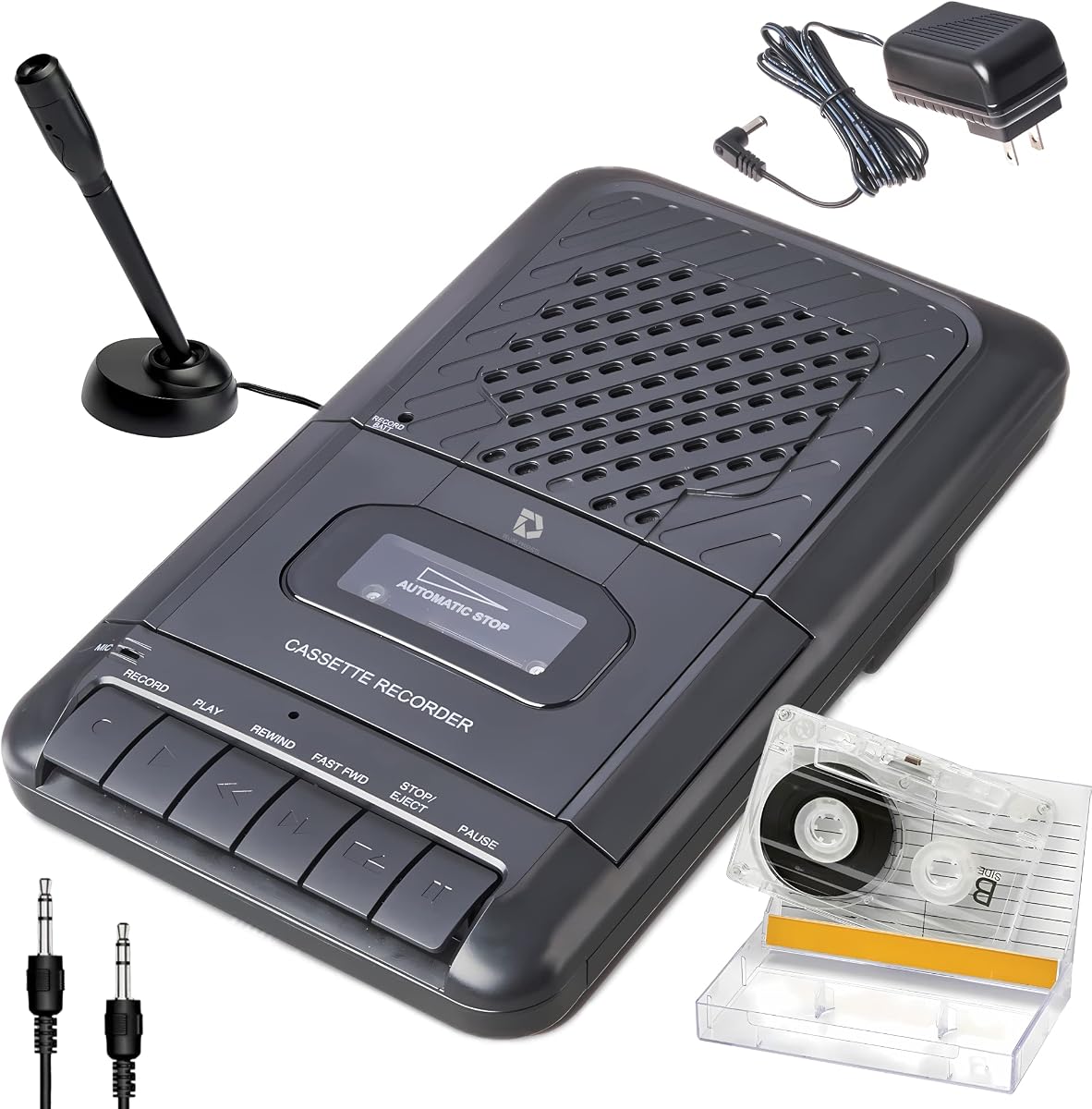
The Deluxe Products Portable Cassette Player Tape Recorder is a complete kit for recording to cassette, with a 3.9 customer rating. It includes an external microphone, auxiliary input cable, and AC adapter, making it convenient for families that want the essential accessories available from the outset.
We may earn a commission when you buy through this link, at no additional cost to you.
Children can record using either the included external microphone or the built-in condenser microphone. The large buttons are designed to be easy to press, which is helpful for younger users and for activities involving puppets, songs, interviews, or home performances. A built-in speaker makes playback practical for a small group.
The auxiliary cable can carry audio from a smartphone, laptop, or tablet onto cassette, provided the source device has a headphone output. A built-in carrying handle supports portability, and the unit can also operate with four C batteries, which are not included. It is a larger, traditional deck rather than a pocket device.
This is a well-rounded choice for a family that wants a complete, uncomplicated analog recording setup. The included accessories reduce the need to identify compatible extras separately. It suits older children working with family media or supervised younger children learning how sound is captured and replayed.
An external microphone, auxiliary cable, and AC adapter cover the most common connection needs. A family can begin recording more quickly than with a model that requires separate purchases.
The oversized transport controls are easier for small fingers to identify and press. That makes stop, play, rewind, and fast-forward less intimidating for children who are new to physical media.
We may earn a commission when you buy through this link, at no additional cost to you.
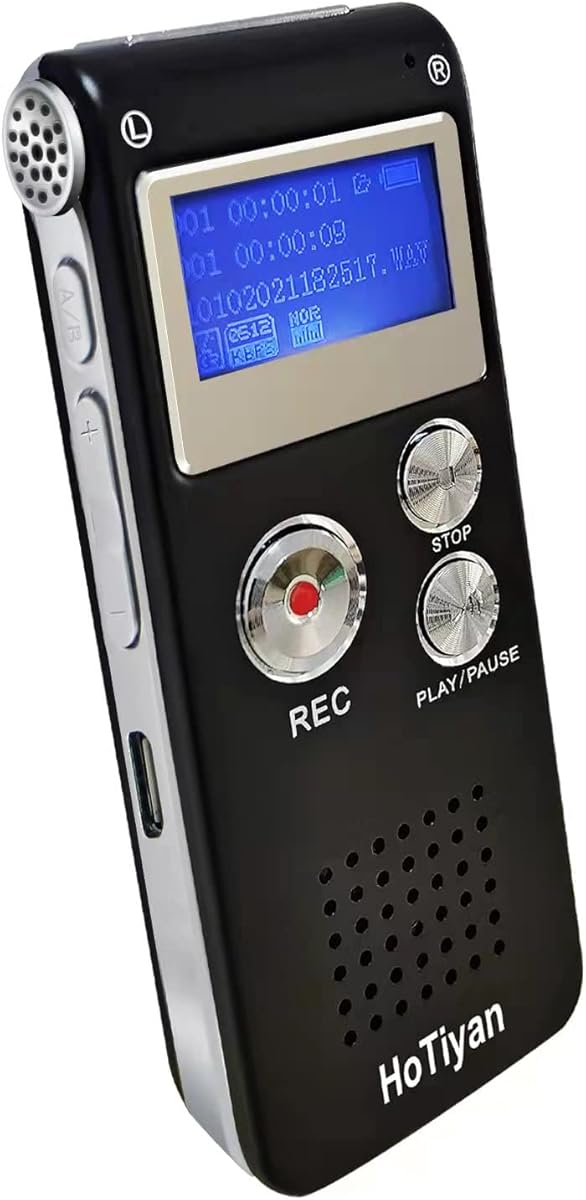
The Digital Voice Recorder 8GB is a compact digital alternative to cassette-based recorders, with a 4.1 customer rating. It stores recordings internally, supports voice-activated capture, transfers files through a supplied Micro USB cable, and can also play MP3 music. It is better suited to older children who can manage files and settings with some adult help.
We may earn a commission when you buy through this link, at no additional cost to you.
The higher-sensitivity microphone, noise-reduction function, and recording chip support stereo recording. Storage estimates vary with the selected quality and range from about 128 to 560 hours, and the device can hold up to 199 files. Voice activation lets recording begin when sound rises above a chosen level and stop when the environment becomes quieter.
A rechargeable 3.6-volt 300mAh battery supports approximately 20 hours of continuous recording and eight hours of headphone playback. A-B repeat, variable playback speed, password protection, timestamps, and named files add value for studying, interviewing, and organizing important clips. Three-button operation keeps the basic workflow manageable.
This is the best choice for a child who wants lots of recording time and easy access to digital audio rather than the experience of handling tapes. The trade-off is that the fun and educational value of cassette mechanics is absent, and voice activation requires an understanding of sound levels. Families should establish a simple folder and file-naming routine.
With 8GB of internal storage and multiple quality settings, the recorder can hold many lectures, stories, interviews, or rehearsals. Children can record a full narrative without repeatedly managing separate files.
A-B repeat and variable playback speed make recorded material easier to revisit. A child can repeat a passage for practice or slow down a difficult sound before comparing it with a new attempt.
We may earn a commission when you buy through this link, at no additional cost to you.
The most useful recorder is the one that matches a child’s age, interests, and ability to manage the device. Consider recording format, controls, speaker access, microphone design, storage, power, and the amount of adult supervision available.
Cassette recorders offer a tactile and visually engaging experience that many children find exciting. They encourage children to handle media, watch the tape mechanism, and understand recording as a physical process. Digital devices, by contrast, are better for long sessions, file organization, and easy playback on a computer. The LeapFrog Let’s Record! uses button-based digital storage rather than tapes, while the 8GB recorder saves MP3 and WAV files. Parents should select the format based on the intended activity rather than assuming one is universally more child-friendly.
In short, choose cassette for nostalgic hands-on play and digital storage for capacity and flexibility.
Young children benefit from a small number of large, distinct buttons and immediate feedback. The LeapFrog Let’s Record! organizes recordings into ten sound buttons, while the Talking Products Voice Pad uses large tactile controls and a short recording limit. Older children can manage more advanced transport keys, menus, file names, and USB connections. Adult guidance is still useful even with straightforward devices because children may not understand the difference between rewind and fast-forward or how to protect recorded media.
In short, prioritize a few clear controls for younger users and richer configuration for older ones.
A built-in microphone is convenient for portable recording, while an external microphone can improve positioning and make interviews or performances more engaging. The PROSCAN includes a free-standing microphone, and the Deluxe Products model includes both an external microphone and a built-in condenser microphone. Automatic level control is useful for unpredictable voices and changing group volumes. Voice activation, one-touch recording, and unlimited re-recording serve different needs, so the best feature is the one that supports the intended activity.
In short, choose microphone placement and recording controls that make the child’s task easy and enjoyable.
A built-in speaker supports shared listening, which is important for family stories, class demonstrations, and sibling performances. Headphone output provides private listening and can help prevent feedback around a microphone. The TOMASHI Pink Green Walkman is intentionally speaker-free, so it depends on earphones. Compact models with a built-in speaker may produce less volume and are best used in calm settings. For regular group listening, choose a larger model with a 3.5-inch speaker or a separate portable speaker.
In short, choose a built-in speaker for sharing and headphone output for focused or individual listening.
Tape length determines how much can be captured, while digital storage depends on file format and quality. The LeapFrog model stores up to three minutes on each of ten buttons, the Voice Pad offers 40 seconds, and the 8GB digital recorder offers far longer sessions. Longer capacity is valuable for storytelling, music practice, and classroom use, but it may be unnecessary for a child practicing short phrases or sounds. File management becomes more important as digital storage grows.
In short, match recording length to the activity, and choose a digital model when long sessions matter most.
Auxiliary input can bring audio from a phone, laptop, or tablet into a recorder, while USB adds file transfer and direct recording capabilities. Bluetooth offers convenient streaming, as seen in the LeapFrog and QFX models. External microphone support can improve performance recording. Check what is actually included: some models provide an external microphone, auxiliary cable, or AC adapter, while batteries, USB cables, memory cards, and cassettes may still need to be purchased separately.
In short, verify included accessories and required connections before making a purchase.
A compact recorder is easier for a child to carry, but a larger unit may offer a bigger speaker, more robust controls, or a handle. Battery requirements vary from two AA batteries to four C batteries, while some models accept AC power or USB. A rechargeable digital recorder is convenient for sustained use but requires charging. Families should consider where the device will be used, whether a child can manage cables, and whether loose batteries need to remain inaccessible to younger children.
In short, choose a size and power system that fit the child’s mobility, storage, and supervision needs.
A child-friendly recorder should have understandable controls, limited setup, and no features likely to cause accidental data loss or confusing behavior. Magnetic tape devices have moving parts that should not be opened, and small accessories should be kept away from children who might swallow them. Digital recorders need guidance about file organization, passwords, and deleting recordings. For the youngest users, selecting a device with a limited recording time and obvious sound buttons can prevent accidental overrecording.
In short, prioritize simple operation, secure storage, and age-appropriate adult oversight.
Begin by reading the included instructions and identifying the play, stop, record, rewind, fast-forward, microphone, and headphone controls. For a cassette model, insert the tape in the correct orientation and make sure the protective tabs are not blocking recording. For a digital model, choose a folder or recording category before the first session and demonstrate how to save, rename, and replay a file.
Choose a quiet space, position the microphone at a suitable distance, and speak or sing at a natural level. Automatic level control or a sensitivity setting can help, but a child should still speak clearly rather than shouting directly into the microphone. Keep sessions short, use headphones when appropriate, and save or transfer important files before changing devices, erasing memory, or overwriting a tape.
Protect the equipment by using the specified power source, avoiding moisture and extreme heat, and keeping magnetic media away from magnets and powerful electrical equipment. Wipe the casing with a soft, dry cloth rather than a liquid cleaner. For cassettes, use a proper cleaning method and avoid forcing a jammed mechanism. Digital devices need regular charging and organized storage, while rechargeable batteries should be replaced if they no longer hold a useful charge.
The easiest choice is usually the LeapFrog Let’s Record! Music Player because it uses large sound buttons, provides curated music and learning content, and is intended for children aged 18 months and older. The Talking Products Voice Pad is another approachable option, with large tactile buttons and 40-second recordings. The best fit depends on whether the child prefers music, speech, or sounds.
No. Many products called tape recorders store recordings digitally even though they resemble portable recorders. The LeapFrog Let’s Record! saves audio on internal buttons, and the 8GB digital voice recorder saves MP3 and WAV files. Only the products explicitly described as cassette players and recorders use physical magnetic tape.
The Talking Products Voice Pad is focused specifically on short voice recordings and supports unlimited re-recording. For longer stories or music performances, the 8GB digital recorder provides substantially more capacity. The JENSEN, PROSCAN, and Deluxe Products models are better when the goal includes recording onto cassette or connecting an external microphone.
They can be, but they require close adult supervision because children may press record accidentally, pull on a tape, or swallow a small accessory. A device with large buttons, short recordings, and immediate playback may be more appropriate. The LeapFrog model provides explicit age guidance, while most cassette models in this guide do not.
Most do. The compact TOMASHI models use two AA batteries, the LeapFrog uses four AA batteries, the QFX and Deluxe Products recorders can use four C batteries, and the Talking Products Voice Pad uses replaceable batteries. Some models also accept AC or USB power. Batteries and power accessories are not included in every listing, so verify the package details.
Yes, with a model that includes auxiliary input. The JENSEN, PROSCAN, QFX, and Deluxe Products recorders support connected audio sources, though the exact process and required cables vary. A source device must generally provide a headphone output. The QFX adds USB conversion, allowing supported digital files to be recorded directly onto cassette.
The 8GB digital voice recorder is the strongest choice for long digital capture, with extensive storage estimates, MP3 and WAV formats, and file transfer through the supplied Micro USB cable. The LeapFrog Let’s Record! is another cassette-free option, but it is more compact and oriented around short button-based recordings, music, and learning content.
Check the age guidance, recording format, included accessories, required power source, and whether the child will need help managing files or tapes. Also confirm the size, microphone options, playback method, and storage limitations. Current product listings can change, so verify the specifications and package contents before ordering.
The LeapFrog Let’s Record! is the most child-centered overall choice, combining simple button-based recording, educational music, and Bluetooth in an age-guided design. The Talking Products Voice Pad is the best budget option for short speech and phonics activities, while the QFX RETRO-39BT stands out as the premium pick for children ready to explore USB, Bluetooth, radio, MP3, and cassette recording together.
For the most authentic tape experience, the compact TOMASHI models, JENSEN, PROSCAN, and Deluxe Products recorders are worth comparing. Choose a built-in speaker for group activities, an external microphone for performances, and enough storage for the intended project. Older children may prefer the digital recorder because it supports long sessions, repeat playback, and computer transfers.
Regardless of format, prioritize age-appropriate controls, safe operation, comfortable listening, and enough capacity for creative expression. Ratings and features provide a useful starting point, but package contents and compatibility can change. Check the current listing, included accessories, power requirements, and current price before making a final purchase.