
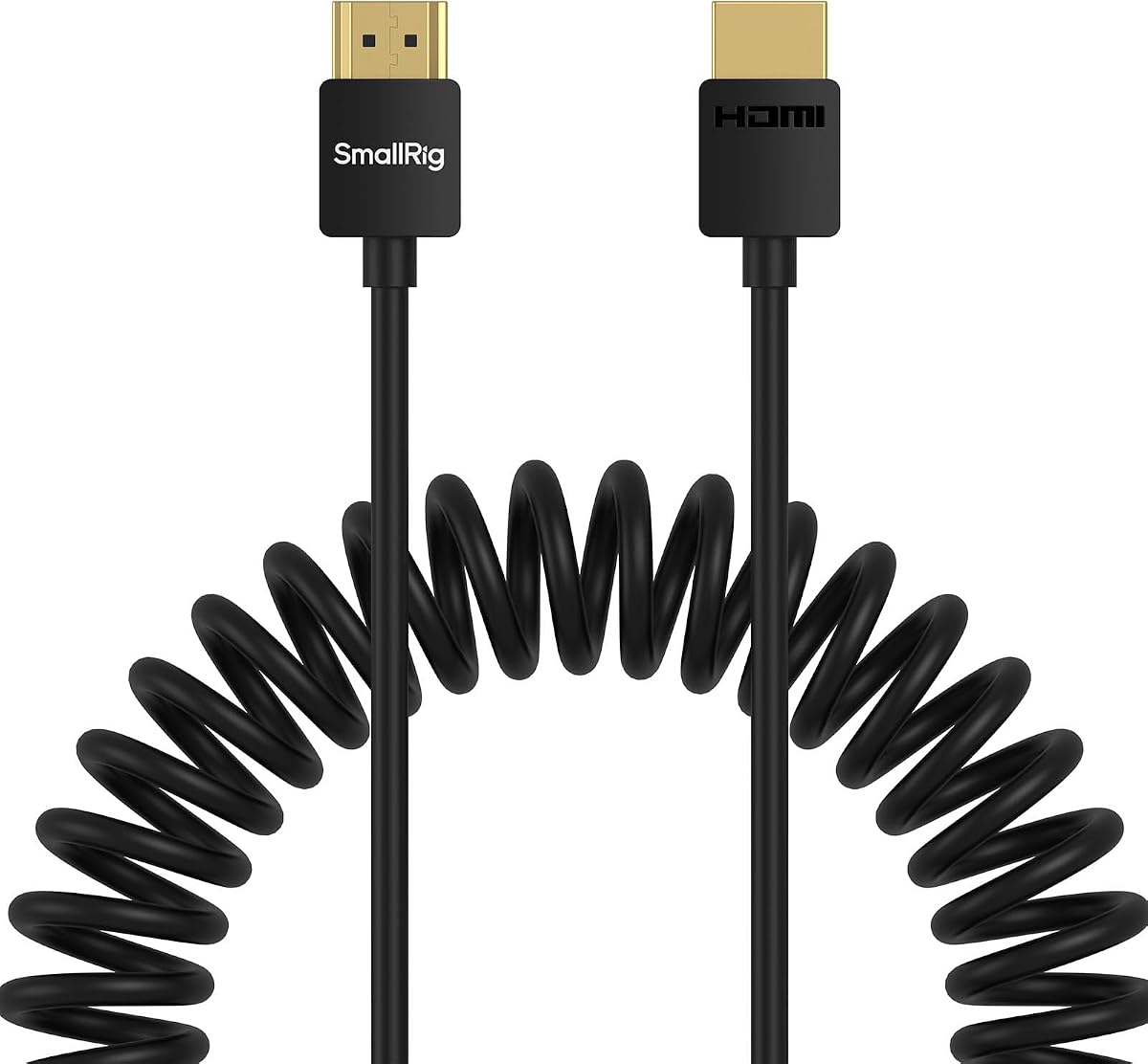
8K Coiled HDMI Cable 1FT-3.3FT
4.8Editor score
Extends one to 3.3 feet
Supports 8K at 60Hz
Uses 48Gbps bandwidth
Compatible with HDMI devices
This expert guide compares the best coiled HDMI cables for gaming, cameras, monitors, home theaters, and compact setups.
A coiled HDMI cable combines a flexible spring-like construction with the convenience of a standard HDMI connection. The design can extend when a device needs more clearance and retract into a compact bundle when it does not, making these cables especially useful for camera rigs, gimbals, desktop stations, and frequently repositioned entertainment setups.
The products in this guide were compared using their stated HDMI specifications, supported resolutions, bandwidth, connector style, extended length, shielding, construction, and intended equipment compatibility. The list covers short HDMI 2.1 options, camera-focused right-angle cables, longer retractable models, and more basic HDMI 2.0 choices for everyday displays.
Each review explains the strongest use case and the compromises involved, helping you distinguish between basic cable management and advanced 8K or high-refresh functionality. Ratings and specifications reflect the supplied product information, while prices and availability can change, so confirm current listing details before purchasing.
4.8Editor score

4.7Editor score

4.7Editor score
The comparison chart below highlights each cable's rated specification, coil length, connector arrangement, and most relevant intended use, making it easier to identify the right model for a camera rig, gaming display, home theater, or compact desktop.



The Cable Matters 48Gbps 8K HDMI Coiled Cable, 1-3ft is our strongest all-around recommendation because it combines modern HDMI 2.1 capabilities with a practical one-to-three-foot coil. Its 4.7 rating reflects a favorable buyer reception, while the listed support for 8K at 60Hz, 4K at 120Hz, Dynamic HDR, eARC, and VRR makes it relevant to more than just tidy cable management.
We may earn a commission when you buy through this link, at no additional cost to you.
The central benefit is adaptability. A camera may sit close to its monitor during part of a shoot and need more clearance during a pan, while a desktop display or wall-mounted television may require a temporary extension during installation. This cable extends smoothly when distance increases and contracts into a compact form afterward, reducing loose loops around the connected equipment. Its stated 48Gbps capacity and HDMI 2.1 support also make it a better match for modern high-resolution and high-refresh displays than a basic 4K cable.
The main limitation is its maximum length of three feet. That is enough for many camera-to-monitor arrangements and short desktop links, but it is not appropriate when the source and display must remain several feet apart. The stated construction also emphasizes a resilient coil rather than a right-angle connector, so users with recessed ports or highly constrained cages may prefer one of the angled alternatives. Within short-range applications, though, the balance of extension, bandwidth, and cable management is particularly convincing.
Choose this cable if you want a future-oriented HDMI 2.1 connection without giving up the organization benefits of a retractable lead. It is especially suitable for mounted TVs, movable gaming stations, home theater components, and compact professional monitoring setups. For buyers who need only a short connection, the three-foot limit is a feature rather than a problem because it keeps excess cable out of the way.
Supporting 8K at 60Hz, 4K at 120Hz, and up to 48Gbps gives the cable broad compatibility with modern displays, game consoles, and production monitors. Actual visible performance also depends on the source device, display, format, and settings.
The retractable one-to-three-foot range is particularly useful when equipment moves. It offers temporary flexibility without leaving a permanently loose cable draped across a desk, camera rig, or entertainment unit.
We may earn a commission when you buy through this link, at no additional cost to you.
This HDMI 2.1 camera cable earns the Best Premium designation because it combines high-bandwidth signal support with a tailored right-angle-to-left-angle connector arrangement. The 4.7 rating and extensive stated compatibility list make it a compelling option for filmmakers using external monitors, external recorders, wireless systems, or camera-mounted accessories. It is not merely a shortened desktop cable; its physical design is purpose-built around demanding production environments.
We may earn a commission when you buy through this link, at no additional cost to you.
The right-angle connector on one end and left-angle connector on the other are particularly useful when the cable must enter ports from different directions. This can reduce strain on a camera's HDMI socket and make routing around a gimbal, cage, or monitor less awkward. The listed 48Gbps class of performance supports 8K at 60Hz and 4K at 120Hz, while the resolution list also covers 4K at 50 and 60Hz, 2K at 144Hz, and multiple high-definition formats.
Three-layer aluminum foil braid shielding, tinned copper conductors, and gold-plated connectors form the stated physical design. The braided red sheath is also intended to resist everyday wear while making the cable easier to identify in a kit containing several different leads. The unavoidable trade-off is specialization: the 12-inch resting length extending to 24 inches is extremely short, and the unusual connector geometry may not suit a standard television or laptop arrangement.
This is the top choice for production teams whose equipment list closely matches the compatibility information, especially camera-to-monitor or camera-to-recorder work around ATOMOS, Blackmagic, Canon, Sony, Panasonic, Nikon, Fujifilm, SmallHD, and similar ecosystems. Buyers should verify the physical orientation and available port space before ordering. If those details align, it offers an unusually specialized and feature-rich coiled connection.
Opposed right- and left-angle connectors can simplify cable routing when both ends face constrained equipment. That geometry is especially valuable around gimbals, cages, and monitor brackets where a straight plug may create unwanted leverage.
The cable's stated format support covers high-resolution production options, including 8K modes, 4K up to 120Hz, 2K at 144Hz, HDR, 3D, audio, video, and Ethernet. Device-side output settings must still support the selected format.
We may earn a commission when you buy through this link, at no additional cost to you.
The 8K Coiled HDMI Cable 1FT-3.3FT is the most compelling value-oriented option in this guide. Its 4.8 rating is the highest listed among the group, yet it does not ask the buyer to sacrifice the headline specifications expected from a modern coiled HDMI cable. It supports 8K at 60Hz, 4K at 144Hz, and 4K at 120Hz through a stated 48Gbps bandwidth.
We may earn a commission when you buy through this link, at no additional cost to you.
One of its most appealing physical traits is the 3.9-millimeter diameter, described by the manufacturer as more than 60 percent thinner than ordinary cables. That slim profile can make the coil easier to pack with cameras, field monitors, and other mobile equipment. The aluminum alloy connector shells are intended to improve heat dissipation and wear resistance, while the copper conductors and gold-plated plugs are designed to support stable transmission and resist interference.
The trade-offs are mostly about maximum reach and connector geometry. Extending to 3.3 feet gives slightly more range than several one-to-three-foot alternatives, but it remains a short cable. It also uses conventional straight connectors, which may be less suitable in a deeply recessed camera port. Its listed support for Dynamic HDR, Dolby Vision, eARC, Dolby Atmos, 3D, and a range of refresh rates is broad, but real output remains dependent on source and display capabilities.
This is a strong choice for gamers, camera operators, office users, travelers, and home-entertainment shoppers who want a compact, modern HDMI cable without paying for a specialized angled design. It also serves as an easy recommendation for anyone prioritizing specifications, portability, and the highest rating in the roundup. Verify that your devices support the desired format before relying on features such as 8K or 4K at 144Hz.
At a stated 3.9 millimeters, the cable is designed to remain light and compact when extended or packed. That makes it practical for field monitors, cameras, laptops, and travel displays where a conventional full-size lead can feel cumbersome.
The listed 48Gbps bandwidth and support for 8K at 60Hz, 4K at 144Hz, and 4K at 120Hz position this cable for modern gaming and media setups. The connected source and screen must independently support the chosen resolution and refresh rate.
We may earn a commission when you buy through this link, at no additional cost to you.
The Short Coiled HDMI 2.1 Cable 8K is built for camera and gimbal workflows where a standard connector can create unwanted strain or awkward routing. Its 4.8 rating places it among the most well-regarded options here, while the low-profile 90-degree connector and retractable one-to-three-point-three-foot coil distinguish it from general-purpose HDMI leads.
We may earn a commission when you buy through this link, at no additional cost to you.
The left-angled head is intended to fit tight cage setups and reduce pressure on the connected port. As the cable expands during movement, the elastic coil helps adapt to changing distances and can reduce cable drag during pans and tilts. This makes the product particularly relevant to a camera connected to an external monitor, wireless transmitter, or gimbal stabilizer. The short design also reduces the amount of loose cable that might otherwise interfere with a moving rig.
Its signal specifications are ambitious for such a compact lead. The product data states 48Gbps bandwidth, 8K at 60Hz, 4K at 120Hz, Dynamic HDR, Dolby Vision, eARC, VRR, ALLM, and support for multiple RAW and color formats. Triple-layer shielding, gold-plated connectors, an aluminum shell, and a red braided jacket add protection against wear and interference. The main concern is physical rather than electrical: a 90-degree connector needs adequate clearance, and not every HDMI port offers it.
This cable is best suited to filmmakers and monitor users who understand their port orientation and need a compact, high-bandwidth lead. Its stated compatibility covers major camera, monitor, transmission, console, display, and capture-card categories, but checking the equipment list before purchase is still wise. For anyone with limited port clearance and a preference for high-refresh performance, it is one of the most focused choices in the roundup.
The 90-degree connector changes the direction of the cable immediately after it enters the port. On gimbals, cages, and compact monitors, that geometry can reduce leverage and make the connection less vulnerable to accidental movement.
Beyond ordinary display use, the stated support for 14-bit and 12-bit RAW, 10-bit 4:2:2, LUT monitoring, and high-frame-rate playback makes the cable relevant to professional monitoring workflows where output settings and device support align.
We may earn a commission when you buy through this link, at no additional cost to you.
The SMALLRIG Coiled HDMI Cable 2.0, model 4963, is a practical option for camera operators who need reliable 4K monitoring but do not require HDMI 2.1 bandwidth. Its 4.5 rating is accompanied by a clear set of useful production features, including an extension of up to 47 inches, a flexible TPU and PVC construction, and full-size Type A connectors.
We may earn a commission when you buy through this link, at no additional cost to you.
The longer coil gives this model more reach than the numerous one-to-three-foot options in the guide. That can be useful when a camera and monitor are mounted on separate sections of a gimbal, stabilizer, or support rig. At the same time, the cable retracts neatly to limit clutter. Its 18Gbps bandwidth supports 4K at 60Hz, HDR, and 3D, with backward compatibility stated for HDMI 1.4 1080p workflows.
The important limitation is technical rather than practical. This is an HDMI 2.0 cable, not an HDMI 2.1 design, so it cannot offer 8K at 60Hz, 4K at 120Hz, or the full bandwidth associated with 48Gbps. Some newer production monitors can display high-resolution formats, but the connection must be matched to the actual output mode. For standard 4K monitoring, however, the stated capabilities are often more than a rig requires.
This cable is well suited to studios, field productions, and established camera kits that rely on conventional HDMI connections. It includes one coiled cable and is designed for gimbals, stabilizers, monitors, and wireless transmitter and receiver systems using Type A ports. Buyers prioritizing future headroom should choose an HDMI 2.1 model, while those prioritizing reach, simplicity, and 4K at 60Hz will find this option more aligned with the task.
A stated extension to 47 inches offers additional flexibility when a monitor or receiver sits farther from the camera than a very short coil allows. Retracting after repositioning helps keep the working area orderly.
The 18Gbps HDMI 2.0 specification is centered on 4K at 60Hz, HDR, and 3D rather than the newest 8K modes. This can be a sensible fit for established 4K workflows, provided no device requires HDMI 2.1-only bandwidth.
We may earn a commission when you buy through this link, at no additional cost to you.
The Twozoh HDMI to HDMI Coiled Cable is a flexible middle ground for users who want more reach than a short coil without needing the bandwidth of an HDMI 2.1 cable. It carries a 4.5 rating and supports 3D, 4K UHD, 1080p, and uncompressed multichannel digital audio, making it relevant to many conventional home and professional display setups.
We may earn a commission when you buy through this link, at no additional cost to you.
Its coil can extend to five feet, which is longer than most of the short camera-oriented products in the list. That range allows a laptop to connect to a television, a camera to reach a monitor, or a streaming device to reach a display positioned a modest distance away. When not needed, the lead retracts into a compact spiral. The product is described as extremely flexible and light, making it straightforward to carry and reposition.
Construction details include gold-plated connectors, bare copper conductors, and foil-and-braid shielding intended to support reliable connectivity and resist interference. The product data also says every cable is inspected and visually checked before packing. However, it does not describe the cable as a 48Gbps HDMI 2.1 model, so buyers should not expect 8K at 60Hz or 4K at 120Hz performance from it. That limitation is easy to accept for 4K viewing and conventional gaming or production tasks.
This is a sensible recommendation for a living room, conference room, travel kit, or camera setup where a five-foot coil is useful but high-refresh 8K is not required. It may also appeal to buyers who prefer a less specialized product with a straightforward HDMI-to-HDMI connection. Verify the display's native format and the source device's output before purchase, especially if the plan depends on a particular refresh rate.
The one-and-a-half-meter maximum extension gives the cable useful placement flexibility while preserving a compact stored form. It can bridge moderate gaps without introducing the excess length of a conventional permanently extended lead.
Gold-plated connectors, bare copper conductors, and combined foil and braid shielding provide a straightforward construction story. These features support dependable everyday connections at displays, computers, streaming devices, and basic production equipment.
We may earn a commission when you buy through this link, at no additional cost to you.
The Duttek Coiled HDMI Cable is designed around portability and compact storage. It has a 4.5 rating and an extreme-thin male-to-male construction that can stretch to 1.2 meters, or four feet. The product data also describes a normal extended length of 80 centimeters, giving users some control over the distance used in a particular setup.
We may earn a commission when you buy through this link, at no additional cost to you.
Its retractable spiral helps protect fragile HDMI ports by reducing the amount of unsupported cable hanging from a connection. That is valuable for portable monitors, mirrorless or DSLR cameras with field monitors, laptops, TV sticks, consoles, event equipment, and mobile industrial carts. The stated 10.2Gbps data rate is associated with 1080p, while the product information also describes support for 4K at 60Hz HDR transmission. Users should therefore confirm the precise mode required by their equipment rather than relying on the broad 4K label alone.
Gold-plated connectors are included to resist corrosion and support signal transmission, while the thin cable body is the principal selling point. The limitation is bandwidth compared with modern HDMI 2.1 options. It does not claim 48Gbps, 8K at 60Hz, or 4K at 120Hz, so it is better suited to 4K at 60Hz, standard 1080p, and basic high-definition applications. Its capability is sufficient for many everyday connections but not every ambitious display mode.
Choose this cable for travel, office, classroom, event, or mobile-cart use where compactness matters more than maximum refresh rate. It is also a sensible option for a camera operator who wants a light retractable lead but does not need the advanced formats associated with newer HDMI 2.1 cables. Verify both the physical connector type and intended resolution before ordering to avoid an unsuitable match.
The thin coil retracts into a small bundle and extends to four feet when more separation is needed. This makes it convenient for mobile monitors, event carts, laptops, and other setups that are packed away or repositioned regularly.
The cable's stated 10.2Gbps rate and 1080p association provide a clear baseline for high-definition work, while the product information also lists 4K at 60Hz HDR use. High-refresh 8K or 4K applications require checking for a higher-bandwidth cable.
We may earn a commission when you buy through this link, at no additional cost to you.
The Duttek 8K Coiled HDMI Cable stands out within this roundup because it combines HDMI 2.1 performance with a maximum extension of six feet. That reach is longer than the one-to-three-foot range used by most competitors, while its stated 4-millimeter diameter preserves a relatively slim profile. Its 4.4 rating is the lowest in the group, but it still reflects a generally favorable response.
We may earn a commission when you buy through this link, at no additional cost to you.
The cable supports a stated bandwidth of up to 48Gbps, 8K at 60Hz, and 4K at 120Hz. It is described as plug-and-play and compatible with laptops, televisions, computers, monitors, projectors, and other HDMI equipment. The flexible spring coil can stretch from one foot to six feet as needed, making it a more conventional choice for desktop installations where the display may not always be within arm's reach.
Compared with the ultra-short camera cables, this model's greater extension comes at the cost of a longer, more stretched spring when fully deployed. The product does not offer an angled connector or an explicitly stated gimbal-specific geometry. Its outer diameter of four millimeters is thinner than a standard eight-millimeter cable according to the listed data, yet buyers considering repeated high-flex use should still handle the coil gently to preserve its shape and connector strain relief.
This is a strong choice for a modern gaming PC, laptop, television, projector, or monitor station where 8K or high-refresh 4K capability and a relatively long reach are both priorities. It is less specialized for a tight camera cage, where a short angled cable may be easier to route. As with any HDMI cable, actual mode support depends on the source device, display, graphics hardware, and selected settings.
The one-to-six-foot range separates this cable from the short coils in the guide. It provides more positioning freedom for desktop, living-room, and studio installations while still retracting into a compact stored shape.
A listed four-millimeter outer diameter keeps the coil visually and physically manageable compared with many standard HDMI leads. The 48Gbps specification and 8K at 60Hz support make it appropriate for modern high-end displays.
We may earn a commission when you buy through this link, at no additional cost to you.
The 8K Short Coiled HDMI Cable 1-3.3FT is a polished camera-focused choice with a 4.8 rating, strong HDMI 2.1 specifications, and a distinctive red braided exterior. Its main appeal is the combination of advanced signal capabilities and physical features intended to reduce strain in moving production environments, such as a DSLR or mirrorless camera connected to a field monitor or external recorder.
We may earn a commission when you buy through this link, at no additional cost to you.
The spring-like body extends smoothly from one to 3.3 feet and retracts automatically, allowing the rig to remain visually organized. That flexibility can also reduce port strain as a camera or gimbal moves. The stated 48Gbps bandwidth supports 8K at 60Hz, 4K at 120Hz, Dynamic HDR, Dolby Vision, eARC, VRR, ALLM, and various RAW and color formats, making the product suitable for modern monitoring workflows where the source and display support the selected mode.
The aluminum alloy shell is intended to improve heat dissipation, while the red nylon braid and gold-plated connectors are described as durable and resistant to EMI/RFI interference. Compatibility information covers numerous camera families, field monitors, wireless systems, PCs, consoles, TVs, capture cards, and streaming devices. The trade-off is that it uses a conventional connector configuration and short maximum length, so it may not be as easy to fit inside a very tight cage as a right-angle model.
This cable is an excellent match for filmmakers who want a modern, high-specification lead that is easy to identify in a gear bag. It also works for desktop users who prefer a braided finish and strong advertised feature support. As always, verify your camera's output format, the monitor's supported modes, and available port clearance before purchase. When those requirements align, the combination of rating, construction, and versatility is especially appealing.
The one-to-3.3-foot coil adapts to moderate movement while retracting when the rig is stationary. It helps limit loose loops around a camera, field monitor, or external recorder without requiring a separate cable-management accessory.
The cable supports a broad set of modern features, including high-resolution high-refresh modes, Dynamic HDR, Dolby Vision, VRR, ALLM, and multiple color formats. This breadth is useful when a production kit moves between displays with different capabilities.
We may earn a commission when you buy through this link, at no additional cost to you.
The CERRXIAN 8K HDMI Coiled Cable is a compact HDMI 2.1 option for desktop displays, camera monitors, projectors, and other short-range connections. Its 4.6 rating reflects positive buyer feedback, while the stated 3.6-millimeter diameter makes it one of the slimmest cables in this guide. It extends from one to three feet and retracts into a small, tidy bundle.
We may earn a commission when you buy through this link, at no additional cost to you.
Despite its small size, the listed specification reaches 48Gbps and includes support for 8K at 60Hz, 4K at 120Hz, 3D, and Dynamic HDR. The connector housing uses an aluminum alloy shell, while the plug is described as gold-plated for durability. A smart chip is also listed as part of the high-speed transmission design. Compatibility is broad, covering computers, laptops, HDMI switches, monitors, projectors, camera monitors, and other HDMI-equipped devices.
The primary limitation is extension. A three-foot maximum is suitable for close desktop arrangements, many compact rigs, and display connections that only need temporary slack. It will not cover a broad room or a widely separated camera and monitor. The product also uses straight connectors, so a recessed port or tight cage may call for the angled camera-focused alternatives elsewhere in the guide.
Choose this cable when a clean desk, small production setup, or lightweight portable system matters alongside future-oriented HDMI performance. It is also suitable for gamers whose console or PC sits close to a high-refresh television. The cable's combination of a very slim body and strong stated bandwidth makes it especially practical for users who want modern specifications without carrying a bulky permanent lead.
The listed 3.6-millimeter diameter helps the cable fit neatly into a crowded workspace or compact camera setup. Its short one-to-three-foot range is best treated as a temporary distance adjustment rather than a general-purpose long connection.
Support for 8K at 60Hz, 4K at 120Hz, Dynamic HDR, and 3D makes the cable suitable for modern displays and production monitors. Its broad device list is useful for builds that may be reconfigured between gaming, desktop, and monitoring functions.
We may earn a commission when you buy through this link, at no additional cost to you.
The right coiled HDMI cable depends on port clearance, required bandwidth, maximum distance, and the equipment you need to connect. Reviewing these factors before purchasing helps avoid a cable that is too short, too thick, or insufficient for the selected display mode.
HDMI version is the first useful filter because it indicates the cable's advertised performance class. Most current high-end options in this guide are HDMI 2.1 cables with stated bandwidth up to 48Gbps, supporting combinations such as 8K at 60Hz and 4K at 120Hz. The SMALLRIG, Twozoh, and Duttek Extreme Thin options are centered on HDMI 2.0-era bandwidth and are better matched to 4K at 60Hz, 1080p, and conventional workflows. Always compare the cable's bandwidth with the output capabilities of both the source and display; a cable cannot create a resolution, refresh rate, or feature that the connected equipment cannot produce.
Coiled HDMI cables come in a compact resting length but a much longer stretched length. Most camera-oriented options extend only three to 3.3 feet, while the Duttek 8K model reaches six feet and the Twozoh reaches five feet. Measure the distance between the equipment when it is at its closest and farthest positions. The cable should bridge that gap without leaving permanent slack on the floor or desk. Remember that a coiled cable becomes longer and narrower as it stretches, so a model that looks sufficient in a product image may not provide the same working reach as a conventional straight lead.
Standard straight connectors are simple and broadly compatible, but they can be awkward when a port sits close to a wall, desk frame, camera cage, or monitor bracket. A 90-degree connector changes the cable's direction immediately after the socket and can reduce strain on the port. The rank-four product uses a left-angled connector, while the rank-two camera cable uses a right-angle connector on one end and a left-angle connector on the other. Before buying an angled model, check the physical orientation of both ports and leave enough clearance for the connector housing.
Camera rigs, gaming stations, home theaters, and office desktops have different needs. A camera-to-monitor cable should offer sufficient reach, a manageable coil, and ideally reduced port strain. A gaming cable should support the resolution and refresh rate of the console or graphics card, while a television connection may place more importance on eARC, HDR, and 4K support. Use the supplied compatibility lists as a starting point, but verify the exact connector type and output format on your own equipment. This prevents a cable with excellent headline specifications from being unusable in a particular setup.
A slim cable is easier to pack, lighter on a camera rig, and less visually intrusive on a desk. Several options in this guide list outer diameters between 3.6 and 4 millimeters. Thinness can be helpful, but durability still depends on the jacket, shielding, connector reinforcement, and how the coil is handled. Avoid sharply bending the connectors or pulling on the cable while it is compressed. A cable that suits a travel kit should also be flexible enough to extend and retract without forcing the connected equipment.
Shielding helps protect a digital signal from electromagnetic and radio-frequency interference, while conductive and corrosion-resistant connectors support dependable contact. Several products use gold-plated plugs, tinned copper or copper conductors, and multiple shielding layers. These details are particularly relevant in production environments with wireless transmission equipment, electronics, or long power runs near the signal path. Material specifications do not guarantee a flawless installation, but they provide useful evidence that the cable was designed for repeated use rather than only basic short-distance storage.
A cable may support high resolution and refresh rate while also listing features such as VRR, ALLM, eARC, Dynamic HDR, Dolby Vision, and Dolby Atmos. These capabilities can be valuable for gaming, cinematic displays, and home theater systems. They require compatible source and sink devices, however, and some features depend on the selected game, streaming service, operating system, or display setting. Treat the feature list as an indicator of potential compatibility rather than a guarantee that every mode is available with every device.
A warranty can provide reassurance for a cable that will be stretched, compressed, and moved repeatedly. Some camera-oriented HDMI 2.1 options in this guide advertise an unconditional lifetime warranty and online support. Other products do not make a comparable claim in the supplied information, so buyers should not assume equivalent coverage. Warranty terms are most relevant when the cable will be used in a professional kit where replacement convenience and long-term reliability affect the total ownership experience.
Begin by confirming that both connected devices use compatible full-size HDMI Type A ports and that the source output matches the display's supported resolution and refresh rate. Connect the cable when equipment is powered off if practical, align each plug squarely, and avoid forcing a connector into a port that does not accept it naturally. For right-angle cables, verify that the socket has enough side clearance before inserting the plug.
Extend the coil only as far as the installation requires. Pulling from the cable body rather than the connector housing helps reduce stress on the strain relief. When repositioning a camera or monitor, move the equipment slowly while allowing the spring-like section to expand naturally. Do not place a stretched coil under a wheel, across a walking path, or where it can be pinched against furniture.
For storage, gently compress the coil into a compact loop and secure it without crushing the cable sharply. Keep both connectors protected from dirt and moisture, and inspect them periodically for bent contacts or damaged shielding. When connecting to a camera, gimbal, or compact cage, keep the cable clear of motors, gears, and other moving parts that can pinch or abrade the jacket.
A coiled HDMI cable provides flexible reach while storing in a compact form. It is especially useful for camera rigs, gimbals, portable monitors, and frequently moved desktop equipment where a long conventional cable would create clutter. The coil can reduce visual mess and may help limit strain at the connected port.
No. The list includes both HDMI 2.1 cables with stated 48Gbps bandwidth and HDMI 2.0 cables centered on 4K at 60Hz or 1080p. To output 8K at 60Hz, the cable, source device, graphics hardware or capture equipment, and display must all support the required format and bandwidth.
They can be better when the camera port is recessed or a cage has limited space. A right-angle connector changes the direction of the lead and can reduce unwanted leverage during movement. It is not universally superior, though, because the angled housing may not fit or may block adjacent ports.
Choose a maximum extension that covers the largest distance between the camera and its monitor, receiver, or recorder without leaving excessive slack. Many camera-oriented coils extend three to 3.3 feet, while some general options reach five or six feet. Measure the actual rig in its most extended position before ordering.
Yes, provided its bandwidth matches the console or PC output and the television or monitor's supported modes. HDMI 2.1 models in this guide advertise 8K at 60Hz, 4K at 120Hz, VRR, and ALLM support. Gaming features remain dependent on the graphics hardware, game, display, and enabled settings.
Coiled cables are designed to extend and retract, but they should still be handled gently. Avoid sharp bends near the plugs, pulling the connector housing, or stretching the cable far beyond its stated range. Store it compressed rather than holding it under tension for long periods.
A thinner cable is easier to carry and manage, but the primary performance factors are its HDMI specification, bandwidth, construction, and the quality of the connection. Modern ultra-thin cables can advertise 48Gbps performance, as several products here do. Verify the formal specifications and device support rather than judging performance by thickness alone.
Most full-size HDMI Type A devices can use a standard male-to-male coiled cable, including many televisions, computers, consoles, monitors, cameras, and field displays. Check for adapter requirements, port clearance, and supported resolution or refresh rate. Specialty connectors and adapters may also be needed for non-HDMI ports.
The Cable Matters 48Gbps model is the strongest overall choice because it combines HDMI 2.1 performance, a practical one-to-three-foot coil, and support for modern display features. The 8K Coiled HDMI 1FT-3.3FT stands out as the best budget-oriented option, offering a 4.8 rating, slim construction, and extensive bandwidth claims. For specialized production work, the right-left angle camera cable provides the most purposeful connector arrangement.
Prioritize compatibility before everything else: confirm your HDMI version, port orientation, maximum required distance, and selected resolution or refresh rate. Right-angle models are valuable in tight camera cages, while longer coils suit more widely separated equipment. Thin construction, shielding, braided jackets, and retractable storage improve usability, but none can compensate for a cable that lacks the bandwidth or physical fit your setup requires.
Before making a final purchase, check the current product listing, supported formats, connector dimensions, warranty terms, and availability. Ratings and specifications can change as manufacturers revise products, and prices also fluctuate over time. Comparing the current listing with the verified needs of your camera, console, computer, monitor, or television is the most reliable way to select the right coiled HDMI cable.