
Gaiatop Mini Space Heater
4.5Editor score
500W PTC ceramic heating
Tip-over and overheat protection
Compact desktop footprint
Low wattage space heaters for RV offer a practical way to warm a personal area without placing a heavy load on campground power, battery systems, or limited electrical circuits. The most useful models combine modest power draw, compact dimensions, quiet operation, and safety features suitable for compact living spaces.
We compared ten personal and portable heaters based on their listed wattage, heating approach, size, controls, safety provisions, noise information, and intended use. The guide covers dedicated RV-friendly options as well as lower-wattage desk heaters that can provide focused warmth without trying to heat the entire cabin.
Each review explains where a heater stands out, where its compromises matter, and which type of RV traveler may prefer it. Product specifications and availability can change, so readers should verify current details, outlet requirements, and RV site rules before purchasing.
4.5Editor score
4.4Editor score

4.6Editor score
As an Amazon Associate we earn from qualifying purchases.
This side-by-side comparison highlights the main differences in power draw, heating style, physical size, controls, safety features, and noise. It helps distinguish heaters intended for focused personal warmth from more capable units designed to warm a broader portion of an RV interior.


The Pereysi Ceramic Personal Space Heater is the most explicitly RV-oriented model in this guide. Its product description identifies 700W and 1000W settings, fast ceramic heating, operation at no more than 45dB, and a design intended to warm a personal area rather than an entire room. That combination makes it a sensible starting point for travelers who need dependable warmth without demanding a large electrical load.
We may earn a commission when you buy through this link, at no additional cost to you.
The strongest feature is the balance between useful power levels and compact operation. A traveler can select the lower setting for gentler warming or move to the higher setting when more heat is needed. Its small, lightweight format is particularly helpful beside a desk, near sleeping quarters, or in a tight footwell. A single control knob keeps adjustments uncomplicated, while the listed tip-over shutoff and flame-retardant materials add visible safety value.
Its limitations reflect its personal-heater format. It does not include a thermostat, remote, timer, or rotating airflow, so it is less suitable for unattended whole-cabin heating. The 1000W maximum is also higher than many of the ultra-low-wattage models included here. Buyers who need the smallest possible load may prefer a 250W or 400W unit, while those wanting more substantial heat from a compact package may find the Pereysi more capable.
This is the strongest general recommendation for RV use because it directly addresses circuit-conscious travelers without becoming oversized or feature-heavy. It is particularly suitable for someone who wants quiet warmth at a desk, beside the bed, or around the feet. The simple controls also make it a better fit for occasional use than heaters with menus and programming that may be unnecessary in a small motorhome.
The 700W setting provides a more conservative option for travelers concerned about circuit load, while 1000W offers additional heat when conditions are colder. The heater is intended to target a personal zone rather than condition the entire RV.
The listed noise level of 45dB or less supports use during work, calls, or sleep. Its compact housing can also be positioned under a desk where space is limited and direct airflow toward the user's feet is more important than wide-room coverage.
We may earn a commission when you buy through this link, at no additional cost to you.
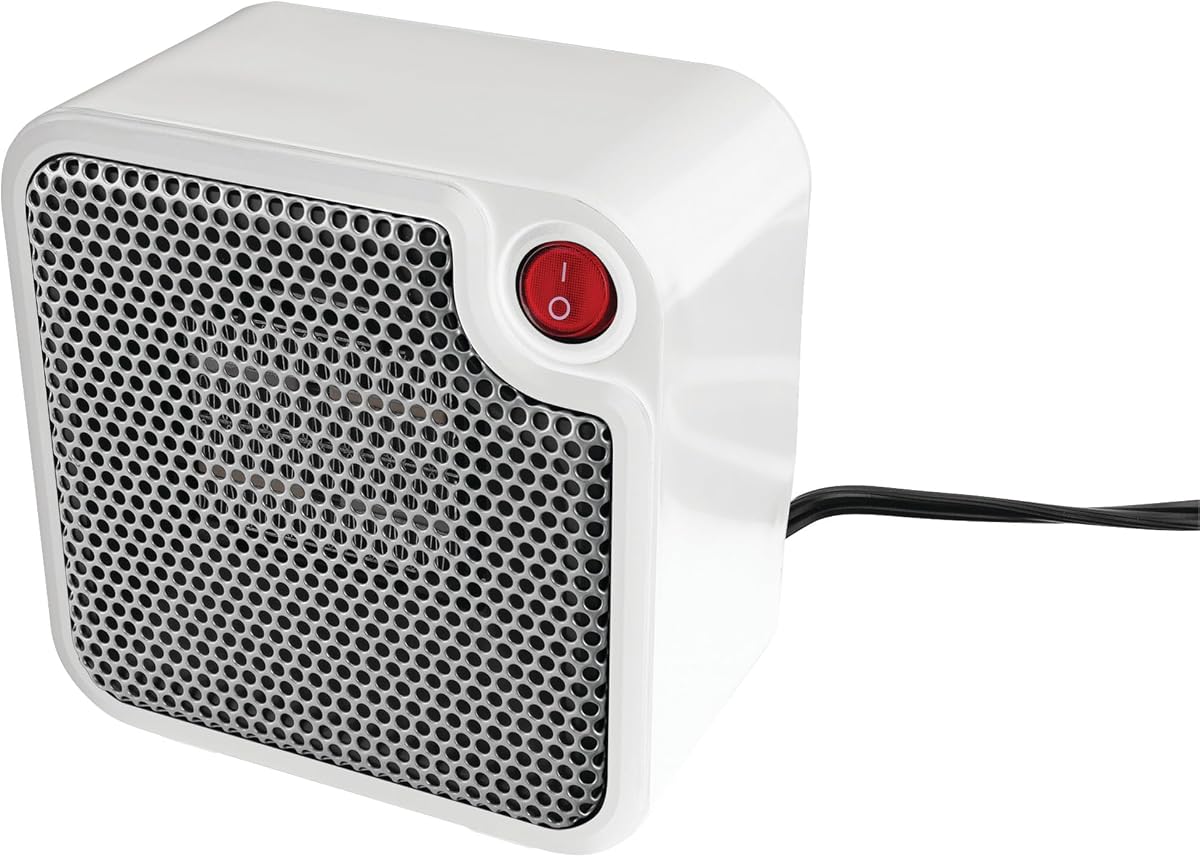
The Performance Tool W5011 is the most power-conscious option here, using only 250W. It is designed strictly as a personal space heater, which means its goal is localized warmth rather than fast heating of a complete RV cabin. That makes it relevant to travelers with modest supplemental heating needs or those who prefer a very small electrical load.
We may earn a commission when you buy through this link, at no additional cost to you.
Its chief strength is the simplicity of the proposition. At 250W, it draws considerably less power than the 400W, 500W, 700W, 800W, 1000W, and 1500W alternatives in the guide. The white housing gives it a neutral appearance, and the personal format should be easier to place than a larger room heater. It may be particularly useful during mild evenings when occupants need only a localized boost.
The limited information is the main reason to proceed carefully. The supplied listing does not mention dimensions, noise level, thermostat controls, tip-over protection, overheat protection, cord length, or included accessories. Buyers should therefore check the current product page for those details rather than assuming features that are not specified.
This heater is best for an RV owner who prioritizes minimum power draw over heating speed and advanced controls. It is less compelling for cold-weather travel, large RVs, or anyone seeking automatic temperature regulation. Even with those limitations, the 250W rating gives it a clear identity and makes it a useful low-load option within a broader low-wattage category.
At 250W, the W5011 offers the lowest listed draw in this comparison. That can make it easier to combine with other powered essentials when an RV's available circuit capacity is limited.
The supplied listing is intentionally sparse and does not confirm key features such as dimensions, automatic shutoff, or tip-over protection. Reviewing the current listing, manual, and RV safety requirements is especially important before relying on it overnight.
We may earn a commission when you buy through this link, at no additional cost to you.
The Brightown 800W Plug In Heater stands apart through its wall-outlet design, rotating plug, remote control, LED display, and timer. It is designed to heat an area of up to 100 square feet with 800W, giving it more reach than a basic personal heater while remaining below the maximum output of the two DREO models in the guide.
We may earn a commission when you buy through this link, at no additional cost to you.
The rotating plug is particularly useful in an RV because outlets may be positioned in awkward locations. It can be installed upright or inverted, which offers flexibility in directing heat and reduces strain on the connection. Operation below 40dB is also suitable for occupants who want background warmth without excessive distraction. Overheat protection, flame-retardant materials, and automatic shutoff support unattended use.
The main compromise is its power draw relative to the truly low-wattage alternatives. An 800W load may still be too demanding when running a microwave, battery charger, coffee maker, or other high-draw appliance on the same circuit. It also requires a wall outlet, so a traveler with limited accessible outlets or a preference for freestanding equipment may find it less flexible.
This model is a strong option for an RV with a convenient outlet and a desire for remote controls. It works particularly well for scheduled evening heating or for changing comfort settings without getting up. Travelers seeking a minimal load should move toward the 250W to 500W models, while those seeking broader heating may prefer the DREO units.
A remote, clear LED display, and twelve-hour timer make the Brightown convenient when the heater is mounted where reaching the controls would be inconvenient. These features support targeted heating rather than leaving the unit running at a fixed setting all day.
The 180-degree rotating plug allows the heater to sit upright or inverted while maintaining a secure connection. In an RV, that flexibility can make it easier to place the unit where the outlet is usable and the warm-air path reaches the desired area.
We may earn a commission when you buy through this link, at no additional cost to you.
The Lasko 400W MyHeat Mini is built around a clear personal-heating concept: warm the user rather than the room. Its 400W output remains low enough for circuit-conscious use, while the six-inch body and one-switch operation make it straightforward to place on a desk, table, or another stable surface.
We may earn a commission when you buy through this link, at no additional cost to you.
The approximately two-amp current draw is one of the most useful specifications for RV users because it provides a clearer view of electrical demand than wattage alone. A six-foot cord and two-pronged plug offer flexibility around a typical outlet, and the ceramic element is described as self-regulating. Automatic overheat protection, an exterior designed to stay cooler to the touch, and ETL listing add practical safeguards.
It lacks conveniences found in more advanced models. There is no listed remote, digital thermostat, timer, oscillation, or memory function. The personal format also means it is not the right choice for trying to heat a large living area or an entire travel trailer. The six-inch dimensions may require careful placement if the outlet is behind furniture or a fixed cabinet.
The Lasko is a strong middle ground for travelers who want something more substantial than an ultra-mini heater without reaching the upper end of the power range. It is best suited to focused warmth at a workstation or bedside and for use on a standard 120V outlet. Its low draw, compact form, and documented safety protections make it an uncomplicated RV travel companion.
The listed draw of approximately two amps helps RV users think about simultaneous appliance loads. It remains a relatively conservative heater while providing more output than the 250W personal model.
The self-regulating ceramic element, automatic overheat protection, and ETL listing create a straightforward safety story. Those details are especially useful when choosing a compact heater for use around sleeping or working areas.
We may earn a commission when you buy through this link, at no additional cost to you.
The Amazon Basics 500W ceramic heater delivers a useful middle-ground level of power in a small, familiar format. It measures 5.87 by 3.15 by 5.95 inches, weighs just 1.4 pounds, and can be moved between a desk, side table, or other stable surface. That makes it convenient for RV layouts where every piece of equipment must earn its footprint.
We may earn a commission when you buy through this link, at no additional cost to you.
Ceramic coils are listed as providing heat within seconds, and the operating noise is given as 48dB. While that is not among the quietest figures in the guide, it remains suitable for many users seeking focused warmth around a work or rest area. Tip-over protection is the most important documented safety feature and automatically shuts the heater down if it is knocked over.
Compared with the more controlled DREO and Brightown heaters, this one offers fewer visible extras. There is no listed thermostat, remote, timer, oscillation, or display, so comfort must be managed manually and by changing its position. It is also designed for personal warmth rather than comprehensive cabin heating. Travelers in very cold environments may find 500W less forceful than they want.
This is a good value-oriented choice for RV users who want a portable ceramic heater with modest draw and basic tip-over protection. It is especially suitable for a desk, bedside area, or compact lounge where a larger unit would crowd the space. Those wanting remote adjustment or automatic temperature control should look toward the Brightown or DREO options instead.
The 1.4-pound weight and compact dimensions make the heater easy to reposition as occupants move between work, dining, and sleeping areas. Its small footprint is valuable in an RV where counters and surfaces are often limited.
The ceramic coils are described as producing heat quickly, while tip-over protection handles a common risk in a moving vehicle. The simple feature set keeps operation approachable for travelers who do not want complex programming.
We may earn a commission when you buy through this link, at no additional cost to you.
The Amazon Basics Mini Space Heater provides the same core 500W ceramic format as another listing in this guide but appears as a separate compact model. Its stated dimensions are approximately 5.9 by 3.2 by 6 inches, and its 1.4-pound weight makes it one of the easiest units here to carry from one part of an RV to another.
We may earn a commission when you buy through this link, at no additional cost to you.
Its quick-heating ceramic coils make it practical for short, targeted sessions at a desk or dining table. The listed noise level is 48dB, which is more noticeable than the 34dB DREO model but still within a range many users accept for background personal heating. Tip-over protection provides an important safeguard if the unit is bumped or if the vehicle is moving.
The product is deliberately basic, and the supplied data does not list a thermostat, remote, timer, oscillation, or child lock. It is therefore better suited to users who value compactness and portability over automated control. Its small size may also limit the area it can warm effectively, and it should not be positioned where it can be knocked over or blocked.
This model is best for an RV traveler who wants a lightweight heater for a specific personal zone. It is a straightforward alternative to the 400W Lasko and 500W Gaiatop, offering similar power with familiar Amazon Basics styling. For remote functions or wider coverage, the Brightown and DREO models are more capable, but they also place a greater emphasis on features and power.
At 1.4 pounds, the unit can be moved from a desk to a lounge or sleeping area with little effort. That portability makes it practical for travelers whose heating needs change throughout the day.
The 500W rating and compact body position this heater as a personal warmth solution. It works best when directed toward a seated or sleeping occupant rather than used to warm an entire motorhome.
We may earn a commission when you buy through this link, at no additional cost to you.
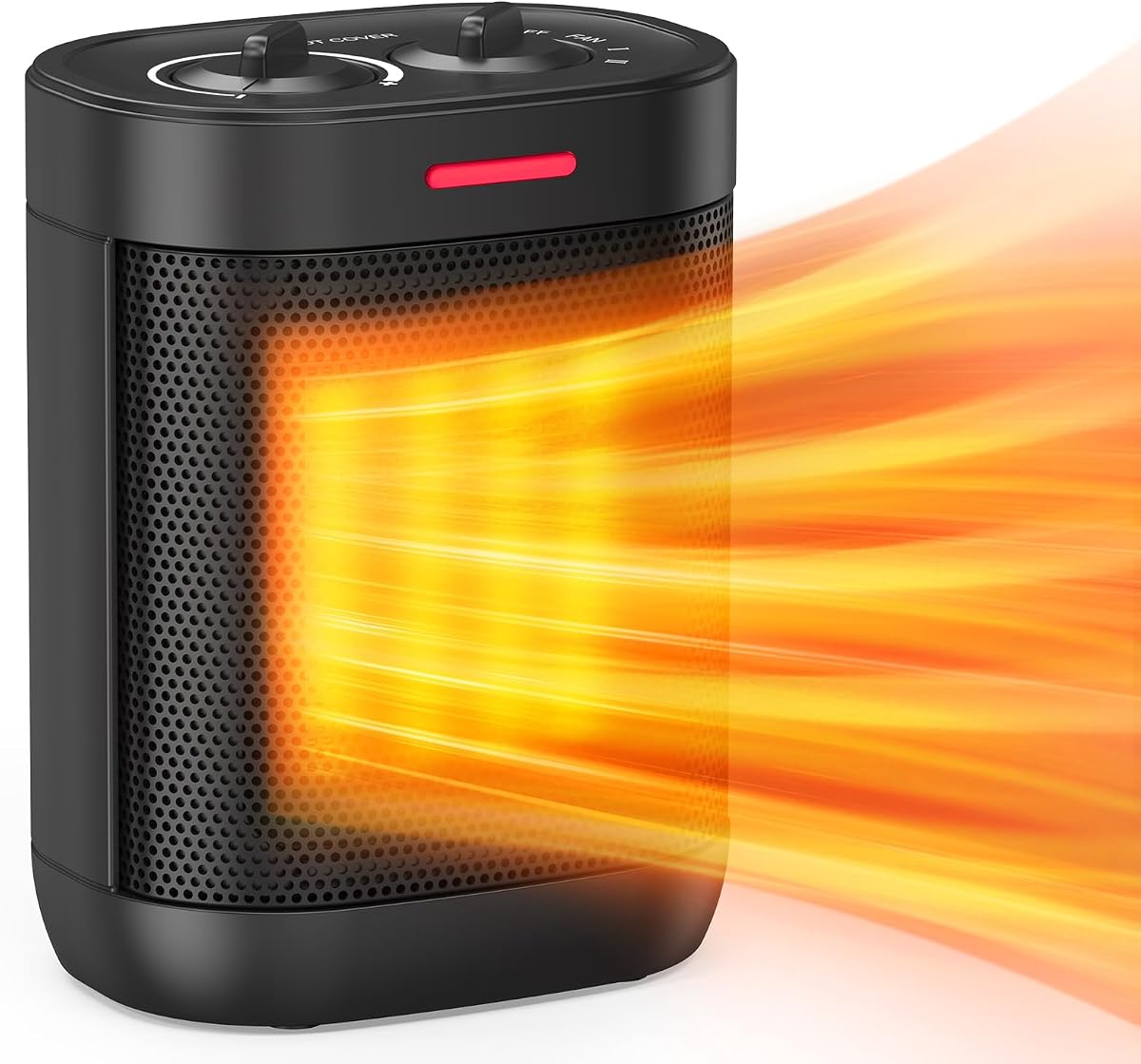
The Gaiatop Mini Space Heater combines a 500W PTC ceramic element with a very compact form and a solid set of basic protections. It is designed for desks, dorms, offices, apartments, and other small spaces, all of which translate well to focused heating in an RV. Its compactness and listed two-second warmup make it convenient for short comfort sessions.
We may earn a commission when you buy through this link, at no additional cost to you.
Safety is a notable strength. The heater includes 45-degree tip-over protection, overheat protection, and V0-class fireproof material. A small LED indicator communicates operating status, which is more useful than having no visual feedback but remains simpler than the full displays and remotes found on premium models. The supplied information also notes an instruction manual and responsive customer support.
The principal trade-offs are the lack of a specified noise figure and advanced controls. There is no listed thermostat, timer, remote, oscillation, or memory function. Noise could be important to someone sleeping beside the heater, so buyers may want to examine customer feedback or the current listing for a clearer sound assessment before deciding.
This is a compelling budget-oriented pick for an RV owner who wants more protection than a bare-bones mini heater without moving into a higher power class. It is best for personal warmth at a desk, dining surface, or bedside. Travelers who prioritize near-silence or automatic temperature adjustment should favor the 400W Lasko or one of the DREO heaters instead.
The 500W PTC ceramic element is paired with a small housing suited to limited RV surfaces. The stated two-second warmup makes the unit appealing when warmth is needed intermittently rather than continuously.
Tip-over and overheat protection cover two common concerns for a compact electric heater. The LED indicator and manual operation make the design uncomplicated, although the lack of a listed timer or remote limits scheduling flexibility.
We may earn a commission when you buy through this link, at no additional cost to you.
The Amazon Basics Blue Space Heater offers the familiar compact 500W personal-heating format in a blue finish. At approximately 5.9 by 3.2 by 6 inches and 1.4 pounds, it is easy to store and reposition, making it a practical option for RV interiors where visual coordination and limited storage space matter.
We may earn a commission when you buy through this link, at no additional cost to you.
Ceramic coils provide fast heating, while the listed 48dB noise level is suitable for many desk and lounge environments. Tip-over protection automatically shuts the unit down if it is knocked over. As with the other Amazon Basics ceramic models in this comparison, the main appeal is the straightforward combination of portability, quick personal warmth, and basic protection.
There is no listed remote, digital display, thermostat, timer, or oscillation, so it does not offer the automated comfort controls of the DREO and Brightown products. It also lacks the broader heating reach of a 1500W unit. A traveler in severe cold or one hoping to heat multiple zones simultaneously may need a more powerful system.
This model is best for users who appreciate a straightforward blue mini heater for a desk, side table, or sleeping area. It can serve as a dependable personal heater in a smaller RV or as a supplementary unit in a larger coach. Those who value efficiency and compactness over elaborate control will find its feature set easy to understand.
The blue finish and compact proportions allow the heater to blend into a work or living area without visually dominating it. Its light weight also makes repositioning simple when different occupants need warmth.
Fast-heating ceramic coils and tip-over protection cover the essential needs of a portable personal heater. The 500W ceiling keeps energy use within a moderate range, although it remains more powerful than the ultralow models.
We may earn a commission when you buy through this link, at no additional cost to you.
The DREO Thermostat Space Heater is the most feature-rich option in this guide. It combines up to 1500W of heating with a wide thermostat range, a brushless DC motor, multiple modes, remote control, a 12-hour timer, mute, child lock, and memory. For an RV with reliable shore power or a suitably robust power system, it offers the most refined control experience.
We may earn a commission when you buy through this link, at no additional cost to you.
The Hyperamics PTC system and heat-funnel design are described as producing heat within seconds and improving warm-air circulation. An enhanced NTC chipset supports temperature selection from 41 to 95°F in one-degree increments. Power Heat, ECO, and Fan Only modes let users match operation to comfort needs, while the remote and timer reduce the need to approach the unit.
Its major caveat is that the 1500W maximum is the highest in the guide, so it is not appropriate for every circuit or battery arrangement. It is also less focused on ultra-compact personal heating than the 250W to 500W models. On the other hand, its 34dB operating level is the lowest listed figure here, and its tilt-detection sensor, overheat protection, safety plug, V0 flame-retardant materials, and ETL certification create one of the strongest safety packages.
This is the best premium recommendation for travelers who want automatic comfort control, quiet operation, and a broad set of functions. It suits larger RVs, parked overnight use with appropriate power, and occupants who value the ability to create a repeatable heating schedule. For minimal-load personal warmth, the Pereysi, Lasko, or Performance Tool alternatives are more aligned.
The NTC thermostat allows settings from 41 to 95°F in one-degree increments, while ECO mode can adjust output toward the selected temperature. These features are valuable in an RV where maintaining a steady personal comfort zone can be more efficient than running a basic heater continuously.
The brushless DC motor and winglet fan design are engineered to reduce turbulence and noise. Tilt detection, overheat protection, a safety plug, flame-retardant materials, and ETL certification provide multiple layers of protection for indoor use.
We may earn a commission when you buy through this link, at no additional cost to you.
The DREO Atom One Space Heater focuses on combining strong heating capability with precise temperature management and broad airflow distribution. Its 1500W maximum provides more potential output than the personal heaters, while the digital thermostat from 41 to 95°F and ECO mode let it target a chosen comfort level.
We may earn a commission when you buy through this link, at no additional cost to you.
A 70-degree oscillation is especially useful in an RV because a fixed directional heater can leave one side of the seating area warmer than the other. The brushless DC motor and nine aerodynamic blades are designed to move air smoothly, with listed noise of 37.5dB. The unit can be positioned by the feet, near a desk, or moved around the interior as needed.
The ETL-listed Shield360° system provides tip-over and overheat protection, an enhanced safety plug, and UL94 V-0 flame-retardant materials. These are substantial safety details, although the highest wattage remains a consideration for travelers with limited electrical capacity. Unlike the other featured DREO model, the supplied information does not list a remote control, timer, mute function, child lock, or memory function.
This model is a strong choice for an RV owner who prioritizes quiet operation, thermostat precision, and oscillating coverage. It works well for seated areas where changing the direction of warmth improves comfort. Travelers seeking the lowest possible draw should choose a smaller 250W to 500W heater, while those wanting additional remote and scheduling features should examine the other DREO model.
The 70-degree oscillation spreads the heater's airflow across a wider zone than a fixed personal unit. In a compact lounge, that movement can create a more even experience for multiple occupants or for a single user sitting off-center.
The digital thermostat supports one-degree adjustments from 41 to 95°F. ECO mode automatically adjusts heat toward the selected temperature, helping the heater avoid unnecessary output once the zone is comfortable.
We may earn a commission when you buy through this link, at no additional cost to you.
The right RV space heater depends on available electrical capacity, cabin size, desired coverage, and how long the heater will operate. Reviewing power draw and safety first prevents a costly mismatch, while features such as thermostats, timers, and oscillation determine day-to-day convenience.
Begin with the heater's wattage and, when available, its current draw. A 250W personal heater presents a much smaller demand than an 800W wall unit or a 1500W feature-rich model. RV owners should also account for the campground pedestal, inverter rating, battery capacity, and every other device operating at the same time. A low-wattage label does not guarantee that a heater is appropriate for every power setup, particularly when several appliances share a circuit.
Choose a heater whose demand fits your available power without crowding essential equipment.
A personal heater is optimized for warming hands, feet, or a nearby desk area. It usually has a smaller body and lower output than a room heater. An area heater can warm a broader space, may include oscillation, and may have a thermostat or multiple modes. Most RV cabins are compact, so focused heating can be more effective and efficient than attempting to warm every wall and surface with one appliance.
Decide whether you need a targeted warmth source or broader circulation around the seating area.
A thermostat allows a heater to maintain a selected temperature rather than relying only on manual output. It is especially helpful for parked overnight use and for travelers who move between day and night settings. A remote control, timer, memory function, and operating modes add further convenience, but they also make the unit more complex. Basic models can still work well when someone is nearby and can adjust them directly.
Prioritize a thermostat for consistency, and add timers or remotes when automated control is worth the extra complexity.
Measure the available counter, shelf, desk, or wall-outlet space before buying. Personal heaters are often only a few inches wide and can sit near the user's feet, while wall units may require clearance around the outlet. Consider cord reach, whether furniture blocks airflow, and whether the heater can be placed on a stable surface. In an RV, a lightweight design is easier to reposition as different occupants use the space.
Prioritize a compact body that fits your layout without blocking airflow or consuming valuable surface area.
Look for tip-over protection, automatic overheat shutoff, flame-retardant materials, and a recognized safety listing where available. A safety plug can reduce the chance of improper wall-outlet contact, while thermal protection is important in a confined space. Even with these features, the heater should be placed on a stable surface, kept away from fabrics, and never covered. RV owners should follow the manufacturer's instructions and local campground rules.
Prioritize multiple thermal safeguards and use the heater exactly as the manufacturer directs.
Noise matters when a heater runs beside a bed, during calls, or while working. Listed figures range from 34dB to 48dB, although real-world sound can vary by setting and placement. A brushless motor and aerodynamic fan design generally support quieter operation. If light sleepers are the primary users, look for a low listed noise level and consider positioning the heater where airflow remains unobstructed but sound is less noticeable.
Choose a quiet design when the heater will run overnight or during focused work.
Confirm that the heater uses a standard 120V connection and that its plug and cord are appropriate for the RV. Some models use a two-pronged plug, while wall-mounted designs may use a rotating plug to fit different outlet positions. Check cord length before purchase and make sure the outlet is in a dry, accessible location. Users should never rely on an extension arrangement that the heater manufacturer has not permitted.
Verify plug type, cord length, and outlet placement before the heater leaves storage.
Lower wattage does not automatically mean better performance in every setting. Heating capacity, airflow, insulation, RV size, and outside conditions all affect the result. A 250W heater may be sufficient for one person in mild weather but inadequate in a cold climate or large coach. A 500W personal heater offers a balanced compromise, while 800W to 1500W models provide more heat and wider control at the cost of greater electrical demand.
Balance available power against the warmth required rather than choosing solely by the lowest wattage.
Before first use, read the manual, inspect the heater and cord, and confirm that the plug, outlet, and power source match the product's requirements. Place the unit on a stable, dry, level surface with its intake and outlet openings unobstructed. Leave appropriate clearance from bedding, curtains, clothing, walls, and other combustible materials, and never cover the heater while it is operating.
Start with the lowest appropriate setting and increase the output only as needed. Personal heaters should be positioned where warm air reaches the occupant without creating a trip hazard. If using a wall unit, follow the specified installation orientation and avoid direct water exposure, particularly in a bathroom. Do not operate a heater in an unattended area unless its safety systems and local rules permit that use, and unplug it before sleeping if the manual instructs you to do so.
Unplug the heater before moving or cleaning it. Remove dust from the exterior with a dry cloth and use the manual's instructions for cleaning vents or other accessible parts; do not immerse the unit or allow liquid into the housing. Inspect the cord and plug periodically for damage, and discontinue use if either shows signs of wear. Store the heater cleanly and completely dry, preferably in its original protective packaging or another dust-resistant location.
The Performance Tool W5011 is the lowest-wattage model included, with a listed 250W output. It is designed for personal heating rather than broad room coverage. RV owners should still compare it with other simultaneous power loads before operating it on a shared circuit.
A lower wattage can reduce demand, but battery suitability depends on the battery bank's capacity, inverter rating, charger, wiring, and the other connected loads. Most personal heaters require standard 120V power, so an inverter or shore power connection is generally involved. Verify the complete electrical setup rather than considering wattage alone.
Usually not effectively. The compact heaters in this guide are primarily intended to warm a personal area such as a desk, bed, or seating location. Heating an entire RV depends on its insulation, dimensions, outside weather, and the heater's output, and a dedicated RV heating system may be more appropriate in severe conditions.
The DREO Thermostat Space Heater has the lowest stated operating noise at 34dB, followed by the DREO Atom One at 37.5dB and the Brightown model below 40dB. Real-world sound can vary with settings and airflow conditions, so placement away from bedding and walls can help reduce perceived noise.
That depends on the manufacturer's instructions, the heater's safety features, and RV or campground rules. Overheat and tip-over protection add safeguards, but no heater should be operated in a way that conflicts with its manual. Unplugging it when leaving the RV or going to sleep may be appropriate unless the manufacturer explicitly supports unattended operation.
A thermostat is convenient when maintaining a consistent temperature and avoiding unnecessary output. Basic personal heaters can still be useful for short, attended sessions, while models with thermostats, timers, ECO modes, and memory offer more control for overnight parking or changing comfort needs.
Choose a stable, dry surface near the person who needs warmth, with space around the intake and outlet. Do not place it beneath bedding, behind curtains, inside a closed cabinet, or where it can be knocked over. A lightweight personal model can also be moved as work and sleeping locations change.
Only products explicitly approved for bathroom use should be operated there, and even then they must be placed away from direct splashes. The Brightown listing specifically states bathroom suitability and recommends installation above the sink, but all other models should be treated as indoor-use products unless their documentation says otherwise.
The Pereysi Ceramic Personal Space Heater is the most versatile overall recommendation because it explicitly addresses RV use, offers two power settings, remains quiet, and includes a single straightforward control. The Gaiatop Mini Space Heater is the strongest budget-oriented option for a traveler who wants 500W ceramic heating, a compact body, and dual thermal protection in a simple package.
At the premium end, the DREO Thermostat Space Heater is the most complete choice for users who want precise temperature control, quiet operation, remote adjustment, a timer, and multiple operating modes. Prioritize electrical compatibility first, then decide between personal and broader heating, and finally select the controls and safety features that suit your travel style.
Specifications, product availability, and customer feedback can change over time, so check the current listing and manual before purchasing. Compare the heater's maximum draw with the RV's available power, follow all placement and safety instructions, and revisit your choice as seasonal travel conditions change.