
Goo Gone Spray Pro-Power
4.4Editor score
Professional-strength formula
Handles tar and wood glue
Safe on hard surfaces
Discover the best Adhesive Remover options for labels, tape, glue, decals, and sticky residue, with expert comparisons on formula, surfaces, and ease of use.
Adhesive removers are formulated to break down the bonds left by labels, tape, stickers, glue, decals, wax, and other stubborn residues. A useful remover should work quickly without damaging the underlying surface, while offering enough control for vertical areas and delicate materials. Formula, dwell time, odor, and included tools all affect the experience.
This guide compares ten adhesive removers based on their stated cleaning power, intended surfaces, application method, residue control, and included accessories. It covers products ranging from citrus-based household formulas to professional-strength sprays and scraping kits. The comparison also distinguishes between broad-purpose removers, clinging gels, and more targeted solutions.
Each pick highlights the type of cleanup it is best equipped to handle, along with practical limitations to consider before use. The top choices are the Goo Gone spray gel, Goo Gone Pro-Power, and Goof Off Adhesive Gunk Remover, while the remaining products provide useful alternatives for workshops, vehicles, collectors, and household projects. Product availability and prices change over time.
4.4Editor score

4.5Editor score

4.3Editor score
The table below compares all ten removers by their most useful attributes, including formula type, residue targets, surface coverage, and application approach. Use it to narrow the field before reading the detailed reviews.




The Goo Gone Adhesive Remover Spray Gel combines a controlled gel formula with broad household versatility, making it the strongest all-around choice in this guide. Its 4.5 rating reflects a favorable balance of cleaning power and surface coverage. The gel is designed to cling where conventional liquids can run, while the included scraper helps lift softened residue.
We may earn a commission when you buy through this link, at no additional cost to you.
Its formula is listed as effective against glue, stickers, labels, tape residue, gum, grease, wax, decals, crayon, and other sticky messes. The citrus-based approach is compatible with a wide list of hard surfaces, carpets, and fabrics, including finished wood, sealed stone, glass, metal, plastics, painted surfaces, ceramic, and porcelain. That breadth makes it useful beyond a single-project purchase.
The main tradeoff is that the gel needs time to work. Applying it directly to a vertical or delicate area, allowing it to sit, and then wiping or scraping is more involved than simply wiping a spot with a wet cloth. Users sensitive to odor may also find the citrus scent noticeable in an enclosed room, even though the formula is designed to be surface-safe.
This is the recommendation for most households because it handles ordinary label and tape jobs while remaining useful for garage, classroom, office, upholstery, and automotive messes. Choose it when the residue may drip, spread, or sit on a vertical surface and you want more control than a standard liquid provides.
The thick gel is the defining advantage here. It stays close to the contaminated area instead of running onto nearby material, which is particularly helpful for labels, wall decals, and tape residue above a countertop.
The included scraper adds leverage for lifting residue after the gel has softened it. Using the tool gently after the recommended dwell time can reduce the need for aggressive scrubbing.
We may earn a commission when you buy through this link, at no additional cost to you.
The Goo Gone Original Liquid earns a 4.6 rating, making it one of the highest-rated options listed. Its familiar liquid format, citrus cleaning agents, and included sticker lifter make it particularly attractive for collectors, thrifting enthusiasts, parents, and teachers who regularly encounter stuck labels and child-made marks.
We may earn a commission when you buy through this link, at no additional cost to you.
The product description identifies stickers, wax, markers, crayons, glue, tar, window decals, glitter, gum, and labels among its targets. It also presents the formula as suitable for restoring surfaces without harming them. Wine glasses, drinking glasses, gifts, clothing, vintage collectibles, and windowsills are specifically mentioned as possible applications.
Compared with the gel options, this liquid is less inherently controlled on vertical surfaces and may require more careful placement. It also does not include the same professional toolkit found in some competitors. Nevertheless, its strong 4.6 rating, broad mess list, and integrated sticker lifter give it an attractive balance for quick household cleanup.
Choose this option when your priority is removing price stickers, marker, crayon, wax, or gum from collectibles and household items. It is also a practical choice for anyone who wants a general-purpose liquid that extends beyond adhesive removal into several common cleanup tasks.
The sticker lifter is especially relevant when removing price labels from glassware or vintage pieces. A broad sticker can be difficult to peel cleanly once the adhesive has partially set, so the tool provides a more controlled way to begin lifting it.
The formula also targets wax, marker, crayon, glitter, and gum. This wider range makes it useful for a mixed cleanup kit, particularly in homes, classrooms, and craft areas where the source of the mess may not always be a conventional glue.
We may earn a commission when you buy through this link, at no additional cost to you.
The 3M Adhesive Remover is the most explicitly automotive-oriented product in this roundup. It combines a non-abrasive solvent blend with a 4.4 rating and is intended to dissolve attachment tape, adhesive residue, tar, wax, and other substances without harming cured paint. Its aerosol delivery also makes it convenient for reaching taped areas during collision repair.
We may earn a commission when you buy through this link, at no additional cost to you.
One of its most important features is the stated compatibility with nearly all cured automotive paints. The product information emphasizes that it removes masking residue and leaves no residue of its own behind. It is also described as suitable for glass and vinyl, giving users a broader set of options when restoring vehicle trim or removing stubborn tape.
The aerosol format is less controlled than a precision nozzle or a clinging gel, and the low-VOC designation does not mean odor-free. Ventilation remains important, particularly in an enclosed garage. Its automotive orientation may also make it seem overly specialized for someone who only wants to remove a single label from a cabinet.
For vehicle owners, detailers, and collision-repair hobbyists, this is a focused and compelling choice. Choose it when cured paint compatibility and masking-residue removal matter more than the ability to apply a small amount to a delicate vertical surface.
A remover that dissolves residue without abrading the finish is valuable during paint preparation and vehicle restoration. This product is explicitly formulated around that automotive requirement rather than treating every surface identically.
The spray can distribute the formula over taped or uneven vehicle areas where a narrow precision nozzle may be difficult to use. Even coverage is especially useful when removing broad bands of masking residue.
We may earn a commission when you buy through this link, at no additional cost to you.
Perco Glue Off is designed for stubborn residues that have had time to cure, including silicone caulk, sealants, tree sap, wet paint, glue, asphalt, ink, marker, soot, tar, wax, and grease. Its 4.2 rating reflects a highly specialized product that rewards a planned approach with its precision nozzle, included scraper, and recommended five-to-ten-minute soak.
We may earn a commission when you buy through this link, at no additional cost to you.
The formula is best suited to metal, painted automotive surfaces, plastics, and finished wood. That focused surface list is useful because it provides guidance about where the product is more likely to be appropriate. The precision nozzle also allows a user to place the remover directly on a small patch rather than flooding a surrounding area.
Its limitations are significant. Perco explicitly advises against use on rubber, leather, silk, fabric, faux stainless steel, unpainted drywall, unfinished wood, unsealed stone, matte or satin finishes, and other absorbent surfaces. The longer soak also makes it less convenient for quick household touch-ups, and the 4.2 rating is modest compared with the leading options.
This is a strong choice for a garage, workshop, or vehicle project involving sealants, tar, asphalt, or dried paint. It is less appropriate for collectors or renters who need a safer general-purpose remover for unknown materials, so surface compatibility should be checked before every application.
The five-to-ten-minute soaking period gives the formula time to penetrate materials such as caulk, sealants, asphalt, and sap. This makes it more appropriate for deliberate restoration work than for a sticky label encountered seconds before guests arrive.
The nozzle directs the liquid onto a defined area, which is helpful around tools, vehicle panels, and finished wood. The included scraper can then lift the softened deposit after treatment.
We may earn a commission when you buy through this link, at no additional cost to you.
The two-pack of Goo Gone Adhesive Remover Spray Gel provides a familiar 4.5-rated formula in a convenient quantity for keeping one bottle in the home and another in a garage, office, or vehicle. Its gel consistency clings to vertical surfaces, while the included sticker lifter helps remove labels and other stuck-on items.
We may earn a commission when you buy through this link, at no additional cost to you.
The formula targets gum, crayon, tape residue, glue, pen marks, and product or price stickers. It is described as surface-safe and intended to remove residue without stripping paint or damaging the finish. The citrus cleaning agents contribute a recognizable scent and fit the product's general-purpose household positioning.
Compared with the 12-ounce spray gel in the top pick, this two-pack emphasizes portability and distribution across locations. Each bottle is smaller, which may be more practical for a compact tool bag or travel kit. If a single large container would be more convenient, however, the multipack offers little advantage, and both formulas require time to penetrate.
This is an excellent choice for households that encounter sticky messes in more than one room or for people who want a dedicated bottle in the car. It combines the low-drip control of a gel with a tool for lifting stubborn labels, making it a flexible addition to a cleaning supply area.
Keeping one bottle in the kitchen and another in the garage prevents repeated trips to a central supply area. It also works well for collectors who may need to treat items in a studio without carrying a larger container.
The clinging consistency stays on tape, gum, and decals rather than spreading rapidly. That control is especially useful on walls, glass, and other surfaces where a freely flowing remover could create a larger wet area.
We may earn a commission when you buy through this link, at no additional cost to you.
Goof Off Adhesive Gunk Remover is a straightforward hard-surface cleaner with a 4.3 rating and a particularly clear mission: removing stickers, labels, tape residue, car decals, bumper stickers, glue, and general adhesive gunk. It is a sensible budget-oriented pick for people who need a reliable dedicated remover rather than a multi-purpose household product.
We may earn a commission when you buy through this link, at no additional cost to you.
The product is listed for metal, glass, brick, wood, concrete, automotive surfaces, and non-acrylic plastic. Application involves spraying or applying the formula directly, allowing it to penetrate for a couple of minutes, and wiping with a clean absorbent cloth. That process is straightforward and does not require a separate scraper for ordinary residue.
The tradeoff is its hard-surface orientation. Nothing in the supplied information suggests that it is the ideal choice for delicate upholstery, fabrics, or unknown finishes. It also needs a short dwell period even though it is described as rapid. The result is a focused formula that may not suit every adhesive or collector's item.
Choose this product for decals, bumper stickers, and labels on glass, metal, wood, concrete, brick, automotive panels, or compatible plastics. It is also a practical choice for renters or homeowners who want an uncomplicated bottle dedicated to sticky residue and do not need a professional scraping kit.
The direct application, brief penetration time, and cloth wipe make the process easy to learn. Users do not need to combine multiple products or purchase an additional lifting tool for most routine adhesive residue.
Bumper stickers, car decals, product labels, and tape residue are central to the formula's positioning. That focus makes it a practical pick for garage doors, storage bins, tools, and vehicle cleanup tasks.
We may earn a commission when you buy through this link, at no additional cost to you.
Goo Gone Spray Pro-Power is the premium choice in this guide, combining a 4.4 rating with a professional-strength formula and a 16-ounce spray. It targets an unusually broad collection of workshop problems, including wood glue, grease, tar, stickers, wet paint, tree sap, bugs, marker, wax, dust, and grill grates.
We may earn a commission when you buy through this link, at no additional cost to you.
The formula combines citrus oils with refined oils, according to the supplied product information. It is stated to be safe on hard surfaces, carpets, and fabrics, giving it more household reach than many heavy-duty options. The included scraper makes it easier to lift residue after the spray has had time to break it down.
Its greater power and larger format may be unnecessary for a small label. The scent may also be more noticeable in a closed garage or small workspace. Nevertheless, for accumulated grease, tar, wood glue, and mixed grime, the broader formula provides useful power that lighter household removers may not offer.
Choose Pro-Power for workshop restoration, vehicle detailing, grill cleanup, and projects involving more than a single stubborn label. It is also a reasonable option for homeowners who want one capable spray to address several categories of gunk and do not want to maintain a collection of narrowly specialized cleaners.
Wood glue, tar, grease, tree sap, wax, bugs, and grill residue can all appear in the same garage. A formula with that range reduces the need to identify the exact cleaner needed for each new mess.
The spray provides broad coverage, while the scraper supports mechanical removal after the formula has softened a deposit. This combination is particularly helpful for thick or layered residue that does not wipe away immediately.
We may earn a commission when you buy through this link, at no additional cost to you.
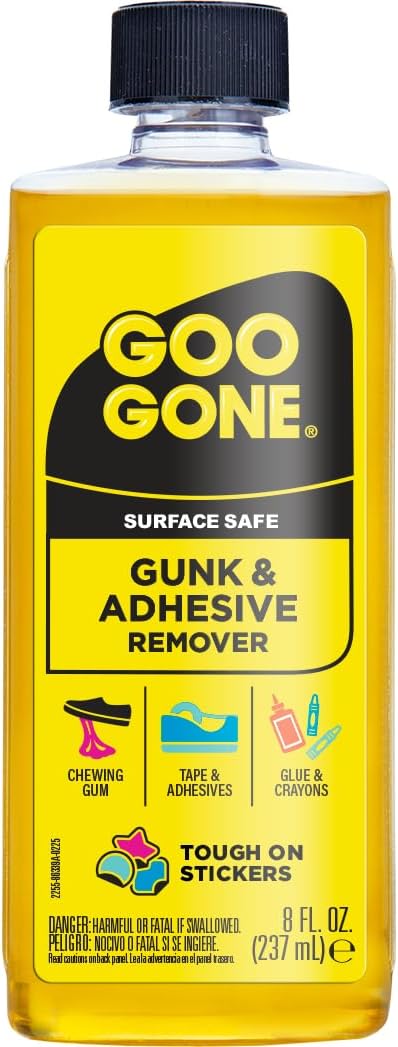
The Goo Gone Gunk and Adhesive Remover stands out with a 4.6 rating and a particularly broad list of household problems. It is presented as a quick, easy formula for stickers, tape, decals, gum, glue, crayons, markers, scuff marks, candle wax, labels, tar, and other sticky or greasy residue.
We may earn a commission when you buy through this link, at no additional cost to you.
Surface coverage is equally wide, with the product information naming carpets, fabrics, hard surfaces, dinnerware, tables, cars, wine glasses, drinking glasses, gifts, and clothing. Citrus cleaning agents and a pleasant citrus scent are highlighted, giving the formula a gentle-sounding profile despite its strong cleaning remit.
The liquid format does not offer the vertical control of a gel, so precise placement matters. The product data also does not state a container size, which makes it difficult to compare capacity directly with the other picks. Even so, the 4.6 rating indicates strong customer reception, and the stated surface range is unusually broad.
Choose this remover when a household encounters many different kinds of sticky marks and wants a single product for gifts, glassware, dinnerware, clothing, furniture, and cars. It is especially useful for mixed cleanup kits, provided the user follows label directions and tests an inconspicuous area first.
The listed range includes both hard and soft surfaces, from dinnerware and glass to carpets, fabrics, and clothing. That makes it appealing for mixed cleanup tasks, though compatibility should still be checked because no remover is appropriate for every finish.
The recommended method is straightforward: apply, allow a few minutes for the formula to work, and wipe with a cloth or paper towel. This makes the product suitable for routine maintenance as well as larger sticky patches.
We may earn a commission when you buy through this link, at no additional cost to you.
The Perco Glue Off Value Kit is built around a 3.3-ounce adhesive remover, a curved non-slip scraper, and a plastic razor. Its two tools distinguish it from most competitors and make it appealing for label, sticker, tape, and car-decals cleanup where lifting stubborn edges is part of the challenge.
We may earn a commission when you buy through this link, at no additional cost to you.
The product information describes a water-based adhesive cleaner formula and says it is gentle on most surfaces. The scraper features double-edged protectant blades intended to reduce the chance of surface damage during use. Its ergonomic grip is designed for comfortable handling at home, in an office, or at school.
Its 4.1 rating is the lowest among the ten products, and the supplied information does not provide a detailed list of excluded materials. Because the formula is powerful enough to remove adhesive, users should not interpret the broad surface claim as permission to apply it to every material. The included razor also requires careful control.
Choose this kit when removing labels, stickers, tape residue, and car decals is the primary task and the included lifting tools would be useful. It is particularly convenient for offices, schools, and moving or unpacking situations where several items may need labels removed one after another.
The scraper with protected edges and the plastic razor offer different levels of control for a remaining patch. Together, they can help remove the final adhesive left after the liquid has softened the bond.
In offices, classrooms, or moving projects, a ready-made kit reduces the need to search for a separate blade or lifting card. The compact spray and compact tools are also easier to organize than a large collection of supplies.
We may earn a commission when you buy through this link, at no additional cost to you.
Goof Off Pro Strength Remover combines a 4.5 rating with a broad project-cleaning remit. Its 8-ounce portable format is designed for people who need strong adhesive and glue removal without carrying a large bottle, and it targets dried latex paint, adhesive, glue, asphalt, tar, stickers, decals, caulk, tree sap, crayon, and road grime.
We may earn a commission when you buy through this link, at no additional cost to you.
The stated compatible surface list includes baseboards, metals, glass, brick, wood, concrete, grout, fiberglass, hand tools, and most automotive surfaces. This range gives it a useful role in home renovation, vehicle maintenance, and general DIY work. The product information specifically advises reading all safety precautions on the label before use.
The tradeoff is that it does not include a scraper, even though removing dried latex paint or caulk may require mechanical assistance after the solvent has done its work. It is also less specifically gentle because its main appeal is strength. As with all solvent-based or solvent-heavy cleaners, proper ventilation and careful application are important.
Choose this option for portable workshop use, especially when the mess may involve dried paint, caulk, tar, asphalt, or road grime. It is less attractive for delicate collectibles or fabrics, but for compatible hard surfaces it offers a capable, compact solution with a strong customer rating.
The formula addresses both building materials such as grout, concrete, brick, and fiberglass and automotive surfaces. That range makes it useful for contractors, property maintainers, and serious DIY hobbyists.
The compact eight-ounce container is easier to place in a toolbox or carry to a project. It still delivers the stronger positioning expected from a professional-strength formula, making it more suitable for substantial residue than for delicate touch-ups.
We may earn a commission when you buy through this link, at no additional cost to you.
The right adhesive remover depends on the residue, the surface, and how much control you need. Consider formula type, compatibility, dwell time, application method, and included tools before making a selection.
Adhesive residues do not all behave the same way. A label left by a removable price sticker may soften quickly, while silicone caulk, asphalt, tar, dried latex paint, and heavy-duty wood glue can require a stronger solvent and mechanical removal. Match the remover to the mess rather than assuming that every sticky patch needs the same chemistry. Products that explicitly mention labels, tape, decals, glue, caulk, wax, gum, and paint offer a useful indication of their intended range.
The words surface-safe do not mean suitable for every material. Check whether the remover is approved for the exact finish, including paint, glass, metal, wood, fabric, plastic, stone, ceramic, upholstery, or carpet. Some products specifically exclude porous, absorbent, unfinished, matte, satin, rubber, leather, silk, and fabric surfaces. Unknown vintage finishes also deserve caution because old coatings may react differently from modern ones. Testing a concealed area and following the label directions can help prevent irreversible damage.
A liquid remover spreads readily and can be efficient for broad, flat messes, but it may run when used on a wall or vertical object. A gel clings to the contaminated area, giving it more dwell time while limiting movement onto nearby surfaces. Gel formats are particularly attractive for decals, tape, and gum on vertical surfaces. A precision nozzle offers a different kind of control by directing a smaller quantity, while an aerosol provides broad coverage over uneven or complex areas.
Most adhesive removers need time to dissolve the bond before wiping or scraping. The supplied instructions range from a few minutes for fast liquids to five to ten minutes for more persistent messes. Rushing the process can reduce results and tempt you to scrub harder than necessary. Allow the formula to work as directed, then reassess before adding more product. Thick residue may benefit from a second application, but repeated soaking should never be assumed to be safe on every material.
A remover built for bumper stickers and decals may be more useful in a garage than one intended for upholstery or glassware. Household users may prefer a formula that treats adhesives alongside gum, crayon, wax, grease, and marker marks. Collectors need to prioritize gentleness on glass, gifts, clothing, and vintage items. Automotive users may want curing compatibility and masking-residue performance. Reading the full use list is often more informative than focusing only on the word adhesive.
A scraper, sticker lifter, razor, or plastic card can make a substantial difference after the adhesive has softened. These tools lift residue without requiring abrasive scrubbing, which may be safer for smooth finishes. Kits with multiple tools are useful for mixed projects, while simple liquids are more convenient when the residue is thin enough to wipe away. Be careful with sharp or rigid implements and move them in one controlled direction rather than dragging them randomly across a surface.
Many effective adhesive removers use citrus cleaning agents, but a citrus scent does not make the product odor-free or suitable for every enclosed space. Spray formats distribute more material into the air than a narrow precision nozzle, and concentrated formulas may produce a stronger odor. Open windows, work outdoors where practical, and keep the product away from ignition sources. If someone in your household is sensitive to fragrances or has respiratory concerns, check the full safety information before use.
The strongest formula is not automatically the best formula. Professional-strength removers may be appropriate for tar, asphalt, caulk, and dried paint, while a household gel may be better suited to labels on painted walls or finished furniture. Consider how much material the formula delivers, whether it runs, and whether you can apply it precisely. A controlled, medium-strength formula is often the safest default when the surface is valuable and the residue is not exceptionally severe.
Begin by identifying the adhesive and checking the remover's compatibility list. Move the item outdoors or into a well-ventilated area, and protect nearby surfaces with disposable paper or a protective pad. Test the product on a hidden or inconspicuous area, allowing enough time to determine whether the color, finish, or material changes before treating the full spot.
Apply the remover directly to the residue in the amount recommended by its instructions. Liquid, gel, nozzle, and aerosol formats have different coverage habits, so avoid assuming that more product will work faster. Allow the stated dwell time, then use a clean cloth, paper towel, scraper, or sticker lifter to lift the softened adhesive. Work gently from the edge inward and avoid vigorous rubbing on delicate finishes.
After removal, wipe the treated area with a clean cloth to remove any remaining film. Dispose of oily cloths and other contaminated materials according to local waste guidance, and keep the container tightly closed when it is not in use. Store adhesive remover away from heat, open flames, children, and pets, and clean the applicator promptly to prevent dried material from blocking a nozzle or spray opening.
It depends on the remover and the type of paint. Some products are specifically described as safe for painted surfaces, while others warn against porous, unfinished, matte, or satin finishes. Test a small concealed area first and use a gel or controlled application to avoid runs. If the paint is old, textured, or delicate, choose a product that explicitly approves that surface.
Dwell time varies by formula and residue. The products in this guide specify anywhere from a couple of minutes to five or ten minutes, with some general formulas recommending a few minutes. Follow the label rather than wiping immediately. Giving the remover time to penetrate is usually more effective than immediately scrubbing the surface.
A well-matched adhesive remover should remove residue without harming a compatible finish, but strong solvent formulas can affect certain paints. Check the product's surface instructions, test an inconspicuous area, and avoid leaving the remover for longer than directed. If the adhesive is holding onto the paint itself, removing the whole layer may be unavoidable.
Gel is often better suited to vertical surfaces because its thicker consistency clings to the residue and is less likely to run. It also stays concentrated over the spot while it works. A precision nozzle can provide similar control with a liquid formula, so the best choice depends on the applicator and the amount of dwell time required.
Only if the product specifically lists the relevant fabric or upholstery as compatible. Some formulas claim use on carpets and fabrics, while others explicitly exclude fabric, leather, silk, and absorbent surfaces. Check the label, test a hidden area, and blot rather than aggressively rubbing. Delicate fabrics and older dyes deserve particular caution.
Apply a remover designed for vehicle decals and tape residue to the affected area, allow it to penetrate, and then lift or wipe the softened adhesive with a cloth. Work with the vehicle's surface compatibility in mind and test a small section first. A scraper may help with remaining residue, but it should not be dragged forcefully across cured paint.
A scraper is helpful for thick, dried, or stubborn residue, but it is not required for every thin label or fresh tape mark. Gels, gels with included tools, and precision kits are especially convenient when a small lifted edge is the main problem. Always use a non-abrasive plastic tool and let the remover soften the adhesive first.
Several formulas in this guide are designed for multiple types of residue rather than adhesive alone. Products containing citrus cleaning agents commonly target gum, crayon, wax, grease, and marker along with tape and glue. Check the full list because not every formula treats every type of mess equally well.
The Goo Gone Adhesive Remover Spray Gel is the most balanced overall choice because it combines controlled gel application, broad household compatibility, and an included scraper. Goo Gone Original Liquid stands out for collectors and glassware, while Goof Off Adhesive Gunk Remover is a straightforward budget option for hard surfaces. Each offers a different balance of control, versatility, and convenience.
Prioritize the type of residue, the exact surface, and the amount of control required. A gel is useful on vertical areas, a precision nozzle helps with small spots, and a professional-strength formula is more appropriate for tar, caulk, asphalt, and dried paint. If a product includes a scraper, treat the tool as an aid for lifting softened residue rather than a substitute for allowing the formula to work.
Finally, check the current product details, safety instructions, and prices before purchasing. Formulas, package sizes, included accessories, and available offers can change over time, so confirm that the selected remover is suitable for your specific project. Prices and promotions are also subject to change.