
ASUS Dual EPYC 9965 AI Server
Eight 96GB GPU slots
Dual 192-core processors
High-speed RDIMM memory
Explore the best Dual GPU AI Setup options, comparing memory, graphics cards, processors, cooling, storage, networking, and expandability for AI workloads.
A capable Dual GPU AI Setup gives demanding models, rendering jobs, and data pipelines more parallel computing power without sending every workload to the cloud. The strongest systems balance graphics memory, processor capability, bandwidth, cooling, storage, and expandability rather than focusing on a single specification.
This guide compares ten workstations, compact AI systems, professional graphics cards, and multi-GPU servers. It examines GPU memory, processing power, networking, cooling, operating-system readiness, and physical form factor to show which options suit local inference, training, simulation, and enterprise deployment.
Each entry reveals what makes a configuration distinctive, from dual professional GPUs and compact unified-memory systems to rack-scale accelerator density. Ratings are included only where supplied, and configurations remain subject to changing availability, software support, and current pricing.


4.5Editor score
The comparison below highlights the principal trade-offs among these AI systems, including GPU memory, processing capacity, expansion options, networking, cooling, and deployment scale.


This dual Intel Arc Pro B60 workstation card is the most focused graphics option in the guide, combining two 24GB accelerators into a single 48GB graphics card. No customer rating was supplied, but its specifications target a clear use: fitting large quantized models and high-concurrency inference into a single professional graphics card.
We may earn a commission when you buy through this link, at no additional cost to you.
The combined 48GB GDDR6 allocation sits on a 192-bit bus with 456 GB/s bandwidth. Each GPU operates at 2,400 MHz with 20 Xe cores, while the pair provides 394 INT8 TOPS. Separate recognition of both chips also allows the operating system and supported software to assign work flexibly across the two accelerators.
Its main practical constraint is platform compatibility. The card uses two PCIe 5.0 x8 connections and expects a motherboard capable of x16 lane bifurcation for full bandwidth. Buyers must also confirm case clearance, power requirements, and driver compatibility rather than assuming it can be installed in any dual-slot workstation.
This is a compelling choice for developers who want a straightforward dual-accelerator upgrade without assembling a complete tower. It offers the memory capacity to host substantial quantized models, broad support for PyTorch, vLLM, IPEX-LLM, and common open-source models, plus a blower and vapor chamber intended for sustained workloads.
The combined 48GB pool creates room for quantized 70B-class and similarly substantial models without immediately relying on cloud services. That makes the card relevant to experimentation, private inference, and iterative development where transferring data or waiting on remote infrastructure is inconvenient.
The dual x8 interface means lane bifurcation is a central compatibility requirement. Confirm processor support, slot arrangement, and physical clearance before purchasing, since the card's headline capacity cannot deliver its intended bandwidth in an incompatible system.
We may earn a commission when you buy through this link, at no additional cost to you.
The APC MES2X is a turnkey professional workstation built around two RTX PRO 6000 Blackwell graphics cards. Its most important feature is the combined 192GB of graphics memory, which gives AI developers far more room to place models, datasets, and concurrent workloads on locally resident accelerators.
We may earn a commission when you buy through this link, at no additional cost to you.
A Ryzen 9 9950X with 16 cores handles orchestration and general computing, while 256GB of DDR5 provides ample host memory for loading and preparing data. The system includes an 8TB NVMe boot configuration using two 4TB drives in RAID, along with a 1600W power supply and 360mm liquid cooler.
This is an enterprise-style proposition rather than a value-oriented creator PC. Two 600W-class professional accelerators can place substantial heat and power demands inside the chassis, while compatibility with the intended workloads depends on driver support and the software frameworks used by the buyer.
It is best suited to organizations running large local models, professional simulation, advanced visualization, or multi-user inference. The preinstalled and activated Windows 11 Pro environment, current drivers, custom cable management, and described testing make it attractive to buyers who want one coordinated system rather than a collection of parts.
Two 96GB RTX PRO 6000 modules create a 192GB graphics-memory envelope. That capacity can support demanding inference, parallel model placement, and professional visualization workflows where a conventional pair of consumer cards would be much more constrained.
Windows 11 Pro and current drivers are included, while the RAID-backed 8TB NVMe storage provides a fast working volume for datasets and models. This reduces the assembly and software-configuration burden for teams that need a deployable workstation.
We may earn a commission when you buy through this link, at no additional cost to you.
The APC ES620 pairs two GeForce RTX 5090 cards with a Ryzen 9 9950X, creating a high-throughput dual-GPU system for AI and machine learning. Each RTX 5090 has 32GB of GDDR7 memory, producing 64GB of combined graphics memory, but no customer rating was supplied for this custom configuration.
We may earn a commission when you buy through this link, at no additional cost to you.
The graphics cards use PCIe 5.0 x16 connections and include extensive display connectivity, while the processor provides 16 cores with boost performance up to 5.7 GHz. Host memory totals 256GB, and storage consists of an 8TB NVMe array configured from two 4TB drives in RAID.
Compared with a workstation based on professional GPUs, the ES620 emphasizes raw GeForce performance while providing less memory per accelerator. That distinction matters for large-model work: two 32GB cards cannot hold as much data as two 96GB professional cards, and some professional workflows may favor ECC memory or workstation-specific drivers.
It is best for creators and developers who want fast multi-GPU inference, rendering, experimentation, and machine learning in a ready-to-use Windows tower. The 1600W power supply, liquid cooling, cable management, stress testing, and one-year parts-and-labor warranty add practical support for a demanding custom build.
Two RTX 5090 accelerators provide substantial parallel compute and 64GB of total graphics memory. The configuration is particularly attractive for workloads that benefit from high-bandwidth local inference and can be partitioned or distributed across both cards.
The RTX 5090 pair is compelling for speed, but it does not reproduce the 192GB memory envelope of the APC MES2X. Compare model size, supported software, memory requirements, and reliability features before treating either configuration as a substitute for the other.
We may earn a commission when you buy through this link, at no additional cost to you.
This two-pack of NVIDIA DGX Spark systems is a compact route into distributed local AI. The supplied rating is 5.0, and each desktop Grace Blackwell system includes 128GB of unified memory, giving the pair 256GB of combined memory when coordinated for larger workloads.
We may earn a commission when you buy through this link, at no additional cost to you.
The Grace Blackwell architecture delivers up to 1 petaFLOP of AI performance per unit, while the bundle is positioned for local fine-tuning, inference, analytics, prototyping, and validation. NVIDIA's integrated software stack is a central advantage because it is designed to let developers move from local experimentation to deployment in broader NVIDIA environments.
The product does not use two conventional graphics cards inside one chassis. Its multi-system approach instead links two compact supercomputers, which can make deployment easier but requires suitable networking, software configuration, and enough desk or rack space for the pair.
It is a strong choice for teams prioritizing compactness, unified memory, and the NVIDIA development ecosystem over a full tower. The two-pack is particularly relevant for experimenting with models up to 200 billion parameters at FP4 and for organizations that want local capacity without operating a large rack server.
The 128GB unified memory allocation per system allows large models to operate without the rigid separation between system RAM and conventional GPU VRAM. For local experimentation, that can make deployment more straightforward and improve flexibility when model and dataset sizes vary.
Buying two units creates the basis for a linked personal AI environment rather than two independent desktop PCs. Developers should still plan the network topology, model-parallel software, and workload scheduling needed to use the combined capacity efficiently.
We may earn a commission when you buy through this link, at no additional cost to you.
The ASUS system represents the high end of multi-GPU AI infrastructure. Designed as a 4U rackmount HPC server, it accommodates as many as eight NVIDIA H200 NVL 141GB HBM3e or RTX PRO 6000 Blackwell 96GB GPUs, subject to the selected configuration and compatibility.
We may earn a commission when you buy through this link, at no additional cost to you.
Two AMD EPYC 9005 processors provide as many as 192 Zen 5c cores per socket, while the listed 2.3TB of 24-channel DDR5 ECC RDIMM memory supports large datasets and model orchestration. The platform also supports numerous high-bandwidth 200GbE network options for distributed clusters.
Storage is another strength, with support for numerous PCIe 5.0 x4 NVMe devices and hot-swap M.2 or U.2 Gen5 drives. A 3200W Titanium-class redundant power configuration and ASUS management tools support the reliability demands associated with continuous server operation.
This server is appropriate for research laboratories, enterprise clusters, and organizations that need to pool many accelerators under a single management layer. It is not a casual desktop purchase, and its scale requires careful review of chassis options, networking, cooling, software, power, and service access.
Eight supported accelerator positions give infrastructure planners far more room than a conventional workstation. The platform can accommodate exceptionally large graphics-memory pools while preserving the high-bandwidth CPU and network infrastructure needed for serious AI workloads.
ASUS Control Center, hardware-level Root-of-Trust features, hot-swap storage, and toolless maintenance reflect the operational demands of a rack system. These details can be more important than raw peak performance when availability and serviceability are priorities.
We may earn a commission when you buy through this link, at no additional cost to you.
The Cloud Ninjas Iron Bull is a high-end AI workstation designed with PIX4Dsurvey workloads in mind. It combines a 32-core Ryzen Threadripper 9970X with an RTX 5090 32GB, 128GB of registered ECC DDR5 memory, and a 4TB PCIe Gen4 M.2 NVMe drive.
We may earn a commission when you buy through this link, at no additional cost to you.
Its networking is unusually comprehensive for a workstation, featuring an AQC113C 10GbE LAN, a 2.5GbE connection, and Wi-Fi 7. That makes it suitable for ingesting remote data, moving datasets, connecting to networked storage, or supporting collaborative analysis environments.
Although the keyword concerns dual-GPU systems, this configuration has one listed RTX 5090. That distinction is important because adding a second graphics card may require motherboard lanes, slot spacing, power, and cooling that are not confirmed in the supplied information.
The Iron Bull is most compelling for users who prioritize CPU parallelism, ECC memory, fast networking, and a single high-end GPU over immediate multi-accelerator capacity. It may serve as the foundation for a dual-GPU build, but purchasers should verify those expansion requirements directly with the system builder.
The 32-core Threadripper is valuable for preprocessing, data analysis, rendering, and other tasks that scale well across CPU threads. It also gives the GPU a capable host processor for orchestration-heavy AI workflows.
The listed configuration includes one RTX 5090 rather than two. Before treating it as a dual-GPU system, confirm board layout, lane allocation, physical spacing, power connectors, and cooling with the manufacturer or system builder.
We may earn a commission when you buy through this link, at no additional cost to you.
This Empowered PC workstation combines three RTX PRO 6000 Blackwell GPUs with two AMD EPYC 9965 processors. Its headline capacity is 288GB of combined graphics memory, supported by 768GB of DDR5-5600 ECC RDIMM system memory for data handling and model orchestration.
We may earn a commission when you buy through this link, at no additional cost to you.
The dual 192-core processors provide exceptional multithreaded throughput for preprocessing, simulation, rendering, and scientific analysis. Two 4TB Gen5 NVMe SSDs form the listed storage configuration, while a 2800W Titanium power supply supports the substantial combined accelerator load.
Physical and electrical requirements are significant. The system uses a spacious server-style chassis and premium cooler, and the power supply operates at reduced compute power with 120V/15A. Maximum utilization is intended for a 240V/20A circuit, making facility planning essential.
It is best suited to organizations that need a large local graphics-memory pool for generative AI, deep learning, engineering simulation, CAD, and rendering. The system is assembled in the USA, stress-tested, backed by a three-year limited hardware warranty, and supported with lifetime technical and diagnostic assistance.
The three 96GB accelerators create a 288GB graphics-memory total, a major advantage when models, render scenes, or concurrent jobs exceed the capacity of one professional card. Software must support the intended multi-GPU partitioning or model-parallel approach.
The listed 2800W Titanium supply indicates the scale of the configuration. Installers should use the recommended high-voltage circuit and confirm cooling, airflow, and service access before deploying the workstation.
We may earn a commission when you buy through this link, at no additional cost to you.
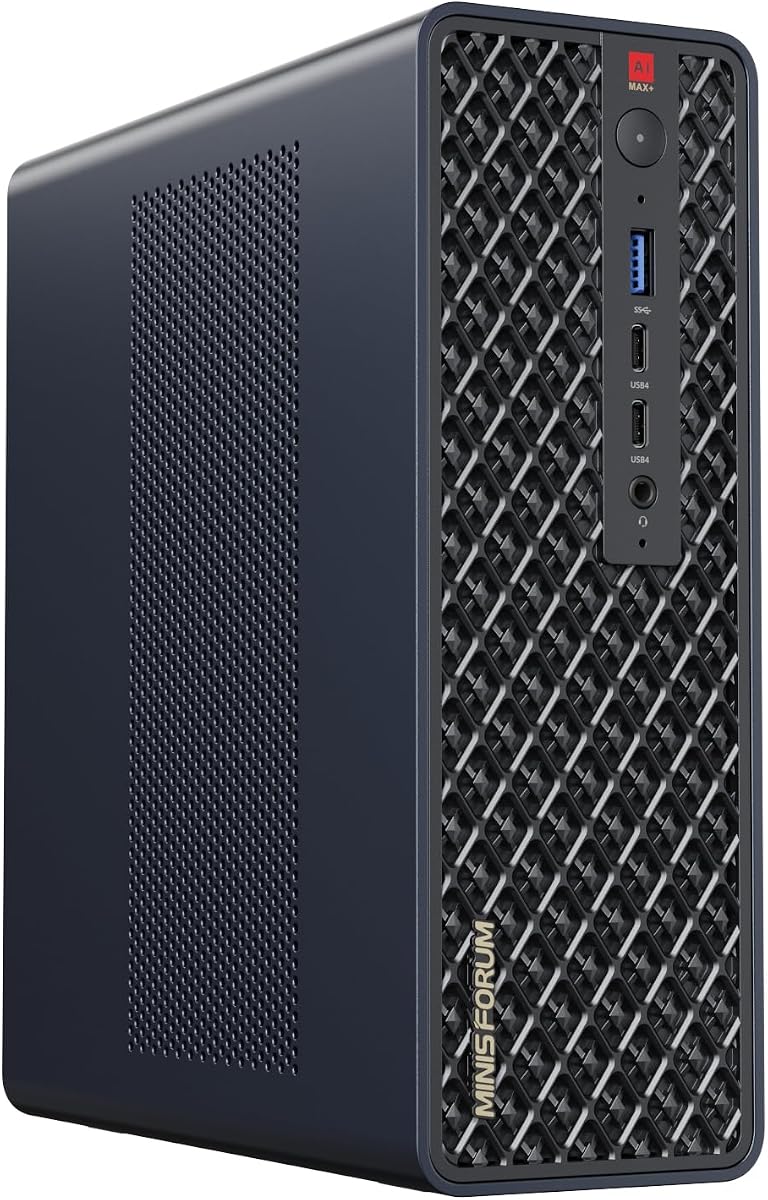
The MINISFORUM MS-S1 MAX is the most space-efficient option here. It combines a Ryzen AI Max+ 395 with 128GB of LPDDR5x-8000 unified memory, 2TB of storage, RDNA 3.5 graphics, and a 50-TOPS NPU within a compact workstation.
We may earn a commission when you buy through this link, at no additional cost to you.
The unified memory pool can be accessed by the CPU and GPU, reducing the separation between host memory and graphics memory that limits some local AI systems. Total system output is listed at 126 TOPS, making the unit suitable for local language models, multimodal models, video, and compute-intensive applications.
Its full-length PCIe x16 slot creates a path toward an expanded multi-GPU arrangement, while dual M.2 storage and dual 10GbE networking improve flexibility. Two units can be configured as a dual-unit cluster, with larger deployments using rack-mount arrangements and additional units.
It is an attractive budget-conscious alternative to a full tower, especially for developers who want substantial memory in a compact enclosure. It is not a conventional workstation containing two discrete GPUs, so buyers seeking immediate dual-card performance should distinguish expansion potential from an installed dual-GPU configuration.
The CPU, RDNA 3.5 GPU, and NPU can work with a large shared memory pool. For AI tasks that need more model data than a typical integrated GPU can hold, this arrangement can be more practical than a small discrete graphics card.
The supplied configuration guidance describes two-unit and larger clusters, including use with very large quantized models. Such scaling still depends on the model, software, and networking implementation, so cluster behavior should be validated before production use.
We may earn a commission when you buy through this link, at no additional cost to you.
The RTX PRO 6000 Blackwell Max-Q is a professional graphics card designed to bring 96GB of GDDR7 ECC memory to a standard desktop. No customer rating was supplied, and the listing notes OEM or bulk packaging with no retail packaging included.
We may earn a commission when you buy through this link, at no additional cost to you.
Its 512-bit memory bus and 1,792 GB/s bandwidth target demanding local generative AI, data science, deep learning, rendering, and multi-stream video workflows. The listed performance reaches 3,511 TOPS for AI operations, backed by 24,064 CUDA cores and 188 fourth-generation ray-tracing cores.
A maximum power consumption of 300 watts makes this Max-Q edition notable for professional-class memory without the highest possible power envelope. Cooling design and multi-GPU scaling depend on the selected workstation, although the card is positioned as suitable for dual-GPU desktop configurations.
It is best for builders assembling a workstation around large models or professional visualization who want ECC graphics memory and strong bandwidth. Pairing two cards can double the aggregate graphics-memory pool, but the system builder must verify lane topology, slot spacing, power supply capacity, and cooling.
The 96GB GDDR7 ECC allocation gives local AI workloads more room while adding error correction valuable in professional environments. It is particularly relevant when the model or dataset cannot be divided into a smaller memory budget.
The 300-watt cap can make two-card deployments more manageable than pairing unrestricted flagship GPUs. Even so, physical spacing, motherboard bifurcation, power delivery, and case airflow remain essential compatibility considerations.
We may earn a commission when you buy through this link, at no additional cost to you.
The MINISFORUM MS-S1 Max is a compact Ryzen AI Max+ 395 workstation with 128GB of LPDDR5-8000 memory, a 2TB PCIe 4.0 SSD, and Radeon 8060S integrated graphics. Its supplied rating is 4.5, making it one of the few products here with an available customer rating.
We may earn a commission when you buy through this link, at no additional cost to you.
The processor delivers 16 cores and 32 threads with boost clocks up to 5.1 GHz, a 50-TOPS NPU, and a listed overall output of 126 TOPS. This mix supports local AI, multimedia work, CAD, scientific calculation, animation, post-production, and multi-monitor operation.
Two 10GbE ports support fast wired networking, while Wi-Fi 7 and Bluetooth 5.4 provide wireless connectivity. Five 8K-capable outputs cover HDMI, two 40Gbps USB4 ports, and two 80Gbps USB4 V2 ports with alternate DisplayPort functionality.
A second M.2 slot supports additional storage and RAID, while an internal PCIe slot provides some expansion. It is not a dual discrete-GPU workstation, but its large unified-memory pool makes it a capable compact AI endpoint or cluster node for users who prioritize efficiency and flexibility over full-tower expansion.
The 128GB memory configuration provides ample room for large-model inference and memory-intensive applications without the footprint of a full tower. The integrated Radeon 8060S graphics also makes the system suitable for general computing and visualization tasks.
Dual 10GbE connections and five high-resolution outputs distinguish this model for studios, control rooms, and technical workspaces. These interfaces can reduce the need for separate adapters when deploying several displays or high-speed network links.
We may earn a commission when you buy through this link, at no additional cost to you.
The right multi-GPU AI system depends on model size, software, available space, memory behavior, networking, and sustained thermal performance. Start with the workloads you expect to run, then match those requirements to the least complicated hardware that can support them.
Graphics memory is often the first constraint for local AI. Adding two cards can increase the pool available to properly supported software, but the usable total depends on VRAM allocation, GPU topology, and the model's quantization. Professional configurations with 96GB cards offer much more room per accelerator than compact systems or 32GB consumer GPUs, while the Arc Pro B60 combines two 24GB modules into a 48GB card.
Two physical GPUs do not automatically mean twice the application performance. Inference engines, training frameworks, visualization tools, and professional applications must recognize the accelerator arrangement and support an appropriate partitioning method. PyTorch, vLLM, IPEX-LLM, and other local AI stacks may behave differently, so review the frameworks and exact model workflow before buying.
The CPU prepares data, schedules jobs, performs preprocessing, and manages storage and memory transfers. The list ranges from 16-core Ryzen desktop processors to dual 192-core EPYC systems and a 32-core Threadripper. Host memory should be large enough to stage datasets and avoid forcing repeated transfers to slower storage, which is why several professional systems provide hundreds of gigabytes of ECC memory.
A multi-GPU configuration needs the correct motherboard topology. Some products require x16 lane bifurcation, while others use conventional x16 slots or a compact system with a single expansion slot. Check physical slot spacing, CPU support, lane sharing, and whether the motherboard can address both devices at the intended bandwidth.
Sustained AI workloads generate sustained heat, particularly when two or more large accelerators operate together. Blower coolers, vapor chambers, liquid CPU cooling, large chassis, and server airflow can improve stability under prolonged load. Power supply capacity and wall-circuit requirements also matter, especially for systems with three or eight GPUs and for 240V operation.
AI datasets, model checkpoints, and temporary files can consume substantial storage, making NVMe speed important. RAID can provide resilience or a larger working volume, while dual 10GbE and high-speed server networking help with distributed training and shared datasets. Match storage and network capacity to whether the system runs as a workstation, cluster node, or shared inference service.
A desktop tower, mini workstation, rack server, and graphics card serve very different buyers. Mini systems reduce physical footprint and simplify clustering, while rack servers provide accelerator density and remote management. Professional cards require compatible enclosures, while large systems need service access, cable management, and appropriate facilities.
Some systems arrive with Windows 11 Pro and current drivers, while rack-oriented configurations may be deployed through enterprise management or specialized cluster software. Check warranty length, local support, driver availability, and whether your workflow requires Windows, Linux, virtualization, or containerized deployment.
Begin with a platform compatibility audit. Confirm the motherboard supports the intended number of accelerators, required PCIe bifurcation, adequate slot spacing, supported operating system, current drivers, and the total graphics, processor, and memory configuration. For rack systems, also verify circuit capacity, environmental controls, remote access, and warranty-compatible installation practices.
Install the hardware in a powered-down state with the correct fasteners, power connections, and airflow path. Apply the latest supported graphics driver and AI framework, then verify that each GPU is detected independently. Test the intended model-parallel or multi-process workflow with a smaller model before moving production datasets onto the system.
Monitor GPU temperatures, memory use, power draw, storage health, and network activity during sustained jobs. Keep intake and exhaust paths clear, maintain clean filters, and use the system's supported performance modes. Back up important checkpoints, monitor RAID arrays where applicable, and schedule maintenance so long-running workloads do not coincide with storage or firmware changes.
No. Performance improves only when the application can divide work across both GPUs efficiently. Memory transfer overhead, unsupported software, uneven task sizes, and limited PCIe bandwidth can reduce the gain. Check the framework and model for explicit multi-GPU support before expecting a proportional increase.
Available graphics memory is usually the first consideration because the model, runtime, and temporary buffers must fit. Memory bandwidth, compute capability, software compatibility, power draw, and cooling also matter. A larger memory pool can be more useful than a faster card when that extra capacity prevents loading from slower storage.
Some can through expansion slots, external enclosures, or multi-unit clustering, but they are not equivalent to towers with multiple full-size cards. The MS-S1 MAX includes a full-length PCIe x16 slot and supports multi-unit clustering. Buyers should verify accelerator size, power delivery, physical clearance, and the intended scaling method.
No. Unified memory can be shared by the CPU and GPU, which can simplify large-model placement and reduce transfers between separate memory pools. Dedicated graphics memory remains distinct and is optimized for graphics workloads. The best choice depends on software behavior, bandwidth, capacity, and how the application allocates memory.
It depends on the card and motherboard. Some dual-GPU designs use two x8 connections and require the motherboard to split a x16 slot into two x8 lanes. Other configurations use two full x16 slots. Confirm the board's manual, CPU support, and whether any additional slots share lanes.
System memory should be sufficient for datasets, preprocessing, model loading, and any CPU-offloaded layers. Professional configurations in this guide range from 128GB to 768GB, with 256GB common on dual-GPU towers. A larger amount helps with large workflows, but the ideal capacity depends on model size and whether inference or training dominates.
They may be, but only after checking noise, heat, dimensions, electrical service, and remote-management needs. High-density systems can demand dedicated circuits and controlled room temperature. A compact workstation is generally easier to deploy in an office, while a rack server makes more sense for a data center or dedicated technical room.
Verify that the operating system and framework detect both GPUs, then run a small inference or training workload that exercises multi-GPU behavior. Monitor memory allocation, transfer rates, temperatures, power draw, and storage activity. Validate the exact production model and software stack before committing important datasets or services.
The WEELIAO MAXSUN Arc Pro B60 stands out as the most focused dual-accelerator card, offering 48GB of combined graphics memory in a single workstation-oriented design. The APC systems cover very different needs with two RTX PRO 6000 GPUs or two RTX 5090 cards, while the ASUS server represents the highest-density option with room for eight professional accelerators.
Prioritize workload fit rather than GPU count alone. Check aggregate memory, framework support, PCIe topology, processor capacity, cooling, power, and expansion needs. For compact use, the MINISFORUM MS-S1 MAX offers large unified memory and cluster potential, but it should not be mistaken for a workstation that already contains two conventional discrete GPUs.
Finally, review current pricing, availability, warranty terms, and compatibility details before ordering. AI hardware configurations change as drivers, frameworks, and model formats evolve, so the specifications listed here should be confirmed with the seller before making a final purchasing decision.

