
StarTech M.2 NVMe Duplicator
4.2Editor score
90GBpm sector duplication
20Gbps USB-C host
Driver-free standalone operation
Active and passive cooling
SMART status indicators
SSD cloner hardware makes it possible to copy a drive without installing cloning software, rebooting a computer, or routing the entire process through an operating system. The right device can simplify system upgrades, laptop migrations, drive replacement, backups, and provisioning work while supporting the drive formats and interfaces you actually use.
We compared the ten products in this guide across standalone cloning capability, drive compatibility, connection speed, bay configuration, cooling, status indicators, power requirements, and everyday usability. The list includes compact dual-bay M.2 enclosures, larger docks that also accept SATA hard drives, and one mounting accessory that can help a completed clone fit into a desktop drive bay.
Each review explains what distinguishes the device, where it is strongest, and which limitations deserve attention before purchase. Ratings reflect the supplied customer feedback, while practical recommendations are based on the documented specifications. Product availability and pricing can change, so compare the current listing, included accessories, and drive requirements at the time of purchase.
4.2Editor score

4.5Editor score

4.4Editor score
As an Amazon Associate we earn from qualifying purchases.
The comparison covers standalone duplicators, multifunction docking stations, and a drive-mounting accessory, with particular attention to supported drive types, cloning method, connection speed, and expansion potential.




The ICY BOX TripleBay is the most broadly useful SSD cloner hardware in this group because it extends beyond a single M.2 format. Its three bays support M.2 PCIe NVMe SSDs as well as 2.5-inch and 3.5-inch SATA SSDs and hard drives, and the 4.5 rating reflects generally favorable customer feedback. A standalone one-touch workflow means the duplication can begin without installing an operating-system-based cloning suite.
We may earn a commission when you buy through this link, at no additional cost to you.
The design is especially helpful for technicians or computer builders who still maintain systems with older SATA storage. Users can move between NVMe-to-NVMe and SATA-to-NVMe cloning configurations according to the stated support, while the three independent slots also let the dock serve as a multi-drive reader. Its USB 3.2 Gen 2 interface is rated for transfer speeds up to 10Gbps, and the included USB-C/USB-A combo cable broadens compatibility with PCs, laptops, and game consoles.
The main trade-off is physical bulk. A three-bay unit naturally takes more desk space than a compact dual-bay M.2 dock, and buyers should verify the exact source and target combination they plan to use before beginning a migration. The product is also most relevant to mixed-format workflows; anyone who exclusively handles modern NVMe drives may not need every feature of the larger enclosure.
This is the strongest all-around recommendation for users who want one dock to cover NVMe, SATA SSDs, and hard drives. Choose it when drive versatility, standalone operation, and the ability to work with multiple disks matter more than a very small footprint. It also suits a staged upgrade: clone the old drive offline, install the new drive, and use the dock again for storage or later transfers.
The ability to combine M.2 NVMe with 2.5-inch and 3.5-inch SATA devices is the standout feature. That versatility lets the dock support a system upgrade, a drive repair workflow, or the temporary connection of several storage types without changing cloning hardware.
One-touch offline cloning removes the need to keep a computer involved for the entire copy. The process is easier to stage physically, particularly when the destination system has no installed operating system or the old drive is the only bootable drive available.
We may earn a commission when you buy through this link, at no additional cost to you.
The SSK Dual Bay M.2 Cloner combines a compact two-drive M.2 dock with standalone duplication in a straightforward package. It has a 4.4 rating and supports both NVMe and SATA M.2 drives, which makes it a practical option for users comparing two compact SSDs or preparing a secondary drive. The RTL9210CDP controller and USB 3.2 Gen 2 interface support host transfers up to 10Gbps.
We may earn a commission when you buy through this link, at no additional cost to you.
Offline cloning is handled with a dedicated one-key control. The supplied information is explicit that a 1:1 duplicate should remain within the same protocol: NVMe to NVMe or SATA to SATA. This limitation is understandable for a compact hardware design, but it means the product is not the right choice for someone expecting to move directly between an NVMe drive and a SATA M.2 drive. S.M.A.R.T. checking and adaptive TRIM add useful device-management functions.
Its open-frame construction encourages airflow and is a sensible alternative to enclosing both drives in a sealed block. The maker also warns that drives can become hot during use and should be allowed to cool before handling. Buyers should therefore avoid treating the dock as an unattended all-purpose charging station and should provide airflow around both slots during a long copy.
The SSK is best suited to a budget-conscious user who works with two M.2 drives of the same protocol and wants direct cloning plus a convenient USB dock. It is less appropriate for mixed SATA hard-drive migrations, multiple simultaneous external disks, or users who need a detailed multi-function display. Within that narrower requirement, it offers a clear and economical combination of useful features.
The requirement to use the same protocol for both bays reduces ambiguity during a standalone copy. Checking the source and target labels before inserting them helps prevent a user from attempting an unsupported NVMe-to-SATA operation.
The exposed construction allows air to move around the drives during demanding transfers. It is particularly useful during cloning, when sustained activity can produce more heat than ordinary occasional file access.
We may earn a commission when you buy through this link, at no additional cost to you.
The SUITOK STK07 Pro is a two-bay M.2 device that emphasizes broad form-factor support and a simple three-step offline clone. It carries a 4.4 rating and accepts NVMe drives using PCIe Gen 3 or Gen 4, SATA M.2 drives, and M.2 sizes 2230, 2242, 2260, 2280, and 22110. The long 22110 support is unusual among compact docks and expands the range of older or specialized modules it can accommodate.
We may earn a commission when you buy through this link, at no additional cost to you.
The device can function as a dual-bay external enclosure or as a sector-level 1:1 duplicator. Its stated compatibility includes Windows, macOS, Linux, Steam Deck, ROG Ally, ASUS Gaming Handheld, and PS5 expansion storage. A claimed one-terabyte clone time of roughly 30 minutes illustrates the intended performance level, although actual results depend on the source drive, destination drive, workload, and thermal conditions.
Some of the more specific compatibility and performance claims should be checked against the current product listing and the user's exact hardware. A standards-based device can fit a drive physically while still presenting limits in a particular console or handheld environment. The same caution applies to complex boot images, encrypted volumes, and hidden recovery sectors: a successful enclosure connection does not guarantee that every device will boot the copied drive.
The STK07 Pro is a compelling pick for a technician who handles unusual M.2 sizes or wants a tool-free dual-bay dock that can also perform offline duplication. It is less suitable for buyers who need full-size SATA hard-drive support or a guaranteed one-button workflow for every mixed protocol. For broad M.2 work, however, it is one of the more versatile options in the guide.
The 22110 accommodation is one of the model's most useful differentiators. Buyers with long modules can avoid adapters or an additional enclosure, while support for the other four listed sizes covers many common and legacy installations.
Between cloning sessions, the dock can present two drives to a Windows or Mac computer. That makes it more than a one-purpose duplicator, particularly for users who need temporary access to media, game libraries, or project files.
We may earn a commission when you buy through this link, at no additional cost to you.
The Rosewill RS-N2-CL is a fast, dedicated NVMe docking and duplication solution with a 4.6 rating. Its two bays support M-Key and B+M-Key NVMe SSDs, and the USB 3.2 Gen 2×2 interface is rated for host transfer speeds up to 20Gbps. That makes it particularly attractive for users who routinely move high-capacity NVMe storage between modern computers.
We may earn a commission when you buy through this link, at no additional cost to you.
Standalone cloning is activated with one button, allowing a 1:1 copy to proceed without a host computer. S.M.A.R.T. monitoring and TRIM optimization provide health and maintenance functions, while the tool-free design makes drive replacement straightforward. The package includes a 20Gbps USB-C cable, a 10Gbps USB-A cable, and a 12-volt, 2-amp power adapter, which helps clarify what is needed for a full-speed setup.
The important boundary is that this is an NVMe product, not a general SATA M.2 duplicator. Buyers should not assume that the B+M Key designation means SATA M.2 modules are supported. Achieving the advertised 20Gbps host rate also requires the computer, port, and cable path to support that standard; a USB-A host connection is limited to the speed of its own interface and the included USB-A cable is listed as 10Gbps.
The Rosewill is a good fit for an NVMe-only workflow, particularly one involving fast external transfers, full-sized desktop SSDs, or laptop upgrades. It is less appropriate for users with SATA M.2 modules or 2.5-inch hard drives. Within an NVMe-focused setup, its high interface speed, simple controls, and strong customer rating make it an attractive compact option.
USB 3.2 Gen 2×2 can reduce waiting time when moving large libraries between compatible hosts. The benefit is most meaningful on machines equipped with the matching port and when both connected and attached devices can sustain the higher transfer rate.
One-button copying is useful when upgrading or replacing an NVMe drive because it removes the need to boot the old system and install cloning software. The physical process remains understandable even for a first-time drive migrator.
We may earn a commission when you buy through this link, at no additional cost to you.
The StarTech M.2 NVMe Duplicator is built around professional duplication and has a 4.2 rating. It can clone or duplicate an M.2 NVMe SSD without a connected computer, copying the entire drive sector by sector at a stated rate of up to 90GBpm. That performance claim makes it the most clearly speed-oriented premium option in the list, although real results depend on the SSDs involved.
We may earn a commission when you buy through this link, at no additional cost to you.
The device doubles as a 20Gbps USB-C M.2 dock, useful for moving data between computers without installing the drive internally. Its top-loading, toaster-style format is compact and allows M-Key PCIe modules to slide into place, including modules that already have heat sinks fitted. LEDs report power, progress, and SMART status, while an audible buzzer confirms completion.
Compatibility is narrower than some multi-format alternatives. The product is specified for PCIe M-Key NVMe drives, not SATA M.2 modules or full-size hard drives. The target must also be equal to or larger than the source, and 4Kn sector sizes are supported. Its active and passive cooling is reassuring for sustained duplication, but the device should still be operated with the ventilation paths unobstructed.
Choose the StarTech when throughput, a compact top-loading layout, and clear operational feedback are the priorities. It is well suited to IT imaging, hardware upgrades, backups, maintenance, and educational cloning tasks where a standalone copier is more useful than a general-purpose dock. The 4.2 rating is respectable, and the device's documented focus makes it a specialized but powerful premium recommendation.
A stated 90GBpm sector-copy rate is the StarTech's defining advantage. That makes it attractive for repeated deployments in which the time required to duplicate each drive can materially affect the overall workflow.
Power, progress, and SMART LEDs reduce the uncertainty associated with unattended-looking copies, while the completion buzzer provides an audible cue. These details are especially valuable when a technician is handling several drives in sequence.
We may earn a commission when you buy through this link, at no additional cost to you.
The UGREEN 20Gbps Cloner combines a polished aluminum enclosure with a two-bay NVMe duplication design. It has a 4.4 rating and accepts both M-Key and B+M-Key NVMe SSDs, with capacity support stated for two eight-terabyte drives. Its clean enclosure and open construction make it a natural choice for a visible desktop setup rather than a hidden back-office tool.
We may earn a commission when you buy through this link, at no additional cost to you.
Offline cloning requires the source and target to be NVMe, and the target capacity must be equal to or greater than the source. A one-button process handles the copy without a computer. For normal external use, the JMS586U controller, UASP, TRIM, and 20Gbps USB-C interface provide a fast path for transfers to compatible hosts. As with every high-speed USB product, both the host port and cable must support the full interface rate.
The open, tool-free aluminum body is intended to promote 360-degree heat dissipation. Anti-slip pads help keep the enclosure stable, and LEDs make it easier to monitor cloning status. Those practical touches make the device pleasant to use, although buyers should still confirm that an NVMe module fits physically and is not obstructed by a large factory heat sink.
UGREEN's cloner is well matched to a modern NVMe workstation and is particularly attractive for Mac mini owners seeking a compact external storage and migration tool. It is not designed for SATA M.2 or 2.5-inch drive cloning, so buyers with mixed storage should choose a broader dock. For an NVMe-only setup, it balances speed, construction, and straightforward offline operation well.
The open form allows heat to move away from both SSDs rather than trapping it inside a fully enclosed box. That design supports sustained transfers and gives the device a refined appearance without sacrificing ventilation.
Supporting two eight-terabyte NVMe SSDs creates a useful high-capacity workspace for projects or libraries. The same tool-free design that supports cloning also makes it convenient to swap storage when a drive is removed.
We may earn a commission when you buy through this link, at no additional cost to you.
The Quad Cooling M.2 SSD Cloner Dock is designed around a dual-bay M.2 format with emphasis on thermal management and mobile deployment. It has a 4.3 rating, supports NVMe and SATA M.2 drives in five listed lengths, and uses the RTL9210CDP controller for USB 3.2 Gen 2 transfers up to 10Gbps. The enclosure uses an anodized aluminum body, sandblasted surface, heat-dissipating front stripes, and multi-sided ventilation.
We may earn a commission when you buy through this link, at no additional cost to you.
Its offline function performs a 1:1 migration from source to target, but the supplied information explicitly rules out cross-protocol copying. Users should therefore clone NVMe to NVMe or SATA to SATA. When connected to a computer, the device can operate as a storage hub with concurrent access to two disks. If one bay contains an NVMe drive and the other contains a SATA drive, however, only one is recognized.
A dedicated Type-C DC power input distinguishes this model from docks powered only through the host USB connection. That can provide steadier energy during extended work, while LED progress bars and ambient lighting offer visual status feedback. Its listed weight of 3.90 ounces and compact dimensions also suit technicians who need to carry a duplicator to client sites or service benches.
This dock is a sensible option for users who work with same-protocol M.2 pairs and value cooling and portability. It is not the right device for direct NVMe-to-SATA copying, full-size hard drives, or situations requiring a mixed-protocol pair to be recognized together. For supported workflows, it brings together practical monitoring, an external-storage role, and careful thermal design.
Multiple ventilation paths and an aluminum shell help move heat away from the drives during demanding transfers. This is especially relevant because SSDs can throttle when sustained access raises their internal temperatures.
The dedicated power input supports stable operation, while the low listed weight makes the dock easier to transport. These characteristics make the device useful for repeated upgrades across multiple computers.
We may earn a commission when you buy through this link, at no additional cost to you.
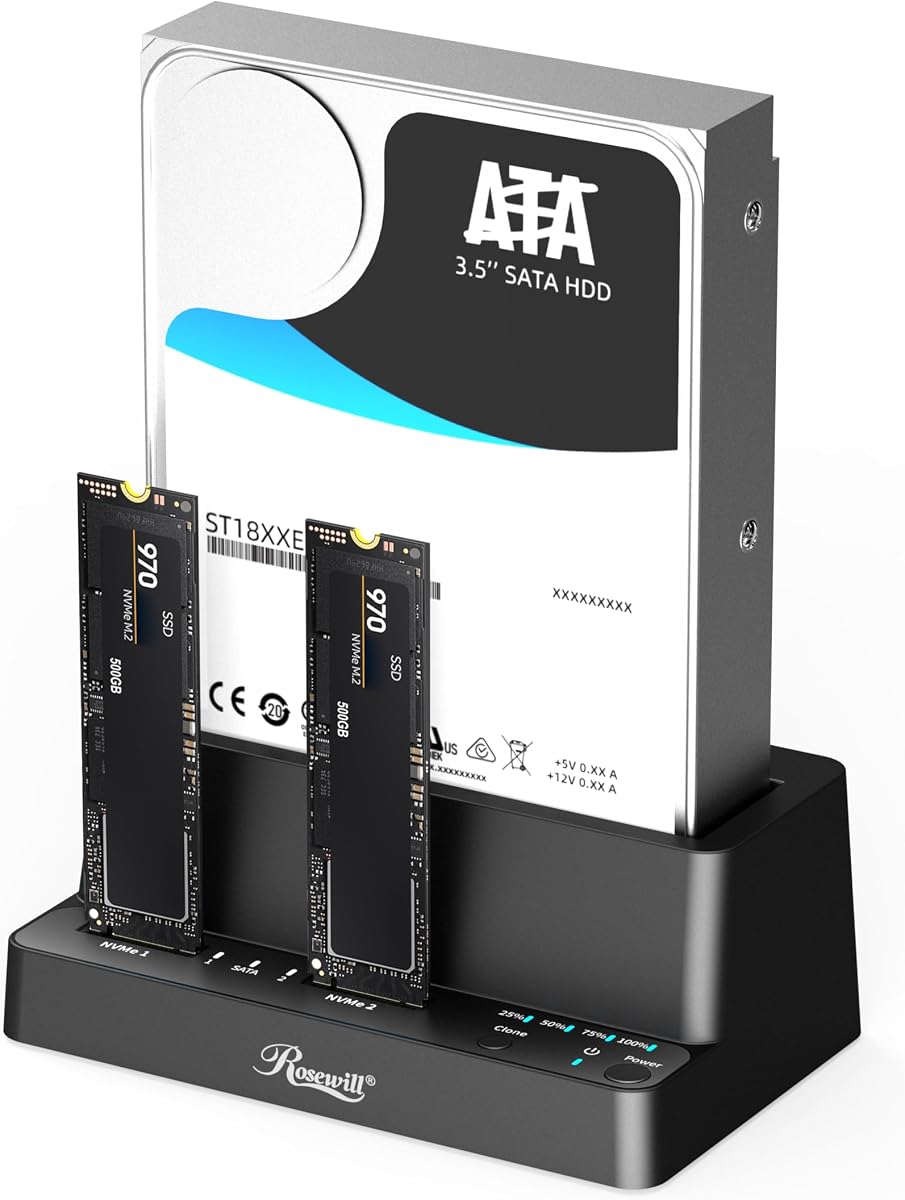
The Rosewill RS-N2S-CL is a three-bay dock that brings M.2 NVMe and SATA SSDs together with 2.5-inch and 3.5-inch hard drives. It has a 4.5 rating and provides a second mixed-format alternative in the guide. Like the ICY BOX, it supports offline cloning without a host computer, allowing a user to duplicate a drive before installing it into a system.
We may earn a commission when you buy through this link, at no additional cost to you.
Its USB 3.2 Gen 2×1 interface is rated up to 10Gbps. That remains a useful standard for many external storage tasks, although it is half the nominal bandwidth of the USB 3.2 Gen 2×2 products also listed. The tool-free arrangement lets users insert or remove drives without a screwdriver, and the three independent bays provide more flexibility than a standard two-drive adapter.
The device is described as lightweight and compact for a three-bay product, making it a candidate for mobile technicians. The supplied information does not detail every compatible M.2 length, protocol-matching rule, power-delivery arrangement, or operating-system limitation, so the current listing should be consulted before purchase. These details are especially important when the intended workflow crosses drive protocols.
The RS-N2S-CL is a good fit for users who still need hard-drive cloning capability but value portability and a tool-free approach. It is a less logical choice when maximum external transfer speed is the primary objective, because a 20Gbps Gen 2×2 dock may better serve a modern NVMe-only workflow. Its real strength is the combination of mixed drive support, three bays, and a relatively portable format.
The ability to accept SATA hard drives as well as SSDs and M.2 modules makes the dock useful for older workstations, storage-archive tasks, and mixed fleets. It avoids requiring a separate full-size drive adapter for every copy.
Three bays allow more than one drive to remain connected during a workflow. This can simplify comparisons, staged migrations, or temporary access to several storage devices without repeatedly changing adapters.
We may earn a commission when you buy through this link, at no additional cost to you.
The 20Gbps Universal M.2 Cloner has the highest customer rating in this guide at 4.7, making it an attractive choice for buyers who prioritize compact M.2 duplication with broad protocol support. It accepts NVMe and SATA M.2 SSDs, works with Windows, macOS, and Linux, and can perform direct drive-to-drive cloning with one button while the computer remains disconnected.
We may earn a commission when you buy through this link, at no additional cost to you.
The supplied listing describes a clone rate that can copy a one-terabyte SSD in under 12 minutes and a 10Gbps external interface. There is a naming discrepancy because the product title includes 20Gbps while the detailed feature list specifies 10Gbps transmission. Buyers should examine the current technical documentation and the host connection specifications before assuming the enclosure can sustain the headline number.
For reliable results, the source and target should use the same protocol, either NVMe to NVMe or SATA to SATA. The target must be equal to or larger than the source. Tool-free insertion and progress LEDs simplify the physical process, while a completion alert gives a clear indication when the copy has finished. The product is designed for 22110, 2280, and 2260 sizes according to the supplied title.
This is an appealing pick for a compact desktop or laptop accessory that can handle either common M.2 protocol. It is particularly useful when both source and target SSDs are SATA, a task that rules out some NVMe-only alternatives. The 4.7 rating is encouraging, although buyers should confirm the actual external transfer specification and confirm that the source drive's filesystem and partition structure suit the intended use.
Supporting both NVMe and SATA M.2 drives adds flexibility without expanding to a bulky hard-drive dock. It can be especially useful for technicians whose equipment inventory includes both protocol types.
Progress LEDs show the state of the copy, and the unit alerts the user when cloning is complete. Those cues make the workflow easier to manage and reduce the need to keep checking a computer for status.
We may earn a commission when you buy through this link, at no additional cost to you.
The final product is not an electronic SSD duplicator, and it would be misleading to treat it as one. It is a metal 2.5-to-3.5-inch mounting bracket kit that helps two compact SATA SSDs or hard drives fit into a full-size 3.5-inch drive bay. Its 4.4 rating and broad compatibility make it a useful physical accessory for a desktop build, storage migration, or replacement drive installation.
We may earn a commission when you buy through this link, at no additional cost to you.
The kit mounts two 2.5-inch drives at once and is designed to fit standard PC enclosures. It includes a screwdriver, eighteen screws, a 14-pin-to-dual-15-pin SATA power adapter, a 15-pin-to-dual-15-pin power adapter, and two SATA data cables. Those components cover the essential physical and cabling needs for fitting compact drives into a larger bay, although a separate SATA power connection may still need to be arranged inside the case.
The bracket supports SATA transfer rates up to 6Gbps and remains backward compatible with SATA I and SATA II. This makes it appropriate for many older and current 2.5-inch SATA SSDs, but it does not provide a way to copy an M.2 NVMe drive, perform offline duplication, or connect drives through a high-speed USB interface. M.2 drives also require a different physical mounting approach.
Buyers should choose this kit when the core problem is making two 2.5-inch SATA drives fit a 3.5-inch bay, not when the goal is to clone data. It complements a separate duplicator by giving the copied 2.5-inch SSD a secure home inside a desktop. For anyone shopping specifically for SSD cloner hardware, the other nine products in this guide perform the actual duplication, while this final option solves the installation problem that may follow.
Many desktop cases still provide full-size drive bays but have limited mounting points for 2.5-inch SSDs. The bracket converts that available space into secure positions for two compact SATA drives.
After data is duplicated onto a 2.5-inch SATA SSD, the kit helps that drive fit neatly into the target system. It also supplies the data and power cabling commonly needed to complete the installation.
We may earn a commission when you buy through this link, at no additional cost to you.
The right cloner depends on your drive formats, source and target capacities, desired transfer speed, and whether the device will serve as a permanent external dock. These factors help separate a compact M.2 specialist from a broader multi-drive workstation tool.
Choose a dock that covers your current and foreseeable drive types without unnecessary bulk.
Prioritize hardware-only cloning when the source system may not boot or software installation is undesirable.
Use a target no smaller than the source, and confirm capacity limits before purchasing.
Compare interfaces and separate clone rates, but avoid assuming the headline number applies to every drive.
Favor effective airflow and reliable power for large clones, but allow drives to cool before removal.
Confirm length, key, screw position, and heat-sink clearance rather than relying on the broad term M.2.
Treat the dock as a daily storage tool only after confirming simultaneous access and mixed-drive behavior.
Match the enclosure, cables, and power supply to your actual workstation rather than assuming every accessory is included.
Before inserting any drives, confirm the source protocol, target protocol, and target capacity. Make sure the target is equal to or larger than the source and that both modules fit the selected bay without force. Back up irreplaceable data before beginning, disconnect the source from the computer, and follow the manufacturer's key or slot labels rather than guessing which connector is source or destination.
For offline cloning, connect the appropriate power supply if the dock has one, insert both drives, start the hardware duplication process, and wait for the completion indicator. Do not remove either drive while it is active. Some units also allow the dock to remain connected to a computer for normal file access, but using a live system as the source or destination of a running copy is a different process and should follow the device instructions.
Afterward, power the system down before changing media, allow hot drives to cool, and connect the new drive directly to the computer to verify that it appears correctly. Keep the dock ventilated, use the supplied or specified cables, and avoid resting hot SSDs on soft surfaces. Periodically check S.M.A.R.T. information when the dock provides it, and keep the original source drive intact until the cloned destination has been backed up and verified.
It depends on the specific hardware, and the two protocols must not be treated as interchangeable. Some broad docks support NVMe-to-NVMe and SATA-to-SATA cloning, while certain products explicitly support mixed copying such as SATA-to-NVMe. Check the listing and manual for the exact permitted source and target combinations before buying.
No. The defining benefit of a standalone duplicator is that it copies directly from one inserted drive to another without a host computer. You still need the correct power connection if required, and you should follow the manufacturer's source and target instructions while watching the progress indicators.
Usually, yes, provided it is at least as large as the source and falls within the cloner's supported capacity range. A 1:1 clone reproduces the source layout, so the additional target capacity may remain unused. Confirm the manufacturer's requirements, especially for specialized enterprise drives and very high capacities.
A properly created clone should include the operating system, partitions, and files, but compatibility still depends on the target computer and drive mode. Secure Boot, encryption, controller differences, and legacy versus UEFI systems can affect startup. Keep the original source intact until the new drive has been fully verified.
USB bandwidth describes the theoretical interface rate, not the entire workflow. The SSD controllers, source and target drive speeds, file layout, thermal conditions, and computer port all affect real performance. Standalone sector-copy rates are a separate specification and should be evaluated independently from host-transfer claims.
No. They use different protocols even though many share a similar physical shape. A dock labeled for both protocols may support each one in a compatible slot, but many products restrict offline copying to matching protocols. Check the key, protocol, and clone rules rather than relying on the physical connector alone.
Good airflow is advisable, particularly with high-capacity NVMe drives or repeated cloning sessions. Open-frame aluminum designs, ventilation channels, and active cooling can help reduce throttling. Keep the enclosure away from enclosed spaces, follow the cooling instructions, and allow a drive to cool before handling it after a long transfer.
Yes, but you may need a bracket when the case offers only 3.5-inch mounting points. The mounting kit in this guide is designed to hold two 2.5-inch SATA drives in a standard 3.5-inch bay. It is an installation accessory, not a cloner, and it does not support M.2 NVMe modules.
The ICY BOX TripleBay is the most versatile overall option because it combines three bays with M.2, SATA SSD, and hard-drive support. The StarTech M.2 NVMe Duplicator is the premium choice for users who value a stated 90GBpm sector-copy rate and professional status feedback, while the SSK Dual Bay M.2 Cloner delivers the most economical route to standalone M.2 duplication.
Your priority should be compatibility before speed. Confirm the protocols, physical sizes, source and target capacity rules, and required power first. Then consider cooling, progress indicators, and whether the dock will also serve as a daily external-storage device. A simpler model that handles your actual drives correctly is usually more valuable than a faster model that cannot accept one of them.
Before ordering, review the current product listing, included cables, power adapter, warranty information, and operating requirements. Ratings and specifications can evolve as hardware revisions change, while pricing and availability fluctuate over time. Comparing those details at checkout will help ensure that the selected SSD cloner hardware remains the best fit for the intended migration.