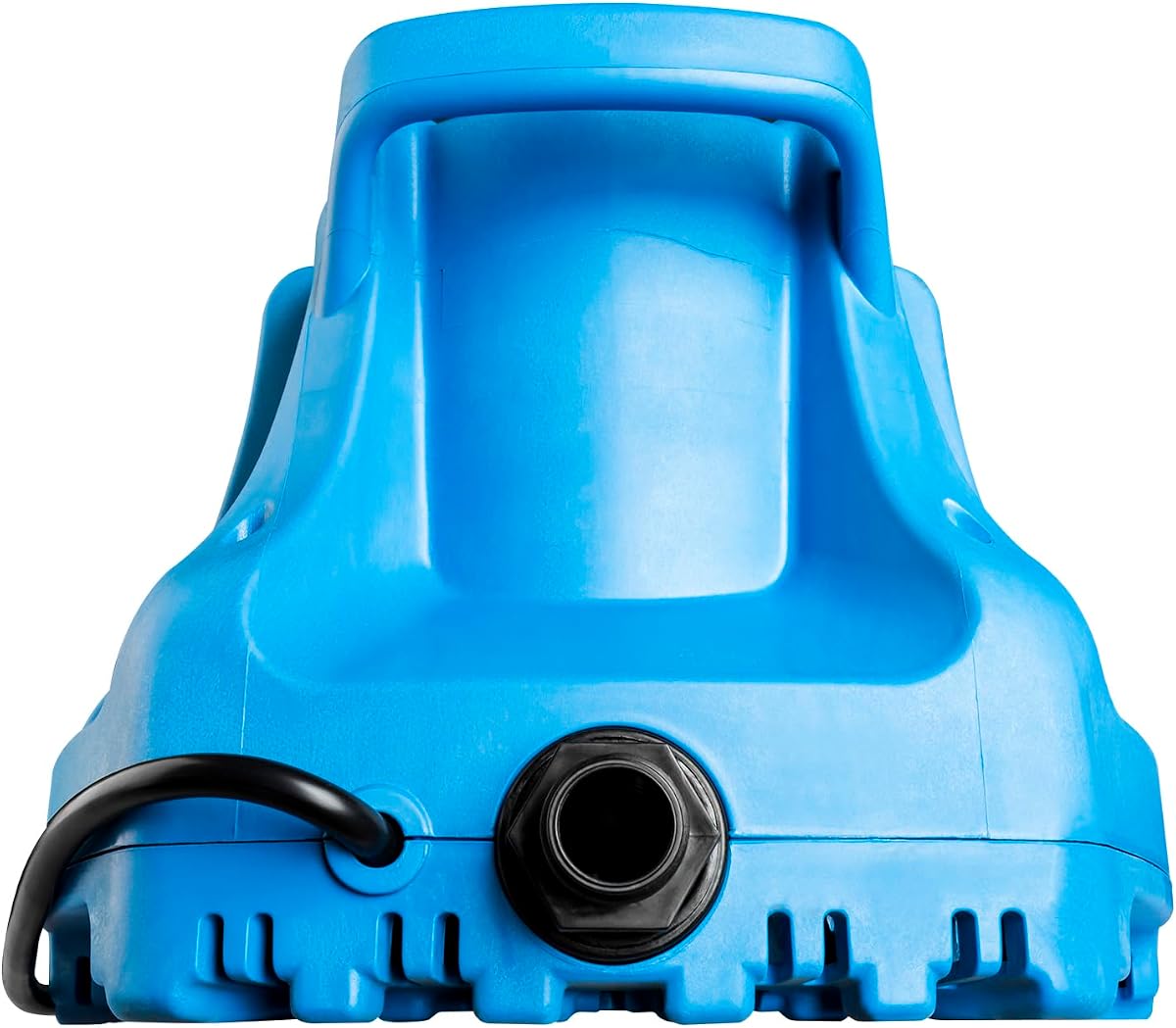
Little Giant APCP-1700
4.5Editor score
Automatic float switch
1700 GPH at one foot
Twenty-five-foot power cord
Designed for covered areas
A submersible pump moves water while its motor and intake sit below the waterline, making it useful for basements, pools, ponds, hot tubs, window wells, and other drainage jobs. The right model balances flow rate, vertical lift, intake clearance, hose compatibility, electrical safeguards, and the degree of automation required for the task.
We compared the ten featured submersible pumps using their published specifications, including maximum flow, lift capability, motor power, cord length, discharge size, solid handling, controls, and intended applications. The guide covers utility pumps, automatic sump pumps, pool-cover pumps, transfer pumps, and a low-noise pond circulation model rather than treating every submersible pump as a general-purpose tool.
Each review explains where that pump is strongest, where its compromises matter, and which homeowner or property manager may benefit most. Ratings reflect the supplied customer feedback, while technical claims come from the listed product information. Availability and prices change frequently, so confirm current details before purchasing.
4.5Editor score

4.5Editor score

4.4Editor score
As an Amazon Associate we earn from qualifying purchases.
This side-by-side comparison highlights each pump's core capabilities, including rated flow, lift, power, cord reach, and principal drainage use.


The Superior Pump 91250 is a straightforward 1/4 HP utility pump rated at 4.6 stars, with a 1,800-gallon-per-hour maximum flow and the ability to lift water as high as 25 feet vertically. Its combination of moderate capacity, thermoplastic construction, and manageable size makes it a versatile option for moving water around a home, yard, pool, or drainage area.
We may earn a commission when you buy through this link, at no additional cost to you.
The removable suction screen is one of the most useful practical details. It filters larger debris while allowing the pump to handle solids up to 1/8 inch, making it more tolerant of ordinary dirty water than a fine-screen clean-water pump. The 1-1/4-inch NPT discharge supports relatively high-capacity pumping, and an included 3/4-inch garden hose adapter simplifies common hookups without requiring a specialized discharge assembly.
The main limitation is the 10-foot power cord. That length is adequate when a suitable outlet is close to the drainage point, but it may not provide enough reach in larger yards, deep basements, or distant pool edges. This is also a manual pump, so it continues running until switched off or disconnected rather than responding to a water-level sensor. The 1/4 HP motor also produces less maximum flow and lift than several higher-output models in the comparison.
Despite those constraints, the 91250 is a sensible general-purpose choice for a homeowner who wants more than a small pool-cover pump but does not need the highest capacity or automatic operation. It is especially appealing for straightforward tasks such as draining a hot tub, transferring water between containers, clearing a garden pond, or emptying a basement where debris may be present. Its strong rating, removable screen, and included adapter also make it one of the more approachable options for buyers new to utility pumps.
The 91250 occupies a useful middle ground between compact pool pumps and high-output transfer pumps. Its 1,800 GPH rating and 25-foot lift offer enough capacity for many residential jobs without introducing a large hose bundle or a more complex automatic controller.
The removable suction screen and stated one-eighth-inch solid handling give this pump an advantage in applications where leaves, grit, or small fragments may reach the intake. Routine screen cleaning remains important, especially after muddy or debris-heavy drainage.
We may earn a commission when you buy through this link, at no additional cost to you.
The SEESII 1HP Submersible Water Pump has a 4.4-star rating and emphasizes high-output removal, with a claimed maximum flow of 4,755 gallons per hour. It is aimed at users who need to drain pools, hot tubs, flooded basements, or other substantial collections of water rather than merely handle small puddles.
We may earn a commission when you buy through this link, at no additional cost to you.
Its stated 36-foot maximum lift is among the strongest in this group, while the 25-foot power cord adds useful placement flexibility. The included 23-foot hose and adapters allow the pump to discharge to a drain or elevated location with fewer separate purchases. A built-in filter is designed to block small debris and reduce clogging, although the product is specifically intended for clean and lightly dirty water.
The important qualification is that maximum flow and maximum lift do not occur under the same conditions. As with any centrifugal pump, output generally decreases as discharge height increases, and hose friction further affects real-world performance. The listed 4,755 GPH therefore represents the headline capacity rather than what should be expected through a long restrictive hose at maximum elevation. The lack of an automatic sensor also means the pump must be monitored and turned off after the water is gone.
This model makes the most sense for buyers who prioritize rapid transfer and already understand the required hose route and electrical placement. It is less suitable for continuous unattended sump duty, very fine sediment, or locations where debris heavier than the filter can quickly obstruct the intake. For capable, supervised drainage of larger volumes, its combination of power, lift, hose length, and included components is difficult to overlook.
The 1 HP motor and 4,755 GPH maximum rating make this pump a strong candidate for emptying sizable pools, hot tubs, and flooded areas. Actual performance will depend on lift height and discharge-hose restrictions.
The supplied 23-foot discharge hose and connection adapters make the package convenient for immediate setup. Buyers should still verify that the outlet thread, hose diameter, and intended discharge path match their site.
We may earn a commission when you buy through this link, at no additional cost to you.
The AgiiMan 850GPH Pool Cover Pump is a compact, purpose-built option rated 4.4 stars. It is designed to remove accumulated rainwater from above-ground pool covers, offering an 850-gallon-per-hour maximum drainage rate, a 75-watt electrical rating, and a maximum lift of approximately 10.5 feet.
We may earn a commission when you buy through this link, at no additional cost to you.
Four mesh-covered sides allow water to enter from a broad area, which is useful when a pool cover collects water unevenly. A built-in temperature-control core is designed to prevent dry burning, adding a useful safeguard for users who might not immediately notice that the cover no longer holds water. The 16-foot anti-twist drainage hose can draw from varying pool depths, while the listed connections accommodate common 1/2-inch, 3/4-inch, and garden-hose arrangements.
The 25-foot power cord is generous for a pool-cover pump, reducing the need for an extension cord in many installations. Its limitations are equally clear: maximum output and lift are much lower than those of general utility pumps, so it is not the natural choice for moving water to a high destination or draining a large flood. The product also focuses on clean covered-pool water rather than handling substantial solids.
For a homeowner whose main need is keeping an above-ground pool cover from collecting rainwater, this focused design is compelling. It offers the essentials without the bulk of a higher-powered transfer pump. The best fit is a pool owner seeking automatic-looking water-level control through a temperature-protected compact unit, not someone who needs broad utility-pump performance or long-distance high-lift transfer.
The broad mesh intake and anti-twist hose are tailored to collecting water from an above-ground cover. This focused design is more useful for that task than simply choosing a high-output pump with unnecessary bulk.
The built-in temperature-control core is intended to prevent dry burning when the available water is exhausted. It adds protection, though regular monitoring and safe electrical placement remain necessary.
We may earn a commission when you buy through this link, at no additional cost to you.
The Acquaer 1/3 HP Automatic Submersible Water Pump has a 4.3-star rating and combines 2,160 GPH maximum flow with automatic on-and-off operation. Its built-in electronic sensor starts the pump when it detects 1-1/2 inches of water and stops it when the level falls below 1/4 inch, making it more suitable for unattended drainage than a basic manual utility pump.
We may earn a commission when you buy through this link, at no additional cost to you.
The bottom suction design is intended to filter debris and remove water down to a residual depth of 1/4 inch. A temperature-control core helps protect the motor if it runs short of water. The strainer base can be removed without tools or screws, simplifying routine cleaning, while the 1-inch NPT discharge and included 3/4-inch garden hose check-valve adapter make the output connection straightforward.
Users need a suitable standard 115-volt outlet within reach of the 10-foot cord. The automatic sensor reduces the need to stand beside the pump, but it does not make electrical placement optional; the pump should be connected safely and operated in accordance with its instructions. Its maximum flow is also lower than the 2,790, 4,000, 4,755, and 5,000 GPH figures associated with several larger competitors.
The Acquaer is a strong option for a finished basement, window well, or other location where automatic shutoff is valuable and the required discharge route is not especially long. Its primary appeal is control rather than maximum power. Buyers needing very high output, extended hose reach, or continuous commercial-scale duty should consider one of the larger manual transfer models instead.
The electronic sensor cycles the pump according to the stated activation and shutoff levels. This makes the pump better suited to recurring basement or well drainage than a manual unit that must be watched and switched off.
The tool-free strainer base allows debris to be removed without loosening screws. This design can simplify routine cleaning, although the screen still needs attention after draining dirty or sediment-filled water.
We may earn a commission when you buy through this link, at no additional cost to you.
This Sump Pump with 25Ft. Hose is a 1.5 HP manual transfer pump rated 4.4 stars. Its stated 4,000 GPH output at a five-foot lift and 31-foot maximum lift position it as a high-capacity option for basement flooding, pools, ponds, water transfer, and other demanding residential or light-commercial drainage tasks.
We may earn a commission when you buy through this link, at no additional cost to you.
One major advantage is the included equipment. The package provides a 25-foot discharge hose and a 25-foot power cord, reducing the need to assemble a separate setup. The 1-1/2-inch outlet includes adapters compatible with 1-inch and 1.5-inch NPT threads and with 3/4-inch and 1-inch barb fittings. That broad connection range is useful when matching the pump to existing hoses.
The pump can suction water as low as 1/5 inch, supporting thorough removal from shallow depressions, pools, or flat surfaces. Its thermoplastic construction is presented as durable and corrosion resistant, while premium bearings and a hardened stainless-steel motor shaft are intended to improve longevity. An automatic thermal overload protector helps prevent motor damage from overheating.
The trade-off is the lack of automatic operation. This is a supervised pump for transferring water or managing a known flood rather than a permanently installed automatic sump system. The instruction to submerge the pump at an angle before operation also matters because trapped air can affect startup. Its larger power rating and bundled hose also make it more of a dedicated equipment package than a lightweight emergency pump.
Choose this model when speed, lift, a very low suction level, and a ready-made hose setup are the priorities. It is well suited to owners who want to empty a pool, pond, or flooded basement and can turn the pump off when the task is complete. For automatic drainage with unattended shutoff, the sensor-equipped models are more appropriate.
A 25-foot discharge hose, a 25-foot power cord, and multiple adapters create a more complete package than many competing listings. Buyers still need a suitable discharge destination and properly rated electrical connection.
The stated one-fifth-inch suction capability is useful for draining shallow areas and collecting remaining water. Debris protection is less emphasized than with screened models, so sediment and solids require care.
We may earn a commission when you buy through this link, at no additional cost to you.
The 1HP 5000GPH portable transfer pump has the highest headline flow rate in the comparison, with a stated maximum of 5,000 gallons per hour and a 30-foot lift capability. Its 4.2-star rating reflects a still-positive customer response, but it is important to judge this model by the specific transfer task rather than by maximum output alone.
We may earn a commission when you buy through this link, at no additional cost to you.
The pump is designed for swimming pools, hot tubs, garden ponds, and flooded basements. A bottom suction arrangement can remove water down to one-fifth inch, while the included mesh bag filters sediment and solids. Connection options include a 3/4-inch NPT garden hose adapter and a multi-size adapter fitting 1-inch and 1-1/4-inch connections.
Its 10-foot power cord is short relative to most of the other utility pumps in the guide. That may be adequate near a wall outlet, but it can restrict placement in a larger yard or pool area. The pump is also manual, so it needs to be switched off after use. The included filter helps it handle clean or dirty water, yet the mesh bag can clog when used with sediment, leaves, or other concentrated debris.
This model is best for owners seeking maximum transfer speed and who can position the pump close to power. Its headline capacity is especially attractive for large pools, ponds, and significant floodwater. If the installation requires a longer electrical reach, automatic shutoff, or particularly careful solids management, a model with a longer cord or integrated sensor may be a better fit despite a lower maximum flow figure.
At 5,000 GPH, the pump has the largest maximum listed flow in this guide. Real output will fall with lift, hose length, and friction, so the rating should be treated as a headline comparison point rather than a guaranteed real-world result.
The multi-size adapter and garden hose connection make it easier to use existing discharge arrangements. Matching the adapter correctly also helps preserve efficient flow and prevent hose slippage.
We may earn a commission when you buy through this link, at no additional cost to you.
The Cleartide 1/3 HP utility pump earns the Editor's Choice recommendation because it combines a 4.5-star rating with a notably flexible operating design. Its 2,790 GPH maximum flow and 30-foot lift exceed many similarly sized pumps, while automatic and manual modes let it handle both recurring water-level management and on-demand transfer tasks.
We may earn a commission when you buy through this link, at no additional cost to you.
In smart automatic mode, the sensor starts at approximately 1-1/5 inches and stops at approximately one-fifth inch. Manual mode begins pumping immediately at any suitable water level, which is convenient for pond drainage, garden watering, or transferring water without waiting for a trigger threshold. The ability to switch between those modes makes this a broader-purpose option than a pump built solely around a float switch.
The motor is described as copper-wound, while the housing uses corrosion-resistant thermoplastic. Protection features include dry-run prevention, overheating and overload protection, an automatic rotor-unlock response that cycles power, tip detection, and self-removal of air locks. It can also handle solids up to one-eighth inch, an important advantage when drain water contains small debris.
The principal trade-off is the 10-foot cord and the fact that a feature-rich automatic model may be more than a simple job requires. Manual users should also follow the instruction to position the pump correctly and monitor operation when air could be trapped. Nevertheless, the combination of meaningful capacity, selectable control, solid handling, and protective systems offers the best all-around balance in this comparison.
This is the recommendation for a buyer who wants one pump to cover basement drainage, pools, hot tubs, ponds, and garden watering without choosing between automatic and manual behavior. It is especially suitable for a property where both recurring low-volume drainage and occasional larger transfer tasks are likely. Those needing a longer power cord may need to choose a different model, but for general versatility it is the most complete option here.
Automatic mode responds to water levels, while manual mode starts immediately for controlled transfer or watering. This dual-mode design reduces the need to own separate sensor and manual pumps for different tasks.
Dry-run, overload, overheating, tip-over, and air-lock protections address several ways a submersible motor can be stressed. These safeguards support reliability, although they do not replace routine cleaning or correct installation.
We may earn a commission when you buy through this link, at no additional cost to you.
The Little Giant APCP-1700 is a purpose-built automatic pump rated 4.5 stars for removing accumulated water from pool covers, boat covers, and rooftops. Rather than attempting to serve as a broad manual utility pump, it focuses on controlled water-level removal where a compact, stable, automatic design is particularly useful.
We may earn a commission when you buy through this link, at no additional cost to you.
Its integrated float switch activates when the water reaches approximately two inches and shuts off when the level falls to approximately one inch. This defined operating range helps protect against dry running and removes the need for a separate control. The compact weighted construction is intended to remain stable during operation, while the ergonomic handle makes the pump easier to place and remove.
The removable intake screen supports cleaning, maintenance, and clearing an air lock. A 1-inch FNPT discharge and included 3/4-inch garden hose adapter provide straightforward hookup, and the 25-foot power cord offers useful reach. Published specifications list 1,700 GPH at one foot of lift, a 21.5-foot shutoff specification, 115 volts, 60 hertz, 2.2 amps, and 270 watts.
This pump is intentionally less versatile than a large transfer model. Its 1,700 GPH figure is lower than the maximum flow of the larger manual pumps, and its float thresholds mean it will not remove every last trace of water. It is also designed primarily for covered locations where the collected water can be routed through a hose. Nevertheless, its integrated switch, long cord, removable screen, and stable body make it a refined, specialized option.
The APCP-1700 is best for a pool-cover, boat-cover, or rooftop installation where automatic switching is the priority and the pump can remain in a stable position. It is a strong premium choice within its category, particularly when a compact integrated design is more valuable than maximum transfer capacity. Users who need a manual pool pump, very low residual suction, or high-volume transfer should compare those specific capabilities before buying.
The integrated float switch provides automatic activation and shutoff within the stated water-level range. This simplifies covered-area drainage compared with a pump that requires a separate switch or manual monitoring.
The weighted body helps the pump remain positioned while the removable intake screen permits cleaning and maintenance. Stable placement is especially valuable on covers where movement could affect the intake or discharge.
We may earn a commission when you buy through this link, at no additional cost to you.
The AOLTCUZ 100W Pond Pump is a quiet circulation model rated 4.3 stars. Instead of focusing on emergency drainage, it is designed to maintain water movement in koi ponds, fish ponds, outdoor ponds, fountains, waterfalls, streams, and connected filtration systems.
We may earn a commission when you buy through this link, at no additional cost to you.
Its adjustable output ranges from 690 to 1,800 gallons per hour, allowing the user to select a lower or stronger flow using the front control knob. The outlet can also be adjusted through a 0-to-180-degree range, making it easier to direct water toward a waterfall, fountain feature, or filter inlet. A maximum lift of 13 feet provides enough head for many landscaped water-feature installations.
The magnetic-drive design uses a stainless-steel rotor and ceramic shaft while operating below 40 decibels. It is oil-free, which is an important characteristic for pumps placed near aquatic life. Dual filtration and a thermal protection switch support stable circulation, while IPX8 waterproof construction suits outdoor placement.
This is not a substitute for a high-output sump or transfer pump. Its lower lift and circulation focus limit it for moving large volumes to distant drains, and actual flow changes with lift height, tubing length, and hose diameter. Regular cleaning of the mesh cover, water chamber, and rotor is needed to maintain performance, although the tool-free design makes that task more accessible.
The pump is best suited to a pond or water feature where continuous circulation, low noise, adjustable output, and fish-friendly oil-free construction matter more than emergency water removal. It can also support a filtration setup if the flow and lift remain adequate for the connected equipment. For a pool, basement, or flood, one of the higher-output utility pumps is the more appropriate choice.
Adjustable flow lets users match circulation needs to the pond, fountain, or filtration arrangement. The rotatable outlet provides additional direction control without requiring a fixed discharge position.
The oil-free magnetic drive and stated sub-40-decibel operation are meaningful advantages near living spaces and aquatic life. A quiet pump still requires stable placement, routine cleaning, and an appropriate outdoor-rated connection.
We may earn a commission when you buy through this link, at no additional cost to you.
The WAYNE WaterBUG is a compact water-removal pump with a 4.5-star rating. It is particularly suited to small spaces and shallow, flat areas, offering up to 1,350 GPH and a very low water-removal level of 1/16 inch when used within its intended conditions.
We may earn a commission when you buy through this link, at no additional cost to you.
Multi-Flo technology allows the discharge arrangement to suit the job. Top discharge is useful in window wells, buckets, and other confined locations, while side discharge works well for flat roofs, basements, yards, and other open surfaces with standing water. Non-corrodible plastic outlets accept standard garden hoses, and the multi-ring suction strainer helps filter debris and reduce intake blockages.
Its defining benefit is shallow cleanup rather than maximum pumping capacity. The 1,350 GPH figure is the lowest headline maximum flow among the featured drain pumps, and the product has no automatic shutoff. The manufacturer specifically instructs users to unplug it once the water is gone, which makes it a manual pump for supervised jobs.
WAYNE notes that the pump is assembled in the United States, giving the product a distinct identity among many generic utility-pump listings. That assembly detail does not by itself establish superior performance, but the 4.5-star rating indicates positive customer feedback. The choice of discharge direction and ability to remove a thin remaining layer make it distinctive for window wells, buckets, and similar cleanup tasks.
This is the pick for a buyer who values compactness, shallow-water removal, and placement flexibility more than high volume or unattended operation. It works well for a window well, small flooded area, flat roof, or yard puddle where changing the discharge direction matters. For a large pool, major basement flood, or recurring sump application, choose a higher-output automatic or manual transfer pump instead.
The stated one-sixteenth-inch removal level helps get close to the bottom of shallow depressions and flat areas. Users should still unplug the pump promptly after the water disappears to avoid dry operation.
Top and side discharge options allow the pump to fit confined containers or open flat surfaces. This flexibility can be more valuable than maximum output for small, awkward drainage locations.
We may earn a commission when you buy through this link, at no additional cost to you.
The best submersible pump depends on the water volume, discharge height, debris level, electrical access, and need for automatic controls. Compare those operating conditions before focusing on the largest advertised flow number.
Choose by workload: a pool-cover pump may handle a small accumulation, while a basement, pool, or pond may require several thousand gallons per hour. Compare maximum flow and any rated flow at a specific lift height.
Measure the actual vertical rise before choosing. Also plan the complete hose route so that a strong maximum rating is not wasted on an unnecessarily high or restrictive outlet.
Choose automatic control for unattended water management. Choose manual operation when direct control, immediate response, and simpler draining of a known volume are the priorities.
Match the intake to the water conditions. For muddy water or debris, select a protected screen, stated solid tolerance, and easy-to-clean intake; for clear pond water, prioritize flow and quiet circulation instead.
For frequent draining, consider motor protection and serviceable construction. For a pond, favor an oil-free design suited to aquatic environments; for a basement, prioritize thermal safeguards and easy strainer cleaning.
Measure the distance from the intended pump location to a suitable outlet before ordering. Do not let cord length distract from the need for a properly rated, protected electrical connection.
Check the outlet size, thread type, hose diameter, and full accessory list before buying. A complete hose-and-adapter package can simplify setup, but only if it matches the planned discharge route.
Follow the pump's intended environment rather than selecting solely by horsepower. Confirm that its controls, cord, hose, stability, and water-handling features suit the location where it will actually be used.
Before operating any model, read its manual, inspect the pump and cord for damage, and confirm that the discharge route will direct water safely away from the area being drained. Check all hose and adapter connections before submerging the unit. Position the pump securely on a stable base, keep the intake unobstructed, and connect it to a suitable electrical source according to the product instructions.
Automatic pumps should be placed where the sensor or float switch can detect the intended water level without being blocked. Manual pumps should be submerged as directed before switching on so trapped air can escape. Start with the outlet open and never operate a pump dry unless the manual explicitly confirms that a particular protection system permits brief dry running. Monitor the unit during the first minutes to confirm stable flow and a secure discharge.
After use, disconnect power before handling the pump. Remove accumulated leaves, sediment, and debris from the intake screen or filter, inspect the hose for obstructions, and return the unit to a clean, dry storage location. Do not leave the pump running after the water has been removed. Periodic cleaning and correct storage help preserve performance, reduce clogging, and support the long-term reliability of the motor, bearings, seals, and protective systems.
For a flooded basement, an automatic pump with a water-level sensor or float switch is usually the most convenient choice. Look for a stated lift height that covers the route to the discharge destination, a low suction level for removing remaining water, and a removable strainer for cleaning. If the flood is large or the outlet is far away, a higher-flow transfer pump with a longer discharge hose may be more suitable.
The pump must handle the vertical height from the water source to the discharge opening, plus additional losses caused by hose length and bends. Measure the highest point in the route rather than estimating only the pump's depth below the surface. A pump with substantially more rated lift than the installation requires may also deliver less flow than expected at the actual operating height.
Continuous operation depends on the pump's design, available water, and protection features. A pump with dry-run, overload, and thermal protection can tolerate conditions that would damage an unprotected unit, but it should still be shut down when the water is gone. Continuous-duty needs should be confirmed in the manual rather than inferred from the presence of a thermal protector.
A utility pump is generally portable and intended to move water for planned transfers or temporary drainage. A sump pump is commonly installed in or near a sump basin and may use a float switch or sensor to respond automatically to changing water levels. The featured products include portable utility pumps, automatic submersible models, pool-cover pumps, and a circulation pump, so their control systems and intended duties differ.
The hose should match the pump's discharge size and the adapter supplied with the unit. Using a compatible hose avoids leaks and excessive restriction, while a larger discharge route may preserve more of the pump's potential flow. Because output falls with long or restrictive hoses, check the pump's lift and flow specifications against the full planned route rather than only the opening size.
Only choose a model specifically rated for the expected debris. Several featured utility pumps include screens, strainers, or solid-handling claims, while the AOLTCUZ pond pump is designed primarily for clean circulation water. Small solids can still clog a screened intake quickly. Always follow the stated solid limit and clean the screen regularly during dirty-water jobs.
Possible causes include trapped air, an obstructed intake, a disconnected hose, a tripped protection system, low or unsuitable electrical supply, and a cord or plug problem. Start with the manufacturer's troubleshooting steps and disconnect power before inspecting the unit. If the pump has restarted an air lock automatically, it may need to be repositioned at an angle and fully submerged before testing again.
Automatic switching is valuable for recurring drainage in a basement, window well, pool cover, boat cover, or similar location because it reduces supervision. A manual pump is often more suitable when draining a known quantity of water or when immediate start and stop control is preferred. Some featured models offer both automatic and manual modes, providing flexibility for both categories of work.
The Cleartide 1/3 HP utility pump stands out as the most versatile overall choice because it combines useful flow and lift with both automatic and manual modes, debris tolerance, and several motor protections. The Little Giant APCP-1700 is the premium specialist for automatic water removal from pool covers, boat covers, and rooftops, while the AgiiMan 850GPH pump provides a focused and economical solution for above-ground pool-cover drainage.
Prioritize the conditions that determine real performance: measured vertical lift, the amount of water to remove, discharge-hose length, debris in the water, electrical access, and the need for unattended control. A larger maximum flow is not automatically the better purchase, while a modest pump with the right automatic controls can be far more useful for a basement or covered area.
Before ordering, verify the current product listing, included accessories, warranty details, operating instructions, and current price. Product availability and pricing can change, and local electrical requirements also affect the installation. Comparing the final specifications against your actual drainage route is the surest way to choose a submersible pump that is suitable for the job.